Italian Flashcards: Free to Make, Study & Print
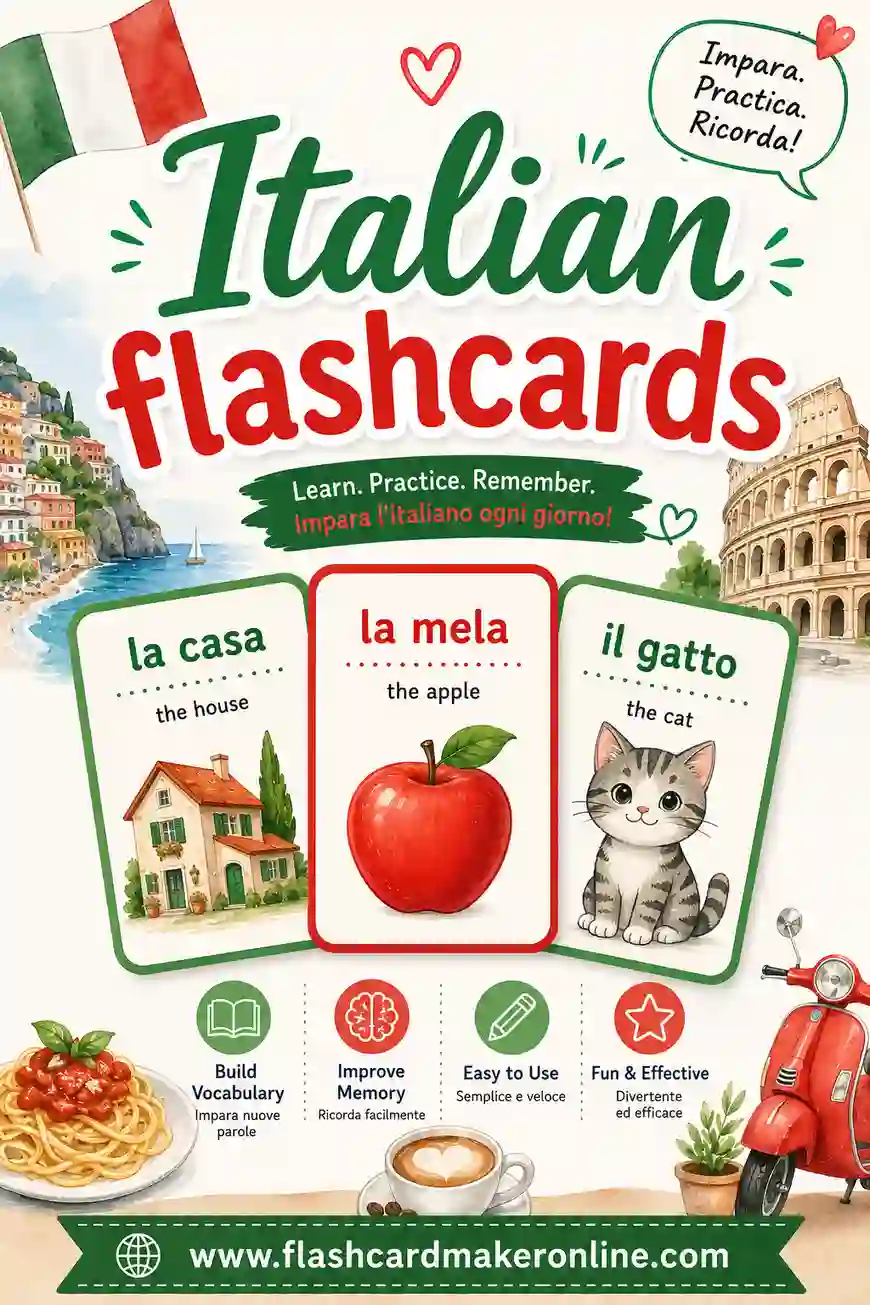
Italian flashcards are two-sided study cards with an Italian word on one side and its English meaning (or a picture) on the other. You flip a card, try to recall the answer, then check yourself. The fastest way to build a set is to use a free flashcard maker that lets you type your Italian words, flip through them on screen, and print a clean deck whenever you want.
Want to start right now? Open the free tool, paste in a list of Italian words and their meanings (there's a ready-made starter deck below), and you'll be flipping through your own cards in under a minute. No sign-up, no app to download, nothing to pay.
What Are Italian Flashcards?
An Italian flashcard is the simplest study tool there is. One side holds the prompt, usually the Italian word. The other side holds the answer, usually the English translation. You look at the prompt, say the answer out loud, then flip to check. Right or wrong, you learn something.
That tiny moment of flipping is doing more than it looks. When you force yourself to recall a word before you see the answer, your brain works harder to find it, and that effort is exactly what makes the word stick. Teachers call this active recall, and it beats re-reading a vocabulary list every single time.
You can use flashcards for almost any part of Italian:
- Vocabulary — single words like casa (house) or mangiare (to eat).
- Phrases — useful chunks like come stai? (how are you?).
- Verb forms — one card per conjugation, like io sono, tu sei, lui è.
- Gender drills — the word on one side, il, la, or lo on the other.
Why Flashcards Work So Well for Italian
Italian is a friendly language to start. It's spelled the way it sounds, so once you learn a handful of rules, you can read almost anything out loud. Flashcards lean right into that strength.
Here's the thing most beginners miss: you don't need to "study" for an hour. You need to see each word many times, spread out over days. Five minutes with your cards in the morning and five at night beats one long cramming session, every time. That's the whole secret of spaced repetition — reviewing a word right before you'd forget it.
A digital deck makes this easy. You shuffle, flip, and mark the ones you missed, then drill those again. Do that for two weeks and a list of 50 words turns into vocabulary you actually own.
A Free Italian Flashcard Starter Deck
Here's a ready-to-use set of common Italian words. Copy any rows you like straight into the flashcard maker. These are the words you'll reach for in your first real conversation.
| Italian | English |
|---|---|
| Ciao | Hello / bye |
| Buongiorno | Good morning |
| Buonasera | Good evening |
| Grazie | Thank you |
| Prego | You're welcome |
| Per favore | Please |
| Sì | Yes |
| No | No |
| Scusa | Sorry / excuse me |
| Acqua | Water |
| Pane | Bread |
| Vino | Wine |
| Caffè | Coffee |
| Casa | House |
| Cane | Dog |
| Gatto | Cat |
| Amico | Friend |
| Famiglia | Family |
| Mangiare | To eat |
| Bere | To drink |
| Dormire | To sleep |
| Quanto costa? | How much is it? |
| Dov'è il bagno? | Where's the bathroom? |
| Non capisco | I don't understand |
| Parli inglese? | Do you speak English? |
That's 25 cards, enough to feel like you've made real progress in your first sitting. When these feel easy, swap them out for harder words and keep going.
Group your cards by theme
Learning is easier when words travel in packs. Try building small themed decks instead of one giant pile:
- At the café — caffè, cornetto, zucchero, il conto.
- Getting around — treno, biglietto, a destra, a sinistra.
- Numbers — uno, due, tre, all the way up.
- Days of the week — lunedì, martedì, mercoledì.
How to Make Italian Flashcards in 4 Steps
You don't need any special skills. Here's the whole process.
- Open the tool. Head to the flashcard maker. Nothing to install.
- Add your words. Type the Italian word on the front, the English meaning on the back. Paste a whole list at once if you have one.
- Flip and study. Click through your deck on screen. Mark the words you miss so you can drill them again.
- Print when you want. Hit print for a paper set you can cut out, carry, and quiz yourself with anywhere.
If you study better on paper, print on cardstock and cut the cards apart. If you study better on a screen, just keep flipping in the browser. Either way, the same deck works.
Smart Ways to Study Your Italian Cards
Making the cards is the easy part. Studying them well is where the real progress lives. A few habits make a big difference.
Say it out loud
Don't just read the answer in your head. Say the Italian word out loud, even quietly. Speaking builds the muscle memory you'll need when you're actually talking to someone, and it locks the sound to the meaning.
Go both directions
Run the deck Italian-to-English first, since recognizing is easier. Then flip it: look at the English and try to produce the Italian. That second direction is harder and far more useful for speaking.
Sort into "know it" and "don't"
As you flip, split your cards into two piles: ones you nailed and ones you fumbled. Set the easy pile aside and hammer the hard pile. This is spaced repetition in its simplest form, and it saves you from wasting time on words you already know.
Keep sessions short and frequent
| Study style | How it feels | How well it works |
|---|---|---|
| One long weekly cram | Exhausting, easy to forget | Weak |
| 10 minutes, 3x a week | Manageable | Good |
| 5 minutes, twice daily | Almost effortless | Best |
Short and often wins. Your brain files away words during the gaps between sessions, so the spacing is doing quiet work even when you're not looking at the cards.
Printable vs. Digital: Which Should You Use?
Both work, and the best choice is the one you'll actually stick with.
- Printable cards are great for screen breaks, for studying on a bus or in line, and for handing a stack to a study buddy. Print on cardstock so they survive being shuffled in a backpack.
- Digital cards are great for quick daily reps, for shuffling instantly, and for marking which words you missed without scribbling. No paper, no scissors.
The good news: you don't have to pick. Build your deck once in the tool, study it on screen during the week, and print it for the weekend road trip. Same words, two formats.
Italian Flashcards for Different Goals
The way you build your deck should match why you're learning.
For a trip to Italy
Lean on survival phrases: ordering food, asking prices, finding the bathroom, saying please and thank you. You don't need grammar perfection on vacation; you need to be understood and polite. Twenty solid phrases will carry you a long way.
For a class
Match your deck to whatever your textbook is covering this week. If the chapter is about food, build a food deck. Cards that mirror your lessons turn quiz prep into a five-minute flip instead of an all-nighter.
For real fluency
Go beyond single words. Make cards for full phrases, common verb conjugations, and tricky pairs that learners mix up (sapere vs. conoscere, both "to know"). The more your cards reflect real sentences, the faster you'll speak in them.
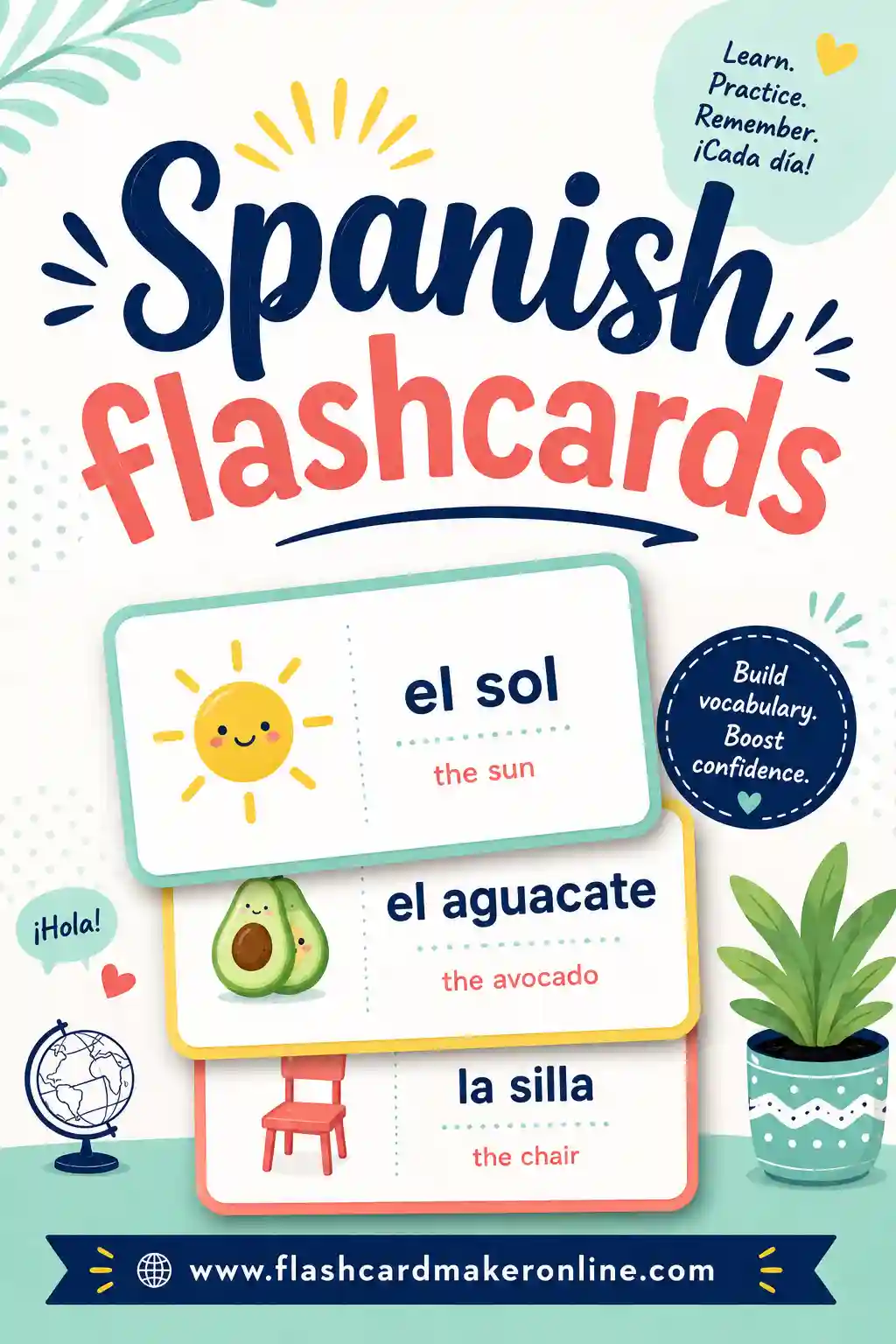
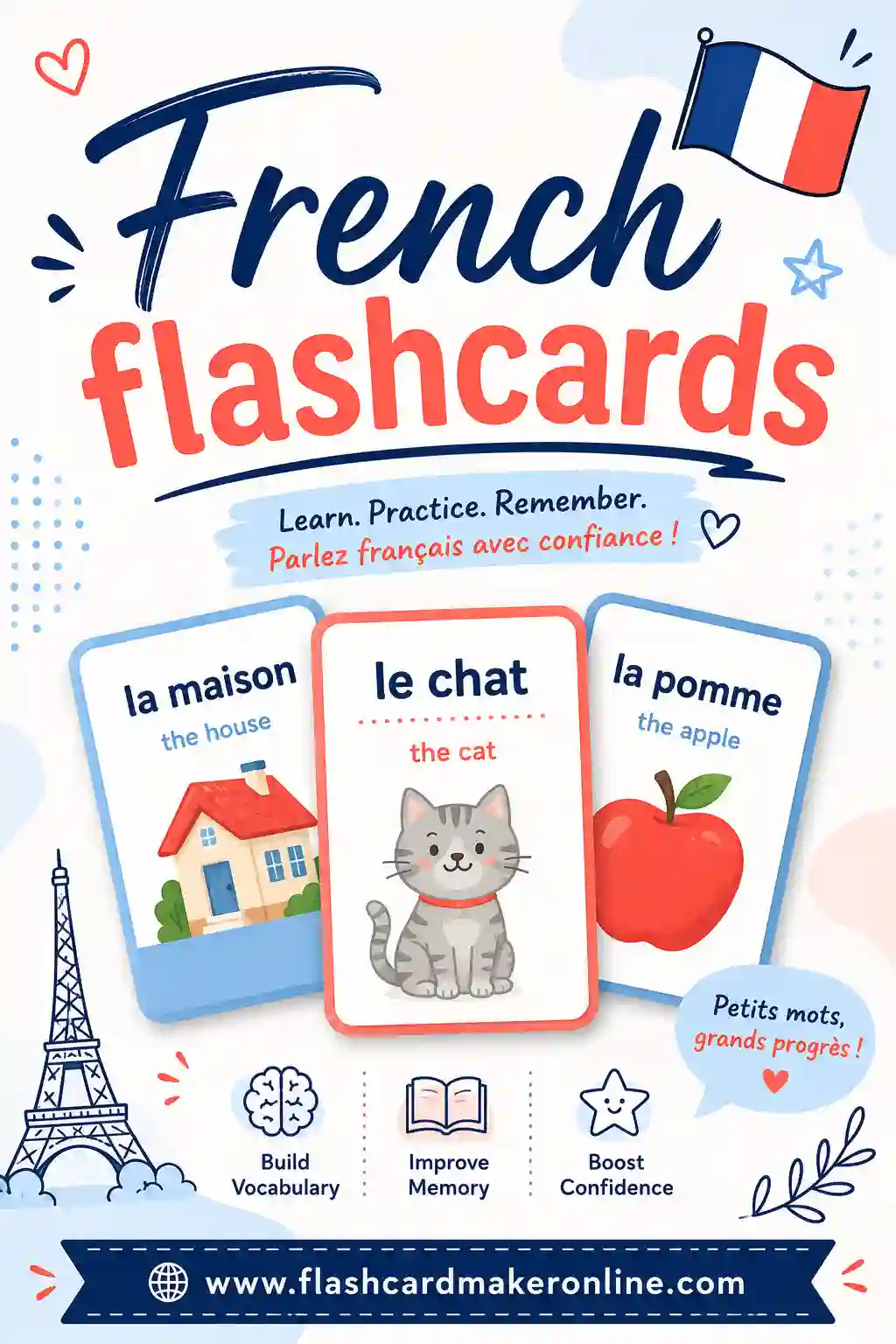
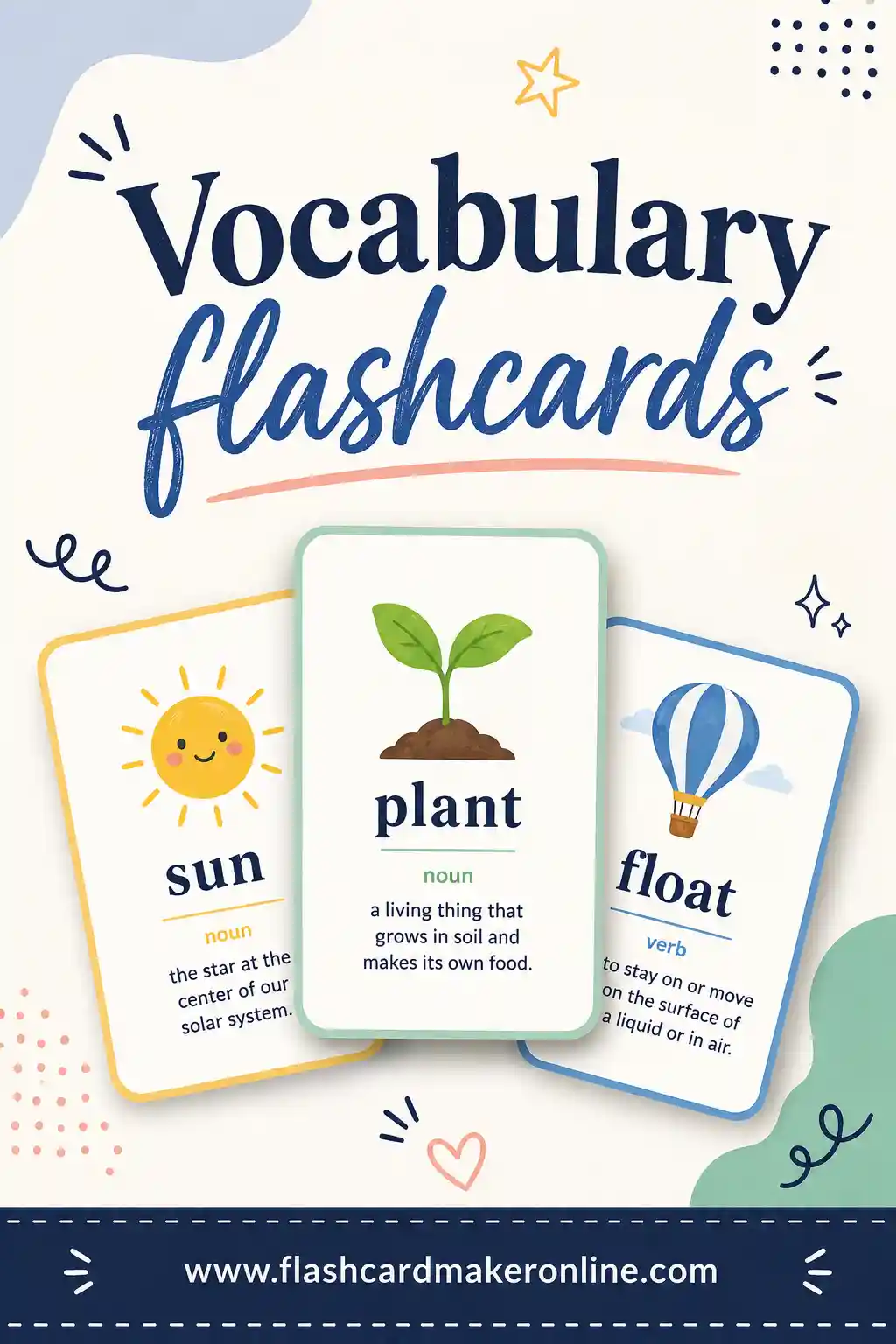
Learning more than one language? You can build the same kind of deck with our Spanish flashcards and French flashcards guides, or browse general vocabulary flashcards tips that work for any language.
Common Italian Flashcard Mistakes to Avoid
A few easy missteps slow learners down. Sidestep these and your deck will work much harder for you.
- Cramming too many new words at once. Pile fifty fresh words onto your plate and most will vanish by morning. Add a small batch, master it, then add more.
- Only ever running the deck one way. Italian-to-English builds recognition, but if you never reverse it you'll struggle to actually speak. Run both directions.
- Studying in the same order every time. You end up memorizing the sequence instead of the words. Shuffle every session so each card stands on its own.
- Skipping the article on nouns. Italian nouns have a gender, so learn il cane and la casa, not just cane and casa. Put the article right on the card.
- Reading silently. Italian is meant to be spoken. Say each word out loud so the sound and meaning lock together.
Tips for Italian Pronunciation
Italian is wonderfully consistent, so a handful of rules will let you say almost any word on your cards correctly.
- Vowels are pure and steady. A is "ah," e is "eh," i is "ee," o is "oh," u is "oo." They don't glide the way English vowels do.
- C and G change with the next letter. Before e or i they go soft — ciao is "chow," gelato is "jeh-lah-toh." Before a, o, or u they're hard, as in casa and gatto.
- Double consonants are held longer. Pizza and nonna linger on that doubled sound, and it changes the meaning, so don't rush it.
- Stress usually lands on the second-to-last syllable. AMIco, forMAGgio. When it falls on the last syllable, you'll often see an accent mark, as in caffè.
Read your cards aloud with these rules in mind and your accent will improve right alongside your vocabulary.
Frequently Asked Questions
How many Italian words should be on each flashcard?
One word or one short phrase per card. The whole point is a single, clean prompt your brain can recall in one go. If you cram three words onto a card, you've made it a reading exercise instead of a memory test.
Are these Italian flashcards really free to make and print?
Yes. You build and print them yourself at no cost. There's no sign-up and no watermark, so you can make a 25-card starter deck or a 200-card course pack on the same free tool.
How many cards should I study at once?
Start with 15 to 20 new cards in a session, then review them daily. Adding hundreds of brand-new words at once leads to overwhelm and forgetting. A steady trickle of new cards mixed with review of old ones works far better.
Should the Italian word go on the front or the back?
Try both. Put Italian on the front to practice understanding, and English on the front to practice producing Italian. Most learners run the deck both directions, because speaking a language needs both skills.
Can I add pictures to my Italian flashcards?
Yes, and it helps. A picture of a dog on the back of cane lets you skip the English middleman and link the Italian word straight to the thing. This is how kids learn their first language, and it works for adults too.
How long until I actually remember the words?
With short daily reps, most people lock in a 25-word deck within two weeks. The trick is showing up briefly every day rather than studying hard once a week. Spacing beats cramming, always.
Ready to Build Your Italian Deck?
Grab the starter list above, open the free flashcard maker, and you'll have your own Italian deck ready to flip in minutes. It's free, there's no sign-up, and you can study on screen or print a stack to carry with you. In bocca al lupo — good luck, and buon studio!