Spanish Flashcards: Free, Printable & Easy to Study
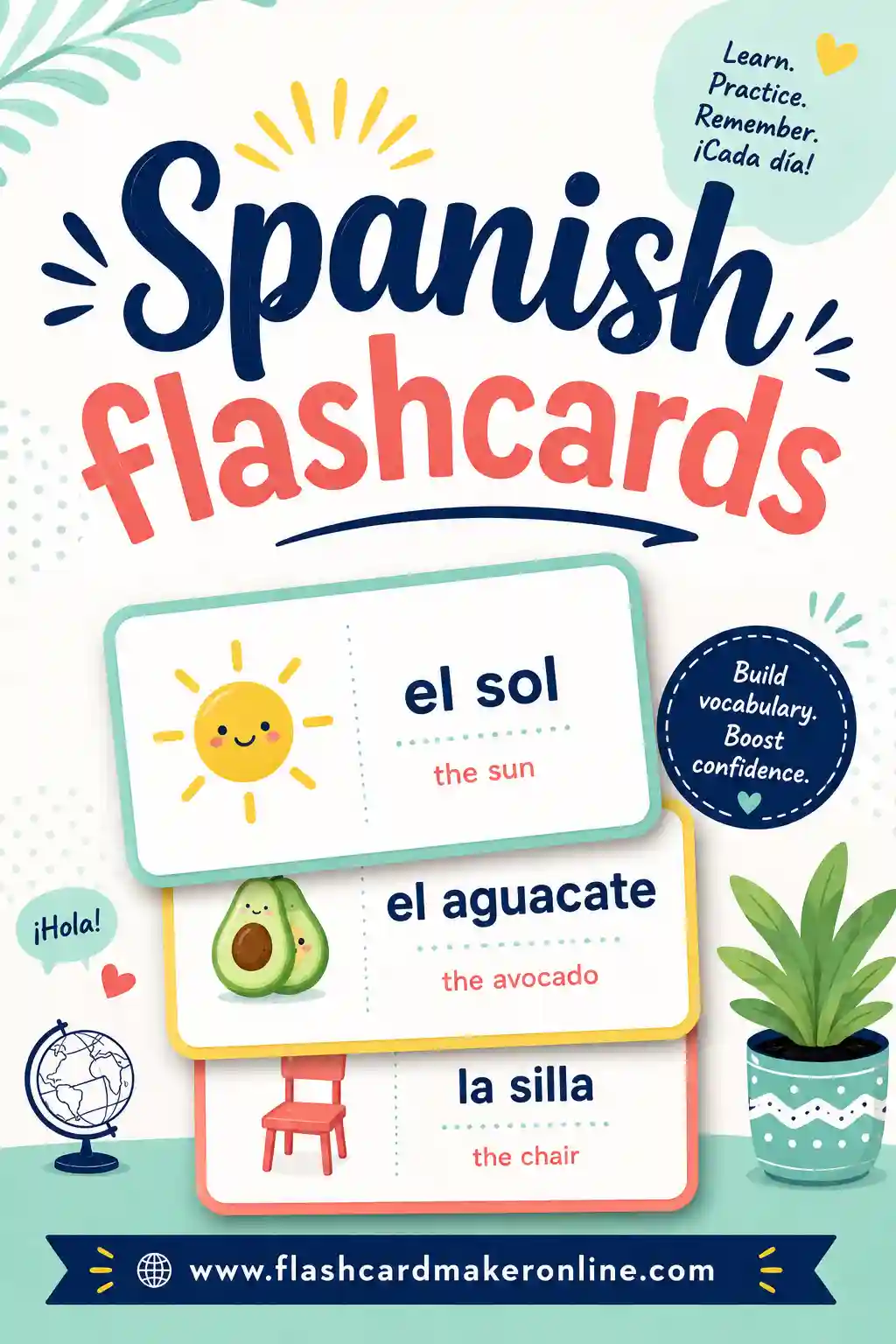
Spanish flashcards are small cards with a Spanish word or phrase on one side and its English meaning on the other. You look at one side, guess the answer, then flip to check. The fastest way to build a set is to use a free flashcard maker that lets you type your words, flip each card on screen, and print the whole deck at home.
Want to skip ahead and just make them? Open the free flashcard maker, paste in a word list (there's a ready-made Spanish starter deck below), study them right in your browser, and print as many as you like. No sign-up, no fee, no app to install.
What Are Spanish Flashcards?
A Spanish flashcard is the simplest study tool there is. One side holds the Spanish ("perro"), the other holds the English ("dog"). You quiz yourself by covering the answer, trying to recall it, then flipping to see if you were right.
That little moment of "wait, what was it again?" is the whole point. It's called active recall, and it's far more powerful than just rereading a vocabulary list. When you force your brain to dig for the answer, the memory sticks much harder than when you passively skim.
You can study them two ways:
- Spanish to English. See the Spanish word, recall the meaning. Great when you're starting out and just building recognition.
- English to Spanish. See the English, produce the Spanish. Harder, but this is the version that helps you actually speak.
Most learners start with the first and switch to the second once the words feel familiar. A digital maker lets you flip the whole deck around with one setting, so you get both directions out of a single set.
Why Flashcards Work So Well for Spanish
Spanish has thousands of words, but you don't learn them in a lump. You learn them one card at a time, and flashcards are built for exactly that.
- Active recall. Guessing before you flip burns the word into memory far better than rereading.
- Spaced repetition. Review a word today, then again in a few days, then a week later. Each time it gets easier and lasts longer.
- Bite-sized. Five minutes in a checkout line is enough for a quick deck run. You don't need a free hour.
- You control the words. Add the vocabulary from your class, your trip, or your favorite show — not a generic textbook list.
The trick is to keep decks small. Twenty to thirty cards per session is the sweet spot. Any more and you spend the whole time on the same handful of hard words while the easy ones go stale.
Free Spanish Starter Deck (Copy & Paste)
Here's a ready-to-use deck of 20 everyday Spanish words. These are the high-frequency basics that show up in almost every conversation, so they're worth knowing cold. Copy them straight into the maker and you've got a deck in seconds.
| Spanish | English |
|---|---|
| hola | hello |
| adiós | goodbye |
| gracias | thank you |
| por favor | please |
| sí | yes |
| no | no |
| agua | water |
| comida | food |
| casa | house |
| perro | dog |
| gato | cat |
| amigo | friend |
| familia | family |
| día | day |
| noche | night |
| grande | big |
| pequeño | small |
| bueno | good |
| hoy | today |
| mañana | tomorrow |
Once these feel easy, swap in your own words — restaurant phrases for a trip, body parts for a class quiz, or verbs you keep forgetting. The deck is yours to shape.
Theme decks to try next
- Travel Spanish. Airport, hotel, and restaurant words: "la cuenta" (the bill), "el baño" (the bathroom), "¿cuánto cuesta?" (how much).
- Food & drink. Menu staples like "pollo," "arroz," and "cerveza" so you can order with confidence.
- Numbers & time. "uno" through "diez," days of the week, and telling time.
- Common verbs. Start with "ser," "estar," "tener," and "ir" — they power most sentences.
How to Make Spanish Flashcards in 4 Steps
You don't need any special skills. Here's the whole process.
- Gather your words. Pull 20 to 30 from your class, a phrasebook, or the starter deck above.
- Type them into the maker. Spanish on one side, English on the other. The maker builds each flip card for you.
- Study on screen. Flip through the deck, marking the ones you miss so you can focus on them.
- Print when ready. Hit print for a physical set you can shuffle, carry, and quiz from anywhere.
If you want them to last, print on cardstock and cut them apart, or slip them in a small box. Digital is great for daily review, paper is great for the couch and the car.
Smart Ways to Study Your Spanish Deck
Making the cards is the easy part. Studying them well is where the real progress hides. A few habits that pay off:
Use spaced repetition
Don't cram all 30 cards every single day. Pull the ones you know cold out of the rotation and review them less often. Spend your energy on the words you keep missing. This is the single biggest upgrade you can make to your routine.
Say it out loud
When you flip a card, say the Spanish word aloud, not just in your head. It links the spelling to the sound and trains your mouth for real conversation. Whispering counts if you're in public.
Sort into "know it" and "don't"
As you go, make two piles (or two folders): words you nailed and words you fumbled. Run the "don't" pile again right away. By the end of a session you'll have shrunk it down to just a few stubborn cards.
Mix up the order
If you always study in the same order, your brain memorizes the sequence instead of the words. Shuffle the deck so each card stands on its own.
How Many Cards Should You Study at Once?
The right deck size depends on where you are in your learning. Here's a rough guide.
| Level | Cards per session | Tip |
|---|---|---|
| Brand new | 10–15 | Stick to nouns and greetings you can picture. |
| Beginner | 20–25 | Add common verbs and short phrases. |
| Intermediate | 25–40 | Include full sentences and tricky verb forms. |
| Reviewing | 40+ | Run quick passes; pull out the easy ones fast. |
Whatever your level, short and frequent beats long and rare. Three ten-minute sessions across a day will out-teach one thirty-minute marathon almost every time.
Tips for Crisp, Reusable Printed Cards
If you're printing your Spanish flashcards, a few small choices make them last.
- Use cardstock. Regular paper bends and tears; cardstock holds up to daily shuffling.
- Print double-sided. Spanish on the front, English on the back, so a flip is a real flip.
- Add a tiny hint. A small example sentence or a gender marker ("el"/"la") in the corner helps it stick.
- Bundle by theme. Rubber-band your travel deck separate from your food deck so you can grab the one you need.
- Test one page first. Print a single sheet to check alignment before you run the whole deck.
Learning more than one language? You can build the same kind of set with our French flashcards, German flashcards, and Chinese flashcards.
Common Mistakes to Avoid
Most people don't fail at flashcards because the method is broken — they trip over a few small habits. Here's what to watch for.
- Decks that are too big. Loading 80 cards at once feels productive, but you end up half-learning everything and mastering nothing. Cap each session at 20 to 30 and rotate fresh batches in.
- Only studying one direction. If you only ever go Spanish-to-English, you'll recognize words but freeze when you try to speak. Flip the deck regularly so you can produce the Spanish, not just read it.
- Skipping the hard cards. It's tempting to breeze past the words you keep missing. Those are exactly the ones that need the most reps. Pull them into their own pile and hit them first.
- Studying without sound. Reading "gracias" silently won't help you say it in a café. Voice every card, even quietly, so your ears and mouth learn alongside your eyes.
- Cramming once a week. One long Sunday session can't beat five short daily ones. The gaps between reviews are what move words into long-term memory, so spread them out.
Fix these and your deck starts working the way it's supposed to — a few focused minutes a day, steady progress you can feel.
Frequently Asked Questions
How many Spanish flashcards do I need to learn the basics?
Around 100 well-chosen words will carry you through most everyday situations. Start with the 20-word starter deck above, then add a new batch of 15 to 20 each week. Quality and frequency matter more than sheer volume.
Are these Spanish flashcards free to make and print?
Yes. You build and print them yourself at no cost. There's no sign-up and no watermark, so you can make a full deck (or several) for free and reprint any time.
Should I study Spanish to English or English to Spanish?
Both, but in that order. Start Spanish-to-English to build recognition, then flip to English-to-Spanish once the words feel familiar. The second direction is harder, but it's the one that helps you actually speak.
How often should I review my flashcards?
Daily, in short bursts, is ideal. Review new words every day for the first week, then stretch the gaps as they stick — every few days, then weekly. That spacing is what moves words into long-term memory.
Can I make Spanish flashcards for kids?
Absolutely. Use simple, picture-friendly nouns like "gato," "casa," and "sol," and keep decks short. Adding a small drawing to each card helps young learners connect the word to its meaning.
Do digital or paper flashcards work better?
Both work — they just suit different moments. Digital cards are perfect for quick daily review on your phone and for flipping the whole deck around. Paper cards are great for sorting into piles, studying without screens, and quizzing with a partner.
Ready to Build Your Spanish Flashcards?
Grab the starter deck above, open the free flashcard maker, and you'll have a deck you can flip, study, and print in minutes. It's free, there's no sign-up, and you control every word, so your study time goes straight to the Spanish you actually want to learn. ¡Buena suerte!