Anatomy Flashcards: Free Printable & Customizable
Anatomy flashcards are cards that pair a body structure, like the "femur," "deltoid," or "alveoli," with its location, function, or definition, so you can drill the sheer volume of names anatomy demands. With hundreds of bones, muscles, nerves, and organs to know, flashcards turn an overwhelming list into small, repeatable bites. The fastest way to build a study set is a free flashcard maker that turns your term list into clean, printable cards you can drill anywhere.
Want to jump straight in? Open the free flashcard maker, paste in a structure list (there's a ready-made one below), and print a deck in minutes. No sign-up, no software, no cost.
Why Anatomy Is a Memorization Game
Anatomy isn't hard because it's complicated. It's hard because it's huge. There are 206 bones, more than 600 muscles, dozens of nerves, and a long list of organs and tissues, each with a name, a location, and a job. The challenge is volume, and volume is precisely what flashcards beat.
Three principles make the cards work:
- Active recall. Looking at "deltoid" and forcing yourself to say "shoulder muscle that raises the arm" before flipping builds memory far faster than re-reading your notes.
- Spaced repetition. Reviewing a structure today, in two days, then in a week locks it into long-term memory instead of letting it leak out after the quiz.
- Small chunks. Anatomy is best learned one region at a time. A 12-card deck of upper-limb bones beats a 200-card pile of everything.
Pair the structures with their meanings using medical terminology flashcards and the names start to make sense rather than feeling random. "Sternocleidomastoid" is a mouthful until you see it's just sternum + clavicle + mastoid, the points it connects.
Free Anatomy Structure List (Copy & Paste)
Here's a ready-to-use set of high-yield structures grouped by system. Copy a column into the flashcard maker and print a deck. Put the structure on the front and its function or location on the back.
| Skeletal & Muscular | Organs & Systems | Brain & Nerves |
|---|---|---|
| Femur (thigh bone) | Aorta (largest artery) | Cerebrum (thinking, senses) |
| Tibia (shin bone) | Alveoli (lung air sacs) | Cerebellum (balance) |
| Humerus (upper arm bone) | Trachea (windpipe) | Medulla (heart, breathing) |
| Scapula (shoulder blade) | Diaphragm (breathing muscle) | Hypothalamus (homeostasis) |
| Patella (kneecap) | Liver (filters blood, bile) | Frontal lobe (decisions) |
| Clavicle (collarbone) | Pancreas (insulin, enzymes) | Occipital lobe (vision) |
| Sternum (breastbone) | Nephron (kidney unit) | Optic nerve (sight) |
| Vertebrae (spine bones) | Villi (gut absorption) | Vagus nerve (organ control) |
| Deltoid (raises the arm) | Atrium (heart chamber) | Spinal cord (signal highway) |
| Biceps (bends the elbow) | Ventricle (heart chamber) | Sciatic nerve (largest nerve) |
| Quadriceps (extends knee) | Bronchi (lung airways) | Hippocampus (memory) |
| Gastrocnemius (calf muscle) | Spleen (filters blood) | Thalamus (relay station) |
Don't try to learn all three columns at once. Pull eight to ten structures from one region, master them, then add the next batch.
Build a function-recall deck
Once you know the names, flip the challenge: see the function, recall the structure. This two-way drilling is what exams reward.
| Function / clue | Structure |
|---|---|
| Longest bone in the body | Femur |
| Pumps blood to the body | Left ventricle |
| Controls balance and coordination | Cerebellum |
| Site of gas exchange in lungs | Alveoli |
| Filters blood, makes urine | Nephron |
| Largest nerve in the body | Sciatic nerve |
| Stores and recalls memory | Hippocampus |
| Separates chest from abdomen | Diaphragm |
Drilling both directions, name-to-function and function-to-name, is the single biggest upgrade you can make to anatomy study.
How to Make Anatomy Flashcards in 4 Steps
No hand-copying your textbook. Here's the whole process.
- Pick one region. Upper limb, heart, brain, whatever you're studying this week. One system per deck.
- Add your structures. Paste your list into the flashcard maker, structure on the front, function or location on the back.
- Print your deck. Hit print. Cardstock survives the constant shuffling far better than paper.
- Cut and study. Slice them apart and run your first short session.
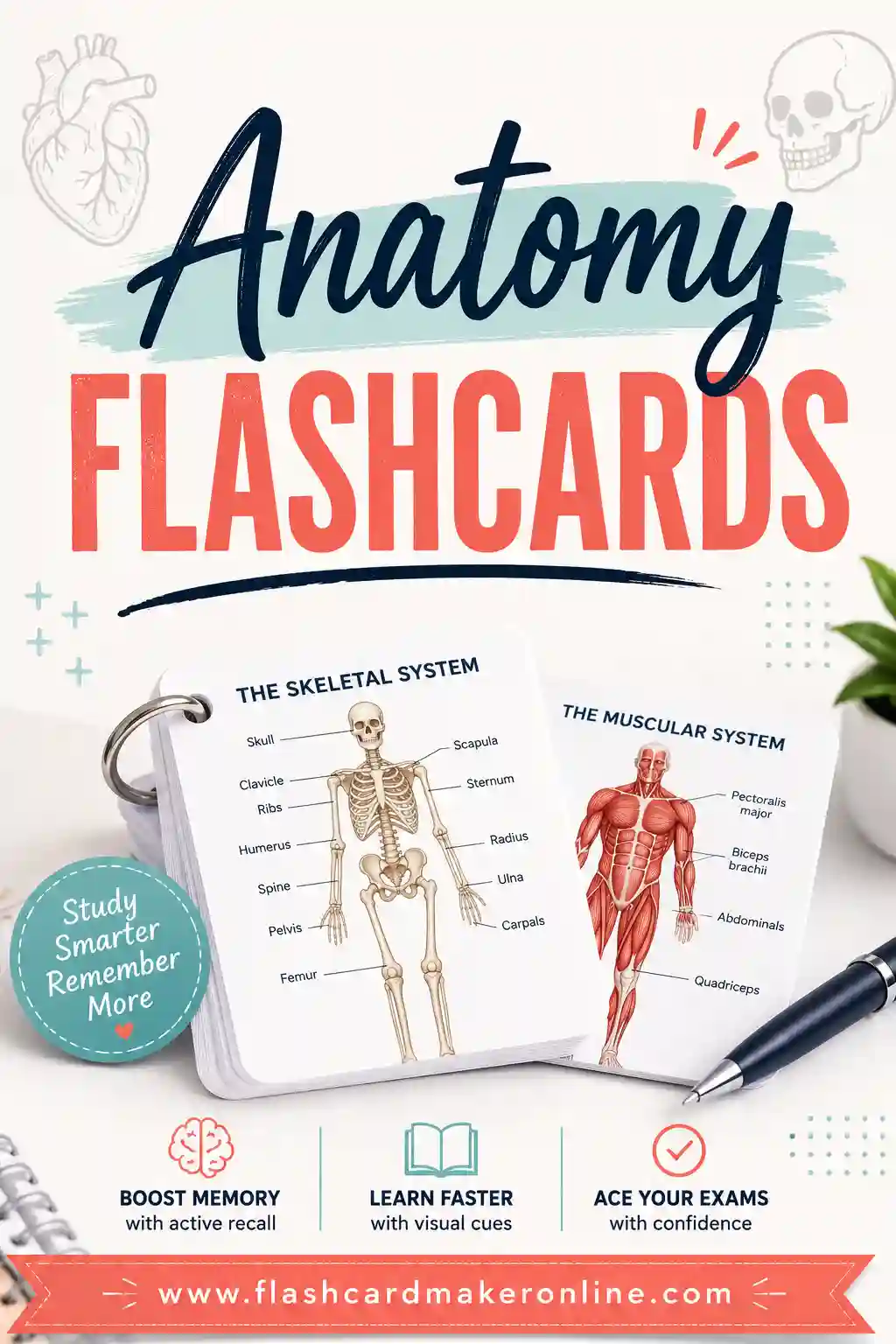
Want a labeled-diagram twist? On the front, write "the muscle here ___" with a quick sketch; on the back, the name. Spatial cards are gold for practical exams. For more, see flashcards for memorization.
How to Study Anatomy Flashcards (That Sticks)
The deck is half the work. Here's how to study so the names stay put.
Drill both directions
See the structure, recall its function. Then see the function, recall the structure. Practical exams point at a model and ask "what's this?", so you have to recognize structures, not just names. Two-way recall covers both.
Study one system at a time
Mixing bones, nerves, and organs in one giant deck makes everything blur. Keep decks tight, one region or system each, so related structures reinforce each other.
Use spaced repetition
Review new cards today, again in two days, then space them out as you get them right. Sort each session into "knew it" and "review," and start the next session with yesterday's misses. That simple loop is spaced repetition without any software.
Add location, not just names
For a structure like the deltoid, don't stop at "shoulder muscle." Note where it attaches and what it does. The richer the card, the more hooks your memory has to grab.
A quick study-tips table
| Tip | Why it helps |
|---|---|
| One system per deck | Related structures reinforce each other |
| Drill name ⇄ function | Covers written and practical exams |
| Say answers out loud | Forces recall over recognition |
| Keep decks to 10–15 | Each card gets real practice |
| Review missed cards first | Spends time where you're weak |
| Sketch quick diagrams | Builds the spatial memory exams test |
Common Mistakes to Avoid
A few fixes save real study time.
- Decks that are too big. A 200-card pile means nothing gets reviewed properly. Break it into regions.
- One-way recall. If you only practice name-to-function, you'll freeze when an exam points at a model.
- Cramming the night before. Anatomy fades fast without spacing. Daily short sessions beat one long panic.
- Ignoring the word roots. Many structure names describe themselves. Pairing cards with medical terminology flashcards turns memorizing into understanding.
- Skipping location. Names without spatial context don't survive a practical exam. Add where, not just what.
Studying biology more broadly? Our biology flashcards guide covers cells, systems, and processes. In a health program? The flashcards for medical students guide lays out a full study plan.
Studying for a Practical Exam vs. a Written Exam
Anatomy courses usually test you two very different ways, and your flashcards should match the format you're facing. Knowing the difference saves you from studying the wrong thing.
A written exam asks you to recall facts: name the function of the cerebellum, list the bones of the wrist, define a structure. For this, classic name-to-definition cards work great. Drill the structure on the front, the function or definition on the back, and quiz yourself both directions.
A practical exam is different. The instructor points at a tagged structure on a model, a cadaver, or a slide, and you have to identify it on sight. There's no list of names to choose from, just the structure itself. For this, you need recognition, not just recall. Build cards with a clue or a quick sketch on the front and the name on the back, and practice until you can name a structure from its appearance and location alone.
Most students under-prepare for the practical because flipping written cards feels productive. Don't fall for it. If your exam is practical, spend real time on visual recognition, ideally with a model or atlas in front of you, matching what you see to the names on your cards.
Building Spatial Memory, Not Just Word Lists
Anatomy is fundamentally about where things are and how they connect, not just what they're called. The students who struggle are usually the ones who memorize names as a flat list, with no mental map to hang them on. A few habits fix that.
Study by region and trace the connections. When you learn the bones of the arm, don't just name them, follow them in order: clavicle to scapula to humerus to radius and ulna. Knowing what connects to what gives every name a place in a structure, which is far stickier than an isolated term.
Sketch as you study, even badly. You don't need to be an artist. A rough drawing of the heart with its four chambers labeled forces you to place each structure in space. The act of drawing builds the spatial memory a practical exam rewards, and it surfaces the gaps you didn't know you had. Pair these sketches with your flashcards and you're learning anatomy the way it's actually tested, as a map, not a glossary.
Frequently Asked Questions
What are anatomy flashcards?
They're cards that pair a body structure, like the femur, deltoid, or alveoli, with its location, function, or definition. Because anatomy demands memorizing hundreds of names, flashcards break that volume into small, repeatable sets you can drill to instant recall.
How should I study anatomy flashcards?
Drill in both directions, name-to-function and function-to-name, study one body system per deck, and space your reviews over several days. Keep decks small, say answers out loud, and start each session with the cards you missed last time.
How many anatomy terms should I learn at once?
Keep decks to about 10 to 15 cards and focus on one region or system at a time. Small, focused sets let each structure get real practice and keep you from drowning in a giant undifferentiated pile.
Are anatomy flashcards free to make?
Yes. Paste your structure list into the free flashcard maker, then study on screen or print them on cardstock. There's no sign-up and no cost, so you can build a fresh deck for every system you cover.
How do I study for a practical (model-based) anatomy exam?
Practice recognizing structures, not just naming them. Make cards that show a clue or a quick sketch on the front and the name on the back, and drill function-to-structure recall. The goal is to identify a structure on sight, the way the exam asks.
Should I combine anatomy with medical terminology?
Yes. Many structure names are built from word roots, so learning terminology makes anatomy names feel logical instead of random. Pair your anatomy deck with a medical terminology deck and the two reinforce each other.
Ready to Make Your Anatomy Flashcards?
Grab the structure list above, open the free flashcard maker, and you'll have a clean, printable deck in minutes. It's free, there's no sign-up, and you can build a fresh set for every system. Study one region at a time, drill both directions, and watch the names stop feeling endless.