How to Memorize Flashcards So They Actually Stick

To memorize flashcards, you have to fail at them first — on purpose, with a real pause, before you flip the card. That uncomfortable three seconds where nothing comes to mind is not wasted time. It is the entire mechanism. A card you flip instantly because you half-recognized the shape of the answer teaches you almost nothing, even though it feels productive. A card you struggle with and then get right lays down a memory you can still reach for a week later.
Most people who say flashcards don't work for them are doing something subtly different from studying: they are reading their own cards. This article is about the gap between those two activities, and how to close it.
Why You Fail to Memorize Flashcards You've Read Fifty Times
Recognition and recall are separate abilities, and only one of them helps you on a test. When you look at the front of a card and immediately flip to the back, your brain says "yes, that's right, I knew that." It didn't know it. It recognized it. Recognition is cheap and it disappears fast.
The research on this is unusually clean. In a well-known 2006 study by Henry Roediger and Jeffrey Karpicke, students read a short passage and then either re-read it three more times or tested themselves on it three times. Five minutes later, the re-readers did better — about 81% recall versus 71%. That's the trap. Re-reading feels better and performs better in the moment.
One week later the results flipped hard. The re-readers had dropped to roughly 40%. The self-testers were still at about 61%. Same study time, half again as much retained.
This is called the testing effect, and it is the reason flashcards for memory work at all. The card is not a delivery device for information. It is a prompt that forces retrieval. If you skip the retrieval, you have built a very inefficient book.
The three-second rule
Before you flip any card, give yourself a genuine attempt and a real pause. Three seconds is about right for factual material — vocabulary, dates, definitions. Ten to fifteen seconds is fair for something that needs a small chain of reasoning.
If nothing comes, flip it. Don't sit there for a minute grinding. The value is in the attempt, not in the suffering.
The One Rule That Fixes Most Broken Decks
Every card should ask for exactly one fact. This is the single highest-leverage change you can make, and it fixes more failing decks than any scheduling tweak.
Here is a card that will haunt you:
Front: The Krebs cycle Back: Also called the citric acid cycle. Occurs in the mitochondrial matrix. Takes acetyl-CoA and produces 3 NADH, 1 FADH2, 1 GTP, and 2 CO2 per turn. Eight steps, starting with citrate synthase.
You will never reliably answer that card. There is no single correct response, so you can never honestly grade yourself. Some days you'll remember four of the six things and call it a pass. The card rots.
Split it:
- Where does the Krebs cycle occur? → Mitochondrial matrix
- How many NADH per turn of the Krebs cycle? → 3
- What enters the Krebs cycle? → Acetyl-CoA
- First enzyme of the Krebs cycle? → Citrate synthase
Four cards, each with one unambiguous answer. Each takes two seconds. Together they take less total time than the monster card, and unlike the monster, they actually get learned.
This principle came out of decades of spaced repetition practice and it holds up across subjects. Big cards are where study time goes to die.
Signs a card is too big
- You can't grade yourself pass or fail without arguing about it
- The answer contains the word "and" more than twice
- You've been "almost getting it" for two weeks
- Reading the back takes longer than five seconds
Any of those means split the card. Two small cards beat one fat one every time.
Making Flashcards for Memorizing That Pull Their Weight
Write the front so that only one answer could possibly be correct, and write the back so it's short enough to say out loud.
A few habits that separate good decks from bloated ones:
Use cloze deletions for anything sequential. Instead of "List the planets in order," write "Mercury, Venus, Earth, ___, Jupiter." You get five cards out of one list, and each one is answerable.
Avoid the sets trap. A card that says "Name the five causes of the Great Depression" gives you five chances to be partly right, which means you'll never be honestly wrong. Turn sets into enumerated individual cards, or into cloze deletions where each blank has one answer.
Front-load the context. "Capital?" is a bad front. "Capital of Bolivia (constitutional)?" is a good front. Cards get reviewed months after you write them, when you have forgotten what you meant. The same rule catches a subtler failure: "the year the treaty was signed" is a fine front in a deck with one treaty in it and a disaster in a deck with nine, because one cue now points at nine different answers and the only thing you learn is confusion. Add the distinguishing detail even when it feels redundant. Redundancy on the front costs you nothing; ambiguity costs you the card.
Shuffle, so position never becomes the cue. If two cards have near-identical fronts and always appear in the same order, you will start answering from position rather than from knowledge, and you won't notice until the exam reorders them. Shuffling isn't a nicety — it's what stops sequence from doing the remembering for you.
Add a personal hook where you can. If you are learning that ephemeral means short-lived, and you write "the ephemeral snow in Manila" on the back, you have attached a slightly absurd image to the word. Absurd is sticky.
Keep the whole card visible without scrolling. If you have to scroll, it's too long.
If you're starting fresh, you can build a deck in a browser at flashcardmakeronline.com without an account — type cards in, or paste a CSV if you already have a word list in a spreadsheet. Being able to import a CSV matters more than it sounds, because the fastest way to build a good deck is often to dump the raw list first and split the fat cards afterward.
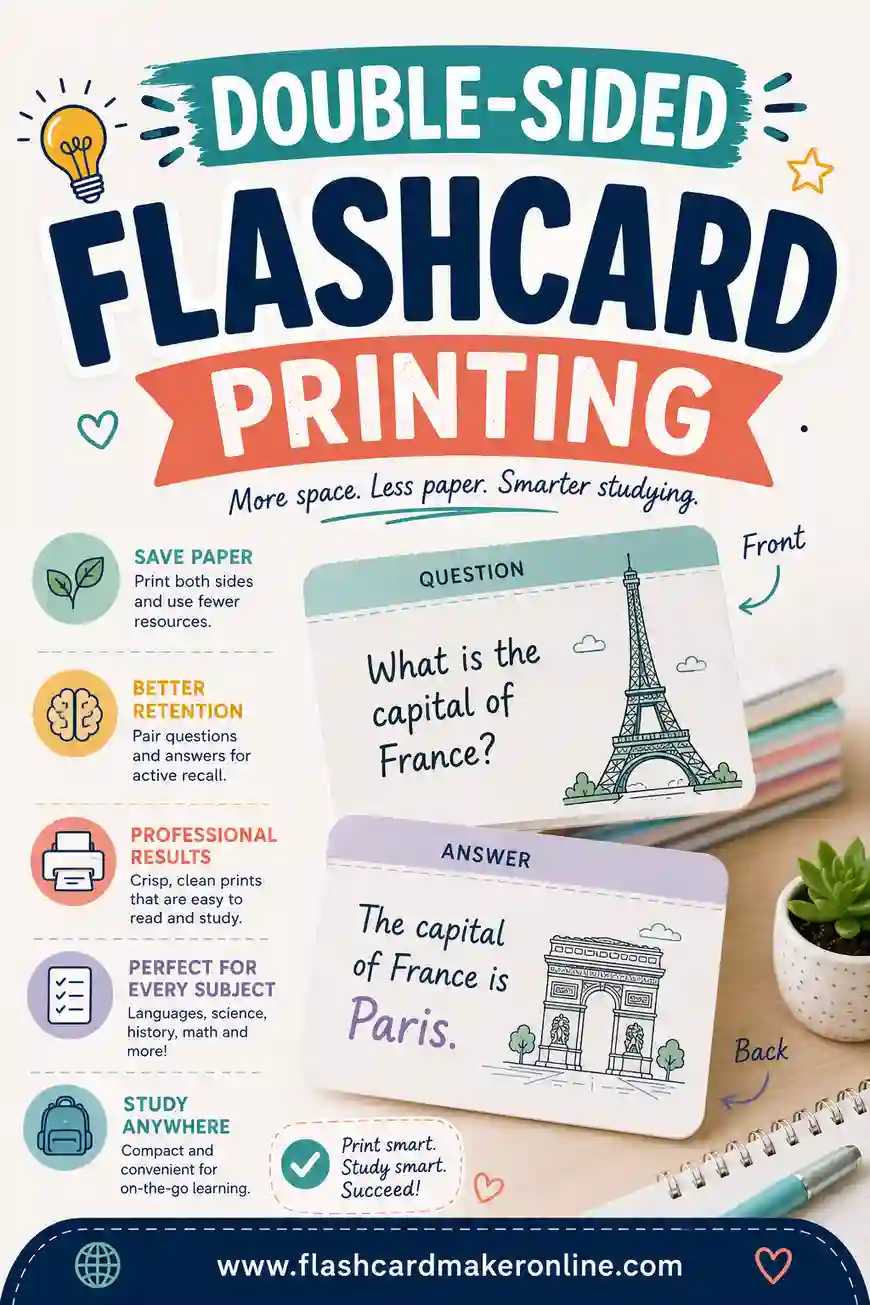
Paper works too, and the gap between the formats is much smaller than the gap between good and bad card writing. Paper's real advantage is physical: moving a card into a "got it" pile is an honest signal that's hard to fake, and sorting into piles separates known from unknown better than most software does. Making flashcards online wins on volume, on image fronts, and on shuffling — 150 cards for a unit is an evening's work with free online flashcards and a week of index cards, and you can reorder before every pass instead of dealing the same sequence forever. Either way, keep the cards themselves plain: one fact, ordinary wording, no color-coding system you'll stop maintaining by Thursday. Free flashcards you actually review beat a beautiful deck you don't.
Different material, different card shape
The one-fact rule holds everywhere, but what counts as a well-shaped card changes with the subject.
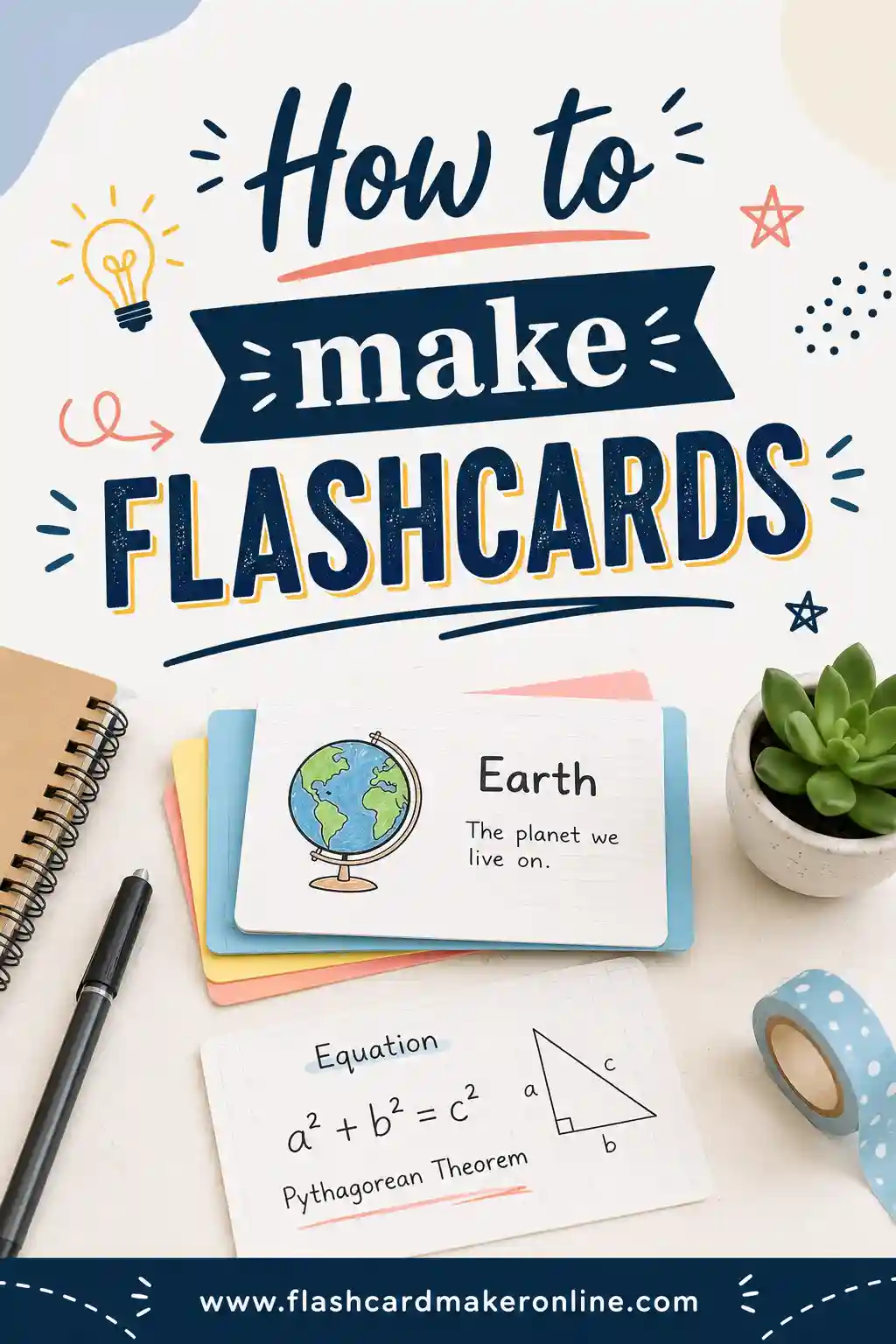
Formulas. Name on the front, formula on the back — then a second card that gives a short worked situation and asks which formula applies. Knowing a formula and knowing when to reach for it are separate memories, and only the second one is tested. Keep derivations off cards entirely; those belong in worked problems.
Dates and sequences. Individual date cards are weak, because a bare year has nothing to hook onto. Cards for order — what came before what — are far stronger, and they're usually what actually gets tested.
Definitions. Both directions. Term to definition, and definition to term. The second is the one that shows up in multiple choice, where you're handed a description and asked to name it.
Diagrams and images. Image on the front, label on the back, plus one card per label running the other way, description to location. This is the format where digital cards clearly beat handwritten ones.
Procedures. One card per step, plus one card asking what follows a named step. Never one card holding the whole procedure — that's the four-questions-in-a-trench-coat problem wearing a lab coat.
Vocabulary. Both directions for words you need to produce, recognition only for words you only need to read; see the FAQ below on why the two directions are best introduced a week or two apart rather than together.
When you didn't write the deck
Plenty of study time goes into cards somebody else made, and the same rules apply to them. The big pre-made sets people go looking for — "netters flashcards" for anatomy, "ap art history flashcards" and "ap world history flashcards" for the exams, "lsat flashcards" for the logic vocabulary, "sec+ flashcards" for the security certification — are built to cover a syllabus rather than to be answerable in one attempt, so a fair share of their cards carry three or four facts on the back and break the one-fact rule on sight.
Triage a bought deck the way you would your own: work through the first fifty cards, split anything you can't grade cleanly as pass or fail, and delete the duplicates of things you already know cold. Simple picture sets are the exception. Body parts flashcards, sight words and basic vocabulary already ask for exactly one thing, and those you can drill straight out of the box.
Two more passes are worth making on an inherited deck. Delete before you study — most shared sets are built to cover a whole syllabus rather than yours, and a deck you can finish is worth more than a comprehensive one you abandon. Then rewrite the wording in your own words. This is the step everyone skips and the one that matters most: a card phrased in a stranger's language stays foreign, and you end up memorizing their sentence instead of your fact. Ambiguous fronts get the same treatment — if a front only makes sense to someone who knows which chapter it came from, put the chapter on the front.
Expect the first two sessions with a borrowed deck to be editing rather than reviewing. That time isn't lost. It's the processing you'd have done anyway if you'd written the cards yourself.
Spacing: When You Should See a Card Again
Review a card just before you would have forgotten it — roughly when your chance of recalling it has dropped to about 90%. Earlier is a waste of a review. Later and you're relearning from scratch.
You don't need to calculate this. You need a schedule that expands when you get a card right and collapses when you get it wrong. Here is a set of intervals that works well for most people learning most things:
| Review | Gap since last correct answer | What it's doing |
|---|---|---|
| 1 | Same session, ~10 minutes | Getting the card into working memory |
| 2 | 1 day | First real test of overnight retention |
| 3 | 3 days | Confirms it survived a weekend |
| 4 | 7 days | The card is now genuinely learned |
| 5 | 16 days | Maintenance |
| 6 | 35 days | Maintenance |
| 7 | 80 days | Near-permanent |
Each gap is roughly 2.2 times the last. That multiplier is the important part, not the exact numbers. If you get a card wrong at any point, drop it back to the 1-day step and climb again.
How this maps to a real deadline
If you have a test in a fixed number of days, the useful research finding is that the optimal gap between reviews is roughly 10 to 20 percent of the time until you need the information. Cepeda and colleagues found this pattern across retention intervals from days to a year.
| You need it in | Sensible review gap | Practical schedule |
|---|---|---|
| 1 week | ~1 day | Daily, short sessions |
| 1 month | 3–5 days | Twice a week |
| 6 months | 3 weeks | Every two to three weeks |
| Permanently | Expanding | Let the intervals grow |
The mistake students make with a one-month deadline is reviewing every single day out of anxiety. Daily review of material you already know is comfortable and nearly useless. The gap is where the strengthening happens.
Session Length: Shorter Than You Think
Twenty minutes of honest retrieval beats ninety minutes of flipping. Retrieval is effortful in a way that reading isn't, and the effort is exactly the thing that fades. People who set out to memorize flashcards in marathon sessions almost always end up skimming for the back half of the session, which is worse than stopping.
What works in practice:
- New cards: 10 to 20 per day, maximum. Every new card you add today becomes roughly nine reviews spread over the next three months. Adding 100 new cards on Sunday is writing checks your Tuesday cannot cash.
- Total session: 15 to 25 minutes. If your reviews regularly run past 30 minutes, you are adding new cards faster than you're absorbing them.
- Two short sessions beat one long one. Morning and evening, ten minutes each, outperforms twenty minutes in a block. You get an extra spacing gap for free.
- Stop when you start guessing. The moment you notice you're pressing "good" without really attempting the answer, the session is over. You're now training yourself to skim.
A shape that works for a twenty-five minute session: five minutes on yesterday's misses, fifteen on the main rotation shuffled, five spent writing new cards for material you have just read. That last block earns more than it looks like it should. Deciding what the testable fact is is the learning, which is most of why cards you wrote yourself outperform cards someone else wrote.
Consistency matters more than volume. Fifteen minutes every day for a month will bury three hours on a Saturday, and it isn't close.
The Card You Keep Forgetting
A card you've failed six or more times is not a memory problem. It's a card problem. Most spaced repetition systems call these leeches, and the standard threshold is eight lapses. When a card hits that, it will keep coming back forever and it will eat your session.
Don't just keep grinding it. Do one of these five things:
1. Split it. Nine times out of ten, a leech is asking for more than one thing. Cut it in half and both halves usually pass immediately.
2. Rewrite the front. If the prompt is ambiguous, you're not failing to remember — you're failing to know what's being asked. "1848?" is a terrible front. "Year of revolutions across Europe?" is answerable.
3. Add a mnemonic to the back. Not a general one. A specific, slightly ridiculous, personal one. For sequences and lists this is often the only thing that works.
4. Attack the interference. Very often two cards are fighting each other — two Spanish words that look alike, two kings with the same name, two similar formulas. Learn them together on one comparison card that explicitly contrasts them, then delete the two originals. Interference dissolves when you stop pretending the items are independent.
5. Delete it. Genuinely. If a fact has resisted twelve honest attempts and it isn't load-bearing for your exam, it is costing you more than it's worth. Cut it and spend that time on cards that move.
That last one is the hardest and the most valuable. A deck you keep pruning is a deck you keep using.
A leech triage table
| Times failed | What to do |
|---|---|
| 3 | Nothing. Normal. |
| 5 | Reread the card. Is it one fact? Is the front unambiguous? |
| 8 | Split it, rewrite it, or add a mnemonic. Suspend the original. |
| 12+ | Delete, unless it's essential. If essential, rebuild it from scratch as two or three new cards. |
Grading Yourself Honestly
The grade you give a card is the only input the whole system has, so lying to it breaks everything.
Use three buckets and be strict:
- Again — you didn't produce the answer, or you produced it after seeing part of the back. Not "I nearly had it." Again.
- Good — you produced the correct answer after a real pause, with some effort.
- Easy — it came instantly, with no effort at all, and it's been that way twice in a row.
The most common failure mode is calling a hesitant recall "good" because pressing "again" feels like a step backward. It isn't. It's the system doing its job. A card marked honestly wrong today is a card you'll own in two weeks.
Say the answer out loud, or under your breath, before flipping. It's a small thing and it makes cheating yourself much harder.
The First Week With a New Deck
Build the deck across two or three sessions rather than one. Writing 200 good cards in a single sitting produces bad cards from about number 80 onward, and bad cards are the expensive kind. Then here's what a realistic first week looks like for a 200-card deck you need in a month.
Day 1 — Add 15 new cards. Review them at 10 minutes and again at the end of the session. About 12 minutes total.
Day 2 — Yesterday's 15 come back, plus 15 new. Roughly 15 minutes. You will get about a third of yesterday's wrong. That's normal and it is not a sign of failure.
Day 3 — Day 1's cards at their 3-day step, Day 2's at 1 day, plus 15 new. This is the day it starts to feel like work.
Day 4–5 — Same rhythm. Somewhere here you should stop and split every card you've failed three times. This maintenance pass takes ten minutes and saves you hours.
Day 6–7 — First 7-day reviews arrive. These are the satisfying ones, because a card you get right after a week is a card you actually know.
This is what it looks like to actually memorize flashcards rather than tour them. By the end of week one you'll have around 100 cards in circulation, a session that runs 15–20 minutes, and a reliable sense of which cards are broken. Week two is where the intervals start doing the work and your daily time goes down even though the deck is growing.
If your deadline is tighter than that, cut the deck rather than the spacing. Fifty cards on a spaced schedule beats 200 cards seen once each, every time, and it isn't close.
If you're studying with someone else, a shared deck link saves both of you the typing — one person builds it, everyone else opens the same deck. Splitting deck construction across a study group and then reviewing individually is one of the better uses of a group chat.
Related Reading
- Traffic Signs Flashcards for the Permit Test — the shape and color system that makes road signs learnable in a weekend
- Spelling Flashcards That Raise Weekly Test Scores — encoding practice for elementary students
- High Frequency Words Flashcards: Daily Sight Word Drills — instant-recognition practice for early readers
Frequently Asked Questions
How many times do I need to see a card to memorize it? For a simple one-fact card, usually seven to nine successful reviews spread over about three months gets it to the point where you'll still have it a year later. The number of reviews matters far less than the spacing between them. Nine reviews in one afternoon is worth roughly one review.
Is it better to write flashcards by hand or type them? Handwriting gives a small encoding benefit while you're making the card, but digital cards give you automatic scheduling, which is worth much more over weeks. If you like writing by hand, write your first draft on paper and then type it in — the rewriting pass is where you'll catch the cards that are trying to hold three facts.
Should I do the cards in both directions? For vocabulary, yes, but not at the same time. Learn recognition first (foreign word → English), get it solid, then add production (English → foreign word) a week or two later. Doing both from day one doubles your workload and creates interference between the two directions.
Why do I know a card in the app but blank on the test? Usually context. If every review happens in the same chair with the same prompt formatting, you've partly memorized the setting along with the answer. Mix up where you study, and occasionally test yourself from a plain list with no app formatting at all. Free recall — writing out everything you know on a blank page — is a useful weekly supplement to card review.
How many cards a day is too many? If your review session regularly exceeds 30 minutes, you're over your budget. Cut new cards to 10 a day and let the backlog clear. Most people can sustain 15–20 new cards a day indefinitely; almost nobody can sustain 50.
Do flashcards for memory work for concepts, or only facts? They work for concepts if you write the cards as questions rather than labels. "Why does increasing surface area speed up a reaction?" is a concept card and it works. "Surface area" as a front is a label and it doesn't. The test is whether the front demands an explanation.