Best Flashcard Size: A Practical Guide to Picking Dimensions
The best flashcard size for most people is 3 x 5 inches. It's big enough to hold a term, a clear definition, and even a small picture, yet small enough to carry in a pocket and shuffle easily. For short vocabulary or single-word cards, 2.5 x 3.5 inches (playing-card size) works great, and for diagrams or longer notes, step up to 4 x 6 inches. The simplest way to get any of these sizes printed cleanly is a free flashcard maker that lays your cards out to exact dimensions.
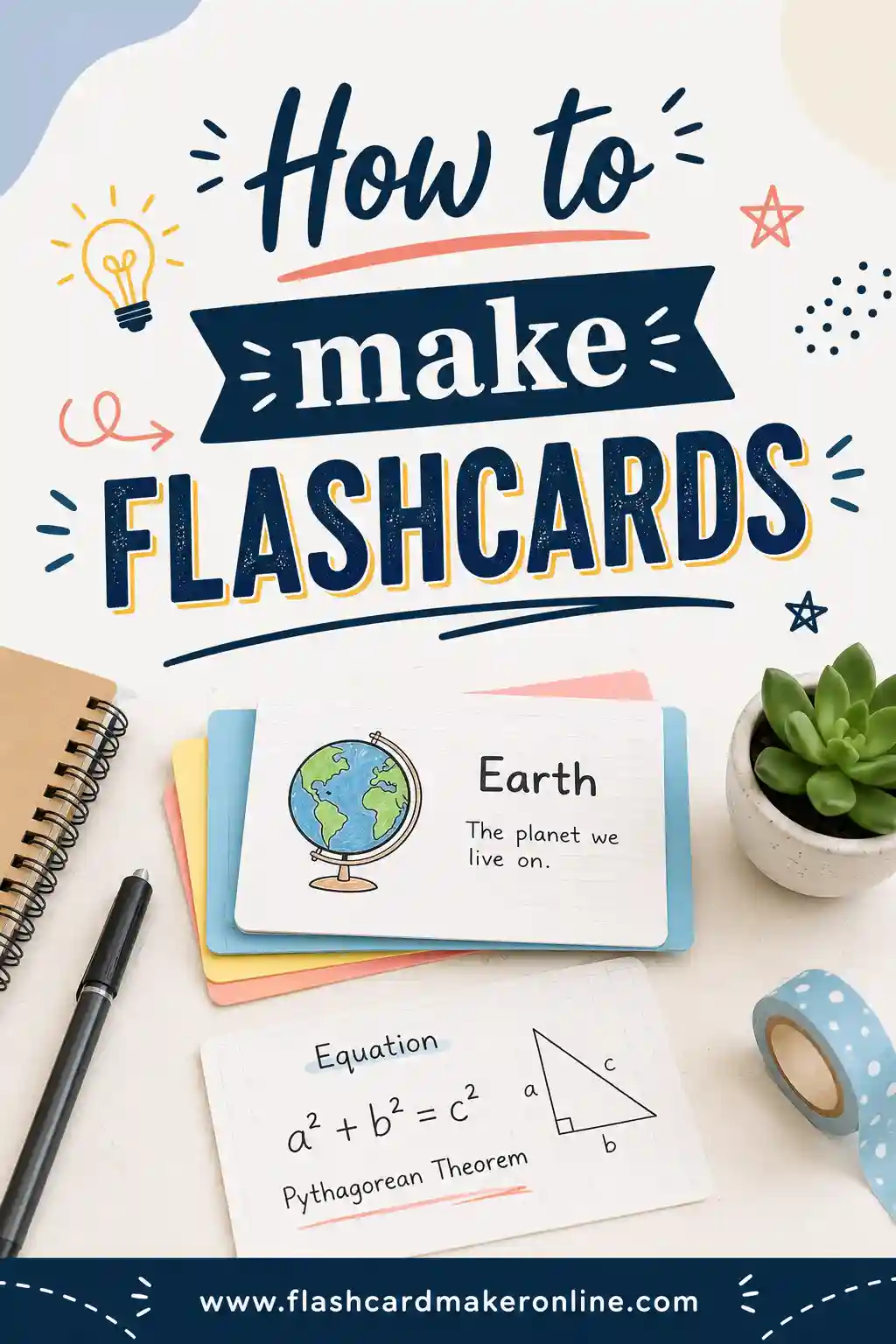
Not sure which to pick? Open the free flashcard maker, choose a size, type your terms, and print a sheet that cuts down to perfectly even cards. No sign-up, no guesswork with rulers.
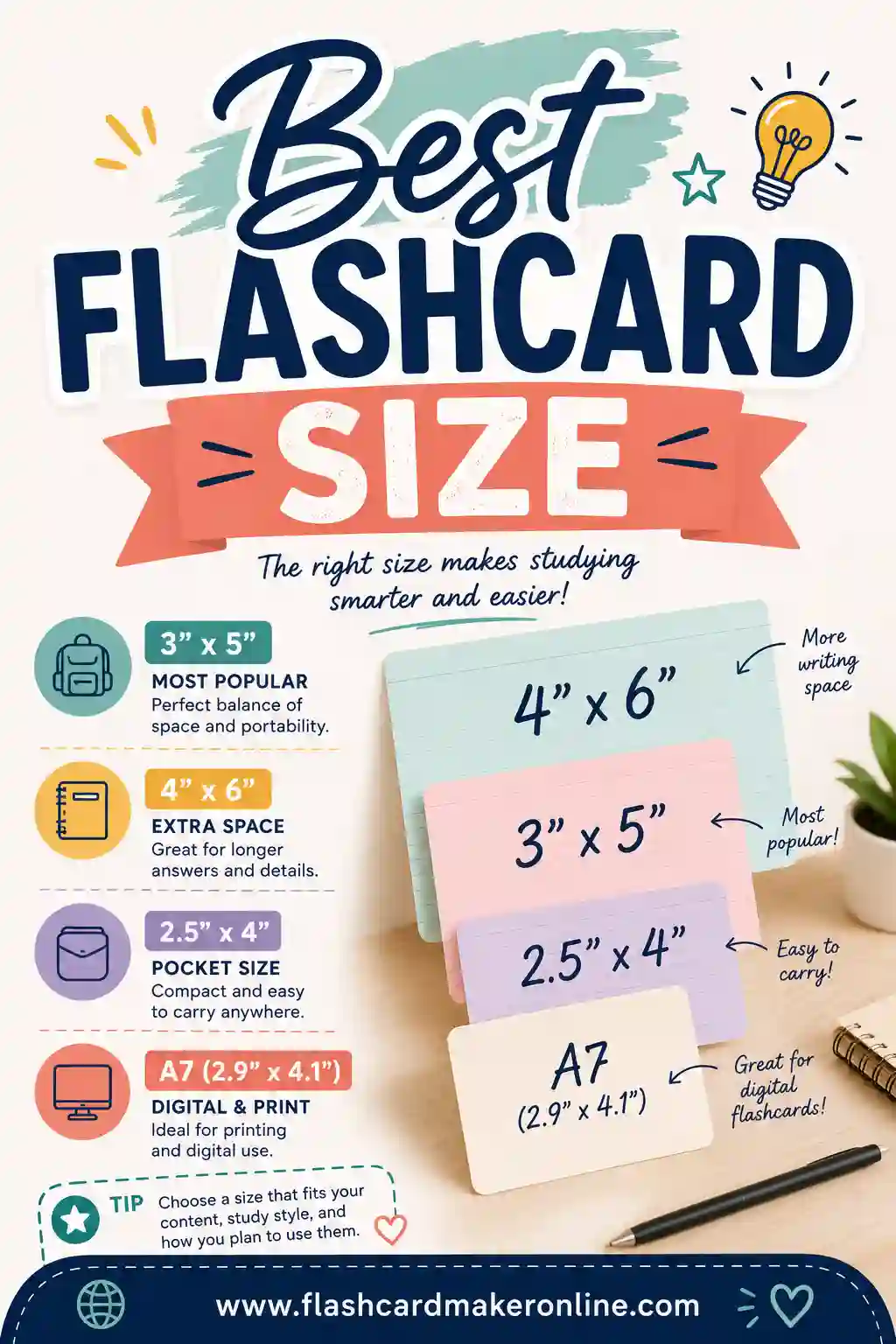
The Three Sizes Worth Knowing
You don't need a dozen options. Almost every flashcard ever made fits into three sizes, and each has a clear sweet spot.
| Size | Inches | Best for |
|---|---|---|
| Playing-card | 2.5 x 3.5 | Single words, quick vocab, kids' hands |
| Standard | 3 x 5 | Most subjects: term + definition + small image |
| Large | 4 x 6 | Diagrams, formulas, longer explanations |
If you only remember one number, remember 3 x 5. It's the index-card standard, it fits in a pocket, and it gives you room for a real definition without becoming bulky.
Why 3 x 5 Is the Default Winner
The 3 x 5 inch card hits a balance that's hard to beat. Here's what makes it the go-to:
- Enough room to write. You can fit a term on the front and a two-line definition on the back without cramming.
- Easy to hold and shuffle. It sits comfortably in one hand, so you can flip through a deck on the bus or in line.
- Pocket-friendly. A stack of thirty fits in a jacket pocket or a small bag.
- Cheap and common. Blank 3 x 5 index cards are sold everywhere, and the size prints neatly from a standard sheet.
For language learning, science terms, history dates, and most test prep, 3 x 5 is the size to start with. You'd have to have a special reason to choose anything else.
When to Size Down to 2.5 x 3.5
Go smaller when your cards are short and you want a big, easy-to-shuffle deck. Playing-card size shines in a few cases:
- Single-word vocabulary. If the front is just "perro" and the back is just "dog," you don't need a big card.
- Young kids. Smaller cards fit little hands, and a chunky picture reads fine at this size.
- Huge decks. When you're drilling 200 words, smaller cards mean a lighter, more portable stack.
- Games. This size feels like a real card game, which is great for matching or memory games.
The trade-off is space. If your definitions run long or you want an image plus text, 2.5 x 3.5 gets crowded fast. When in doubt, write a sample card by hand at that size and see if it feels tight.
When to Size Up to 4 x 6
Bigger cards earn their bulk when each card carries more. Reach for 4 x 6 inches when:
- You're drawing diagrams. Anatomy, chemistry structures, and labeled sketches need room.
- The answer is a paragraph. Some subjects, like law or medicine, have answers you can't shrink.
- You're sharing across a room. Larger cards are easier for a study group or a teacher to hold up.
- Eyesight is a factor. Bigger cards mean bigger text, which helps anyone who finds small print tiring.
The downside is portability. A deck of 4 x 6 cards is heavier and won't slip into a pocket. Many people keep these at a desk rather than carrying them around.
Size by Subject: A Quick Guide
Different subjects pull toward different sizes. Here's a cheat sheet.
| Subject | Recommended size | Why |
|---|---|---|
| Language vocab | 2.5 x 3.5 or 3 x 5 | Short terms, big decks |
| Science terms | 3 x 5 | Term plus a clear definition |
| Math formulas | 3 x 5 or 4 x 6 | Room for the formula and an example |
| Anatomy / diagrams | 4 x 6 | Space for labeled drawings |
| History dates | 2.5 x 3.5 | Short, fact-style answers |
| Medical / law | 4 x 6 | Long answers and lists |
These are starting points, not rules. If your science definitions are short, drop to playing-card size. If your vocab cards need example sentences, bump up to 3 x 5.
Don't Forget the Margins
Whatever size you pick, leave a small blank border around the edge of each card, usually about a quarter inch. Two reasons:
- Cutting room. When you print several cards per sheet, a margin gives you a clean line to cut along without slicing into your text.
- Printer safety. Most home printers can't print all the way to the paper's edge. Text too close to the edge gets clipped.
A good flashcard maker handles this for you, adding even margins so every card cuts square. If you're laying cards out by hand in a document, set your margins before you start typing, not after.
Sample Deck: Sized for a 3 x 5 Card
Here's a 20-card geography set built for the standard 3 x 5 size. Each answer is short enough to read at a glance but detailed enough to be a real card.
| Term | Definition |
|---|---|
| Capital of France | Paris |
| Capital of Japan | Tokyo |
| Capital of Canada | Ottawa |
| Capital of Australia | Canberra |
| Capital of Brazil | Brasilia |
| Capital of Egypt | Cairo |
| Capital of Kenya | Nairobi |
| Capital of India | New Delhi |
| Capital of Norway | Oslo |
| Capital of Peru | Lima |
| Longest river | The Nile |
| Largest ocean | The Pacific |
| Largest desert | The Antarctic |
| Tallest mountain | Mount Everest |
| Largest country | Russia |
| Smallest country | Vatican City |
| Largest rainforest | The Amazon |
| Highest waterfall | Angel Falls |
| Largest lake | The Caspian Sea |
| Most populous country | India |
| Largest island | Greenland |
| Driest desert | The Atacama |
| Deepest ocean trench | The Mariana Trench |
| Largest waterfall by volume | Niagara Falls |
Notice how each definition is one short line. That's the test for whether 3 x 5 is right: if your answers fit on one or two lines, the standard size is perfect.
How Many Cards Per Page?
When you print, the size decides how many cards fit on a standard 8.5 x 11 sheet:
- 2.5 x 3.5: 8 to 9 cards per page
- 3 x 5: 4 cards per page
- 4 x 6: 2 cards per page
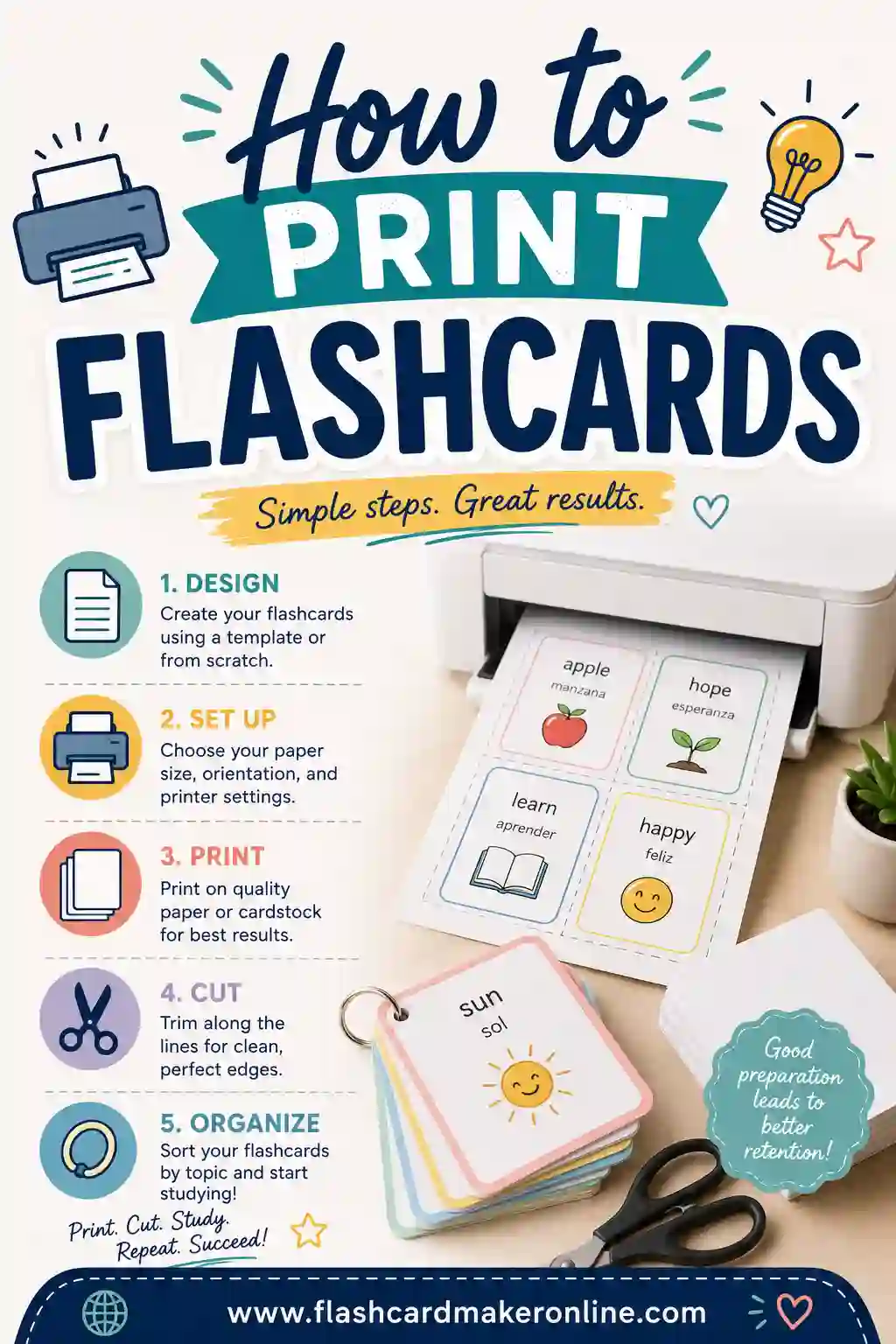
Smaller cards save paper, which matters for big decks. If you're printing a few hundred cards, dropping from 3 x 5 to playing-card size can cut your paper use roughly in half. For the full printing walkthrough, see our guide on how to print flashcards.
Paper Weight Matters as Much as Size
Size gets the attention, but the paper you print on affects how the cards feel and last. Regular printer paper is fine for a one-time study session. For cards you'll shuffle daily for weeks, use cardstock (about 65 to 110 lb). It survives handling, doesn't show the writing through the back, and feels like a real card.
If you want reusable cards, print on cardstock and slip them into clear sleeves so you can write and wipe. Pairing the right size with the right paper is what separates a flimsy stack from a deck you'll keep using.
Digital Cards Don't Have a "Size" — and That's the Point
Everything above is about paper. But if you study on a phone or laptop, the whole size question changes. A digital flashcard fills the screen one card at a time, so you're never squinting at a 2.5 x 3.5 rectangle. You get the full display for both the term and the answer.
That's a quiet advantage of studying in a flashcard maker before you print. You can pack a longer definition, a full example sentence, or a bigger image onto a digital card than would ever fit on a small printed one. Then, when you do print, you decide the physical size separately. The content and the paper size are two different choices.
So a smart workflow is: build and study digitally, where space is unlimited, then print only the decks you want to carry, at whatever physical size suits them.
Card Size for Kids vs. Adults
Hand size matters more than people think. A card that feels perfect to an adult can be clumsy for a five-year-old, and a card sized for a toddler looks like a stamp in an adult's hand.
For young children
Go with 2.5 x 3.5 or even slightly larger square cards. Little hands grip small cards more easily, and you want big, bold pictures rather than lots of text anyway. Round the corners so they don't bend or poke. Fewer words, bigger images, sturdier stock.
For students and adults
The standard 3 x 5 is the sweet spot. It holds a real definition, shuffles well, and fits the way an adult holds a deck. Bump to 4 x 6 only when the content genuinely needs the room, like diagrams or multi-line answers.
For older eyes
If small print is a strain, size up. A 4 x 6 card lets you set the text larger without crowding, and that alone can make a study session far less tiring. Don't fight a too-small card; just give the words more room.
A Quick Way to Test Your Size Before Printing a Whole Deck
Before you commit a stack of cardstock to one size, run this thirty-second check. Take your single longest, wordiest card, the one with the most text, and write it out by hand at the size you're considering. If it fits comfortably with room to spare, that size works for the whole deck. If it's cramped, size up.
Always design for your hardest card, not your easiest. A deck is only as readable as its most crowded card, so the worst-case card sets the size. Once that one fits, every other card will too.
Frequently Asked Questions
What is the best flashcard size for studying?
For most subjects, 3 x 5 inches is the best size. It fits a term, a clear definition, and even a small image, while staying easy to hold, shuffle, and carry. Drop to 2.5 x 3.5 inches for short single-word cards and step up to 4 x 6 inches for diagrams or long answers.
What size are standard index cards?
Standard index cards come in three common sizes: 3 x 5 inches, 4 x 6 inches, and 5 x 8 inches. The 3 x 5 card is the most popular for flashcards because it balances writing space with portability. The 4 x 6 size suits diagrams and longer notes.
What is the best flashcard size for vocabulary?
For single-word vocabulary, 2.5 x 3.5 inches (playing-card size) is ideal because the terms are short and you can build a big, portable deck. If your vocab cards include example sentences or a small image, step up to 3 x 5 inches for more room.
How many flashcards fit on one page?
It depends on the size. You can fit about 8 to 9 playing-card-size cards, 4 standard 3 x 5 cards, or 2 large 4 x 6 cards on a standard 8.5 x 11 sheet. Smaller cards save paper, which helps when printing large decks.
Should flashcards be printed on cardstock?
For cards you'll use daily, yes. Cardstock (65 to 110 lb) resists bending, stops writing from showing through the back, and feels like a real card. For a quick one-time review, regular printer paper is fine. Cardstock plus clear sleeves makes reusable, wipe-clean cards.
What flashcard size is best for kids?
For young children, 2.5 x 3.5 inches (or a small square) works best because little hands grip smaller cards more easily. Use big pictures and few words, and round the corners so they don't bend or poke. As kids get older and start reading, you can move up to the standard 3 x 5 size.
Does flashcard size matter for studying?
Indirectly, yes. The right size means your text and any images fit clearly without cramming, which keeps cards easy to read and quick to review. Too small and you crowd the content; too big and the deck is hard to carry. Match the size to your content, and the studying takes care of itself.
Ready to Print Perfectly Sized Flashcards?
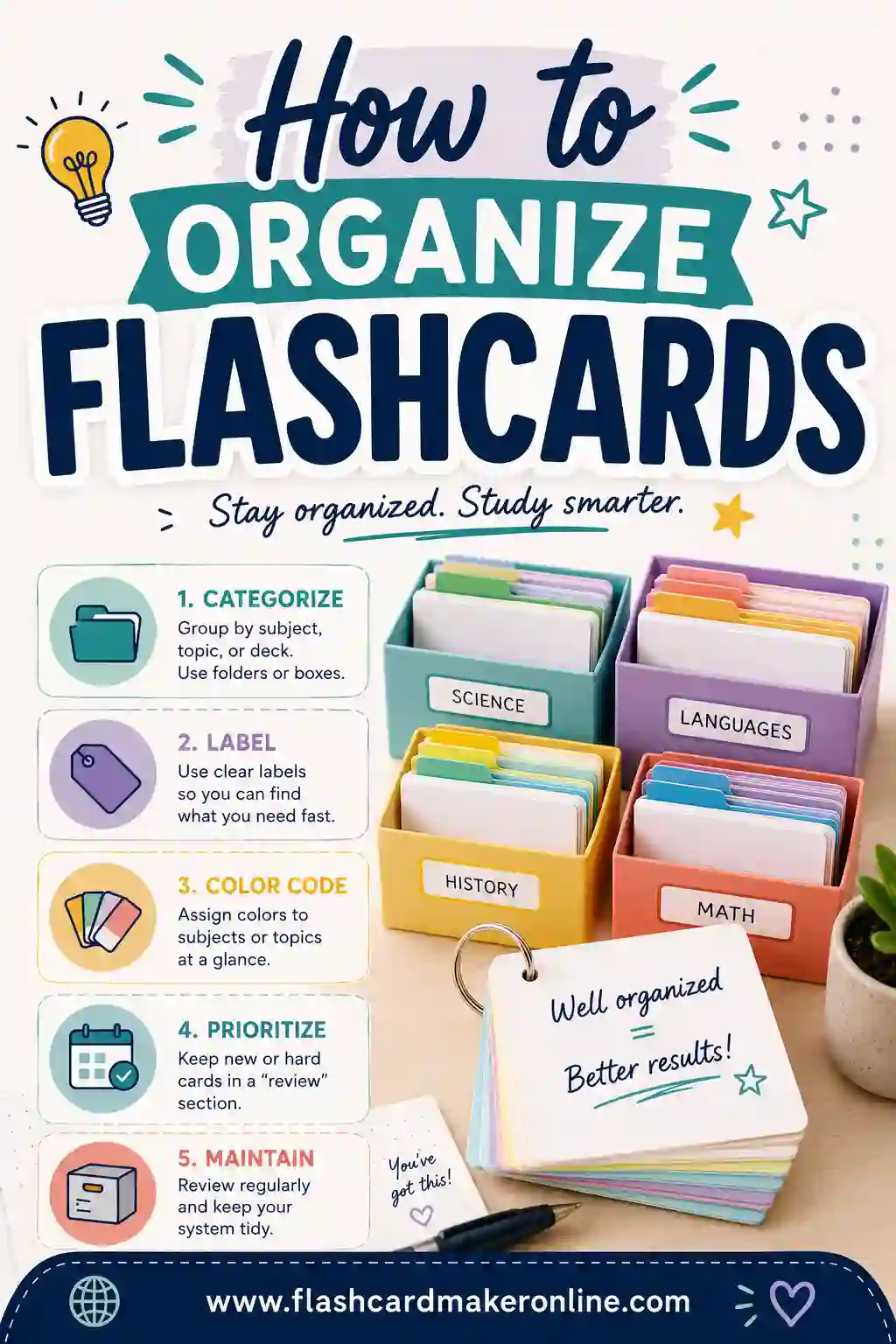
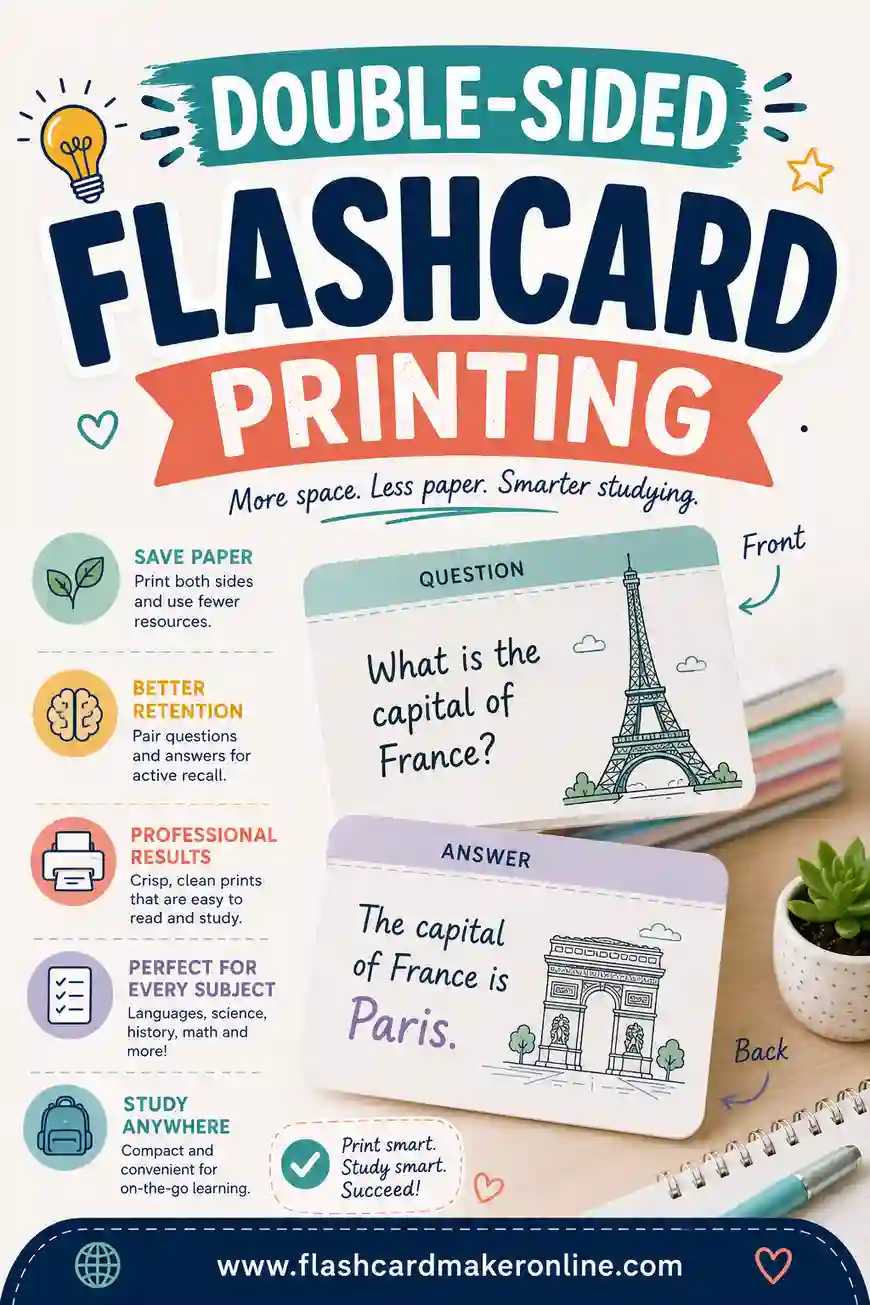
Pick 3 x 5 for most things, size down for short vocab, and size up for diagrams. Add a quarter-inch margin, choose cardstock for cards you'll keep, and you're set. When you're ready, open the free flashcard maker, choose your size, and print a sheet that cuts down to clean, even cards. It's free and there's no sign-up. For more, see our tips on how to organize flashcards and double-sided flashcard printing.