Medical Terminology Flashcards: Free Printable & Customizable
Medical terminology flashcards are cards that pair a medical word part, like the prefix "hyper-," the root "cardi/o," or the suffix "-itis," with its meaning, so you can decode unfamiliar terms instead of memorizing thousands of them one by one. Learn the parts and "myocarditis" becomes obvious: heart muscle inflammation. The fastest way to build a study set is a free flashcard maker that turns your term list into clean, printable cards you can drill anywhere.
Want to jump straight in? Open the free flashcard maker, paste in a term list (there's a ready-made one below), and print a deck in minutes. No sign-up, no software, no cost.

Why Word Parts Beat Brute Memorization
Medical terminology looks like a wall of impossible words until you spot the trick: almost every term is built from a small set of reusable parts. There are really only three jobs a part can do:
- Prefix — comes first, often signals location, time, or amount ("hyper-" = excessive, "sub-" = under).
- Root — the core meaning, usually a body part or system ("cardi/o" = heart, "nephr/o" = kidney).
- Suffix — comes last, often signals a condition, procedure, or specialty ("-itis" = inflammation, "-ectomy" = removal).
Stack them and the term decodes itself. "Hyper-tens-ion" = high pressure condition. "Nephr-ectomy" = kidney removal. "Cardi-ology" = study of the heart. Learn a few hundred parts and you can read terms you've never seen before, which is far faster than memorizing tens of thousands of whole words.
That's exactly what flashcards are built for: small, self-contained facts drilled to instant recall. Pair the cards with active recall and spaced repetition and the parts stick for the long haul, not just until the next quiz.
Free Medical Terminology List (Copy & Paste)
Here's a ready-to-use set of high-yield word parts, sorted by job. Copy a column into the flashcard maker and print a deck. Put the part on the front and the meaning on the back.
| Prefixes | Roots | Suffixes |
|---|---|---|
| hyper- (excessive) | cardi/o (heart) | -itis (inflammation) |
| hypo- (below normal) | nephr/o (kidney) | -ectomy (removal) |
| brady- (slow) | hepat/o (liver) | -otomy (incision) |
| tachy- (fast) | gastr/o (stomach) | -ostomy (opening) |
| dys- (difficult, painful) | pulmon/o (lung) | -ology (study of) |
| a-/an- (without) | neur/o (nerve) | -pathy (disease) |
| peri- (around) | oste/o (bone) | -emia (blood condition) |
| sub- (under) | derm/o (skin) | -algia (pain) |
| inter- (between) | my/o (muscle) | -megaly (enlargement) |
| intra- (within) | cyt/o (cell) | -scopy (viewing) |
| post- (after) | hem/o (blood) | -plasty (repair) |
| pre- (before) | arthr/o (joint) | -genic (producing) |
| poly- (many) | cerebr/o (brain) | -rrhea (flow, discharge) |
Don't try to swallow all three columns at once. Pull eight to ten parts, master them, then add the next batch.
Build it into real terms
Here's the payoff: combine the parts above and the meaning falls out. This makes a great second deck once the parts are solid.
| Term | Decoded |
|---|---|
| cardiology | study of the heart |
| nephritis | kidney inflammation |
| hepatomegaly | enlarged liver |
| gastrostomy | opening into the stomach |
| osteopathy | bone disease |
| dyspnea | difficult breathing |
| tachycardia | fast heart rate |
| neuralgia | nerve pain |
| dermatitis | skin inflammation |
| arthroscopy | viewing inside a joint |
Studying these alongside the parts trains you to assemble meaning on the fly, which is exactly what exams and the clinic demand.
How to Make Medical Terminology Flashcards in 4 Steps
No hand-writing hundreds of cards. Here's the whole process.
- Pick your batch. Grab eight to ten word parts, or a set of related terms from one body system.
- Add them to the maker. Paste your list into the flashcard maker, part on the front, meaning on the back.
- Print your deck. Hit print. Cardstock holds up to daily shuffling far better than paper.
- Cut and study. Slice them apart and run your first short session.
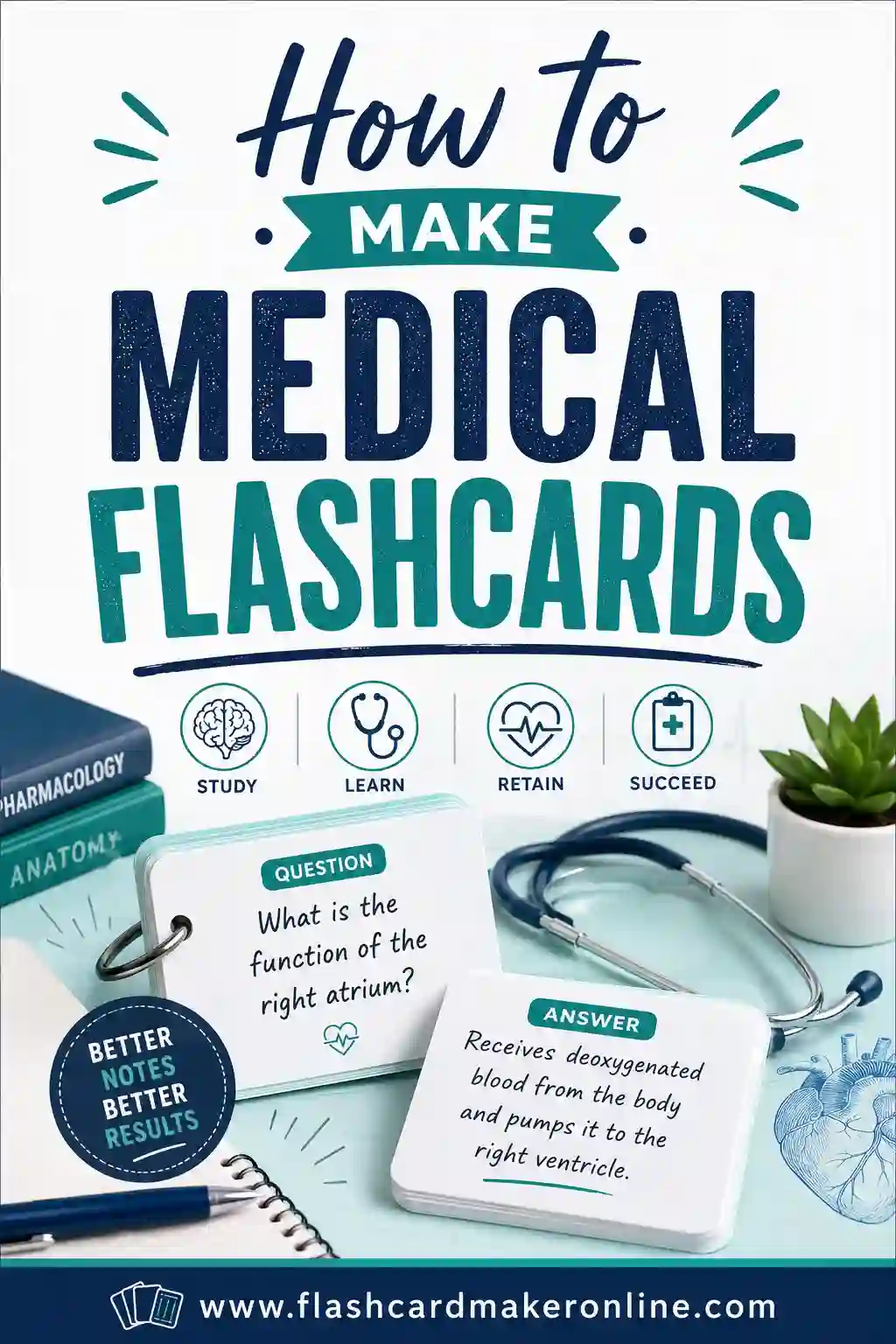
Prefer to study on your phone between classes? The same maker lets you flip cards digitally, so you can drill in line for coffee or on the bus. For more, see how to make medical flashcards.
How to Study Medical Terminology (That Sticks)
The deck is only half the work. Here's how to study so terms stay in long-term memory.
Use active recall, both directions
Don't just read the cards. Look at "cardi/o," say "heart" out loud, then flip to check. Then go the other way: see "heart," recall "cardi/o." Two-directional recall is far stronger than one-way.
Lean on spaced repetition
Review a new card today, again in two days, then in four, then in a week. Each correct recall pushes the next review further out. A simple "knew it / didn't" sort each session approximates this without any app.
Decode, don't memorize whole terms
When you hit a new term, break it apart: prefix + root + suffix. "Pericarditis" = peri (around) + cardi (heart) + itis (inflammation) = inflammation around the heart. Practicing the breakdown is what makes new terms easy later.
Study tips that work for med students
| Tip | Why it helps |
|---|---|
| Group by body system | Related parts reinforce each other |
| Say answers out loud | Forces real recall, not recognition |
| Keep decks small (8–15) | Each card gets real practice |
| Review missed cards first | Spends time where you're weak |
| Drill in short bursts daily | Beats one long weekly cram |
| Build terms from parts | Trains decoding, not rote memory |
Common Mistakes to Avoid
A few fixes save hours of frustration.
- Memorizing whole words. There are far too many. Learn the parts and decode instead.
- Decks that are too big. A 100-card pile means nothing gets real review. Break it into small sets.
- One-way recall only. If you only practice part-to-meaning, you'll freeze when an exam goes the other way.
- Cramming. Terminology fades fast without spacing. Short daily sessions win.
- Ignoring combining vowels. Roots often carry an "o" (cardi/o) that links to a suffix. Drill the combining form so spelling stays right.
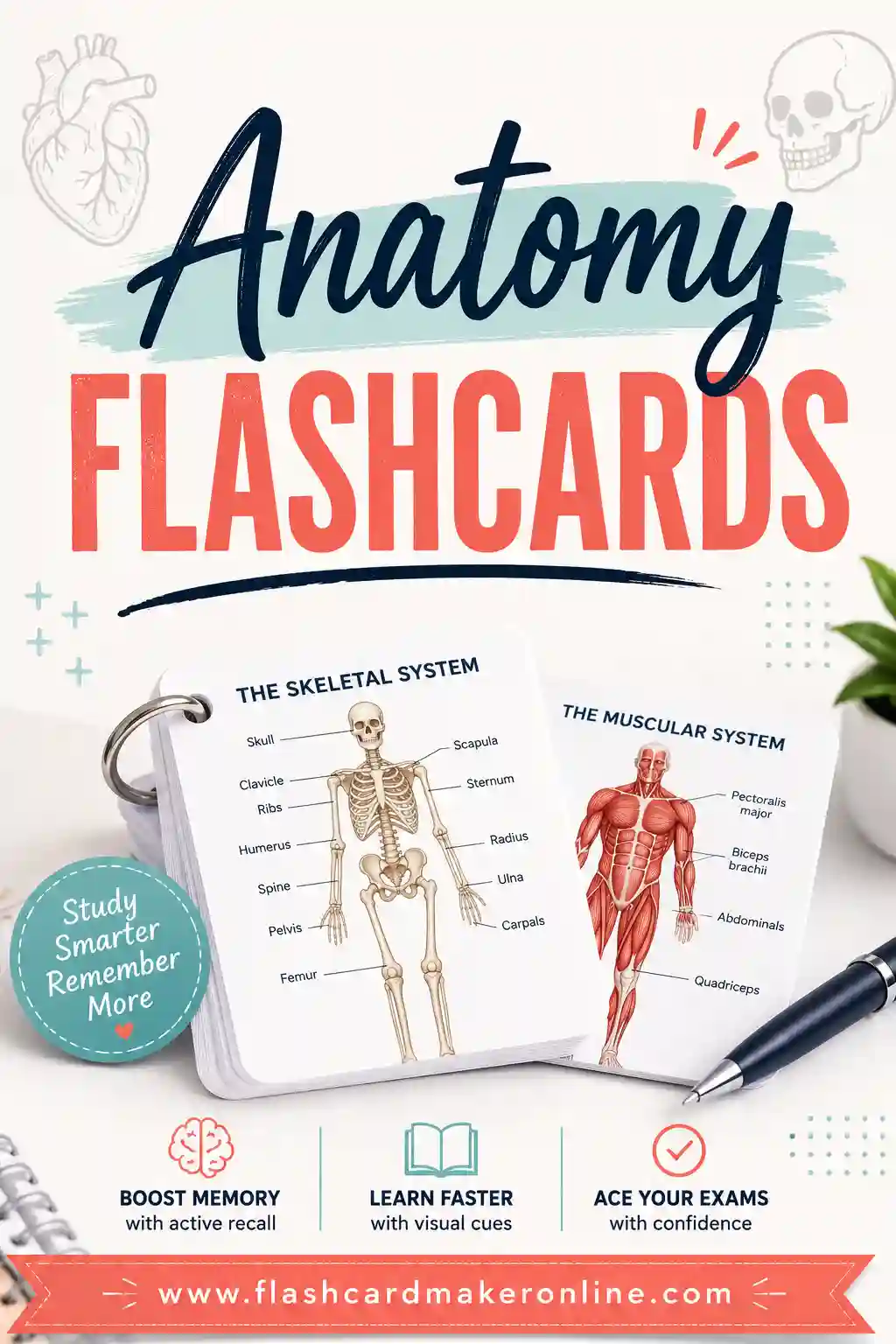
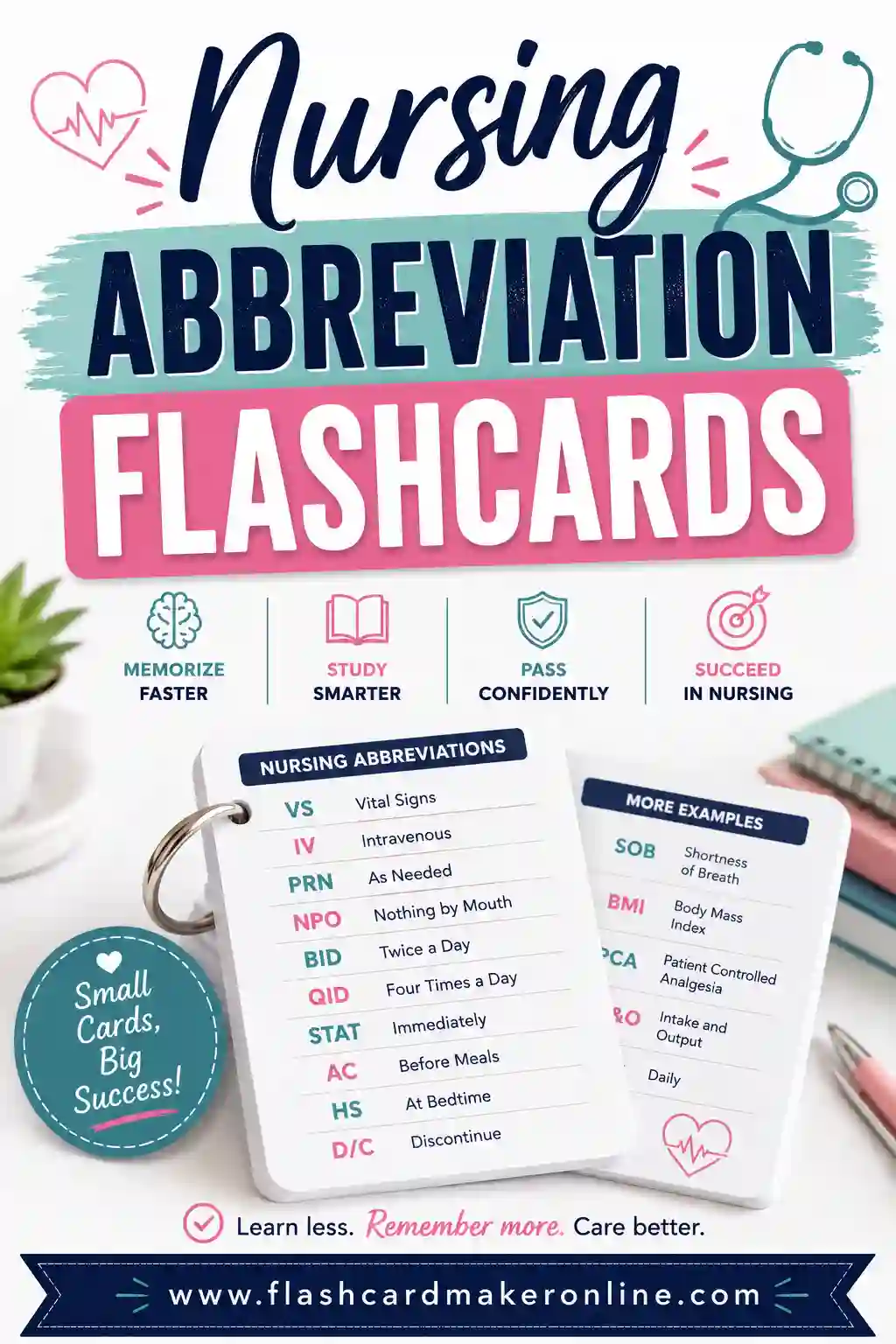
Pair this with anatomy flashcards to connect terms to the structures they name, and nursing abbreviation flashcards for the shorthand you'll see on charts. Studying for school? Our flashcards for medical students guide has a full study plan.
A Study Schedule That Actually Holds Up
Medical terminology fades fast if you cram it, so a realistic schedule beats heroic all-nighters. The goal is short, frequent contact with the material spread across the week, not one marathon the night before.
Here's a simple weekly rhythm that works for most students. Adjust the numbers to your course load, but keep the spacing.
| Day | What to do | Time |
|---|---|---|
| Monday | Learn one new batch (8–10 parts) | 15 min |
| Tuesday | Review Monday's batch + learn new | 15 min |
| Wednesday | Review both batches, missed cards first | 10 min |
| Thursday | Build real terms from the week's parts | 15 min |
| Friday | Mixed review of the whole week | 15 min |
| Weekend | Quick run of any stubborn cards | 5–10 min |
Notice how each batch gets reviewed several times across the week, with the gaps stretching out. That spacing is what moves terms from short-term to long-term memory. By Friday, the Monday batch should feel almost effortless, and that's exactly the point.
If you fall behind, don't try to make it all up in one sitting. Just pick up the rhythm again. A missed day costs you far less than a panic-cram that you'll forget by Monday.
Studying With a Partner or Group
Medical terminology is a great subject to study with someone else, because the back-and-forth forces real recall. Hand your deck to a study partner and have them quiz you, then swap. Saying answers out loud to another person is harder, and more useful, than flipping cards alone.
A few group tactics that work especially well for terminology. Try a quick "decode race": one person reads out a term nobody has drilled as a whole word, and everyone breaks it into parts to find the meaning. The first to decode it correctly wins. It's fast, it's a little competitive, and it trains exactly the skill exams test.
You can also split the load. Each person builds a deck for one body system, then you trade decks and quiz each other. You cover more ground, and explaining a term to someone else cements it in your own memory better than silent review ever could. For more on group methods, our flashcards for group study approach pairs naturally with terminology drills.
Frequently Asked Questions
What are medical terminology flashcards?
They're cards that pair a medical word part, prefix, root, or suffix, with its meaning, so you can decode unfamiliar terms instead of memorizing them whole. Learn that "cardi/o" means heart and "-itis" means inflammation, and "carditis" decodes itself.
How should I study medical terminology flashcards?
Use active recall in both directions (part to meaning and meaning to part), space your reviews over days, and practice breaking real terms into parts. Keep decks small, drill daily in short bursts, and review your missed cards first.
How many medical terms should I learn at once?
Start with eight to ten word parts per deck. Small sets let each card get real practice and keep you from burning out. Master one batch, then add the next, rather than facing a hundred cards at once.
Are medical terminology flashcards free to make?
Yes. Paste your term list into the free flashcard maker, then study them on screen or print them on cardstock. There's no sign-up and no cost, so you can build a fresh deck for every body system or unit.
What's the difference between a prefix, root, and suffix?
A prefix comes first and often signals location or amount ("hyper-" = excessive). A root carries the core meaning, usually a body part ("nephr/o" = kidney). A suffix comes last and often signals a condition or procedure ("-itis" = inflammation). Stacked together, they form the full term.
Should I learn terminology by body system or by word part?
Both, and the two reinforce each other. Drill the high-yield word parts first so you can decode anything, then group your study decks by body system (cardiovascular, renal, and so on) so related terms cluster and stick.
Ready to Make Your Medical Terminology Flashcards?
Grab the word-part list above, open the free flashcard maker, and you'll have a clean, printable deck in minutes. It's free, there's no sign-up, and you can build a fresh set for every unit. Learn the parts, decode the rest, and watch the wall of jargon turn into something you can actually read.