Spaced Repetition Explained: A Simple Guide
Spaced repetition is a study technique where you review information at increasing intervals, just before you'd naturally forget it, instead of cramming it all at once. Each time you successfully recall something, you wait a little longer before the next review, which signals to your brain that the memory is worth keeping. The simplest way to put it into practice is a free flashcard maker that lets you build a deck, flip through it, and print a set so you can space your reviews over days and weeks.
Want to try it now? Open the free flashcard maker, build a small deck (there's a sample below to copy), and review it across a few days instead of all at once. No sign-up, no fee, nothing to install.
What Is Spaced Repetition, Really?
Think about how you study without a plan. You read something once, feel like you "got it," and move on. A few days later, it's gone. That's normal, your brain forgets things it doesn't see again.
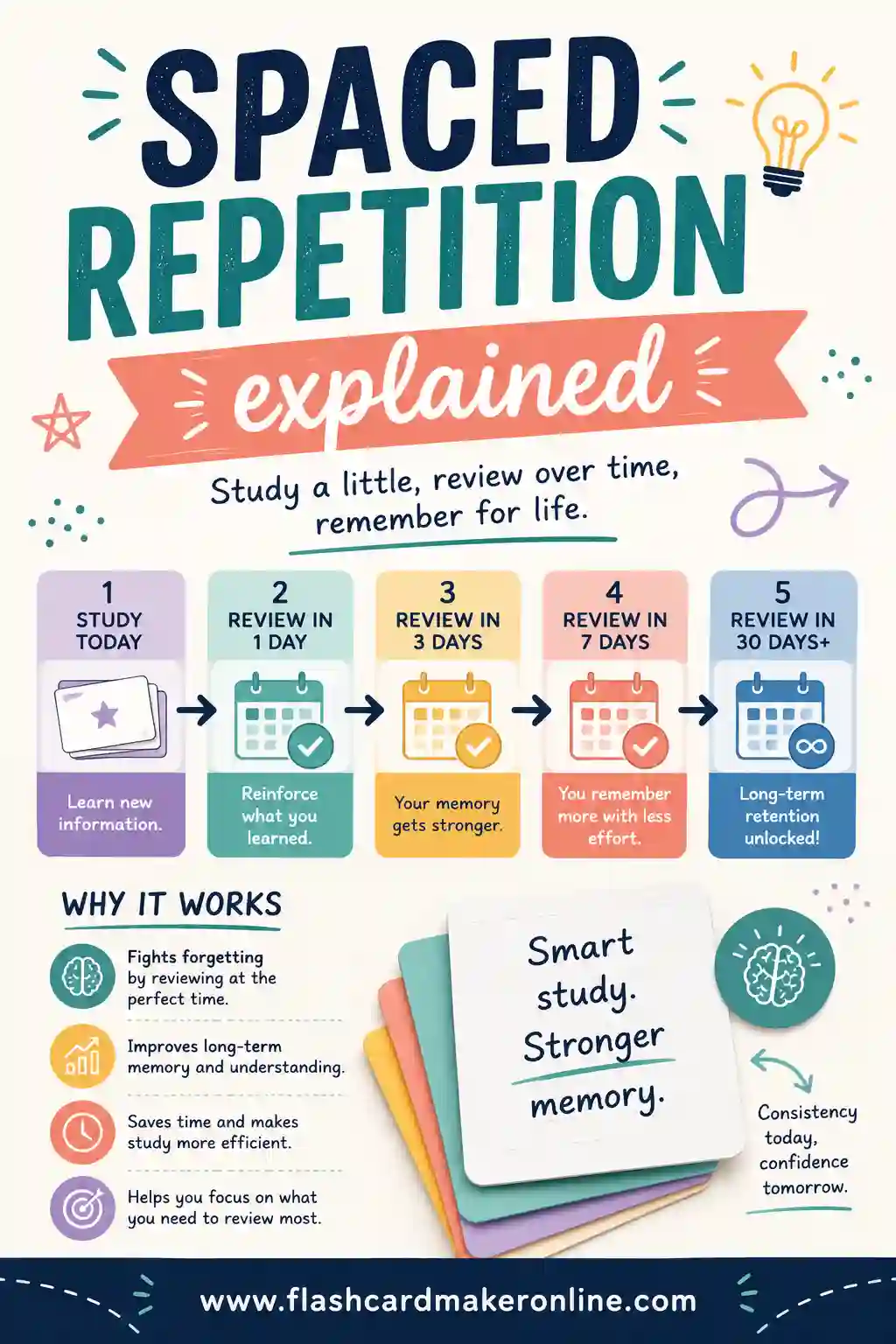
Spaced repetition flips that. Instead of one big study session, you spread your reviews out over time. You see a fact today, again tomorrow, then a few days later, then a week later, each gap a little bigger than the last. Every time you successfully recall it, your brain treats it as more important and holds onto it longer.
The result: you remember more, for longer, with less total study time. It sounds too good to be true, but it's one of the most reliable findings in all of memory research, dating back to the 1880s.
The Forgetting Curve
To understand why spaced repetition works, you need to know about the forgetting curve. A researcher named Hermann Ebbinghaus mapped how quickly we forget new information, and the picture isn't pretty: without review, you can lose more than half of what you learned within a day or two.
But here's the magic. Each time you review a fact, the curve resets, and it drops more slowly the next time. Review it a few times, spaced out, and the curve flattens almost to a flat line. The memory becomes durable.
So every well-timed review does two things:
- It rescues the memory before it fully fades.
- It strengthens the memory so it fades more slowly next time.
That's the whole idea. You're surfing the forgetting curve, jumping in right before each drop.
Why "Spaced" Beats "Massed" Study
Cramming, doing all your studying in one block, is called massed practice. It feels efficient because you cover a lot fast, and you do remember it for the test tomorrow. The problem is it evaporates almost as quickly.
Spreading the same study time across several days is called distributed practice, and it wins by a mile for long-term memory. This is known as the spacing effect: the same amount of study produces far more durable learning when it's spread out.
| Cramming (massed) | Spaced repetition (distributed) | |
|---|---|---|
| Short-term recall | Good | Good |
| Long-term recall | Poor | Excellent |
| Total time needed | High (you relearn it) | Lower over time |
| Stress level | High | Low |
| Best for | A test you'll forget | Knowledge you'll keep |
The takeaway: studying for one hour over four days beats studying for four hours in one night, every time.
A Simple Spaced Repetition Schedule
You don't need fancy software to do this. A basic expanding schedule works great for a deck of flashcards.
| Review number | When to review |
|---|---|
| Learn the card | Day 0 (today) |
| Review 1 | Day 1 (tomorrow) |
| Review 2 | Day 3 |
| Review 3 | Day 7 (one week) |
| Review 4 | Day 16 |
| Review 5 | Day 35 (about a month) |
The rule is simple: if you recall a card correctly, push its next review further out. If you miss it, pull it back to "review tomorrow." Over time, the cards you know drift to the back of your schedule, and the ones you struggle with stay front and center. That's spaced repetition doing your prioritizing for you.
The Leitner System: Spaced Repetition With Real Cards
The Leitner system is the classic low-tech way to run spaced repetition with printed flashcards. You sort cards into a few boxes by how well you know them.
- Box 1 — review daily. New cards and any you just missed.
- Box 2 — review every few days. Cards you've gotten right once.
- Box 3 — review weekly. Cards you keep getting right.
- Box 4 — review monthly. Cards you know cold.
The rules:
- Get a card right? Move it up one box.
- Get a card wrong? Send it back to Box 1.
- Study lower boxes often, higher boxes rarely.
Because you're physically moving cards, printing your deck on cardstock makes this smooth. The flashcard maker prints a clean set in seconds, and our how to study with flashcards guide walks through a full session.
Spaced Repetition Needs Active Recall
Here's a crucial point people miss: spaced repetition only works if you're actually testing yourself, not just rereading.
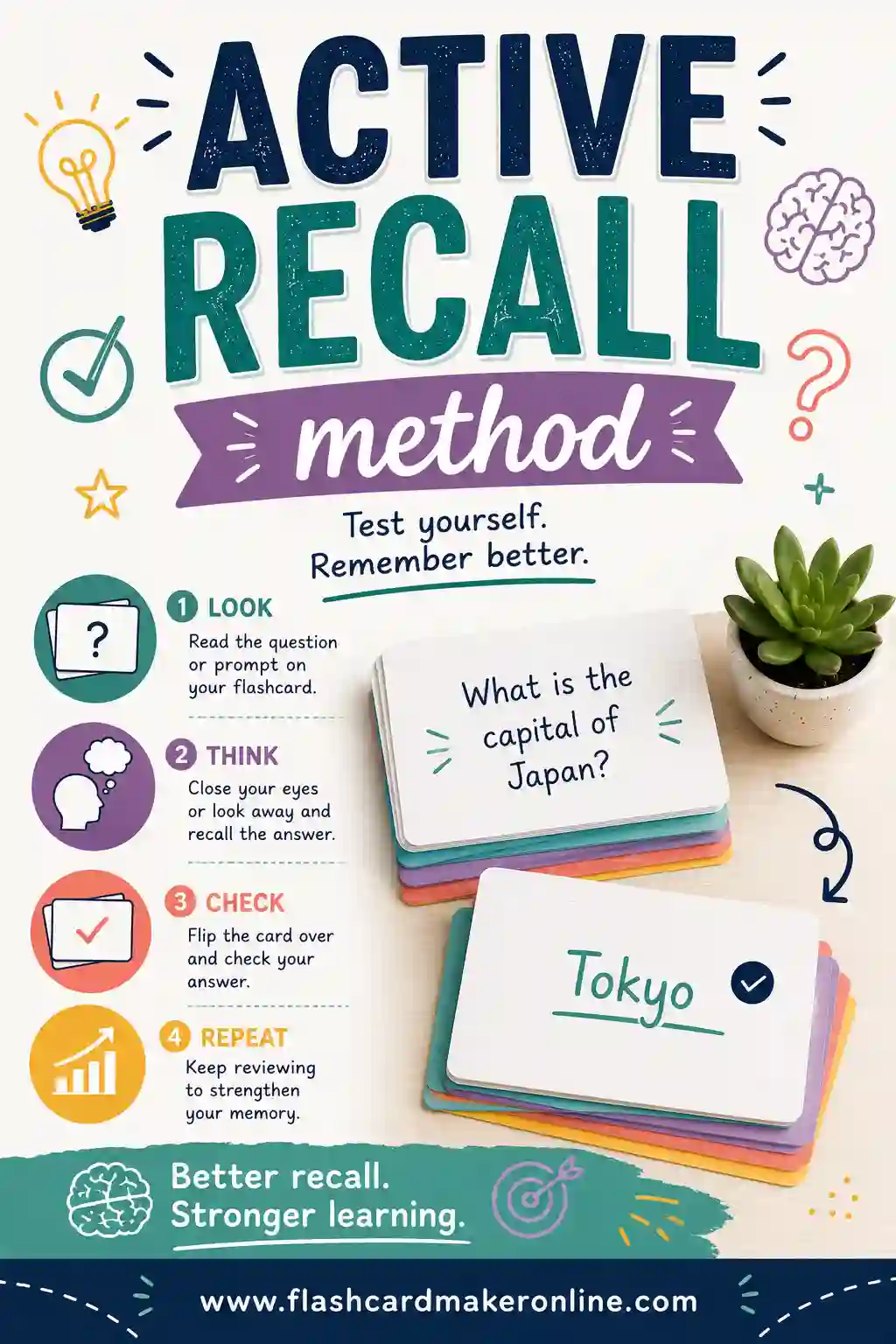
When a card comes up for review, you should try to recall the answer before you flip it. That act of retrieval is what strengthens the memory. If you just read both sides, you get the timing benefit but lose most of the power. Pairing spaced repetition with active recall is the combination that makes flashcards so effective, and our active recall method guide explains exactly how to do it.
In short: space your reviews and make each review a real test.
A Sample Deck to Practice With (Copy & Paste)
Here's a ready-to-use deck of memory and study terms, perfect for practicing spaced repetition on the very concepts behind it. Copy the rows into the flashcard maker.
| Term | Definition |
|---|---|
| Spaced repetition | Reviewing material at increasing intervals over time |
| The forgetting curve | How quickly memory fades without review |
| The spacing effect | More durable learning when study is spread out |
| Massed practice | Cramming all study into one block |
| Distributed practice | Spreading study across multiple sessions |
| Active recall | Retrieving an answer from memory instead of rereading |
| Retrieval practice | Testing yourself to strengthen a memory |
| The Leitner system | Sorting cards into boxes by mastery level |
| Review interval | The time gap between two reviews of a card |
| Consolidation | The brain settling a memory into long-term storage |
| Encoding | Turning new information into a memory |
| Ebbinghaus | The researcher who mapped the forgetting curve |
| Overlearning | Studying past the point of first success |
| Interleaving | Mixing topics within a study session |
| Cue | A prompt that triggers recall |
| Lag effect | Bigger gaps between reviews often help long-term memory |
| Expanding schedule | Review intervals that grow after each success |
| Confidence trap | Mistaking familiarity for real knowledge |
| Maintenance review | An occasional review to keep a memory alive |
| Mastery | Recalling a card quickly and reliably every time |
Practice spacing your reviews of this very deck and you'll learn the concept and the content at the same time.
Common Mistakes With Spaced Repetition
- Reviewing too soon or too often. If you review a card you already know cold every day, you're wasting time. Let the easy ones drift out.
- Just rereading instead of testing. Without active recall, you lose most of the benefit. Always try to answer first.
- Letting the deck snowball. If you add cards faster than you review them, reviews pile up. Add in moderation.
- Quitting after the test. If you want to keep the knowledge, keep a light maintenance schedule going.
- Being dishonest about misses. "I almost had it" is a miss. Send it back to Box 1.
Who Spaced Repetition Helps Most
This technique shines for anyone who needs to remember a lot over the long haul:
- Language learners building vocabulary that has to stick.
- Students and professionals prepping for big, content-heavy exams.
- Anyone learning facts, terms, or formulas they'll need months from now.
- Busy adults who can only spare short study windows, see flashcards for adult learners.
If you're memorizing something once for a quiz next hour and never again, cramming is fine. For anything you want to actually keep, spaced repetition is the way.
Frequently Asked Questions
What is spaced repetition in simple terms?
It's reviewing information at growing time gaps, today, tomorrow, in a few days, in a week, instead of all at once. You review each fact right before you'd forget it, which strengthens the memory and stretches out how long it lasts. Over time you study less and remember more.
Why does spaced repetition work better than cramming?
Because of the spacing effect: spreading study across days produces far more durable memory than the same time crammed into one block. Cramming gets you through tomorrow's test but fades fast, while spaced reviews build long-term retention with less total effort over time.
How do I do spaced repetition with paper flashcards?
Use the Leitner system. Sort cards into boxes by how well you know them, review easy boxes rarely and hard boxes often, move a card up a box when you get it right, and back to Box 1 when you miss it. A free flashcard maker lets you print a deck to sort.
How many times do I need to review a card?
It varies, but five to seven well-spaced reviews are often enough to move a fact into durable long-term memory. The exact number depends on the material and on you. The key is that each successful recall lets you wait longer before the next review.
Do I need an app for spaced repetition?
No. Apps automate the scheduling, but a simple expanding schedule or the Leitner box system works perfectly with printed flashcards. Build your deck with a free flashcard maker, print it, and sort cards by hand as you review.
Ready to Put It Into Practice?
Spaced repetition is simple once you see it: review at growing intervals, recall before you peek, and let your easy cards drift out while the hard ones stay close. Do that and you'll remember more with less effort. Grab the sample deck above, open the free flashcard maker, and build a deck you can space out over the coming days, on screen or printed for the Leitner box. Start small and let the schedule do the work.