Desirable Difficulties: Why Harder Study Leads to Longer-Lasting Learning
Desirable difficulties are study conditions that make learning feel slower and harder in the moment but leave you remembering more weeks later. The term comes from UCLA psychologist Robert Bjork, and the main ones are spacing your study, mixing topics together, testing yourself instead of rereading, and changing the conditions you practice under. The catch is in the word "desirable": the struggle only helps when it makes your brain do useful work, and when you have enough background knowledge to rise to it.
If you have ever crammed for a test, felt great walking in, and then forgotten nearly everything a week later, you have already lived the problem this idea solves. This guide explains where the idea came from, the theory behind it, the key studies (with their real numbers), and how to build the right kind of difficulty into your flashcard routine without crossing into the kind that just wastes your time.
What desirable difficulties are, in plain English
Here's the short version. Some ways of studying make you look good right now. Others make you good later. They're often not the same ways.
Robert Bjork and Elizabeth Ligon Bjork, a husband-and-wife research team at UCLA, put it this way in a widely read chapter called "Making Things Hard on Yourself, But in a Good Way": conditions that make performance improve quickly during practice often fail to support long-term retention, while conditions that slow down apparent progress often produce the best long-term retention and transfer. "Transfer" just means being able to use what you learned in a new situation, like a test question worded differently from your notes.
The Bjorks name four main desirable difficulties in that chapter:
- Spacing: spreading study sessions on a topic out over time instead of massing them into one block.
- Interleaving: mixing practice on different topics or problem types instead of doing all of one kind, then all of the next (which researchers call "blocking").
- Testing: using quizzes and recall attempts as study events, instead of just reading the material again.
- Varying the conditions of practice: changing things up, including where you study, instead of keeping everything constant and predictable.
They also tie in a fifth, closely related idea: the generation effect, the long-term benefit of producing an answer yourself instead of being shown it. In their words, any time you look up an answer you could have generated from your own memory, you rob yourself of a learning opportunity.
Every one of these feels harder than its easy alternative. That's the point, and it's also why most students avoid them.
Where the idea came from: a short history
The phrase is younger than you might think, but the roots go back a century. In a 2020 article titled "Desirable Difficulties in Theory and Practice", published in the Journal of Applied Research in Memory and Cognition, the Bjorks looked back on how the idea took shape.
| Year | Milestone | Why it matters |
|---|---|---|
| 1914 | Edward Thorndike's "Law of Disuse" | Proposed that learned habits fade with time unless practiced. The Bjorks kept the emphasis on use but rejected the idea that memories simply decay. |
| 1978 | Smith, Glenberg and Bjork's two-room study | Studying the same material in two different rooms led to better recall than studying it twice in one room. |
| 1979 | Shea and Morgan's motor-skill study | A classic case of practice that looked worse during training but held up far better 10 days later. |
| 1992 | Bjork and Bjork's "New Theory of Disuse" | Introduced storage strength and retrieval strength, the theory behind the whole idea. |
| 1994 | The term "desirable difficulty" is coined | Robert Bjork gave a name to the pattern that some difficulties help learning. |
| 2011 | "Making Things Hard on Yourself, But in a Good Way" | A short, readable chapter that brought the idea to students and teachers. |
| 2020 | "Desirable Difficulties in Theory and Practice" | The Bjorks reflected on 25 years of research and on how hard it is to get these ideas into real classrooms. |
The Bjorks are open about one thing in that 2020 piece: they say the name has a nice ring to it, but it has forced them to keep stressing that the word "desirable" carries real weight. Many difficulties, they write, are undesirable during instruction and forever after.
The theory: storage strength versus retrieval strength
To understand why harder can be better, you need the two-strength idea at the heart of the Bjorks' New Theory of Disuse. Every memory, they propose, has two separate strengths:
- Storage strength is how deeply learned something is: how well connected it is to the rest of what you know. It builds up and, in their model, doesn't really get lost.
- Retrieval strength is how easy the memory is to pull up right now, given the cues around you. It rises fast and falls fast.
Think of a friend's phone number. If you dialed it every day for years, its storage strength is high, even if today you'd fumble for a second (lower retrieval strength) after not calling for a month. A number someone read to you 30 seconds ago has high retrieval strength but almost no storage strength. You can recite it right now. Tomorrow it's gone.
Here's the part that runs against intuition. According to the 2020 article, the higher an item's current retrieval strength, the smaller the gain in storage strength you get from studying it again. In plain terms: studying something that's already right on the tip of your mind does very little for long-term memory. Studying it when it has started to fade, so that pulling it up takes effort, does much more.
The Bjorks put it as "forgetting can enhance learning." Spacing works because the gap lets retrieval strength drop. Interleaving works partly because switching topics means you have to "reload" each one from memory. Testing works because a recall attempt is effortful in a way rereading isn't.
This also explains why you can be fooled. During practice, all you can see is your current performance, and performance reflects retrieval strength. Learning, the lasting change, is about storage strength, and you can only measure it after a delay. If you treat today's easy recall as proof of learning, you'll naturally prefer the study methods that feel smooth, which are often the weaker ones.
The key studies, explained simply
Here are the experiments that made researchers take desirable difficulties seriously. Each one has the same shape: the easier condition looks better during practice, and the harder one wins on a delayed test.
Interleaving motor skills (Shea and Morgan, 1979)
As the Bjorks describe in their 2011 chapter, participants learned three different movement patterns, each one a fast sequence of knocking down barriers on a pinball-like device. Everyone got 18 trials on each pattern. One group practiced in blocks (all of pattern A, then all of B, then all of C). The other got the patterns in random order.
During practice, the blocked group improved faster. If the researchers had stopped there, blocking would have looked better. But participants came back 10 days later. When tested in random order, the interleaved group did far better, and the blocked group looked as if they had learned almost nothing. Even when tested in blocks, the interleaved group still came out slightly ahead.
Varied practice in children (Kerr and Booth, 1978)
Eight-year-olds and 12-year-olds practiced tossing beanbags at a floor target without being able to see it at the moment of each throw. Half of each age group always threw at one fixed distance (for example, 3 feet for the 8-year-olds). The other half threw at targets that were closer and farther away, but never at the test distance.
Then everyone was tested at the fixed distance. Common sense says the kids who practiced at exactly that distance should win. In both age groups, the varied-practice kids did better. Learning to adjust the throw seems to have mattered more than rehearsing one exact throw.
Interleaving math problems (Rohrer and Taylor, 2007)
Students learned to calculate the volumes of unusual solid shapes, such as a truncated cone, either in blocks or mixed together. On a test a week later, the interleaved group solved 63 percent of new problems correctly, compared with 20 percent for the blocked group, according to the Bjorks' summary of the study. That's more than three times as many.
Learning painters' styles (Kornell and Bjork, 2008)
This one surprised even the researchers. In a study in Psychological Science, people learned the styles of 12 painters from six paintings each. Some saw each artist's paintings one after another; others saw them mixed in with other artists' work. The researchers expected that mixing would make it harder to spot what each artist's paintings had in common.
It went the other way: the mixed group was better at identifying the painter of new paintings they had never seen. And here's the striking part. When asked which method had helped them more, most participants said blocking, even after their own test results showed the opposite.
Testing versus rereading (Roediger and Karpicke, 2006)
In a well-known study at Washington University in St. Louis, students read short prose passages and then either restudied them or took recall tests with no feedback. On a test five minutes later, restudying won. On tests two days and one week later, the students who had taken practice tests remembered substantially more. Restudying also made students more confident in their memory, which is exactly the kind of misleading feeling the Bjorks warn about.
Getting it wrong first (Kornell, Hays and Bjork, 2009)
What if you can't answer the test question at all? In six experiments published in the Journal of Experimental Psychology: Learning, Memory, and Cognition, people either tried to answer a question before seeing the answer or simply read the question and answer together. The materials were made-up trivia questions or weakly related word pairs, so most first attempts failed. Even so, the failed attempts improved learning compared with just reading. The authors concluded that taking on hard tests, instead of avoiding errors, may be an important route to effective learning.
Desirable difficulties at a glance
This table pulls the main ones together, with what each feels like and what the research shows.
| Desirable difficulty | The easy alternative | How it feels | What studies show |
|---|---|---|---|
| Spacing | Cramming one topic in a single session | You've "forgotten" some of it each time you return | Better long-term retention across a huge range of materials; the best gap grows with how long you need to remember |
| Interleaving | Blocking (all of one type, then the next) | Choppy and confusing; slower progress | Better delayed performance in motor skills, math and category learning |
| Retrieval practice (testing) | Rereading notes or the textbook | Effortful; you notice what you can't recall | Rereading wins after minutes; testing wins after days |
| Generation and pretesting | Being shown the answer right away | Frustrating, especially when you guess wrong | Even failed attempts can improve later learning when feedback follows |
| Varied practice | Same place, same order, same format every time | Less comfortable and less predictable | Better recall in new settings and better transfer to new versions of the task |
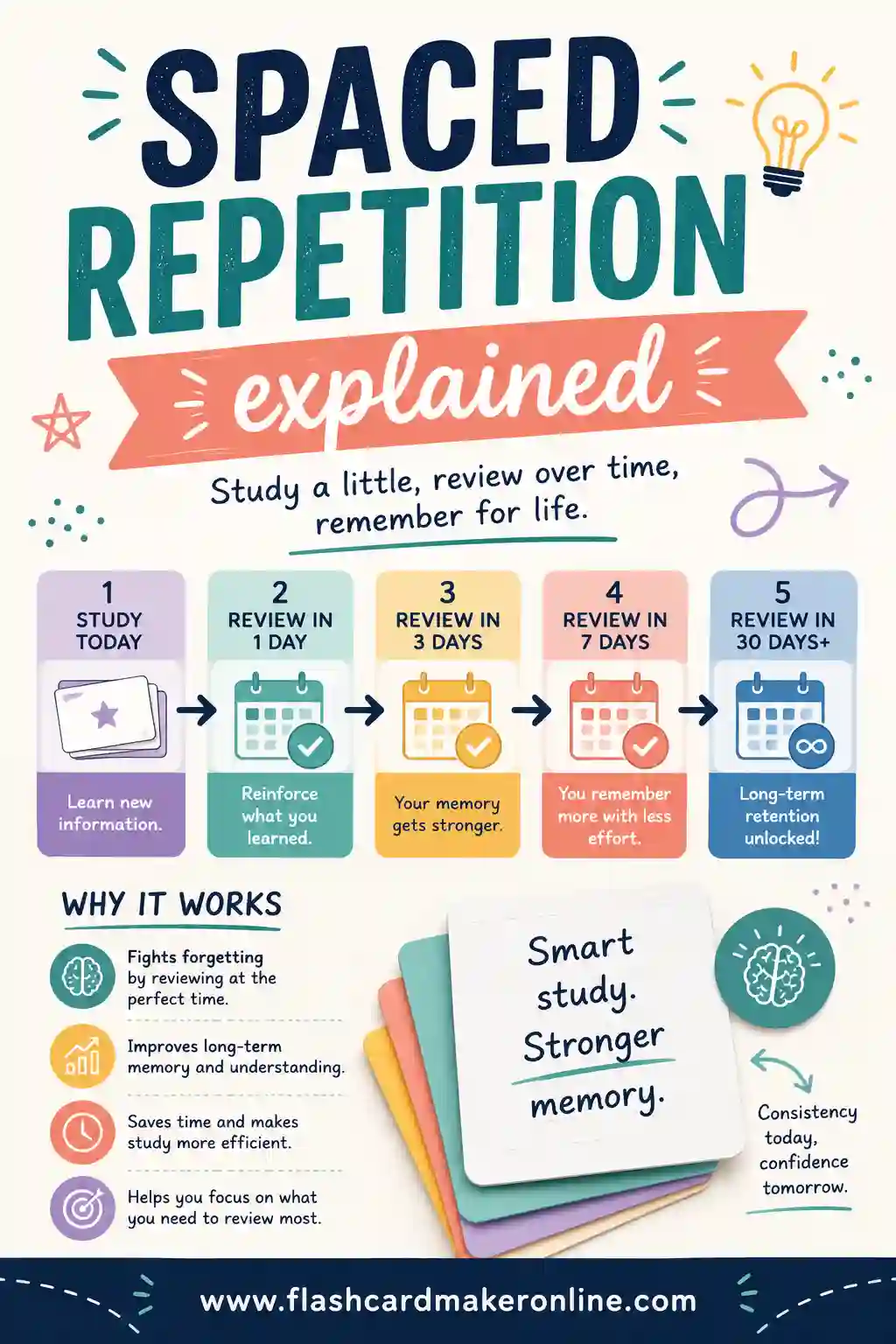
On spacing, a large review in Psychological Bulletin by Nicholas Cepeda and colleagues pulled together 839 assessments from 317 experiments in 184 articles. One clear finding: as the time you need to remember something grows, the study gap that produces the best retention grows too. Our guide to spaced repetition covers how flashcard schedules put that to work.
Why "desirable" is the most important word
It would be easy to walk away thinking "harder is always better." The Bjorks say clearly that it isn't. In both the 2011 chapter and the 2020 article, they write that desirable difficulties help because they trigger the encoding and retrieval processes that support learning. If the learner doesn't have the background knowledge or skills to respond to them, they become undesirable difficulties.
In other words, the right level of difficulty depends on you and what you already know. Asking yourself to recall a definition you studied yesterday is a productive struggle. Asking yourself to recall a definition you've never seen is just guessing. In the 2020 article, the Bjorks point to the "Challenge Point" framework from motor-skills researchers Guadagnoli and Lee (2004), which makes the same argument: the most useful amount of challenge depends on the learner's current skill level.
| Usually desirable | Usually undesirable | Why the difference |
|---|---|---|
| Trying to recall a card's answer before flipping it | Quizzing yourself on material you haven't studied at all, with no answer to check | Recall needs something to retrieve, and feedback to fix mistakes |
| Mixing similar problem types you've each practiced once | Mixing in topics you haven't been taught yet | Interleaving helps you compare things you partly know |
| Coming back to a deck after a few days, when it's a little fuzzy | Waiting so long that you have to relearn it from scratch | Some forgetting helps; total forgetting means starting over |
| Studying in a couple of different spots | Studying with loud lyrics, a TV on, or constant phone alerts | Changing context adds cues; distraction just splits your attention |
| Writing your own answer before checking | Making your card text hard to read on purpose | Effort only helps if it goes into thinking about the material |
That last row matters. You may come across the claim that hard-to-read fonts act as a desirable difficulty. The theory behind desirable difficulties doesn't predict that any kind of hassle helps. It predicts that effort spent retrieving, comparing, and connecting ideas helps. Squinting at a messy font isn't the same kind of work, so don't make your flashcards harder to read in the hope that it'll boost memory.
The feeling-of-learning trap
The single biggest obstacle to using desirable difficulties is that they don't feel like they're working. Your sense of how well you're learning is largely based on how smoothly things are going right now, and smoothness is exactly what these strategies take away.
A 2019 Harvard study in PNAS showed this clearly in a real college course. Louis Deslauriers and colleagues compared active, effortful class sessions with polished traditional lectures in introductory physics, using the same content and handouts. Of 157 students recruited, 149 completed the study. Students in the active sessions scored higher on a test of learning (about half a standard deviation), yet they reported feeling they had learned less. The authors traced part of this gap to the extra mental effort, which students took as a sign of poorer learning.
The Kornell and Bjork painting study showed the same thing: people preferred the method that had helped them less. And in the Bjorks' 2011 chapter, they describe a study by Simon and Bjork (2001) in which people learning keystroke patterns with blocked practice were markedly overconfident about how they'd do the next day, while the interleaved group predicted their scores quite closely.
The takeaway for you: when a study session feels clunky, that isn't proof it's failing. Judge your methods by how you do on a delayed self-test a few days later, not by how you feel at the end of the session. We go deeper on this in our article on the illusion of competence, a closely related topic.
How to use desirable difficulties with flashcards
Flashcards happen to be one of the easiest tools for building in the right kind of difficulty, because they're designed for recall. Here's how to use each one on purpose.
1. Always answer before you flip
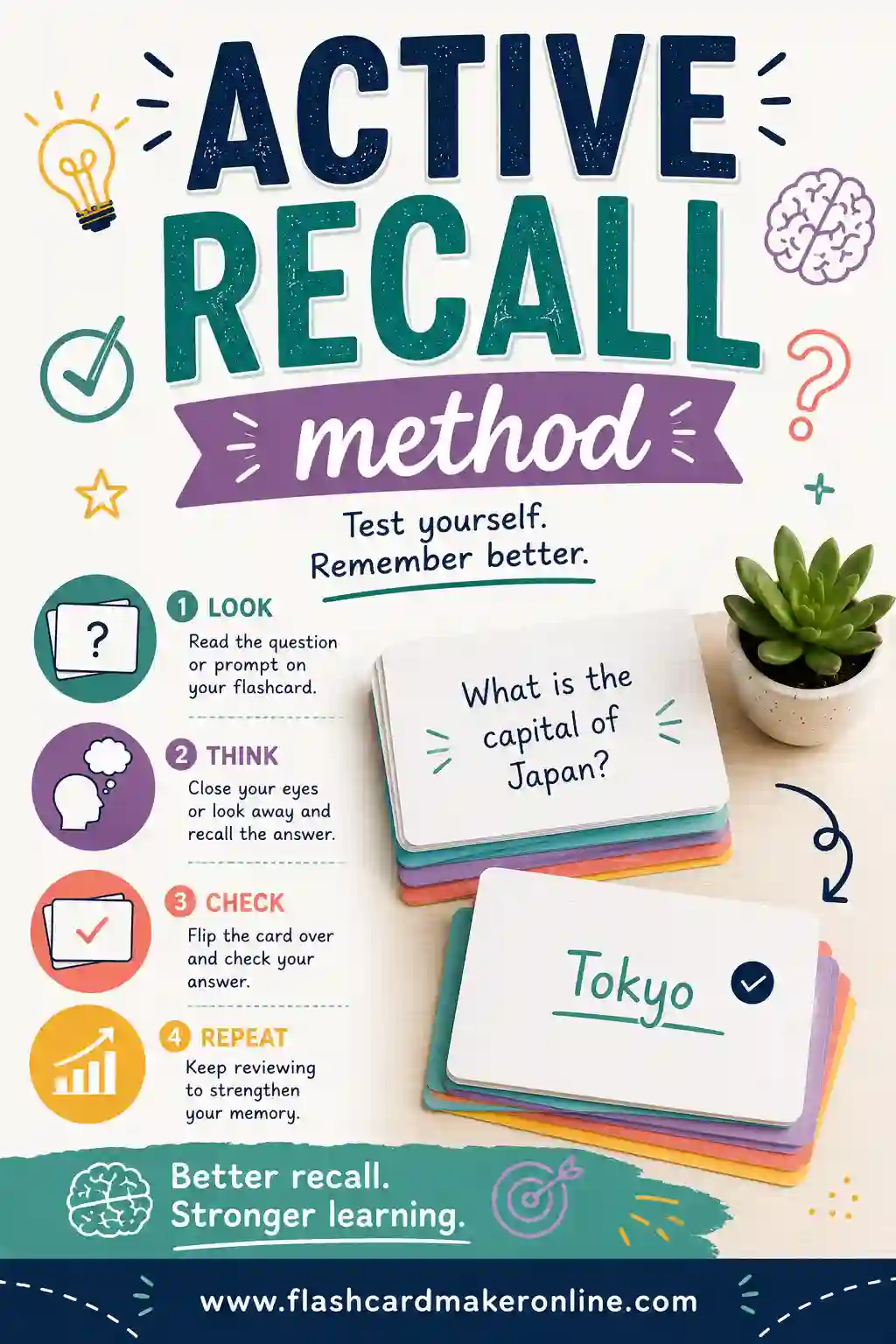
Say the answer out loud or write it down before you turn the card. Don't flip at the first flicker of "oh, I know this." That small commitment turns a card from a reminder into a test. The Kornell, Hays and Bjork results suggest that even when you get it wrong, the attempt makes the answer stick better once you see it. If you're new to this, our active recall method guide walks through the basics.
2. Space your sessions
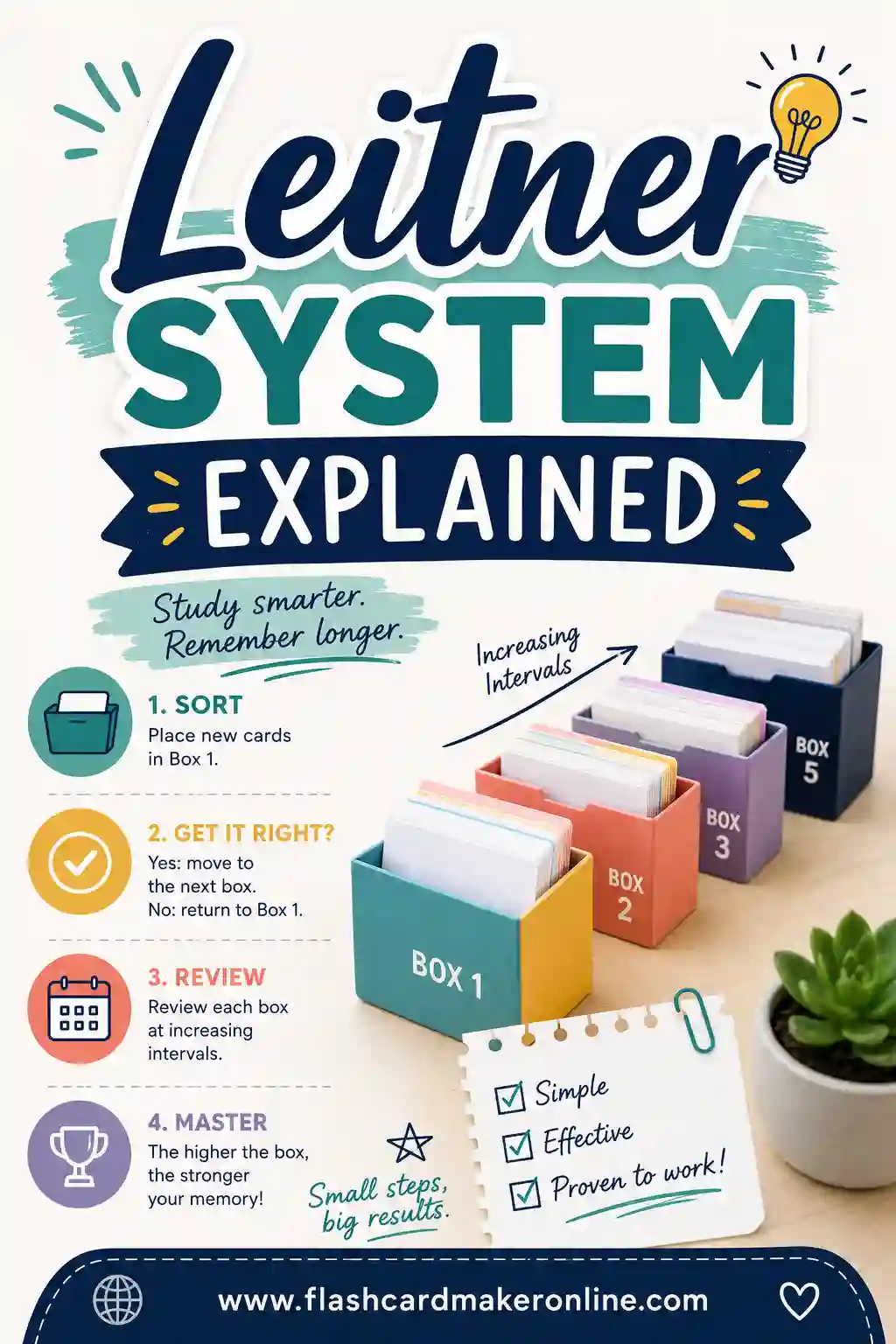
Instead of one long session the night before, split the same total time across several days. When you come back and a card feels a bit fuzzy, that's the forgetting that makes the next review count. A box-based system like the Leitner system builds growing gaps in automatically: cards you know move to boxes you review less often, and cards you miss move back.
3. Shuffle across topics
If you're studying for a biology exam, don't do all the cell cards, then all the genetics cards. Once you've studied each topic at least once, mix the decks. You'll be slower, and you'll mix things up more at first. That confusion is your brain learning to tell similar ideas apart, which is what the Kornell and Bjork painting study suggests interleaving trains.
Interleaving pays off most when the items are easy to confuse: similar math problem types, related vocabulary words, look-alike diagrams. If the topics have nothing in common, mixing still adds spacing but adds less comparison.
4. Keep cards you "know" in the deck a little longer
One correct answer isn't a finish line. In the Bjorks' framework, an item you just recalled has high retrieval strength, so it's easy to drop it too soon. Keep reviewing it at growing gaps instead of retiring it right away.
5. Flip the direction
Study vocabulary from English to the new language and back. Study a term from its definition, then a definition from its term. This is a mild form of varied practice: the same knowledge, reached from a different starting point.
6. Change your setting now and then
The two-room study the Bjorks describe suggests that learning tied to one place doesn't always travel well. Review a deck at your desk, then at the kitchen table, then on the bus. Exams rarely happen in your bedroom.
7. Pretest yourself on new material
Before reading a new chapter, flip through its terms and try to guess what they mean. You'll get many wrong, and that's fine. Then read the chapter and check. The point is to prime your brain to notice the answers.
A worked example: one week of desirable difficulties
This example is illustrative, with a made-up student. Maya has a Spanish vocabulary quiz in eight days on three units: food (30 words), travel (30 words), and weather (20 words). She has about 20 minutes a day.
| Day | What Maya does | Which difficulty it uses |
|---|---|---|
| 1 | Pretests the food unit: guesses meanings before looking. Then studies the food cards, answering out loud before each flip. | Pretesting, retrieval |
| 2 | Studies travel cards the same way. Quick 3-minute recall check of food cards first. | Retrieval, spacing |
| 3 | Studies weather cards. Then shuffles all three units together and goes through once, Spanish to English. | Interleaving |
| 4 | Rest day for vocabulary. | Spacing (the gap) |
| 5 | Mixed deck, English to Spanish this time, at the kitchen table. Missed cards go in a "redo" pile. | Interleaving, variation, retrieval |
| 6 | Only the "redo" pile, plus a few random cards from the rest. | Retrieval, spacing |
| 7 | Rest day. | Spacing |
| 8 | Morning: one fast mixed pass in both directions. Quiz in the afternoon. | Retrieval, variation |
Notice what Maya is not doing: reading the word list over and over, or doing one marathon session on day 7. Her plan will feel less comfortable. Day 5 in particular will feel worse than day 3, because she's switching direction and topic at once. That dip is expected.
What desirable difficulties look like in different subjects
The principles stay the same, but the details change by subject.
- Math: Mix problem types in homework review instead of doing 20 of the same type. Make cards that show a problem and ask "Which method?" instead of only "What's the answer?" Our algebra flashcards page has card ideas.
- History: Quiz yourself on events and dates in both directions (put the event on the front and the year on the back, then make a second card that does the reverse). Mix eras once you've studied each one.
- Science: Interleave look-alike concepts (mitosis vs meiosis, speed vs velocity) so you practice telling them apart. Pretest each chapter's vocabulary before reading.
- Languages: Study in both directions, space reviews, and mix units. Say words out loud and use them in a new sentence, which adds variation.
- Music and sports: This is where much of the original research on varied and interleaved practice happened. Mix drills instead of repeating one until it feels smooth.
Common mistakes and limits
Desirable difficulties are well supported, but they're easy to misuse. Watch for these.
- Making it hard in the wrong way. Dim lighting, tiny text and noisy rooms are difficulties, but not the useful kind. The useful kind makes you retrieve, compare, or produce something.
- Starting with difficulties before you know anything. Interleaving and testing work best once you've had a first pass through the material. A quick first exposure, then harder practice, is a good order.
- Skipping feedback. Testing without ever checking your answers can let errors settle in. Always flip the card after you try.
- Quitting after one bad session. A session that feels worse is often working. Check yourself a few days later before you decide.
- Expecting magic with young children. In their 2020 article, the Bjorks note that relatively little research has looked at spacing for young children in real classrooms, and that big differences in attention, memory and prior knowledge at young ages may change what helps.
- Treating every technique as equal. In a major 2013 review of 10 study techniques, John Dunlosky and colleagues rated practice testing and distributed practice (spacing) as high utility, while interleaved practice was rated moderate because the evidence in real educational settings was more limited at the time.
One more honest point. In the 2020 article, the Bjorks admit that simply telling students and teachers about this research isn't enough. People bring strong beliefs about how learning works, and what they've been doing has gotten them this far. Changing habits takes practice, which is a nice irony.
Tips for teachers and parents
The Bjorks end their 2011 chapter with a nudge for teachers and parents: think about how you might build desirable difficulties into the way you teach. Here are some practical ways to do that with flashcards and short reviews.
- Start class with a quick recall warm-up. Two or three questions on last week's material, answered from memory, add both spacing and retrieval. Give the answers right after.
- Mix old cards into new units. When a class moves on to a new chapter, keep a small stack of cards from earlier chapters in the rotation. This spreads practice out and makes students tell old and new ideas apart.
- Give "best guess" pretests. Before a new topic, ask students to guess answers to a few questions. Make it clear that the guesses won't be graded. The goal is to get them thinking, and the Kornell, Hays and Bjork findings suggest that wrong guesses followed by feedback can still help.
- Warn students that it will feel harder. The 2019 Harvard study authors argued that students need to understand, early on, why effortful learning is worth it. A one-minute explanation of storage versus retrieval strength can keep students from deciding that a good method "isn't working."
- Keep it reachable. If most of the class can't answer anything, the difficulty has become undesirable. Back up, reteach, and try again.
For parents helping at home, the simplest change is to quiz instead of re-read. Rather than reading the spelling list aloud together five times, read it once, then ask your child to spell each word from memory, check it together, and come back to the missed words the next day.
In the 2020 article, the Bjorks also describe a law school at Florida International University that rebuilt its teaching around these ideas, including more practice testing. According to their account, the school's bar exam pass rate rose from about fifth among Florida law schools to first in most recent exams. That's one school's story, not a controlled experiment, but it shows the ideas can be used well beyond flashcards.
Try it yourself: a five-minute experiment
You don't have to take anyone's word for this. Here's a small test you can run on yourself.
- Pick 20 facts you don't know yet, such as world capitals, vocabulary in a new language, or anatomy terms. Make 20 cards.
- Split them into two piles of 10. Call them Pile A and Pile B.
- Study Pile A by reading each card front and back four times in a row.
- Study Pile B by reading each card once, then quizzing yourself on it three times, answering before you flip. Give both piles about the same total time.
- Right after, rate how confident you feel about each pile on a 1 to 10 scale.
- Wait two or three days. Then test yourself on all 20 cards, front side only.
Many people feel more confident about Pile A right after studying. Based on the research above, you'd expect Pile B to hold up better on the delayed test. Your own results will vary, and a single small test isn't proof of anything. But it's a good way to see the gap between how learning feels and how it lasts.
How desirable difficulties connect to other study methods
Desirable difficulties aren't one technique. They're a lens that explains why several well-known techniques work. Spaced repetition apps, the Leitner box method, practice tests, and mixing problem sets all fit under the same umbrella.
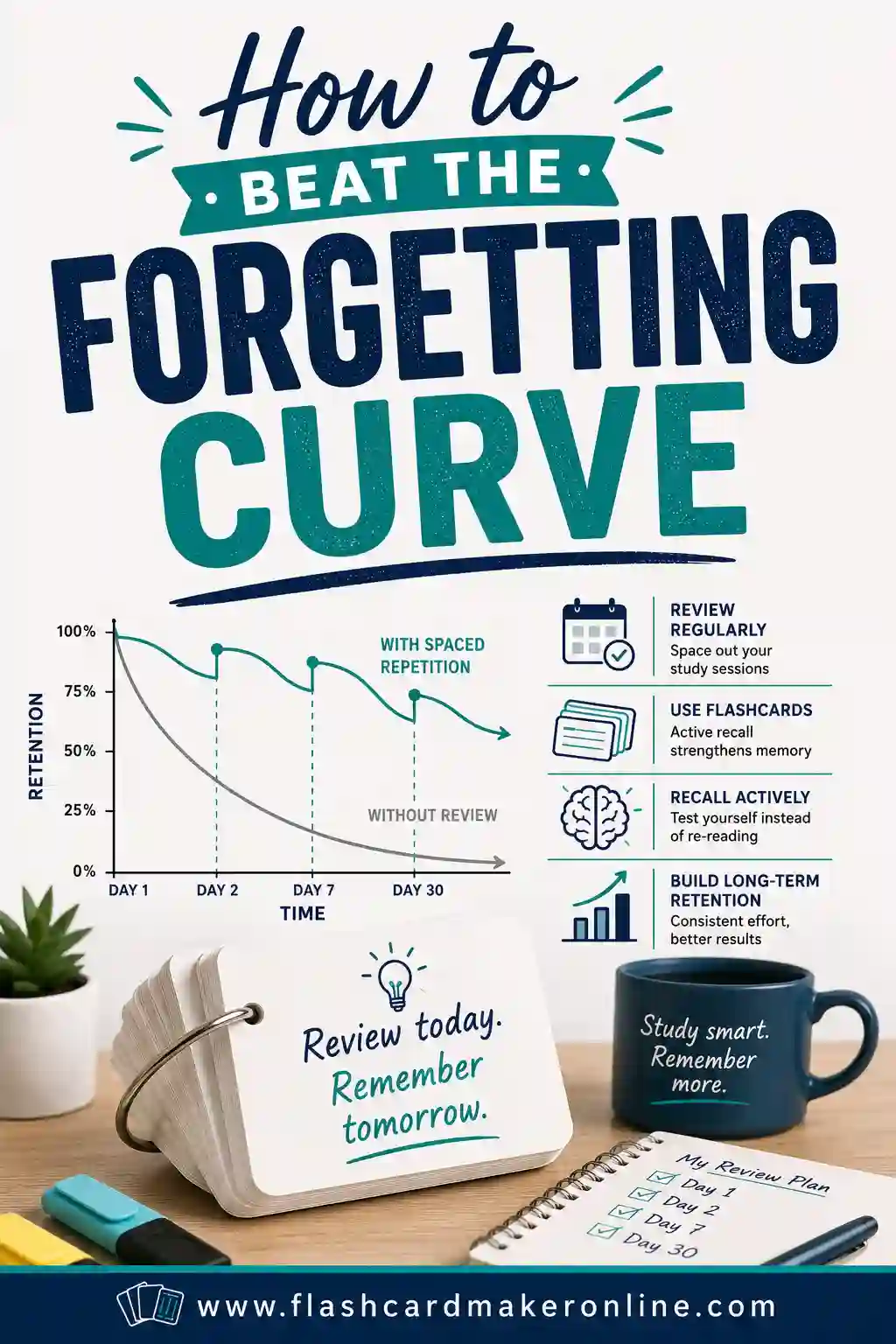
- Spaced repetition is the spacing difficulty on a schedule. See how to beat the forgetting curve for why gaps help.
- Active recall is the testing difficulty applied to every card.
- Interleaved practice is the mixing difficulty. We're publishing a separate full guide on it.
- Self-explanation and asking "why" add effort of a different kind: connecting new facts to what you know. Those overlap with the elaborative interrogation and Feynman technique methods.
For a broader list of methods that use these principles, see our memory techniques for studying.
Put desirable difficulties to work with your own cards
The simplest way to start is to make flashcards for what you need to learn, then use them the hard way: answer before you flip, mix your decks once you've seen each topic, and spread your reviews over several days. The free flashcard maker on our homepage lets you add your own words and pictures, study with flip cards on screen, and print your cards double-sided or as cut-out sheets, so you can shuffle real paper cards across topics or quiz yourself on screen.
Expect your study sessions to feel a bit harder. That's the good kind of hard.
Five Classic Experiments Side by Side
Each study below followed the same pattern: the easier condition looked better during practice, but the harder one won later. Here is how they compare.
| Study | Easy condition | Harder condition | Result on the later test |
|---|---|---|---|
| Shea and Morgan (1979) | Movement patterns practiced in blocks | Patterns practiced in random order | Ten days later, the random-order group did far better |
| Kerr and Booth (1978) | Beanbag throws at one fixed distance | Throws at closer and farther targets | Varied-practice kids did better at the fixed distance, in both age groups |
| Rohrer and Taylor (2007) | Solid-shape problems in blocks | Problems mixed together | 63 percent correct vs. 20 percent a week later |
| Roediger and Karpicke (2006) | Restudying passages | Taking recall tests | Restudying won at five minutes; testing won at two days and one week |
| Kornell, Hays and Bjork (2009) | Reading the question and answer together | Trying to answer first, even when most attempts failed | Failed attempts still improved learning compared with just reading |
Frequently Asked Questions
What are desirable difficulties in learning?
Desirable difficulties are study conditions that slow down your progress during practice but improve how well you remember and use the material later. The term was coined by UCLA psychologist Robert Bjork in 1994. The best-known examples are spacing study sessions apart, interleaving different topics, testing yourself instead of rereading, and varying the conditions you practice under. They work because they make your brain retrieve, compare and reconstruct information, which builds stronger long-term memory than smooth, easy repetition does.
Who came up with the idea of desirable difficulties?
Robert A. Bjork of UCLA coined the term in 1994, building on a theory he developed with Elizabeth Ligon Bjork called the New Theory of Disuse, published in 1992. That theory separates a memory's storage strength, how deeply it is learned, from its retrieval strength, how easy it is to recall right now. The Bjorks later wrote a popular 2011 chapter on the topic and a 2020 article looking back on the research.
What is the difference between a desirable and an undesirable difficulty?
A desirable difficulty makes you do useful mental work, such as recalling an answer, comparing similar ideas, or producing a solution yourself. An undesirable difficulty just adds hassle without that work, such as a noisy room, tiny text, or being tested on material you were never taught. The Bjorks stress that even a normally helpful difficulty becomes undesirable if you lack the background knowledge to respond to it successfully, so the right level depends on what you already know.
Why does studying the easy way feel more effective?
Your sense of learning mostly reflects how easily things come to mind during the session. Rereading and blocked practice make material feel familiar and fluent, so you feel confident. But that ease reflects short-term retrieval strength, not lasting learning. Studies show people often rate the easier method as better even after their own test scores show the opposite. A 2019 Harvard physics study found students in more effortful classes learned more yet felt they had learned less.
Is interleaving always better than blocking?
Not always. Interleaving tends to help most when the items you are mixing are similar enough to confuse, such as related math problem types or look-alike concepts, because it trains you to tell them apart. It also works best after you have had at least a first pass through each topic. In a major 2013 review, Dunlosky and colleagues rated interleaved practice as moderate utility because the classroom evidence was still limited at the time.
How do I use desirable difficulties with flashcards?
Answer every card out loud or on paper before you flip it. Spread your reviews over several days instead of cramming. Once you have studied each topic, shuffle decks together so different subjects are mixed. Study in both directions, term to definition and definition to term. Keep cards you got right in rotation at longer gaps instead of retiring them after one correct answer. Every so often, review in a different place.
Does getting answers wrong really help you learn?
It can, as long as you see the correct answer afterward. In six experiments, Kornell, Hays and Bjork found that people who tried and failed to answer a question before seeing the answer learned it better than people who simply read the question and answer together. The effort of searching memory seems to prepare you to encode the answer. Without feedback, though, wrong guesses can stick, so always check the back of the card.
Do desirable difficulties work for kids?
Many of the classic findings, such as spacing and varied practice, have been shown in children, including a beanbag-throwing study with 8- and 12-year-olds. But in their 2020 article the Bjorks note that relatively little research has tested spacing with young children in real classrooms, and that differences in attention, memory and background knowledge at young ages may change what helps. For younger learners, keep difficulties gentle and make sure they can succeed with some effort.
How do I know if a difficulty is helping me?
Don't judge by how a session feels. Instead, test yourself after a delay of a few days on the material you studied, without looking at notes. If the harder method leads to better delayed recall than your usual method, it is working for you. If you are getting almost nothing right even with effort, the task may be too hard for your current knowledge, and you should step back to an easier first pass before adding challenge.
Sources
We checked every source below while writing this guide. Last reviewed October 30, 2026, by Joan Ramos.
- Making Things Hard on Yourself, But in a Good Way: Creating Desirable Difficulties to Enhance Learning (Bjork & Bjork, 2011) (Bjork Learning and Forgetting Lab, UCLA)
- Desirable Difficulties in Theory and Practice (Bjork & Bjork, 2020), Journal of Applied Research in Memory and Cognition (Bjork Learning and Forgetting Lab, UCLA)
- Learning concepts and categories: is spacing the 'enemy of induction'? (Kornell & Bjork, 2008), Psychological Science (PubMed, US National Library of Medicine)
- Test-enhanced learning: taking memory tests improves long-term retention (Roediger & Karpicke, 2006), Psychological Science (PubMed, US National Library of Medicine)
- Unsuccessful retrieval attempts enhance subsequent learning (Kornell, Hays & Bjork, 2009) (PubMed, US National Library of Medicine)
- Distributed practice in verbal recall tasks: A review and quantitative synthesis (Cepeda et al., 2006), Psychological Bulletin (PubMed, US National Library of Medicine)
- Improving Students' Learning With Effective Learning Techniques (Dunlosky et al., 2013), Psychological Science in the Public Interest (PubMed, US National Library of Medicine)
- Measuring actual learning versus feeling of learning in response to being actively engaged in the classroom (Deslauriers et al., 2019), PNAS (PubMed Central, US National Library of Medicine)