Algebra Flashcards: Formulas, Properties and Problem Types Worth Memorizing
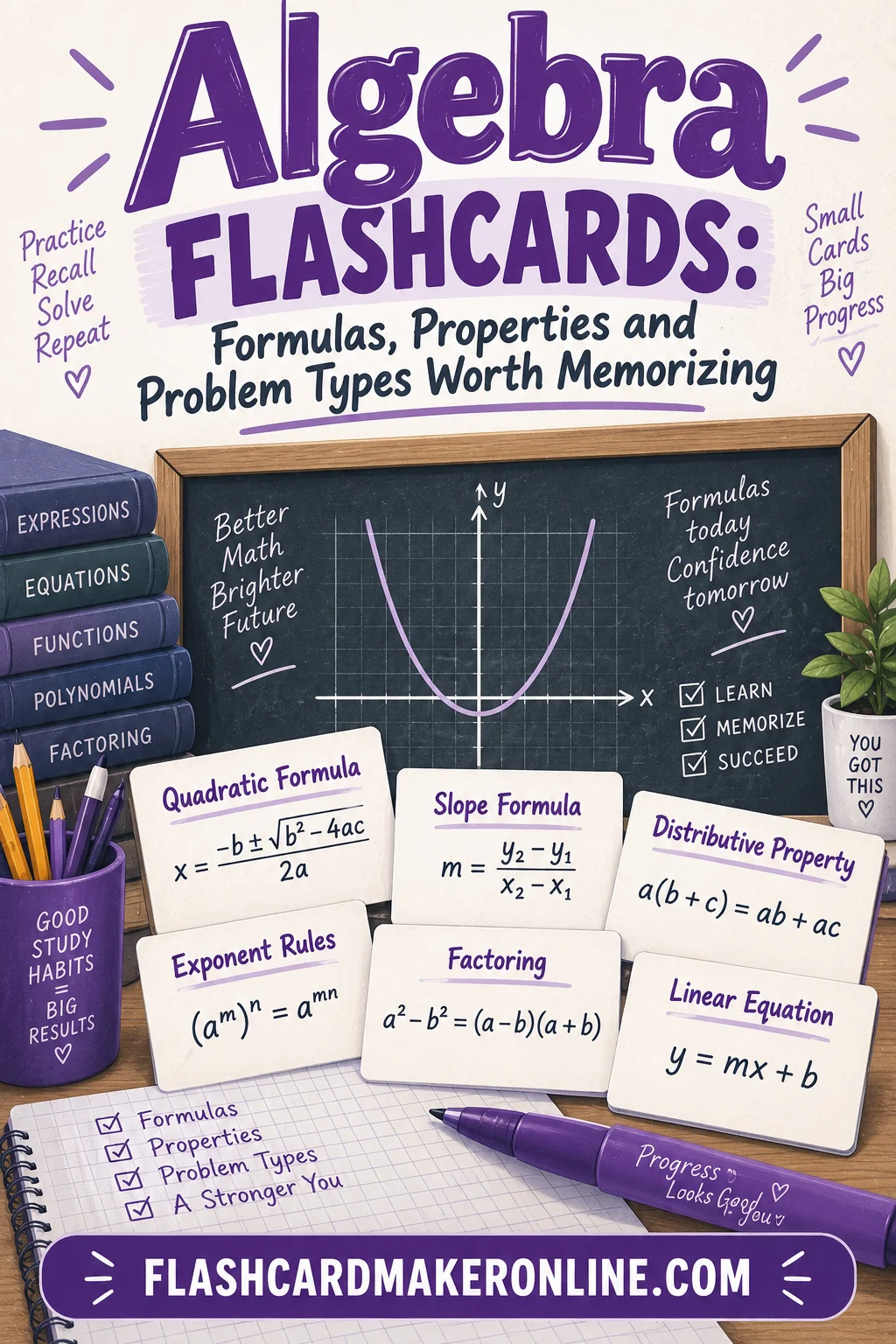
Algebra flashcards are excellent at one job and useless at another, and knowing the difference is worth more than any deck you could download. They are excellent at making rules instant — the quadratic formula, the difference of squares, what happens to an exponent when you raise a power to a power. They are useless at teaching you to solve a problem you have not seen before, because solving is a sequence of decisions and a card only holds a fact.
Students who understand that split use cards to clear the mental clutter, then spend their real study time on problems. Students who do not understand it end up with a beautiful deck, a shaky test grade, and no idea why. This guide covers what belongs on a card, what does not, dozens of concrete examples worth copying, and how to run cards and practice problems together so each one makes the other cheaper.
The Test for Whether Something Belongs on a Card
If the answer is always the same regardless of the problem, card it. If the answer depends on what the problem looks like, practice it.
The quadratic formula is always the quadratic formula. Card it. Whether a particular equation should be solved by factoring, completing the square, or the formula depends entirely on the equation in front of you. That is a judgment, and judgment is built by doing twenty problems, not by flipping a card twenty times.
Here is the split applied across a typical algebra course:
| Card it (fixed facts) | Practice it (situational decisions) |
|---|---|
| The quadratic formula | Choosing which solving method to use |
| a² − b² = (a + b)(a − b) | Spotting that a messy expression is a difference of squares |
| Slope formula, point-slope form | Setting up an equation from a word problem |
| Exponent and logarithm rules | Simplifying a four-layer nested expression |
| The definition of a function | Determining whether a specific relation is one |
| Special right triangle ratios | Deciding what to do when a problem gives you only two sides |
| Vertex form and what h and k do | Graphing a transformed function from scratch |
| The vocabulary: coefficient, degree, radicand | Interpreting an answer in the context of the problem |
There is a middle category worth naming: pattern recognition. Recognizing that x² + 6x + 9 is a perfect square trinomial sits between the two columns. You can card the pattern itself, and you should, but the recognition only becomes fast after you have seen it in the wild thirty times. Cards prime it. Problems install it.
Formula Cards Worth Making
These are the fixed facts. Write them front-to-back and back-to-front, because on a test you sometimes need to go from the name to the formula and sometimes from the shape of an equation to the name.
Linear and coordinate geometry
Front: Slope formula Back: m = (y₂ − y₁) / (x₂ − x₁) — the change in y over the change in x between any two points on the line.
Front: Point-slope form, and when you'd use it Back: y − y₁ = m(x − x₁). Use it when you have one point and a slope, which is the most common way a line is handed to you.
Front: Distance formula Back: d = √[(x₂ − x₁)² + (y₂ − y₁)²] — the Pythagorean theorem wearing a coordinate costume.
Front: Midpoint formula Back: ((x₁ + x₂)/2, (y₁ + y₂)/2) — average the x's, average the y's.
Quadratics
Front: The quadratic formula Back: x = [−b ± √(b² − 4ac)] / 2a, for ax² + bx + c = 0.
Front: The discriminant, and what each case means Back: b² − 4ac. Positive → two real solutions. Zero → one repeated real solution. Negative → two complex solutions, no x-intercepts.
Front: Vertex of a parabola from standard form Back: x = −b/2a, then substitute back to get y. The axis of symmetry is the vertical line through that x.
Front: Vertex form, and what each letter does Back: y = a(x − h)² + k. Vertex is (h, k). |a| > 1 stretches vertically, |a| < 1 compresses, negative a flips it downward. Note the minus sign inside — h = 3 means the vertex sits at x = +3.
Sequences and growth
Front: Arithmetic sequence, nth term Back: aₙ = a₁ + (n − 1)d, where d is the common difference you add each step.
Front: Geometric sequence, nth term Back: aₙ = a₁ · r^(n−1), where r is the common ratio you multiply by each step.
Front: Exponential growth and decay Back: y = a(1 + r)^t for growth, y = a(1 − r)^t for decay, where a is the starting amount, r the rate as a decimal, t the number of periods.
Factoring Patterns: The Highest-Value Cards in Algebra
Factoring is where card-based recall pays off most, because every pattern you can spot in two seconds is a problem you do not have to grind through.
Front: Difference of squares Back: a² − b² = (a + b)(a − b). Example: x² − 49 = (x + 7)(x − 7). There is no sum-of-squares equivalent over the real numbers.
Front: Perfect square trinomial Back: a² + 2ab + b² = (a + b)², and a² − 2ab + b² = (a − b)². Check: is the first term a square, the last term a square, and the middle term twice the product of their roots?
Front: Sum of cubes Back: a³ + b³ = (a + b)(a² − ab + b²). Example: x³ + 8 = (x + 2)(x² − 2x + 4).
Front: Difference of cubes Back: a³ − b³ = (a − b)(a² + ab + b²).
Front: Factoring x² + bx + c Back: Find two numbers that multiply to c and add to b. If c is positive both share b's sign; if c is negative they have opposite signs and the larger matches b.
Front: Factoring ax² + bx + c when a ≠ 1 Back: Multiply a·c, find two numbers multiplying to a·c and adding to b, split the middle term into those two, then factor by grouping.
Add a card that lists the factoring order of operations, because the most common factoring mistake is not a wrong pattern but a skipped step: always pull out the greatest common factor first, then count terms — two terms means look for a difference of squares or cubes, three terms means a trinomial method, four terms means try grouping — then check whether anything factors again.
Exponent and Logarithm Rules
These are pure card material. They are arbitrary in the sense that you cannot reason them out mid-test, and they appear constantly.
Exponent rules
| Rule | Statement | Quick example |
|---|---|---|
| Product | xᵃ · xᵇ = x^(a+b) | x³ · x⁵ = x⁸ |
| Quotient | xᵃ / xᵇ = x^(a−b) | x⁷ / x² = x⁵ |
| Power of a power | (xᵃ)ᵇ = x^(ab) | (x²)⁴ = x⁸ |
| Power of a product | (xy)ᵃ = xᵃyᵃ | (2x)³ = 8x³ |
| Zero exponent | x⁰ = 1, for x ≠ 0 | 47⁰ = 1 |
| Negative exponent | x^(−a) = 1 / xᵃ | 2^(−3) = 1/8 |
| Fractional exponent | x^(a/b) = ᵇ√(xᵃ) | 8^(2/3) = 4 |
Make a separate card for the two traps: (x + y)ᵃ does not equal xᵃ + yᵃ, and a negative exponent does not make a number negative, it makes it a reciprocal. Both errors are so common that they deserve their own cards phrased as "true or false."
Logarithm rules
Front: What does log_b(x) = y mean? Back: b^y = x. A logarithm answers the question "what exponent do I put on b to get x?"
Front: Product, quotient and power rules for logs Back: log(mn) = log m + log n; log(m/n) = log m − log n; log(mᵖ) = p · log m. Multiplication becomes addition, division becomes subtraction, exponents come out front.
Front: Change of base formula Back: log_b(x) = log(x) / log(b), in any base your calculator supports.
Front: log(1) and log_b(b) Back: log(1) = 0 in every base, because b⁰ = 1. log_b(b) = 1, because b¹ = b.
Procedural Steps Worth Automating
Some things are not formulas but sequences, and a sequence you have to reinvent every time burns time. Card the sequence itself.
Front: Steps to solve a system by substitution Back: 1) Solve one equation for one variable. 2) Substitute that expression into the other equation. 3) Solve the resulting single-variable equation. 4) Back-substitute for the second variable. 5) Check in both original equations.
Front: Steps to complete the square for x² + bx Back: Take half of b, square it, add and subtract it. x² + 6x becomes x² + 6x + 9 − 9 = (x + 3)² − 9.
Front: What flips an inequality sign? Back: Multiplying or dividing both sides by a negative number. Adding and subtracting never flip it.
Front: Solving a rational equation — the step people forget Back: After clearing denominators and solving, check every answer against the original. Any solution that makes a denominator zero is extraneous and gets thrown out.
Front: Steps to find the inverse of a function Back: Swap x and y, solve for y, rewrite as f⁻¹(x). Then verify with f(f⁻¹(x)) = x.
Front: Domain restrictions to check every time Back: Denominators cannot be zero. Even roots cannot contain negatives. Logarithm arguments must be strictly positive.
That last one is a genuinely high-value card. Domain errors cost points on problems students otherwise solved correctly.
Where Flashcards Stop and Practice Begins
A flashcard can hold the quadratic formula. It cannot hold the decision that this particular equation is best handled by factoring. That decision is what tests actually measure, and it is trained only by working problems.
The concrete difference: if you flip a card that says "difference of squares" and recite the pattern, you have practiced recall. If you look at 9x⁴ − 25y² and recognize it as a difference of squares whose roots are 3x² and 5y, you have practiced the thing the test asks for. The second is harder, slower, and the only one that transfers.
There is also a subtler problem. Cards create a false sense of fluency because the front of the card tells you what topic you are in. Real problems do not announce themselves. On a mixed review, you have to decide whether you are looking at a factoring problem, an exponent problem, or a systems problem before you can start — and that recognition step is invisible to a deck.
How to Combine Cards and Problems
Run them on a cycle. The pattern that works looks like this:
| Stage | What you do | Why |
|---|---|---|
| 1. Learn | Read the section, work three examples with the book open | You cannot card what you do not understand |
| 2. Card | Write cards for the fixed facts you just met, in your own words | Writing is half the retention |
| 3. Drill | 5 minutes of cards until the rules come without hesitation | Removes the lookup cost from problem solving |
| 4. Practice | 10–15 problems with no notes, no card deck | Trains recognition and decision-making |
| 5. Diagnose | For every miss, decide: forgotten rule or wrong approach? | The two failures need different fixes |
| 6. Route | Forgotten rule → add or fix a card. Wrong approach → do more of that problem type | Sends each error to the tool that fixes it |
Step 5 is the one that makes the whole system work. Most students look at a wrong answer, see the correct one, say "oh right," and move on. Instead, ask which failure it was. If you could not remember that a negative exponent means a reciprocal, that is a card problem and a card fixes it in a week. If you remembered every rule but chose the wrong one, no card will help — you need ten more problems of that shape.
Keep the cards short and rebuild them as the course moves. A flashcard maker that lets you tag by unit is useful here, because algebra is cumulative in a way most subjects are not: the exponent rules you learned in September show up inside logarithm problems in February and inside rational expressions in April. Retire nothing. Rotate old units back in for five minutes a week and you will never have to relearn them.
One last habit worth building: keep a small pile of mistake cards. Every time you make an error twice, write a card whose front states the trap and whose back states the fix. "When I distribute a negative across parentheses, what do I always forget?" is a strange-looking card and one of the most valuable ones you will own.
Frequently Asked Questions
How many algebra flashcards should I have? Far fewer than you would for a vocabulary-heavy subject — roughly 80 to 150 for a full year of Algebra 1 or 2. Algebra has a small number of genuinely fixed facts, and a deck that grows past 200 usually means you have started carding problems, which cards cannot teach.
Do flashcards help with word problems? Only indirectly. Cards can hold the setup phrases that recur, like distance equals rate times time or "consecutive integers means n, n+1, n+2," but translating a paragraph into an equation is a judgment skill that needs actual word problems worked start to finish.
Should I write out the full derivation on the back of the card? No. Keep backs under fifteen seconds of reading. If you want to understand where the quadratic formula comes from, work through completing the square on general form once in your notebook, then card only the finished formula.
Are premade algebra decks worth using? Use them as a checklist to find rules you forgot to card, then write your own versions. The act of phrasing a rule yourself is a large share of the benefit, and someone else's deck will be built around a different textbook's notation.