The Generation Effect: Why Making Your Own Answers Improves Memory
The generation effect is the finding that you remember information better when you produce it yourself than when you simply read it. If you fill in "hot and c___" and come up with "cold," you're more likely to remember "cold" later than if you'd just read "hot and cold." It's one of the most reliable results in memory research, and it's the reason that making your own flashcards, and making your own answers on them, tends to beat flipping through someone else's deck.
This guide explains what the generation effect is, where it came from, how big it really is, why it works, when it stops working, and how to build it into the way you study. There are worked examples, two comparison tables and a short experiment you can run on yourself tonight.
What the generation effect means in plain words
Psychologists use the word "generate" in a narrow way. It means you produce the target information from a cue, instead of having it handed to you. The cue might be a definition, a fragment of a word, an opposite, a question or a picture. The point is that your brain has to do a little work to arrive at the answer.
Here's a simple contrast:
- Read condition: You see "rapid – fast" and read both words.
- Generate condition: You see "rapid – f___" plus the rule "synonym," and you come up with "fast" yourself.
In both cases you end up looking at the same word, "fast." The only difference is whether you produced it or received it. Again and again, people in the generate condition remember more.
That sounds small, but it matters for everyday studying. A lot of popular study habits are "read conditions" in disguise: rereading a textbook, looking over highlighted notes, watching a video a second time, or flipping a premade flashcard over before you've really tried to answer. A lot of stronger habits are "generate conditions": answering questions before checking, writing a card in your own words, or explaining a step before you look at the worked solution.
The 1978 study that named the generation effect
The name comes from a paper by Norman Slamecka and Peter Graf at the University of Toronto, "The Generation Effect: Delineation of a Phenomenon," published in 1978 in the Journal of Experimental Psychology: Human Learning and Memory. Earlier researchers had poked at the idea that "learning by doing" helps, but Slamecka and Graf pointed out that the older studies were messy. In some, the people who made up their own answers also chose different words from the people who read, so you couldn't tell whether generating helped or the words were just easier.
Their fix was clever. They made generation constrained, so that everyone ended up with exactly the same words. Each card gave a rule, a cue word and the first letter of the answer. With the rule "synonym," the cue "rapid" and the letter "f," almost everyone produces "fast." People in the read condition saw the full pair, "rapid – fast," instead.
In their first experiment, 24 introductory psychology students worked through 100 cards, 20 for each of five rules. The paper gives an example for each rule:
- Associate: lamp – light
- Category: ruby – diamond
- Opposite: long – short
- Synonym: sea – ocean
- Rhyme: save – cave
Some students got 4 seconds per card, and others went at their own pace. Afterward, everyone took a recognition test: for each set of three words, circle the one you saw. Generation errors were rare, with a median error rate of only 6%, so the task really did produce the intended words.
Across five experiments, the result was the same. In the authors' own summary, performance in the generate condition was better than in the read condition in every case. That held for recognition, for free recall (write down every word you can remember) and for cued recall, and it held across rules, timing and designs. The advantage was specific to the words people produced; generating "fast" didn't make them remember the cue word "rapid" any better on the recognition test. The authors concluded that the effect was real and that it posed "an interesting interpretative problem," which researchers have been working on ever since.
How big is the generation effect? Two meta-analyses
One study can be a fluke. A meta-analysis is a study of studies: researchers pull together results from many experiments and estimate the typical size of an effect. The generation effect has had two big ones.
Bertsch and colleagues, 2007
Sharon Bertsch, Bryan Pesta, Richard Wiscott and Michael McDaniel combined 445 effect sizes from 86 studies, published in Memory & Cognition. They found an overall effect size of about 0.40, which they described as a benefit of almost half a standard deviation for generating over reading.
What does "half a standard deviation" mean in practice? A standard deviation is a measure of how spread out scores are. Picture a class where test scores spread out in the usual bell shape. A shift of 0.4 standard deviations would move a student who'd otherwise score right in the middle of the class (the 50th percentile) to about the 66th percentile, which is what a standard bell-curve table gives for 0.4. It's not magic, but for a technique that costs almost nothing, it's a meaningful edge. They also found that the size of the effect varied a lot depending on the details, which is useful because it tells us when to expect the most benefit.
McCurdy and colleagues, 2020
M. P. McCurdy, Wolfgang Viechtbauer and colleagues took a bigger and more theory-focused look in Psychonomic Bulletin & Review. They analyzed 126 articles covering 310 experiments and 1,653 estimates, and used them to test seven leading theories of why the effect happens. They looked separately at memory for the item itself and memory for its context (such as where or how it appeared). Their key practical finding: generation constraint, meaning how tightly the task limits what you can produce, significantly changes the size of the effect. Some theories held up and others didn't.
Here's a quick map of the main studies discussed in this article.
| Study | What they did | Main takeaway |
|---|---|---|
| Slamecka & Graf (1978) | Five experiments; people generated words from a rule, cue and first letter, or read the full pair | Generated words were remembered better on every test type they used |
| Bertsch et al. (2007) | Meta-analysis of 445 effect sizes from 86 studies | Average benefit of about 0.40 standard deviations, with big variation by condition |
| Richland, Kornell & Kao (2009) | Students tried to answer questions about a reading before seeing it | Even failed attempts improved later learning compared with extra reading time |
| Karpicke & Zaromb (2010) | Compared "complete this fragment" with "use this fragment to recall a studied word" | Deliberate recall beat simple generation on later tests |
| McCurdy et al. (2020) | Meta-analysis of 126 articles, 310 experiments | How tightly generation is constrained changes the size of the effect |
| Pan et al. (2023) | College students made their own digital flashcards or used premade ones | Making your own cards generally led to better learning |
Why generating helps: the leading explanations
Nobody has a single, settled answer for why the generation effect happens, and the 2020 meta-analysis found support for some accounts but not others. Here are the main ideas in plain language. They aren't mutually exclusive; several can be true at once.
1. Generating makes you process the item more deeply
To come up with "short" from "long – s____," you have to think about what "long" means and search for its opposite. Reading "long – short" lets you skim. Working through the meaning creates more connections, and more connections give you more ways to find the memory later.
2. Generating sharpens what makes each item unique
Researchers call this item-specific processing: paying attention to the features that make one thing different from everything else. When you generate a word, you notice its particular sound, spelling and meaning in a way you don't when you read it. That distinctiveness helps you tell later, "Yes, I definitely saw that one."
3. The item-order trade-off
This explanation, described by Jeffrey Karpicke and Franklin Zaromb in their review of the research, comes from Nairne and colleagues. It says generating boosts memory for individual items but disrupts memory for the order in which they came. That trade-off explains a puzzling pattern we'll come back to: the generation effect is strong when a list mixes generated and read items, but it can vanish when a whole list is generated.
4. Effort and the "desirable difficulty" idea
Generating takes effort, and effortful processing often leads to more durable memories. This connects to the broader idea that some kinds of difficulty during study pay off later. (We cover that bigger idea in our article on desirable difficulties.) But effort alone isn't the whole story, because some hard tasks don't help much at all.
When the generation effect shrinks or disappears
The generation effect is robust, but it's not unconditional. Knowing the limits helps you avoid wasting time.
Whole lists versus mixed lists
When people study a mixed list (some items generated, some read) and then try to recall everything, the generated items usually win. But when one group generates every item and a different group reads every item, the free-recall advantage often shrinks or disappears, and sometimes reading even comes out ahead. Karpicke and Zaromb summarize this research and explain it with the item-order trade-off: a fully generated list gets the item boost but loses the order information that helps free recall. For students, the lesson is not "don't generate." It's that generation mostly strengthens memory for specific facts, so pair it with something that gives you structure, such as an outline, a concept map or a well-organized deck.
When you can't generate the answer
If the cue is so vague that you can't come up with anything, you're not generating, you're guessing. The 2020 meta-analysis found that constraint matters, and in everyday terms the sweet spot is a cue that's hard enough to require thought but specific enough that you can usually land on the right answer. "Mitochondria – the p________ of the cell" is a good generation cue. "Mitochondria – ?" with no other context is fine only after you've studied the material.
When the material is meaningless to you
Generation works by connecting new information to things you already know. If the items have no meaning for you, there's nothing to connect them to. That's one reason why beginners in a subject often need a short "read and understand" phase before generation exercises pay off.
When generation costs too much time
Generating is slower than reading. In the lab, studies usually give both groups similar time, but in real life you have a fixed amount of study time. If making an elaborate set of cards eats all your time and leaves none for review, you lose. The good news, which we'll see below, is that at least one classroom-style study found that making your own cards still came out ahead even when the creation time came out of the study time.
Generation versus retrieval practice: related but not the same
If you've read about active recall, you might wonder whether the generation effect is just the testing effect with a different name. Both involve producing an answer instead of reading it. For years many researchers treated them as the same thing.
Karpicke and Zaromb tested this directly in four experiments published in the Journal of Memory and Language in 2010. Everyone first saw a list of target words. Then they saw fragments of those words. One group was told to complete each fragment with the first word that came to mind (generation). Another group was told to use the fragment as a cue to recall a word from the earlier list (retrieval). The cues were identical; only the instruction changed.
On the final tests of free recall and recognition, the recall group did better than the generate group. The authors concluded that what matters is retrieval mode: deliberately thinking back to what you learned produces stronger memories than producing the same answer without that intention.
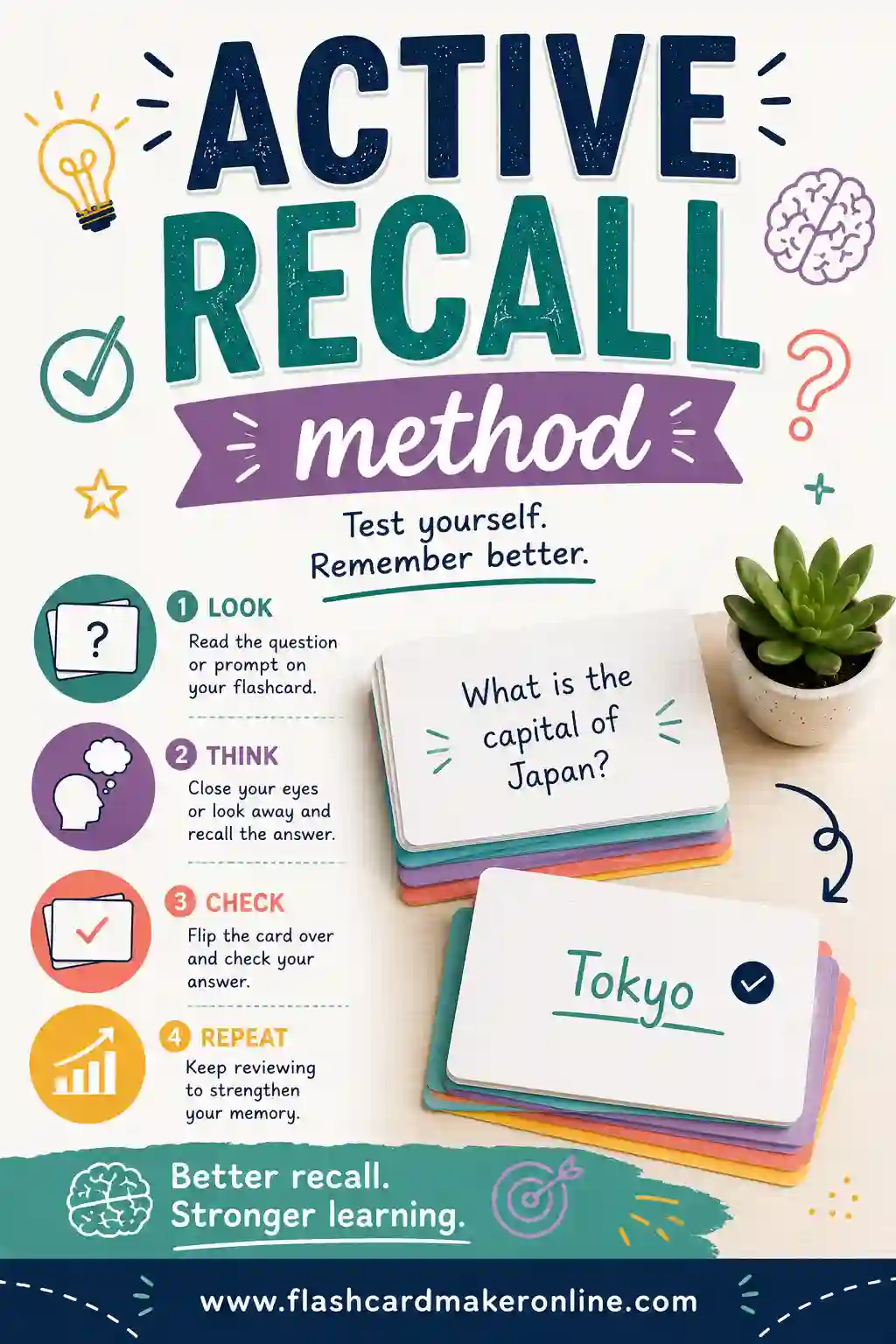
For flashcard users, this is a big deal. It means the best version of a flashcard isn't just "produce something." It's "try to remember what you studied." When you flip a card, don't just think of any answer that fits. Ask yourself, "What did I learn about this?" and try to pull the specific answer from memory. Generation gets the memory built; retrieval keeps it strong. Our guide on whether flashcards are effective covers the testing-effect research in more detail.
Getting it wrong first: the pretesting effect
Here's a surprising cousin of the generation effect. What if you try to generate an answer before you've learned it, and you get it wrong?
Lindsey Richland, Nate Kornell and Liche Sean Kao looked at this in five experiments published in the Journal of Experimental Psychology: Applied in 2009. Students read an essay about vision. In the test condition, they first tried to answer questions about concepts in the essay before reading it. In the comparison condition, they got extra time to read instead. To make sure the benefit wasn't just about knowing what to pay attention to, the researchers highlighted the tested concepts for both groups with italics or bold keywords.
The students who were tested first did better on the final test in every experiment, and this was true even when the researchers looked only at the questions students had gotten wrong on the pretest. A failed attempt to generate the answer made the later reading more effective.
The practical lesson is freeing: you don't have to know the answer to benefit from trying. Before you read a chapter, flip through the end-of-chapter questions and write a guess for each. Before you look at a new deck, try to answer a few cards cold. Then study, and check your guesses. Feedback is the key part. A wrong guess you never correct is just a wrong memory.
Should you make your own flashcards? What the research says
The generation effect is the main scientific reason to make your own flashcards instead of downloading a premade deck. When you make a card, you decide what's important, phrase the question, and write the answer in your own words. That's generation at every step.
Steven Pan and colleagues put this to the test with college students in a set of experiments published in the Journal of Applied Research in Memory and Cognition in 2023, titled "User-generated digital flashcards yield better learning than premade flashcards." As the title says, students who created their own cards generally learned more than students who studied premade cards, even though making the cards took up some of their study time. Not every experiment showed a difference, which is normal in research, but the overall pattern favored making your own.
There are some sensible caveats:
- Copying isn't generating. If you copy a definition word for word from the textbook onto a card, you've done very little generation. The benefit comes from choosing, paraphrasing and connecting.
- You still need to know what matters. A teacher's study guide, a syllabus or end-of-chapter objectives can help you pick the right concepts.
- Quality beats speed. A messy card with a wrong answer can teach you the wrong thing. Check your cards against the source.
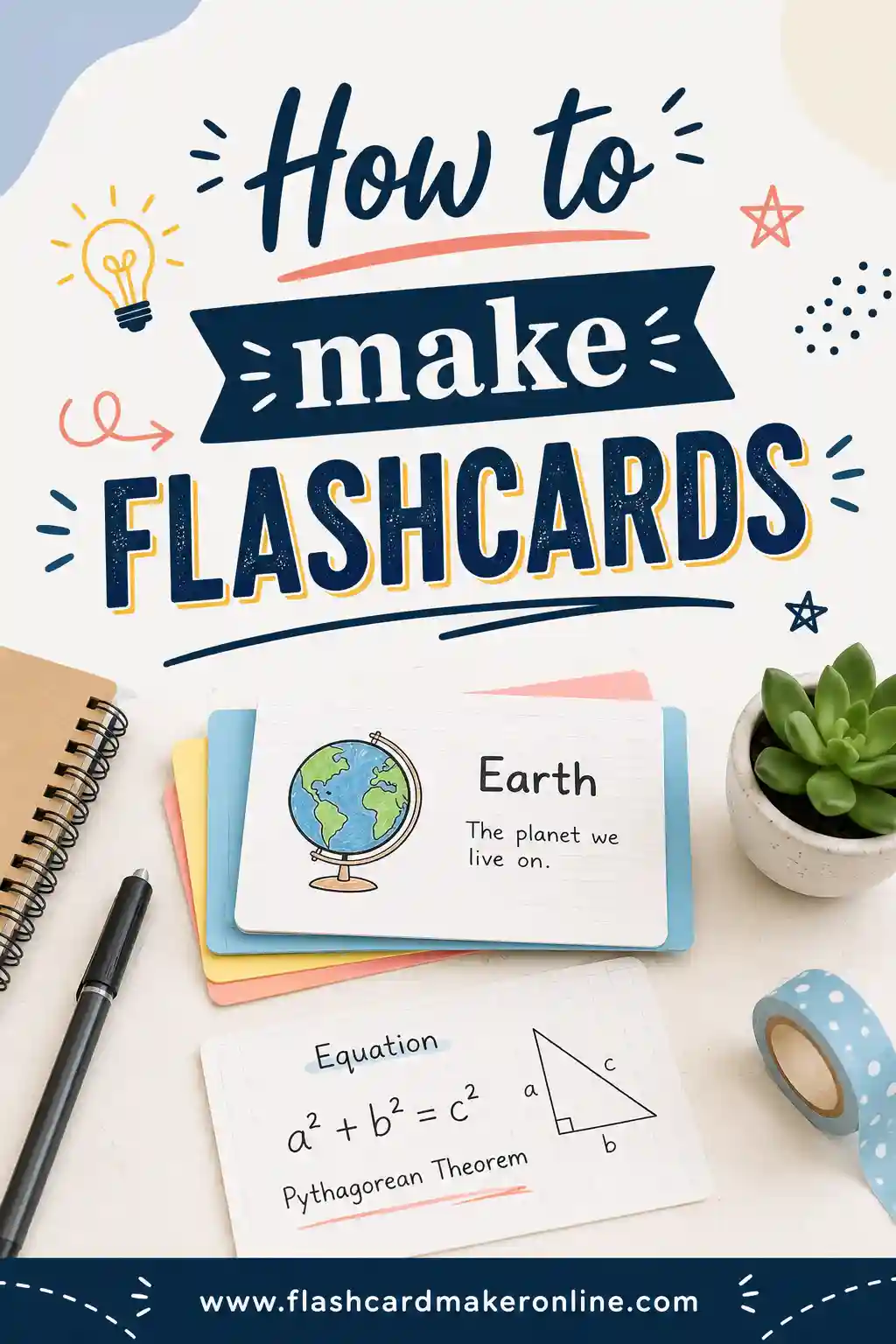
If you've never made your own deck before, our step-by-step guide on how to make flashcards covers the basics, and our article on handwritten flashcards looks at writing cards by hand.
How to use the generation effect with flashcards: step by step
Here's a practical routine that builds generation into every stage, from making cards to reviewing them.
- Read or listen once for understanding. Generation works best when the material means something to you. Get the big picture first.
- Close the book and list what you remember. Before you make a single card, write down the key ideas from memory. This is generation plus retrieval, and it shows you what you missed.
- Write each card in your own words. Rephrase definitions. Use your own examples. If the book says "photosynthesis converts light energy to chemical energy," your card might ask, "What kind of energy goes in and what kind comes out of photosynthesis?"
- Make the front a real cue, not a giveaway. The front should require you to produce the answer. Avoid fronts that contain most of the answer already.
- Add a partial cue for brand-new material. For the first few reviews, a first letter or a blank with a hint ("the p_______ of the cell") can help you generate successfully. Remove the hint once the card gets easy.
- Say or write the answer before flipping. Thinking "I know this one" doesn't count. Commit to an answer out loud or on scrap paper.
- Check, correct and note why. If you got it wrong, read the correct answer and say one sentence about why it's right.
- Space your reviews. Generation builds the memory, and spacing keeps it. Our guide to spaced repetition explains how.
The table below shows how to turn "read" versions of cards into "generate" versions.
| Subject | "Read" version (weak) | "Generate" version (stronger) |
|---|---|---|
| Vocabulary | Front: "ephemeral = lasting a very short time." Back: same. | Front: "Word starting with e- that means lasting a very short time." Back: "ephemeral," plus your own example sentence. |
| Biology | Front: "Mitochondria are the powerhouse of the cell." | Front: "Which organelle makes most of the cell's usable energy, and how would you explain that to a 10-year-old?" |
| History | Front: "The Stamp Act angered the colonists." Back: same. | Front: "Why did the Stamp Act anger colonists who weren't printers?" Back: your own two-sentence answer, checked against the book. |
| Math | Front: a solved equation with every step shown | Front: the equation only. Back: the steps. Solve it before you flip. |
| Languages | Front: "perro = dog" | Front: a picture of a dog. Back: "el perro," said aloud before you flip. |
| Chemistry | Front: "Na is sodium." | Front: "Symbol for sodium, and why isn't it S?" Back: "Na, from the Latin natrium." |
Worked examples by subject
The following examples are illustrative. The students are made up to show how the method looks in practice.
Example 1: Maya learns anatomy terms
Maya is starting an anatomy course and has to learn the bones of the arm. Her first instinct is to download a deck. Instead, she reads the chapter once, closes the book and sketches the arm from memory, labeling what she can. She gets the humerus and the radius but forgets the ulna and mixes up which forearm bone is on the thumb side.
She then makes her own cards. One card shows her own rough sketch with an arrow pointing to the thumb-side forearm bone and asks, "Name this bone." Another asks, "Which forearm bone forms the point of the elbow?" Because she wrote these questions after noticing her own mistakes, the cards target exactly what she didn't know. That's generation working twice: once when she drew the arm from memory, and again when she wrote the questions.
Example 2: Jordan studies for a history quiz
Jordan has a quiz on the causes of the American Revolution. Before reading the chapter, he spends five minutes writing guesses for the review questions at the end. He gets most of them wrong or vague. Then he reads the chapter, checks his guesses and corrects them in a different color. This is the pretesting effect in action. When he makes flashcards afterward, he phrases them as "why" questions: "Why did the Stamp Act anger colonists who weren't printers?" Generating an explanation, not just a date, gives him more to hold on to.
Example 3: Priya practices Spanish verbs
Priya's premade deck has cards like "hablar – to speak." She rewrites a few to require generation. The front now says, "Yo ______ (hablar) con mi abuela cada domingo." She has to produce "hablo" in context. On the back she writes the full sentence and a quick English translation. The card is still small and fast to review, but it makes her produce the form she'll need in a real conversation.
Example 4: Sam learns math formulas
Sam needs the quadratic formula. Rather than a card that shows the formula, he makes one that asks him to write it from scratch, and a second that gives a specific equation and asks him to solve it. He also makes a "derive it" card: "Where does the minus b come from when you complete the square?" He won't always get that last one, but trying to generate the reasoning makes the formula feel less like a random string of symbols.
Common mistakes when applying the generation effect
- Generating without checking. The benefit depends on getting to the right answer eventually. Always check and correct.
- Cues that are too open. "Tell me about World War I" is too broad for a flashcard. Break it into specific questions.
- Cues that give the answer away. "The capital of France is Pa___" is so easy it barely counts. Make the cue require some thought.
- Peeking too soon. Flipping the card after one second of "hmm" turns a generate card back into a read card. Give yourself a real attempt, then flip.
- Spending all your time making cards. Making cards is valuable, but reviewing them is where long-term memory gets built. Aim for a balance.
- Treating generation as a replacement for understanding. Generation strengthens memory for specific facts. You still need to understand how the facts fit together.
- Making every card the same type. Mix definition cards, example cards, "why" cards and picture cards. Variety helps you think about ideas from more than one angle.
Where the generation effect fits among study strategies
It helps to see how the generation effect relates to other well-known strategies. In a large review published in Psychological Science in the Public Interest in 2013, John Dunlosky and colleagues rated 10 popular learning techniques. Practice testing and distributed practice got the top "high utility" rating. Elaborative interrogation, self-explanation and interleaved practice were rated "moderate." Summarization, highlighting, the keyword mnemonic, imagery for text and rereading were rated "low."
Notice a pattern. The high- and moderate-rated techniques all ask you to produce something: an answer, an explanation, a reason. Rereading and highlighting, the low-rated ones, mostly ask you to look at material that's already there. The generation effect is part of why that pattern exists. Producing beats viewing.
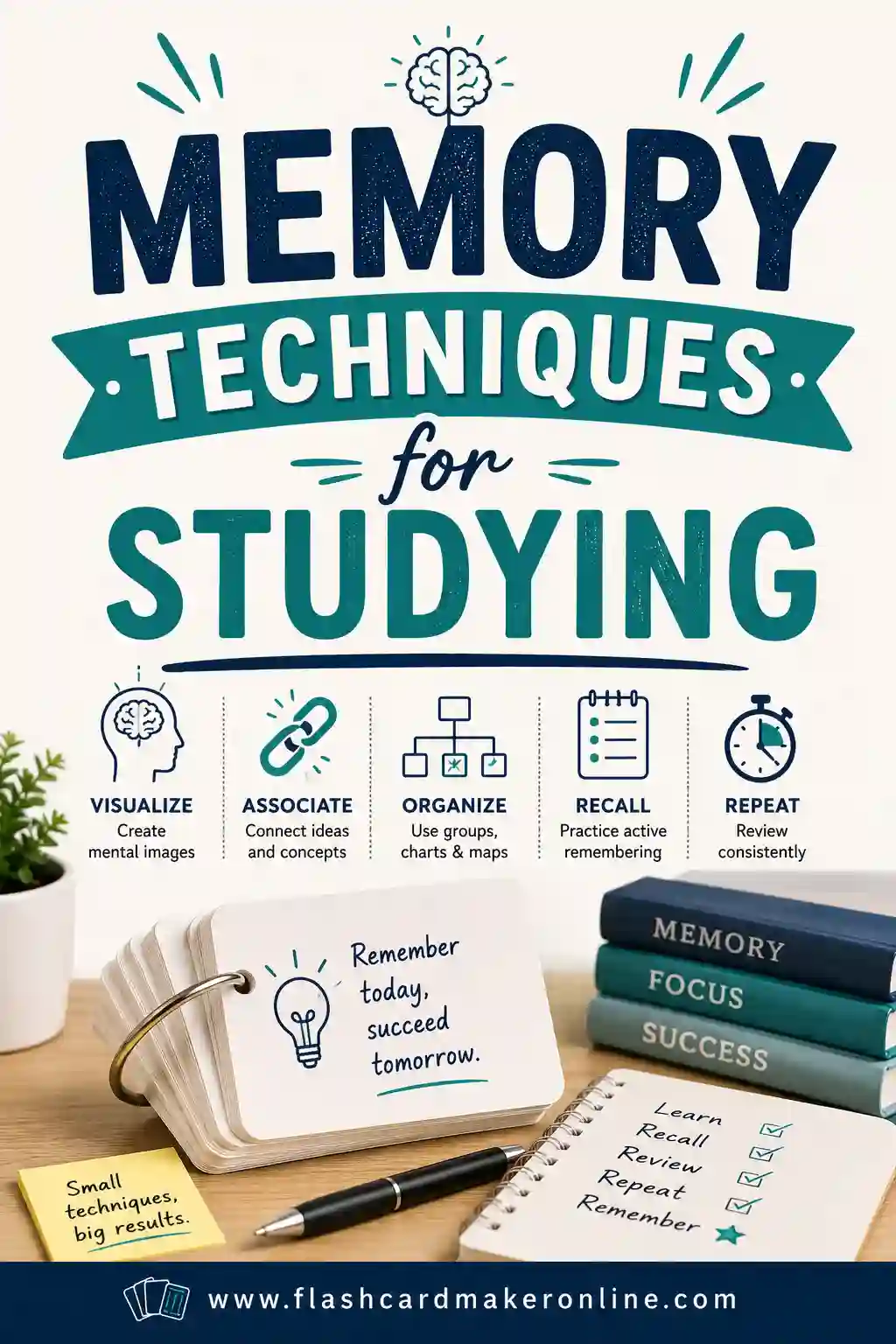
That also explains why flashcards can be either very effective or nearly useless depending on how you use them. A card you answer honestly before flipping is a small generation and retrieval exercise. A card you flip immediately is a tiny rereading session. Our tips on how to make flashcards stick and our guide to memory techniques for studying show how to combine these strategies.
Ideas for teachers and parents
You can build generation into lessons and homework without changing much. These ideas follow directly from the research above.
- Start with a quick guess. Open a lesson with two or three questions students try to answer before you teach. Tell them wrong answers are expected. Then come back to the questions at the end so everyone corrects their guess.
- Hand out half-finished cards. Give students card fronts and let them write the backs in their own words, or give them backs and have them write the questions. Either way, they produce something.
- Use partial words for young learners. For spelling or sight words, a card with one missing letter ("c_t" with a picture of a cat) asks a child to generate without overwhelming them.
- Ask for examples, not just definitions. "Give a new example of a mammal that lives in water" requires more generation than "define mammal."
- Swap decks. Students make cards, then trade and quiz each other. Writing the cards is generation; answering a classmate's cards is retrieval practice.
- Keep feedback fast. Generation only helps if wrong answers get corrected. Go over the answers the same day.
One caution: struggling for too long is discouraging, especially for younger kids or anyone new to a subject. If a student can't produce anything after a fair try, give a hint, then the answer, and move on. The goal is effortful success most of the time, not constant failure.
Try it yourself: a 20-minute generation effect experiment
You don't have to take the research on faith. Here's a small experiment you can run with a friend, a family member or yourself. It's informal, so don't expect lab-quality results, but it's a good way to feel the effect.
- Make 20 word pairs. Use simple opposites and synonyms, such as hot – cold, begin – start, fast – slow, large – big. Write them on 20 cards.
- Split them into two piles of 10. For one pile, write the cue word and only the first letter of the answer on the front (hot – c). For the other pile, write the full pair (begin – start).
- Shuffle the piles together. Go through all 20 cards once, spending about 4 seconds each. For the "first letter" cards, say the answer out loud. For the full-pair cards, read both words aloud.
- Take a 10-minute break. Do something unrelated so you're not rehearsing.
- Write down every answer word you can remember in any order.
- Count. How many of the generated words did you remember, and how many of the read words?
Many people find they remember more of the generated words. If you don't, that's fine too. Small, informal tests are noisy, and the research shows the effect varies by situation. Try it again a day later, or with harder material, and see what happens.
Make your own cards and put the generation effect to work
The generation effect boils down to a simple habit: produce it before you see it. Write your own questions, phrase answers in your own words, guess before you read, and always say an answer before you flip. Then check yourself and come back to the card later.
If you want an easy place to start, our free flashcard maker lets you add your own words and pictures, study with flip cards on screen, and then print your deck double-sided or as cut-out sheets. Writing the cards yourself is where the generation effect kicks in, so take your time with the fronts and make every card ask you to produce something.
Reading, Generating, Recalling and Copying Compared
These ways of handling an answer sound alike but work differently. This table shows what you do in each and what the article says about the result.
| Approach | What you do | What the article says |
|---|---|---|
| Reading | See the full pair, such as "rapid – fast" | People in the generate condition remember more than people in the read condition |
| Generating | Produce the answer from a cue, such as "rapid – f___" | Better recognition and recall; works best when the cue is hard enough to need thought but not so vague that you're guessing |
| Deliberate recall | Try to remember what you studied | The recall group beat the generate group on final tests (Karpicke and Zaromb, 2010) |
| Guessing before you learn | Try to answer questions before reading the essay | Failed attempts still led to better final scores than reading alone |
| Copying a definition | Write the textbook wording onto a card word for word | Very little generation; the benefit comes from choosing, paraphrasing and connecting |
Frequently Asked Questions
What is the generation effect in simple terms?
The generation effect is the finding that you remember information better when you produce it yourself than when you just read it. If you see 'hot and c___' and come up with 'cold,' you'll usually remember 'cold' better than if you had simply read 'hot and cold.' Psychologists Norman Slamecka and Peter Graf named the effect in 1978, and it has been tested in hundreds of experiments since. For students, it means that answering, explaining and writing in your own words beats rereading and looking over notes.
Who discovered the generation effect?
Norman Slamecka and Peter Graf of the University of Toronto named and carefully tested the generation effect in a 1978 paper in the Journal of Experimental Psychology: Human Learning and Memory. Earlier researchers had looked at whether making up your own answers helps memory, but their studies mixed up generation with other differences, such as which words people chose. Slamecka and Graf fixed that by giving everyone a rule, a cue word and a first letter, so the generate group and the read group ended up with exactly the same words.
How strong is the generation effect?
A 2007 meta-analysis by Bertsch and colleagues combined 445 effect sizes from 86 studies and found an average benefit of about 0.40 standard deviations for generating over reading. That's almost half a standard deviation, a meaningful but not enormous boost. The size varies a lot with the details, such as how the memory is tested and how tightly the task limits what you can produce. A 2020 meta-analysis of 126 articles found that this constraint significantly changes how big the effect is.
Is the generation effect the same as active recall or the testing effect?
They are closely related but not identical. Both involve producing an answer instead of reading it. In 2010, Karpicke and Zaromb gave people the same word fragments but different instructions: one group completed them with any word that came to mind, while the other used them to recall words they had studied earlier. The deliberate recall group remembered more later. So trying to remember what you learned seems to add something beyond simply producing an answer. Good flashcard practice uses both.
Is it better to make your own flashcards or use premade ones?
Research generally favors making your own. A 2023 set of experiments by Steven Pan and colleagues found that college students who created their own digital flashcards usually learned more than students who studied premade decks, even though making cards used some of their study time. The benefit comes from choosing what matters, phrasing questions and writing answers in your own words. Copying text word for word onto a card gives you much less of that benefit, so paraphrase and add your own examples.
Does guessing wrong before studying hurt your memory?
Usually not, as long as you get the right answer afterward. In 2009, Richland, Kornell and Kao had students try to answer questions about a reading before they read it. Those students did better on the final test than students who got extra reading time instead, even on questions they had gotten wrong at first. Trying to generate an answer seems to prepare your memory for the correct one. The key is feedback: always check your guess and fix it, so you don't keep the wrong answer.
When does the generation effect not work?
It can shrink or disappear in a few situations. When one group generates a whole list and another reads a whole list, the free-recall advantage is often small or absent, possibly because generating helps memory for individual items but disrupts memory for their order. It also helps less when you can't produce the answer at all, when the material has no meaning to you, or when generating takes so long that you run out of time for review. Generation works best with meaningful material and cues you can usually answer.
How can I use the generation effect when studying with flashcards?
Write cards in your own words instead of copying. Make the front a real question that requires you to produce the answer, not one that gives it away. For brand-new material, add a small hint such as a first letter, then remove it once the card feels easy. Always say or write your answer before flipping, then check and correct it. Mix in 'why' and 'give an example' cards, and review the deck on a spaced schedule so the memories you built last.
Does the generation effect work for kids?
The original studies used college students, but the basic idea, that producing an answer helps you remember it, is used widely in classrooms for all ages. For younger kids, keep the generation small and achievable: a picture card where they say the word, a word with one missing letter, or a simple 'what comes next' question. Make sure they get the right answer quickly if they're stuck, because repeated failure is discouraging and doesn't help. Praise the effort of trying, not just being right.
Sources
We checked every source below while writing this guide. Last reviewed October 30, 2026, by Joan Ramos.
- The generation effect: Delineation of a phenomenon (Slamecka & Graf, 1978), Journal of Experimental Psychology: Human Learning and Memory 4(6), 592-604 (American Psychological Association)
- The generation effect: a meta-analytic review (Bertsch, Pesta, Wiscott & McDaniel, 2007), Memory & Cognition 35(2), 201-210 (PubMed, U.S. National Library of Medicine)
- Theories of the generation effect and the impact of generation constraint: A meta-analytic review (McCurdy et al., 2020), Psychonomic Bulletin & Review 27(6), 1139-1165 (Maastricht University)
- Retrieval mode distinguishes the testing effect from the generation effect (Karpicke & Zaromb, 2010), Journal of Memory and Language 62, 227-239 (Purdue University Learning Lab)
- The pretesting effect: Do unsuccessful retrieval attempts enhance learning? (Richland, Kornell & Kao, 2009), Journal of Experimental Psychology: Applied 15(3), 243-257 (University of Chicago Learning Lab)
- User-generated digital flashcards yield better learning than premade flashcards (Pan, Zung, Imundo, Zhang & Qiu, 2023), Journal of Applied Research in Memory and Cognition 12(4), 574-588 (American Psychological Association)
- Improving students' learning with effective learning techniques (Dunlosky et al., 2013), Psychological Science in the Public Interest 14(1), 4-58 (PubMed, U.S. National Library of Medicine)