The Active Recall Method: How to Use It to Learn Faster
The active recall method is a study technique where you deliberately retrieve information from memory, by answering a question or recalling a fact, instead of passively rereading or highlighting it. That act of struggling to remember is what actually builds strong, lasting memory, which is why a quick self-quiz beats hours of rereading. The simplest tool for it is the humble flashcard, and a free flashcard maker lets you build a deck, flip through it, and print a set so every card becomes a tiny test.
Want to try it right now? Open the free flashcard maker, build a small deck (there's a sample below to copy), and quiz yourself instead of just reading. No sign-up, no fee, nothing to install.
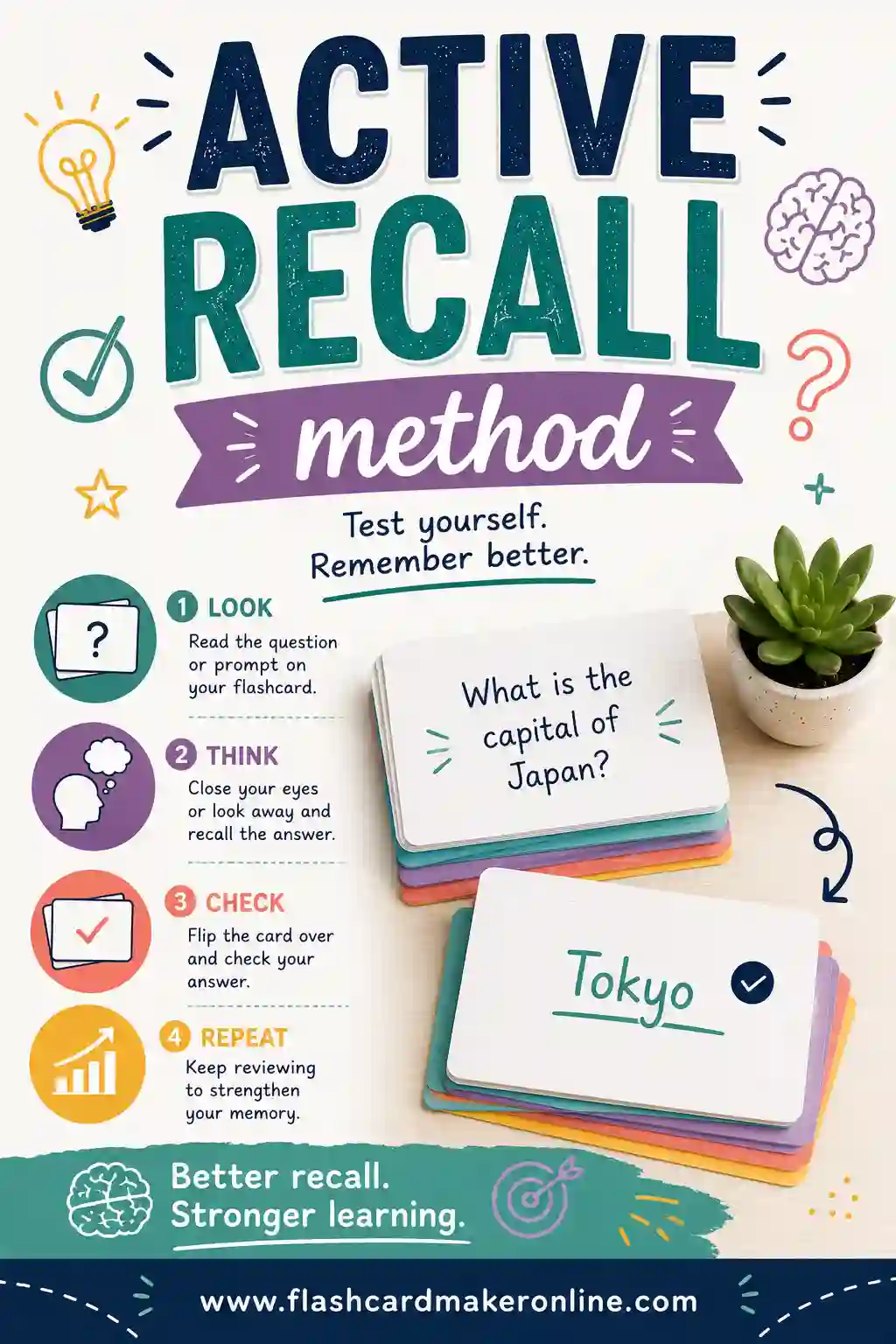
What Is Active Recall?
Active recall means actively pulling an answer out of your own head. You see a question or a prompt, and before checking anything, you try to produce the answer from memory.
Compare that to how most people study: they reread their notes, highlight the textbook, or watch the lecture again. That's passive review. It feels like learning because the material starts to look familiar, but familiarity isn't the same as knowing. When the test asks you to produce the answer, familiarity won't save you.
Active recall is the opposite. It's uncomfortable, you have to dig, and you'll get some wrong. But that effort is exactly what carves the memory deeper. Every time you successfully retrieve a fact, you make it easier to retrieve next time.
Why Active Recall Works So Well
There's a name for this: the testing effect. Decades of research show that testing yourself on material teaches you more than spending the same time restudying it. The act of retrieval isn't just measuring what you know, it's actively strengthening it.
Here's why it beats rereading:
- Retrieval strengthens memory. Each successful recall reinforces the path to that fact.
- It exposes gaps. Rereading hides what you don't know. A failed recall reveals it instantly.
- It builds real fluency. You practice the exact skill the test demands: producing the answer.
- Mistakes help. Even when you guess wrong, then see the right answer, you learn more than if you'd just read it.
That last point surprises people. Struggling and failing, then correcting, beats smoothly reading the answer. Researchers call this a "desirable difficulty." A little struggle is the feature, not the bug.
Active Recall vs. Passive Review
The difference is stark when you lay it side by side.
| Passive review | Active recall | |
|---|---|---|
| What you do | Reread, highlight, rewatch | Quiz yourself, recall from memory |
| How it feels | Easy, comfortable | Harder, requires effort |
| Reveals gaps? | No, hides them | Yes, immediately |
| Long-term memory | Weak | Strong |
| Builds test skill | No | Yes |
The irony is that the method that feels easier (rereading) is the one that works worse. The slightly uncomfortable method is the one that delivers. If a study session feels effortless, that's a warning sign, not a good sign.
Proven Ways to Use Active Recall
Active recall isn't just flashcards, though they're the easiest entry point. Here are the main techniques.
Flashcards
The classic. Prompt on the front, answer on the back. Look at the front, recall the answer, then flip to check. This is active recall in its purest, simplest form, and it's why a flashcard maker is such a useful tool.
The blank-page method
Close your notes. On a blank page, write everything you can remember about a topic. Then open your notes and fill the gaps. Brutal and effective.
Practice questions
Do practice tests and past papers. They force retrieval under real conditions and reveal exactly where you're weak.
The Feynman technique
Explain a concept out loud in plain language, as if teaching a child. Where you stumble is where your understanding is thin. Go relearn that part and try again.
Question your notes
As you read, turn headings and key points into questions. Later, answer them from memory. This converts passive notes into an active-recall study set.
A Sample Active-Recall Deck (Copy & Paste)
Here's a ready-to-use deck of learning-science terms, perfect for practicing active recall on the topic itself. Copy the rows into the flashcard maker and quiz yourself.
| Term | Definition |
|---|---|
| Active recall | Retrieving an answer from memory instead of rereading |
| The testing effect | Learning more from being tested than from restudying |
| Retrieval practice | Deliberately testing yourself to strengthen memory |
| Passive review | Rereading or highlighting, which feels useful but is weak |
| Desirable difficulty | A useful struggle that makes learning stronger |
| The Feynman technique | Explaining a concept simply to expose gaps |
| The blank-page method | Writing all you recall, then checking your notes |
| Metacognition | Judging how well you actually know something |
| The confidence trap | Mistaking familiarity for real knowledge |
| Spaced repetition | Reviewing at growing intervals over time |
| Elaboration | Explaining ideas in your own words |
| Encoding | Turning new information into a memory |
| Retrieval cue | A prompt that triggers an answer |
| Self-testing | Quizzing yourself instead of rereading |
| Generation effect | Better memory for answers you produce yourself |
| Feedback | Checking the right answer after you try |
| Interleaving | Mixing topics within a study session |
| Effortful retrieval | Working to recall, which strengthens memory |
| Overlearning | Practicing past the first correct recall |
| Mastery | Recalling a fact quickly and reliably |
| Distributed practice | Spreading study across several days |
| Massed practice | Cramming everything into one long block |
| Cue-dependent recall | Remembering better with the right prompt |
| Chunking | Grouping small facts into larger units |
| Consolidation | The brain locking a memory into long-term storage |
Don't just read this table, cover the right column and try to define each term first. That's active recall in action.
How to Study With Active Recall (Step by Step)
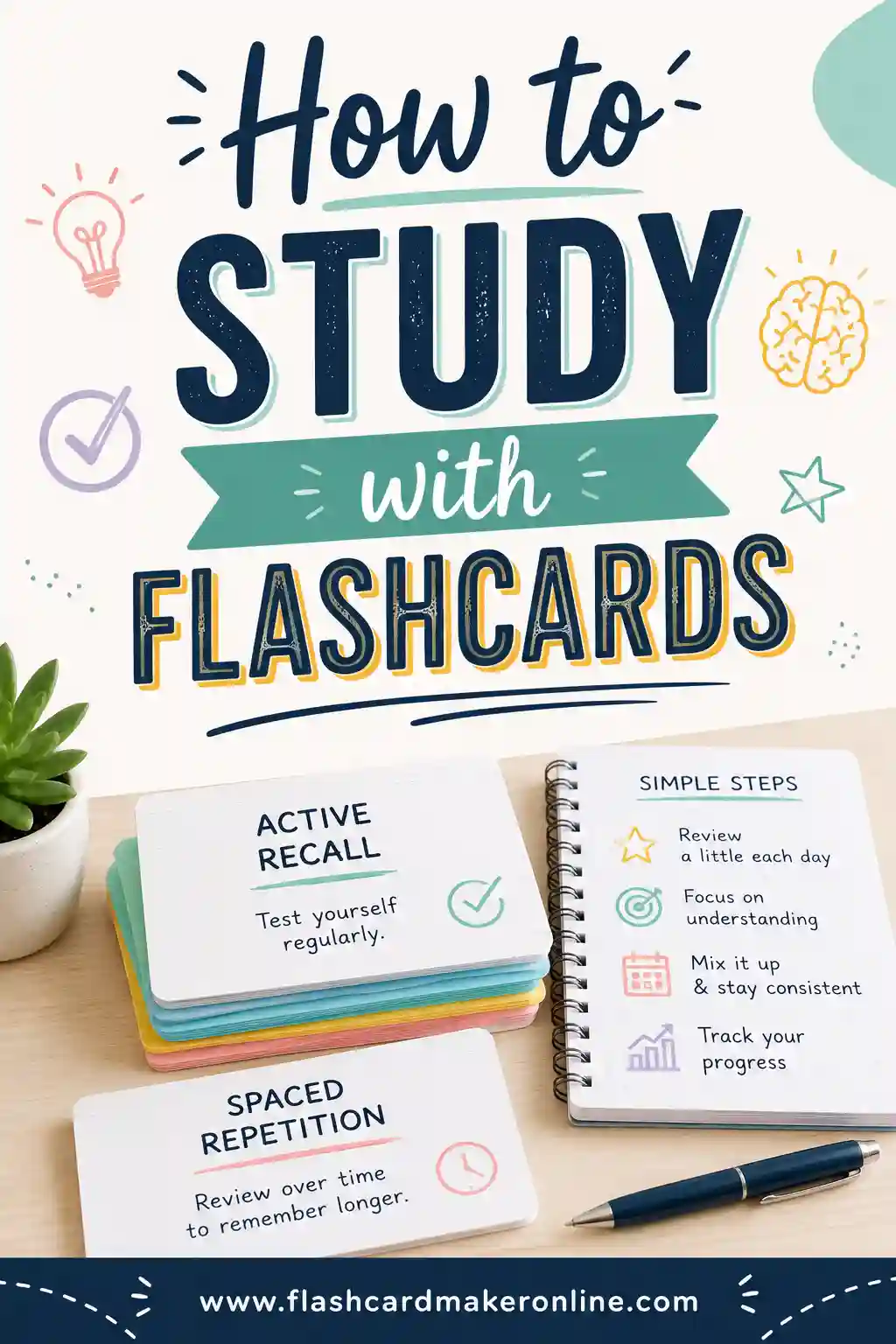
Here's how to turn any flashcard session into pure active recall.
- Look at the prompt only. Resist the urge to peek at the answer.
- Try to recall. Say or write the answer from memory, even if you're unsure.
- Commit to an answer. A real guess beats a vague "I sort of know it."
- Flip and check. See whether you were right.
- Be honest. "Close" counts as a miss. Sort that card for another round.
- Repeat the misses. Cycle the hard cards until you can recall them cleanly.
Our how to study with flashcards guide walks through a full session if you want more detail.
Pair It With Spaced Repetition
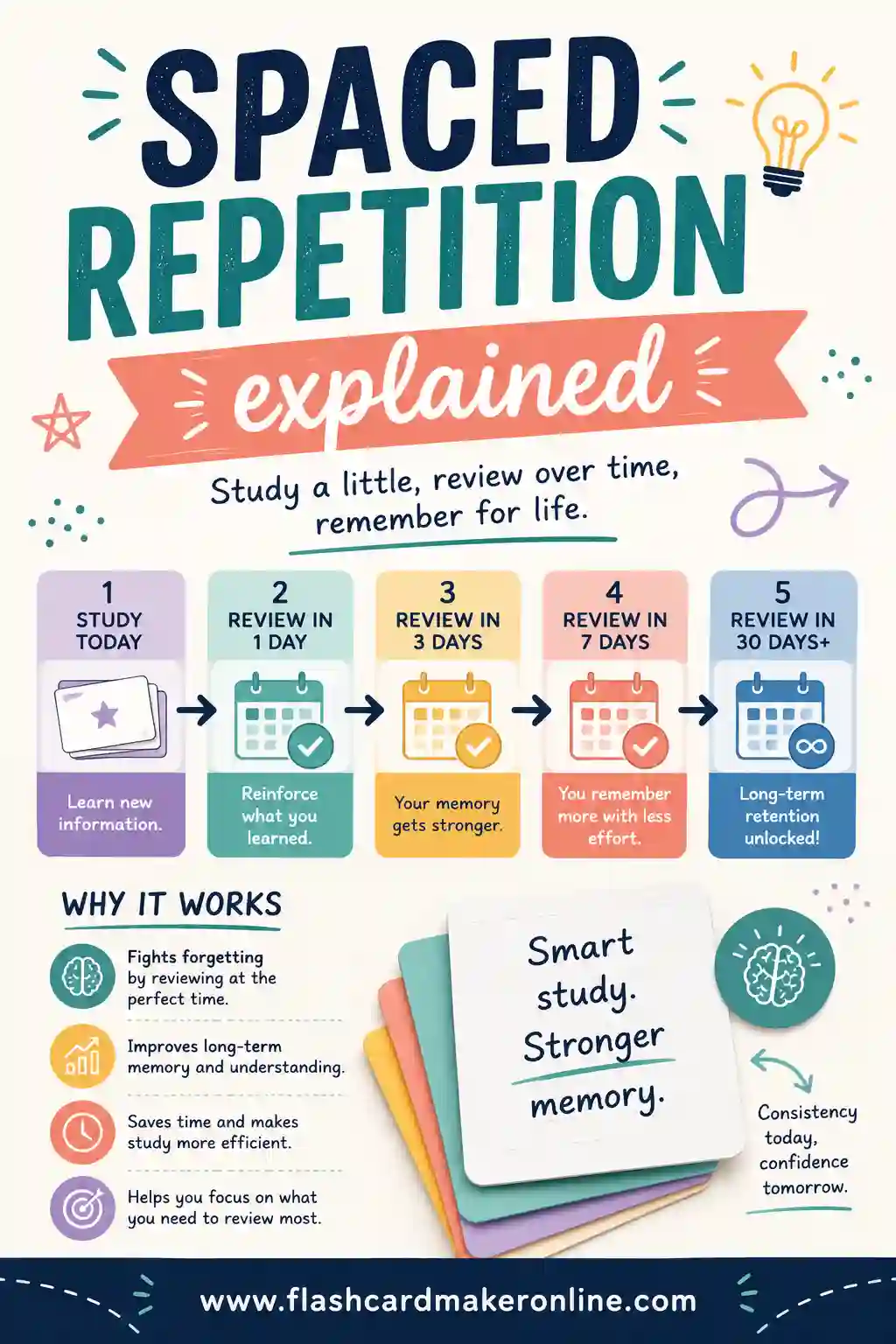
Active recall and spaced repetition are a power couple. Active recall makes each review count; spaced repetition decides when to review.
Use active recall every time a card comes up (always recall before flipping), and space those reviews out over days using an expanding schedule or the Leitner box system. Together they're the most efficient way to learn known to research. Our spaced repetition explained guide covers the timing side in full.
In short: active recall = how you study each card. Spaced repetition = when you study it.
Common Mistakes With Active Recall
- Peeking too soon. If you flip before really trying, you've turned it back into passive review. Make yourself struggle first.
- Calling "almost" a win. Be strict. Partial recall is a miss.
- Avoiding the hard cards. It's tempting to drill the ones you know. Spend your time on the ones you miss.
- Skipping the feedback. Always check the right answer after you try, that correction is part of the learning.
- Never writing real questions. A vague prompt leads to a vague recall. Make each card test one clear thing.
Who Should Use Active Recall
Honestly? Anyone trying to remember anything. It's especially powerful for:
- Students facing content-heavy exams.
- Language learners drilling vocabulary and grammar.
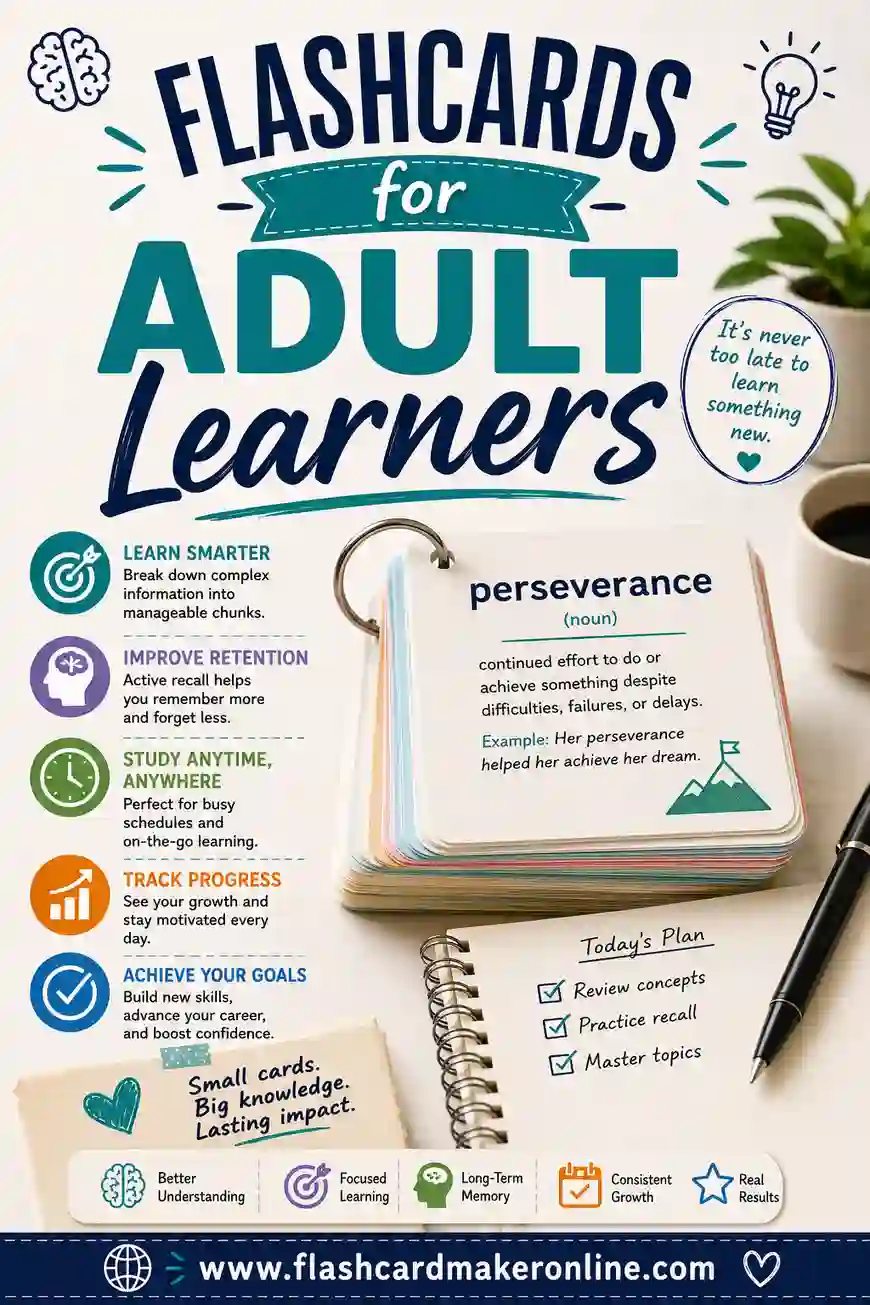
- Professionals prepping for certifications, see flashcards for adult learners.
- Anyone who's tired of rereading notes and forgetting them anyway.
If you've ever finished a study session feeling confident, then blanked on the test, active recall is the fix. It trades a little comfort now for a lot of remembering later.
Why Active Recall Feels Hard (and Why That's Good)
Here's the catch nobody warns you about: active recall is uncomfortable, and that discomfort scares a lot of people back to rereading. Understanding why it feels hard makes it much easier to stick with.
When you reread your notes, everything looks familiar, so your brain whispers "I've got this." That feeling is pleasant, and it's also a lie. Familiarity isn't knowledge. The moment a test asks you to produce the answer cold, that comfortable familiarity evaporates.
Active recall flips the experience. You stare at a prompt, your mind goes blank, and it feels like you're failing. But that very struggle is the work paying off. Researchers call it a "desirable difficulty," a bit of friction that actually deepens the memory. The harder you reach, the stronger the path you carve.
So if a study session feels effortless, treat it as a warning sign, not a victory. And if active recall feels tough, that's the sound of it working. Push through the awkward blank moments; they're where the learning lives.
How to push through the discomfort
A few small mindset shifts make the struggle bearable.
- Expect to get some wrong. Misses aren't failure, they're data. Each one shows you exactly what to fix.
- Reframe the blank. That "I don't know" moment is the workout, not a sign you're bad at this.
- Trust the lag. Recall feels slow at first and speeds up with practice. Give it a few sessions.
- Keep stakes low. It's just a card. There's no penalty for guessing wrong, only learning.
Active Recall Beyond Flashcards
Flashcards are the easiest on-ramp, but once active recall clicks, you'll start using it everywhere. The habit is bigger than any one tool.
After a lecture or a reading
Close the book and, from memory, summarize what you just learned, out loud or on paper. The gaps you hit are exactly what to go back and reread. This turns passive reading into an active test in seconds.
In everyday conversation
Try to explain something you're learning to a friend or family member without notes. If you can teach it simply, you know it. If you fumble, you've found a weak spot. It's the Feynman technique in disguise, and it works at the dinner table.
While commuting or doing chores
Quiz yourself in your head during dead time. "What were the three causes I read about? What's the formula for this?" No cards needed, just the prompt and your memory. These tiny self-tests add up.
Before you look something up
When you're tempted to instantly search for an answer you half-know, pause and try to retrieve it first. That brief reach strengthens the memory far more than jumping straight to the answer would.
The thread through all of these is the same as the flashcard loop: try to produce the answer from your own head before you check. Build that one reflex and you learn faster at everything, cards or not.
Frequently Asked Questions
What is the active recall method?
It's a study technique where you retrieve information from memory, by answering a question or recalling a fact, instead of rereading or highlighting. The effort of pulling the answer from your own head is what builds strong, lasting memory. Flashcards are the simplest way to practice it.
Why is active recall better than rereading?
Because of the testing effect: retrieving information strengthens the memory far more than passively reviewing it. Rereading feels productive and creates familiarity, but familiarity isn't knowledge. Active recall also exposes exactly what you don't know, so you can fix it instead of fooling yourself.
How do I practice active recall with flashcards?
Look at the prompt, try to recall the answer before flipping, then check. Be honest about misses and review them again. The key is always attempting the answer from memory first, never peeking. A free flashcard maker makes building and printing a self-quiz deck quick.
Does active recall work if I get answers wrong?
Yes. Even failed attempts help, as long as you then see the correct answer. The struggle to recall, followed by feedback, strengthens learning more than smoothly reading the answer would. Getting things wrong and correcting them is part of how the method works.
Should I combine active recall with spaced repetition?
Definitely. Active recall makes each review effective, and spaced repetition schedules those reviews at growing intervals so memories last. Used together they're the most efficient study approach research has found. See our spaced repetition explained guide for the timing details.
How often should I use active recall?
Every time you study. Active recall isn't a once-a-week event, it's the default way to review anything. Each card, each summary, each self-quiz should start with a real attempt to retrieve the answer before you check. Pair that with spaced repetition so you're recalling each fact at growing intervals, and the memory sticks for the long haul.
Is active recall good for all subjects?
Yes, with small tweaks. It's a perfect fit for facts, vocabulary, formulas, and definitions, anything with a clear answer to retrieve. For essay-style or skill-based subjects, use it to lock in the underlying facts and terms, then practice the actual writing or skill separately. The recall habit helps everywhere; you just shape the prompts to fit the material.
Ready to Quiz Yourself?
The active recall method comes down to one habit: try to remember before you check. It feels harder than rereading because it works harder, and that's exactly why it sticks. Grab the sample deck above, open the free flashcard maker, and turn every card into a quick self-test, on screen or printed for hands-on study. Build your first deck today and start learning the way your brain actually remembers.