The Illusion of Competence: Why Studying Feels Like Learning When It Isn't
The illusion of competence is the feeling that you've learned something when you really haven't. It happens when studying feels smooth and familiar, for example while rereading notes or glancing at the answer side of a flashcard, so your brain mistakes "this looks familiar" for "I'll be able to recall this on the test." Psychologists Asher Koriat and Robert Bjork used the phrase in a 2005 study on how learners misjudge their own future memory. The fix is simple to say and harder to do: test yourself without looking, and judge your learning by what you can recall later, not by how confident you feel now.
This guide explains where the illusion comes from, the studies that measured it, the most common ways it shows up in everyday studying, and practical flashcard habits that cut through it.
What the illusion of competence is
When you study, you're constantly making quiet predictions: "I've got this one," "I need to look at that again," "I'm ready for the test." Researchers call these predictions judgments of learning. They're part of metacognition, which simply means thinking about your own thinking.
Those predictions matter, because they decide what you study next and when you stop. If your judgments are accurate, you spend time on what you don't know. If they're inflated, you stop too early and walk into the test with gaps you never noticed.
An illusion of competence is an inflated judgment of learning: you feel more prepared than you are. In their study in the Journal of Experimental Psychology: Learning, Memory, and Cognition, Koriat (University of Haifa) and Bjork (UCLA) describe the core problem neatly. When you study, the question and the answer are usually in front of you at the same time. On the test, only the question is. Your sense of "I know this" is formed in the presence of information that won't be there when you need it.
It's a little like being sure you know the way to a friend's house because you've been there many times as a passenger. Then you have to drive there alone, and you discover you were never actually paying attention to the turns.
Why studying feels like learning when it isn't
UCLA researchers Elizabeth and Robert Bjork explain several sources of the illusion in their chapter "Making Things Hard on Yourself, But in a Good Way." Here they are in plain terms.
1. Familiarity feels like understanding
Reading a chapter a second time gives you a sense of familiarity and fluency (ease of processing). The Bjorks note that we tend to interpret that ease as understanding, when it may just reflect that our brains have recently processed the same words. Recognizing something isn't the same as being able to produce it.
2. Cues in the room do some of the work
Information may come to mind easily during study because of cues that are present right then: the page layout, the heading above it, the diagram next to it, the previous card in the deck. The Bjorks point out that those cues are unlikely to be there later. Recall that leans on them can collapse when they're gone.
3. Fast progress during practice is misleading
The Bjorks also stress that conditions that make performance improve quickly, like repeating the same thing over and over in one sitting, often fail to support long-term memory. Conditions that slow down your visible progress, like spacing and mixing topics, often work better in the long run. If you judge by speed of improvement, you'll pick the weaker method. We explain this more fully in a separate article on desirable difficulties.
4. You can't easily "unsee" the answer
Koriat and Bjork call this a foresight bias. Once you've seen an answer, it's hard to imagine not knowing it. It's related to the better-known hindsight bias ("I knew it all along"), but it points forward: you predict your future recall while the answer is right in front of you, and that makes the prediction too rosy.
The studies that measured it
The illusion of competence isn't just a catchy phrase. Researchers have measured the gap between how well people think they've learned and how well they actually do. Here are the key studies, explained simply.
Koriat and Bjork (2005): word pairs that fool you
Participants studied pairs of words, like flashcards, and for each pair predicted how likely they were to recall the second word when later shown only the first. Then they were tested.
The clever part was the choice of pairs. Some word pairs have a one-way connection. The paper's example is cats and kittens. According to word-association norms, the word "kittens" brings "cats" to mind about 72 percent of the time, but "cats" brings "kittens" to mind only about 2 percent of the time. When people study "cats – kittens" with both words visible, the link feels obvious. But at test, seeing only "cats" doesn't naturally lead to "kittens."
The results showed exactly that gap:
| Type of word pair | Average predicted recall | Average actual recall | Gap |
|---|---|---|---|
| Forward pairs (cue naturally leads to the answer) | 78.1% | 78.8% | About zero; well calibrated |
| Backward pairs (answer leads to cue, but not the other way) | 75.7% | 60.3% | Overconfident by about 15 points |
| Unrelated pairs | 37.3% | 24.3% | Overconfident by about 13 points |
(Figures from Experiment 2, which had 20 participants. Gaps are simple subtraction: 75.7 minus 60.3 is 15.4; 37.3 minus 24.3 is 13.0.)
The important finding wasn't that people are always overconfident. For the forward pairs, their predictions were almost perfect. The illusion appeared specifically when seeing the answer created a sense of connection that wouldn't be available from the question alone. That's a precise description of what happens when you flip a flashcard too soon.
Predictions that ignore forgetting
In the same paper, Koriat and Bjork describe related work (Koriat, Bjork, Sheffer and Bar, 2004) in which people expected a test either right away, a day later, or a week later. Their predictions barely changed with the delay, even though their actual recall dropped steeply over time. In other words, people judged how well they knew something now and didn't account for forgetting.
Testing versus rereading (Roediger and Karpicke, 2006)
In a well-known study, students read prose passages and then either restudied them or took recall tests without feedback. Five minutes later, restudying looked better. Two days and one week later, the students who had practiced recall remembered substantially more. And the restudying students were more confident in their memory. The method that felt better was the one that worked worse.
Repeated recall that students didn't value
Jeffrey Karpicke and colleagues describe an earlier experiment (Karpicke and Roediger, 2008) in which students learned Swahili-English word pairs, like mashua (boat). Students who stopped practicing recall of a word once they'd gotten it right once remembered about 35 percent of the words a week later. Students who kept recalling words even after getting them right remembered about 80 percent. Yet when asked to predict their scores, all groups guessed about 50 percent. They couldn't sense the difference that repeated recall was making.
Mixing versus blocking (Kornell and Bjork, 2008)
In a study in Psychological Science, people learned to recognize painters' styles. Seeing the paintings mixed together led to better learning than seeing each painter's work in a block. But most participants rated blocking as more effective, even after their own test results showed the opposite.
Active versus passive classes (Deslauriers and colleagues, 2019)
This illusion shows up outside the lab too. In a Harvard physics study published in PNAS, 149 students experienced both effortful "active" class sessions and polished lectures with the same content. Students in the active sessions scored about half a standard deviation higher on a test of learning, yet rated their feeling of learning lower. The authors suggest students took the extra mental effort as a sign they weren't learning well. They also warned that a superstar lecturer could create such a strong feeling of learning that students would prefer it over methods that teach them more.
What students actually do: the rereading habit
If the illusion of competence is real, you'd expect students to favor study methods that feel good over ones that work well. That's what a survey found.
Karpicke, Andrew Butler and Henry Roediger surveyed 177 college students for a 2009 paper in the journal Memory. Here's what they reported:
| Survey finding | Result |
|---|---|
| Listed rereading notes or the textbook as a study strategy | 84% |
| Named rereading as their number one strategy | 55% |
| Listed using flashcards | 40% |
| Said they practiced recalling information while studying | 11% (19 of 177) |
| Named practicing recall as their number one strategy | 1% (2 of 177) |
| After reading a chapter, would choose to reread it | 57% |
| After reading a chapter, would choose to test themselves | 18% |
The authors proposed that many students experience illusions of competence while studying, and that those illusions shape which strategies students choose. Rereading produces fluency, fluency feels like learning, so students reread.
The same paper describes a survey by Kornell and Bjork (2007) that adds a twist. Most students said they did quiz themselves at least sometimes. But only 18 percent said they did it because quizzing helps them learn more than rereading. Most (68 percent) said they quizzed themselves only to check how well they'd learned. In other words, many students who do use self-testing think of it as a measuring tool, not as a way to strengthen memory. It's both. And flashcards only help if you actually use them for recall, a point we cover in are flashcards effective?
Common illusions of competence, and what to do instead
Here's how the illusion shows up in everyday studying, and a better alternative for each.
| What it feels like | Why it's misleading | Try this instead |
|---|---|---|
| "I've read this chapter twice. I know it." | Familiarity from rereading isn't the same as being able to recall | Close the book and write down everything you remember, then check |
| "I knew that card; I flipped it as soon as I saw the front." | Flipping early lets the answer do the work | Say or write the full answer before you flip |
| "I got them all right in a row." | Answers in a fixed order can be cued by the previous card | Shuffle the deck every time |
| "The lecture made total sense." | Following an explanation isn't the same as producing one | Explain it back without notes within a day |
| "My highlighted notes look great." | Highlighting marks text but doesn't test memory | Turn highlights into questions and quiz yourself |
| "I knew it last night." | Judgments made right after study ignore forgetting | Test yourself again a day or more later |
| "I recognized the right answer on the practice quiz." | Recognizing an answer among options is easier than recalling it | Practice with open-ended recall, not just multiple choice |
| "I understand how it works." | People overestimate their grasp of how things work | Write a step-by-step explanation and see where it breaks |
The illusion of explanatory depth
That last row deserves its own section. Yale researchers Leonid Rozenblit and Frank Keil documented a related effect they called the illusion of explanatory depth, published in Cognitive Science in 2002.
Participants rated how well they understood everyday devices, such as a zipper, a flush toilet, a cylinder lock and a speedometer, on a 1-to-7 scale. Then they wrote step-by-step explanations of how each worked and rated themselves again. Their ratings dropped significantly after trying to explain. Independent judges agreed that the explanations matched the lower ratings better than the original ones.
The illusion was strongest for knowledge about how things work: devices and natural processes. It was weaker for simple facts like capital cities, and it didn't appear for procedures (how to do something) or for movie plots. That pattern matters for students. The "how" and "why" knowledge that science and history tests often ask about is where self-assessment is least reliable.
The fix is built into the finding: try to explain. Writing out a full explanation is one of the fastest ways to discover what you don't know. That's the idea behind the Feynman technique, which we cover in a separate guide.
How it relates to the Dunning-Kruger effect
You may have heard of the Dunning-Kruger effect. In a 1999 paper in the Journal of Personality and Social Psychology, Justin Kruger and David Dunning of Cornell University reported four studies on humor, grammar and logic. Participants who scored in the bottom quarter greatly overestimated themselves: their scores put them around the 12th percentile, but they estimated they were around the 62nd. The authors argued that the skills needed to do well are often the same skills needed to recognize doing badly. When they trained participants and improved their skills, those participants got better at judging their own ability too.
The two ideas are related but not the same:
- The Dunning-Kruger effect is about how people with low skill in an area misjudge their overall ability, often compared with others.
- The illusion of competence in study research is about how anyone, including strong students, can misjudge whether a specific item will be remembered later, because of how studying feels.
The shared lesson is that feelings of knowing aren't reliable on their own. Outside checks, like a self-test, are.
How to break the illusion with flashcards
Flashcards are one of the best tools against the illusion of competence, but only if you use them in a way that forces real recall. Here are the habits that matter most.
1. Commit to an answer before flipping
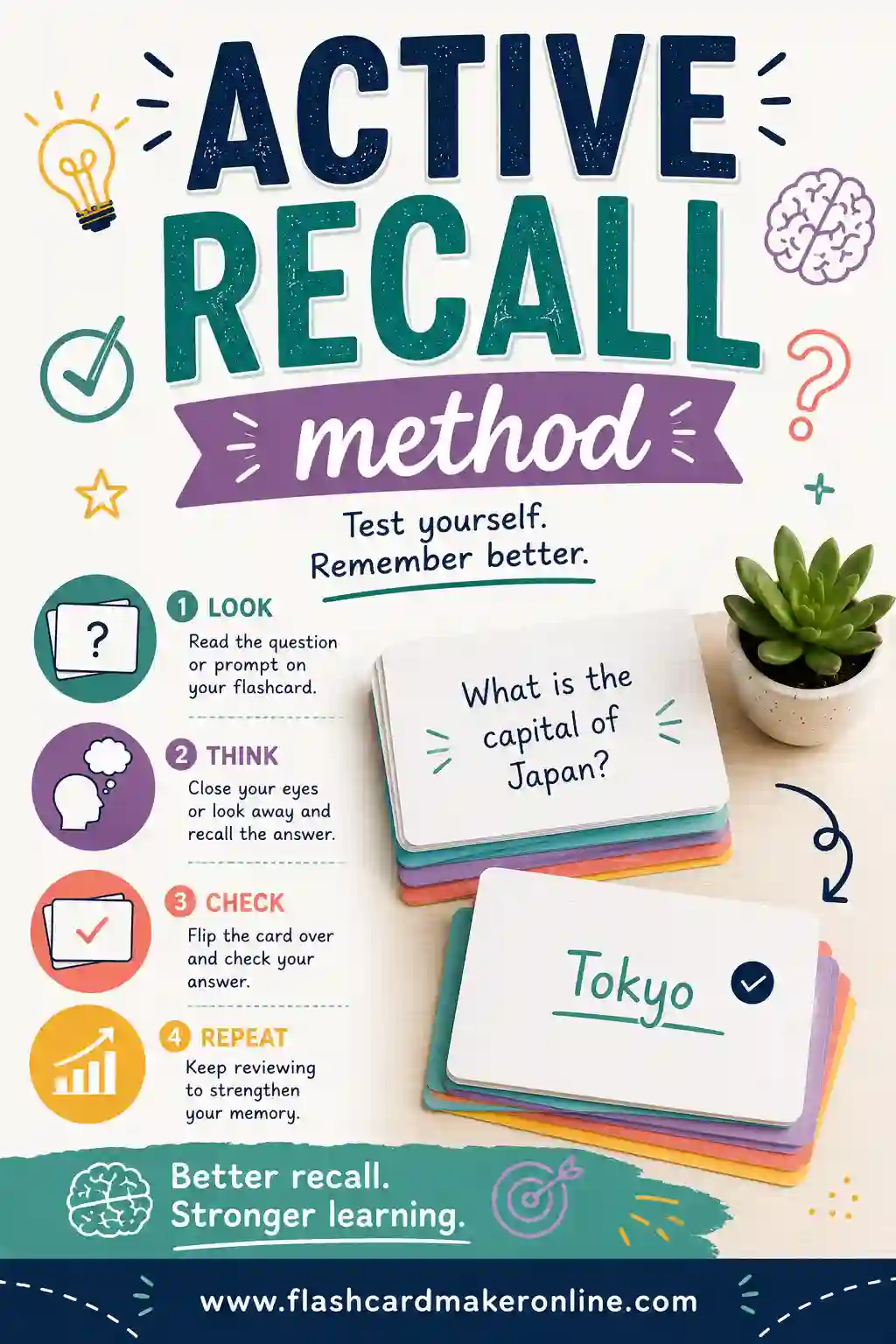
This is the single most important habit. The Koriat and Bjork findings show that judging your memory with the answer visible inflates your confidence. So produce the answer first: say it out loud, whisper it, or write it on scrap paper. Then flip and compare. If you hesitated or got it partly wrong, count it as a miss. Our active recall method guide walks through this step by step.
2. Shuffle every time
If your deck is always in the same order, one card can cue the next. Shuffling removes that crutch, so you're recalling each answer on its own.
3. Keep practicing after the first correct answer
The Swahili word study showed that continuing to recall words after getting them right once made a big difference a week later, even though students didn't predict it. Don't retire a card after one success. Bring it back on a later day.
4. Wait before you judge
Your sense of knowing forms while the material is fresh, and the Koriat, Bjork, Sheffer and Bar findings suggest those feelings don't account for forgetting. A delayed check gives you a more honest reading. A practical version: at the end of a session, set aside the cards you think you know. Test them again the next day. Only the ones you still get right count as learned.
5. Space your reviews
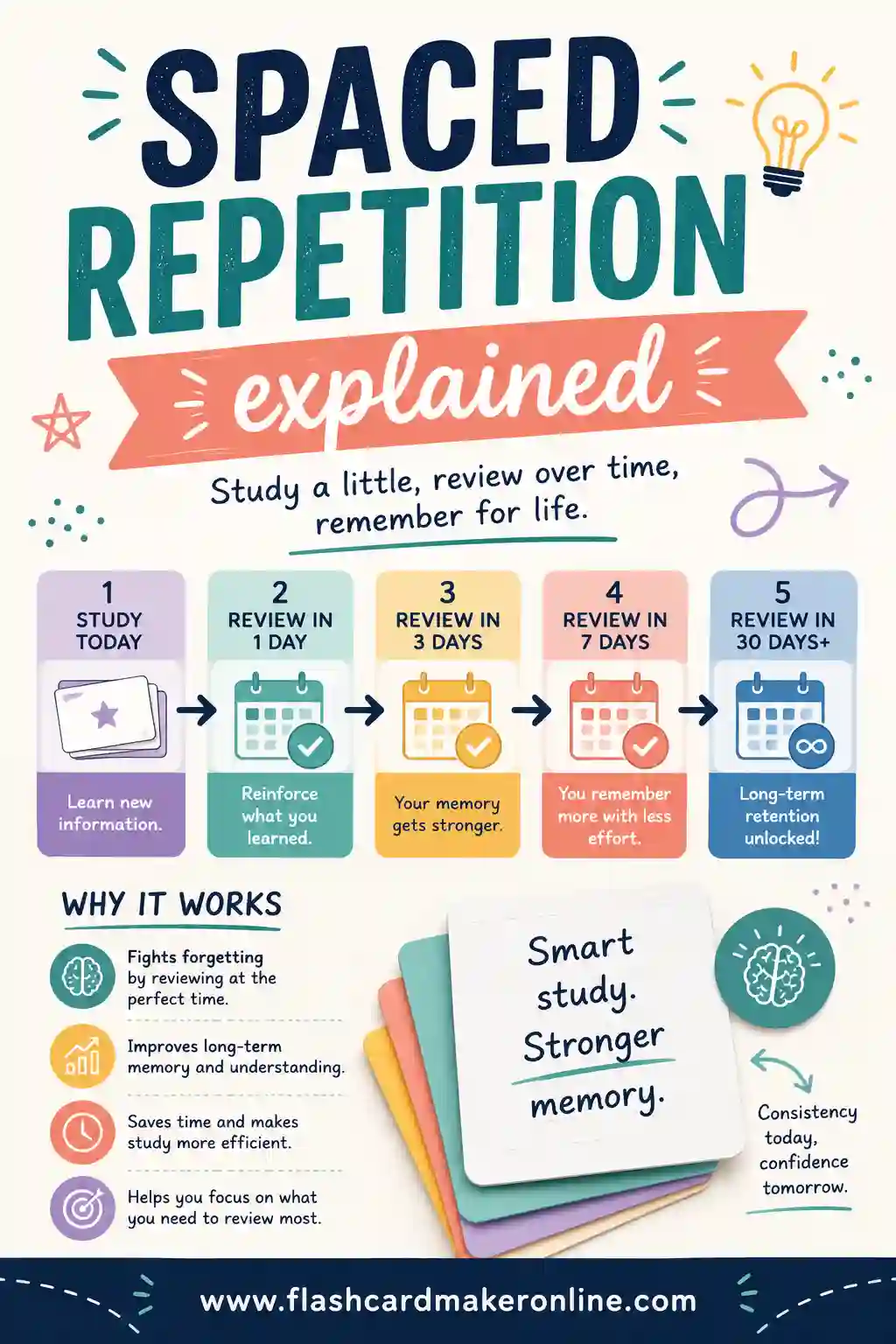
Gaps between reviews let some forgetting happen, which makes each review a real test instead of an echo of the last one. Our guide to spaced repetition explains how to schedule them.
6. Test both directions
Remember the cats and kittens example: a link that works one way may not work the other. If you'll need to recall a term from its definition and a definition from its term, make cards for both directions.
7. Track your hit rate honestly
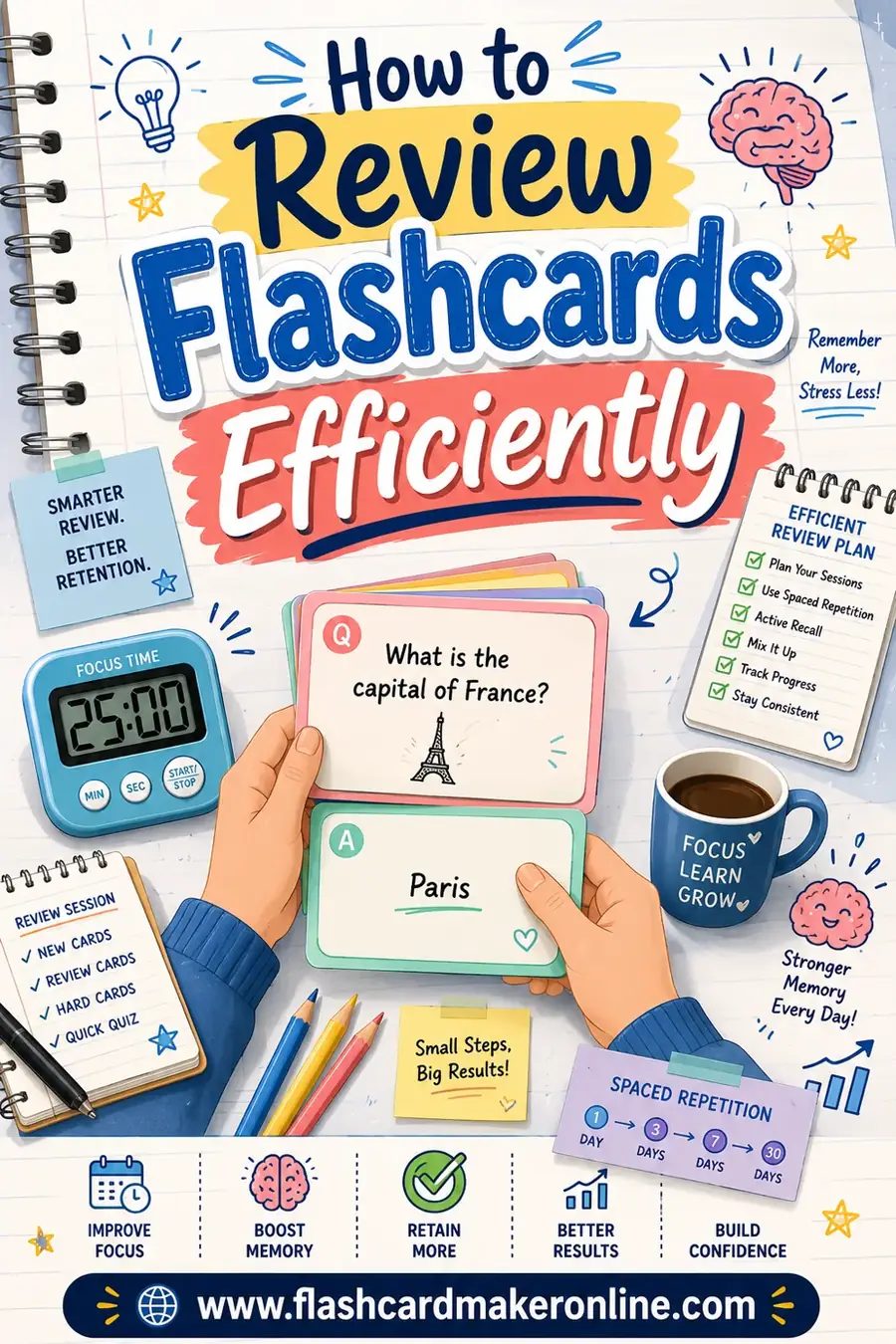
Keep two piles: "got it" and "missed it." At the end, count them. A number on paper is harder to fool yourself about than a vague feeling. For more on making reviews count, see how to review flashcards efficiently.
A worked example: two ways to study the same deck
This example is illustrative, with made-up students. Sam and Alex both have 40 flashcards of anatomy terms for a quiz on Friday. It's Monday.
Sam's approach: Each evening, Sam reads through the deck in order, looking at the front, then flipping right away to "check." By Wednesday, every card looks familiar, and Sam feels sure about 35 of the 40. Sam studies less on Thursday because everything feels done.
Alex's approach: Each evening, Alex shuffles the deck and says each answer out loud before flipping. On Monday, Alex gets only 15 right and feels discouraged. Missed cards go in a separate pile and get extra rounds. On Tuesday, Alex starts by testing yesterday's "got it" pile again and finds that a handful have slipped. By Thursday, Alex is getting about 33 right on a shuffled, first-try pass.
On Monday night, Sam felt more confident than Alex. That's the illusion of competence at work. Alex's lower confidence came from an honest measurement. Based on the research above, you'd expect Alex's approach to hold up better on Friday, and to leave Alex with a much more accurate sense of which terms still need work.
Where the illusion shows up beyond flashcards
Flashcards are easy to fix because the answer is hidden on the back. Other study habits hide the illusion better. Here are a few to watch.
Watching videos and lectures
A clear explainer video or a great lecture can leave you feeling that you understand a topic completely. The Harvard physics study suggests why that feeling can mislead: a fluent presentation can create a strong sense of learning without the effort that builds memory. Following an explanation is a different skill from producing one. After a video, pause and try to explain the main idea in your own words, or answer two or three questions from memory before moving on.
Worked examples in math and science
Reading a solved problem step by step usually makes perfect sense. That's the illusion again: each step is easy to follow when it's in front of you, like the cats and kittens pair. The real test is solving a similar problem with the solution covered. If you can't get started, you've found your gap.
Making beautiful notes
Rewriting notes neatly, color-coding and highlighting can take hours and feel very productive. But they mostly involve copying, not recalling. Notes are a great raw material for self-testing; they just aren't the test. Our comparison of flashcards and notes covers how to turn one into the other.
Group study
When a friend explains something and you nod along, it feels like you've learned it. Take turns instead: one person asks a question, and everyone else answers from memory before anyone looks it up.
Multiple-choice practice
Picking the right answer from four options relies on recognition, which is easier than recall. If your real test has short-answer or essay questions, a high practice-quiz score can overstate how ready you are. Cover the options and try to answer first.
A one-week plan that keeps you honest
This plan is an illustrative example. It's built for a test about a week away, and it uses the research above to replace feelings with checks.
- Day 1: Read or review the material once. Then close it and do a "brain dump": write everything you remember on a blank page. Make flashcards for what you missed or got fuzzy.
- Day 2: Shuffle the deck and go through it, answering out loud before each flip. Sort into "got it" and "missed it."
- Day 3: Test yesterday's "got it" pile first. Move any slips back to "missed it." Then work the missed pile.
- Day 4: Write step-by-step explanations for the two or three biggest "how" or "why" topics. Fix gaps and add cards for them.
- Day 5: Full shuffled pass, both directions where it makes sense. Count your score.
- Day 6: Missed cards only, plus a short random sample of the rest.
- Day 7 (before the test): One quick shuffled pass. Trust the count, not the feeling.
Notice that each day starts with a check on what you thought you knew. That's the core habit. For more ways to make reviews last, see how to make flashcards stick, and for test-specific planning, our guide to flashcards for exams.
Why your brain takes these shortcuts
It's tempting to see the illusion of competence as a flaw in students, but it comes from something normal. Most of the time, things that feel easy to process really are things you know well. Using ease as a quick signal usually works in daily life. The trouble is that studying creates special conditions, like seeing the answer next to the question or repeating something minutes apart, that make material feel easy for reasons that won't last until the test.
Koriat and Bjork make this point directly: in their study, people's predictions were well calibrated for many items. The overconfidence appeared in specific situations where the study conditions made the answer feel more connected to the question than it really was. So the goal isn't to distrust every feeling of knowing. It's to recognize the situations where those feelings are likely to be wrong, and to check with a real test in those moments.
Signs you might be fooling yourself
Run through this checklist after your next study session. Each "yes" is a warning sign.
- Did you spend most of your time reading, highlighting or recopying notes?
- Did you flip flashcards before fully saying or writing the answer?
- Did you go through cards in the same order as last time?
- Did you stop studying a topic because it "felt" familiar, without testing yourself on it?
- Did you judge yourself ready right after a session, with no delayed check?
- Did practice feel smooth the whole time, with almost no mistakes?
- Could you recognize the right answer on a multiple-choice question but not produce it from scratch?
That second-to-last point surprises people. Smooth, error-free practice can be a sign that the practice is too easy to build lasting memory. Some struggle is normal and useful.
Try it yourself: measure your own calibration
Calibration means how well your confidence matches your actual performance. Here's a quick way to check yours.
- Pick 20 flashcards you've studied recently.
- For each card, look only at the front and rate your confidence from 0 to 100 percent that you'll get it right. Write the numbers down.
- Now answer each card from memory and mark it right or wrong.
- Add up your confidence ratings and divide by 20. That's your average predicted score.
- Count your correct answers and divide by 20. That's your actual score.
- Compare the two. If your prediction is much higher than your actual score, you're overconfident on this deck.
For extra insight, repeat step 2 with a different set of cards, but this time look at both sides before rating. Then test yourself the next day. Many people find their "both sides showing" ratings are the most inflated, which is exactly what Koriat and Bjork described. Your results will vary, and a quick self-test isn't a study, but it's an eye-opening exercise.
How to read your mistakes
Once you start testing yourself honestly, you'll get more answers wrong during practice. That can feel discouraging, so it helps to know what different kinds of misses tell you.
- Blank: nothing comes to mind. The item isn't stored well yet, or the cue on the front isn't linked to it. Restudy it, then test again later in the same session and again the next day.
- Tip of the tongue: you almost had it. The memory is there but hard to reach. This is a good sign. Keep it in rotation at short gaps until it comes quickly.
- Confident but wrong. This is the most important kind to catch, because it's the illusion of competence in its purest form. Write the correct answer next to your wrong one and note why you mixed them up. These cards deserve extra reviews.
- Right only in one direction. You can go from term to definition but not back. Add a reversed card.
- Right on the card, wrong in a new question. You've memorized the card's wording but not the idea. Rewrite the card in a different form, or add a "why" or "explain" card.
Treat every miss as information you got before the test instead of during it. That's the whole value of checking yourself honestly. A practice session with plenty of misses and corrections is often a better sign than a session where everything felt easy.
Over a few weeks, keep a rough note of how your predicted scores compare with your actual ones. Many people find the gap shrinks as they get used to testing themselves, which is consistent with Kruger and Dunning's finding that improving skills also improved people's ability to judge themselves.
Advice for teachers and parents
- Explain the illusion out loud. The Harvard physics researchers argued that students need to understand early on why effortful learning feels worse but works better. A two-minute explanation can change how students read their own struggle.
- Use low-stakes quizzes often. Short, ungraded recall questions at the start of class give students honest feedback about what they know.
- Ask for explanations, not just answers. "Tell me how you got that" reveals gaps that a correct answer can hide.
- Model the "test, don't reread" habit at home. Instead of reading a spelling list together again, ask your child to spell the words from memory and check together.
- Praise effort on hard recall, not smooth reading. Help students see mistakes during practice as information, not failure.
Start testing yourself with your own cards
The cure for the illusion of competence is honest feedback, and flashcards are a fast way to get it, as long as you answer before you flip. The free flashcard maker on our homepage lets you add your own words and pictures, study with flip cards on screen, and print double-sided or as cut-out sheets. Make a deck for your next test, shuffle it, answer every card out loud, and check yourself again tomorrow. The score you get then is a far better guide than the feeling you had while studying.
Four Related Effects Compared
Several effects in this article sound alike. This table shows what each one is about and how it shows up when you study.
| Effect | What it is | Where it shows up |
|---|---|---|
| Illusion of competence | An inflated judgment of learning: feeling more prepared than you are | Rereading notes, or glancing at the answer side of a card |
| Foresight bias | Once you've seen an answer, it's hard to imagine not knowing it | Predicting your future recall while the answer is in front of you |
| Illusion of explanatory depth | Overestimating how well you understand how things work | Ratings dropped once people wrote step-by-step explanations of everyday devices |
| Dunning-Kruger effect | People with low skill in an area misjudge their overall ability, often compared with others | Studies on humor, grammar and logic |
Frequently Asked Questions
What is the illusion of competence?
The illusion of competence is the false sense that you have learned something well enough to recall it later, when you actually have not. It usually comes from study methods that feel smooth, like rereading notes or looking at the answer side of a flashcard. Because the material feels familiar, your brain treats that ease as evidence of learning. Psychologists Asher Koriat and Robert Bjork studied it in 2005, showing that people overestimate future recall when the answer is visible during study.
What causes the illusion of competence?
Several things. Rereading creates familiarity, which feels like understanding. Cues present during study, such as page layout or the previous card, help you recall in the moment but will not be there on a test. Fast progress during repetitive practice looks like learning but often fades. And once you have seen an answer, it is hard to imagine not knowing it, which Koriat and Bjork called a foresight bias. Your predictions also tend to ignore how much you will forget.
Why does rereading create an illusion of competence?
Reading something a second time is easier than the first, and that ease feels like mastery. The Bjorks explain that this fluency may come from your brain having recently processed the same words, not from deep learning. Rereading also never asks you to produce anything from memory, so you never find out what you cannot recall. In a 2006 study, restudying made students more confident than testing, yet tested students remembered substantially more a week later.
How common is rereading among students?
Very common. In a survey of 177 college students published in 2009 by Karpicke, Butler and Roediger, 84 percent listed rereading as a study strategy and 55 percent called it their top strategy. Only 11 percent said they practiced recalling information while studying, and just 1 percent named it as their main strategy. When asked what they would do after reading a chapter, 57 percent chose to reread it and only 18 percent chose to test themselves.
Is the illusion of competence the same as the Dunning-Kruger effect?
They are related but different. The Dunning-Kruger effect, from a 1999 Cornell study, describes how people with low skill in an area overestimate their overall ability; bottom-quarter scorers placed themselves near the 62nd percentile when they were near the 12th. The illusion of competence in study research is broader and more specific at once: anyone, including strong students, can misjudge whether particular material will be remembered later because of how studying feels. Both show feelings of knowing are unreliable.
How can I tell if I really know something?
Test yourself without looking, and do it after a delay. Close your notes and write or say everything you remember, or answer flashcards out loud before flipping them. Then check honestly and count partial or hesitant answers as misses. Try again the next day, since knowledge that is still there after a gap is far more reliable than a feeling right after studying. If the material is about how something works, try writing a step-by-step explanation.
How do flashcards help with the illusion of competence?
Flashcards force you to recall an answer from a cue, which is the same thing a test asks you to do. That gives you honest feedback about what you know. They only help if you use them properly, though: commit to an answer before flipping, shuffle the deck so order does not cue you, keep cards in rotation after one correct answer, and review over several days. Flipping a card the moment it looks familiar recreates the illusion.
Why do effective study methods feel less effective?
Effective methods like self-testing, spacing and mixing topics involve effort and visible mistakes, and people tend to read effort as a sign of poor learning. In a 2019 Harvard physics study, students in active, effortful class sessions learned more but felt they had learned less than students in polished lectures. In a 2008 painting study, most participants preferred blocked study even after their own results showed that mixed study had worked better. Judge methods by delayed results, not feelings.
Can you overcome the illusion of competence completely?
Probably not completely, because it comes from normal features of memory, such as treating ease as a sign of knowing. But you can work around it. Build in outside checks that do not depend on how you feel: answer before flipping, test after a delay, shuffle cards, explain concepts in writing, and track how many you actually get right. Over time, comparing your predictions with your real results can also make your judgments more accurate.
Sources
We checked every source below while writing this guide. Last reviewed October 30, 2026, by Joan Ramos.
- Illusions of Competence in Monitoring One's Knowledge During Study (Koriat & Bjork, 2005), Journal of Experimental Psychology: Learning, Memory, and Cognition (University of Haifa)
- Metacognitive strategies in student learning: Do students practise retrieval when they study on their own? (Karpicke, Butler & Roediger, 2009), Memory (PubMed, US National Library of Medicine)
- Making Things Hard on Yourself, But in a Good Way (Bjork & Bjork, 2011) (Bjork Learning and Forgetting Lab, UCLA)
- Test-enhanced learning: taking memory tests improves long-term retention (Roediger & Karpicke, 2006), Psychological Science (PubMed, US National Library of Medicine)
- Learning concepts and categories: is spacing the 'enemy of induction'? (Kornell & Bjork, 2008), Psychological Science (PubMed, US National Library of Medicine)
- Measuring actual learning versus feeling of learning in response to being actively engaged in the classroom (Deslauriers et al., 2019), PNAS (PubMed Central, US National Library of Medicine)
- The misunderstood limits of folk science: an illusion of explanatory depth (Rozenblit & Keil, 2002), Cognitive Science (PubMed Central, US National Library of Medicine)
- Unskilled and unaware of it (Kruger & Dunning, 1999), Journal of Personality and Social Psychology (PubMed, US National Library of Medicine)