The Feynman Technique: Learn Anything by Explaining It Simply
The Feynman technique is a study method where you learn a topic by explaining it in plain, simple words, as if teaching someone with no background, and then go back to fill the gaps your explanation exposes. It's named after the physicist Richard Feynman, famous for clear teaching. One honest note up front: Feynman never wrote up a "technique" by this name. It's a popular modern recipe inspired by his reputation. Still, the core idea, explaining something to find out whether you really understand it, is backed by solid research on self-explanation and learning by teaching.
This guide covers what the method is, where the name really comes from, what the science does and doesn't support, a full worked example, and how to combine it with flashcards so the understanding you build actually sticks.
What the Feynman technique is
Most versions you'll find online boil down to four steps:
- Pick a concept and write its name at the top of a blank page.
- Explain it in simple language, as if you were teaching a curious friend or a younger student who knows nothing about it. No jargon unless you define it.
- Find the gaps. Wherever you got stuck, waved your hands, or fell back on a technical term you couldn't unpack, go back to your source material and relearn that part.
- Simplify and refine. Rewrite your explanation more clearly, ideally with an example or comparison, until it flows from start to finish.
The appeal is obvious. It needs nothing but paper. It turns vague "I think I get it" feelings into a concrete test. And it pushes you to connect ideas instead of memorizing phrases.
The core idea is "explain it to learn it." That's what the research supports. The four-step packaging is just one convenient way to do it.
Did Feynman actually invent it? An honest answer
No, not in the sense of writing it down as a method. There's no Feynman paper, lecture or book chapter that lays out "the Feynman technique" in four steps. We couldn't find any source in which he described a study method by that name. The label appears to be a modern one that spread through study blogs, online courses and productivity writing, attached to Feynman because of his reputation as a gifted explainer.
That reputation is real, though, and there's a well-documented story that captures the spirit of the method. Caltech physicist David Goodstein told it in a Physics Today article in February 1989, and it was retold in Caltech's magazine in "Feynman at 100." A colleague asked Feynman to explain why particles with a property called spin one-half obey a set of rules known as Fermi-Dirac statistics. Feynman said he'd prepare a freshman lecture on it. A few days later he came back and admitted, "I couldn't reduce it to the freshman level." His conclusion, as Goodstein tells it, was that this meant physicists didn't truly understand it yet.
That's the heart of the modern technique: if you can't explain something simply, that's a sign your understanding has holes. Feynman held that standard. The four-step recipe is someone else's way of turning it into a routine.
Why does this matter? Because you'll often see the method described with confident claims, such as "Feynman's secret study method" or "the technique Feynman used to win a Nobel Prize." Those claims go beyond the evidence. What we can say is narrower and more useful: a respected physicist treated simple explanation as a test of understanding, and decades of learning research, covered below, suggest that explaining material in your own words really does help people learn. You don't need the legend for the method to be worth using.
It's also worth knowing that the idea isn't unique to Feynman. Fiorella's review of learning by teaching, discussed below, notes that the Roman philosopher Seneca wrote about learning while teaching nearly two thousand years ago. The Feynman name is a modern label on a very old insight.
Who was Richard Feynman
A bit of background helps explain why his name stuck to this idea.
| Fact | Detail |
|---|---|
| Born | May 11, 1918, New York City |
| Died | February 15, 1988, Los Angeles |
| Best known for | Work in quantum electrodynamics, including Feynman diagrams (introduced in 1948), simple drawings that represent how particles interact |
| Nobel Prize | Physics, 1965, shared with Sin-Itiro Tomonaga and Julian Schwinger |
| Institution at the time of the prize | California Institute of Technology (Caltech), Pasadena |
| Famous teaching | Spent two years teaching beginning physics at Caltech; his lectures became The Feynman Lectures on Physics |
The dates, prize and affiliation come from the Nobel Prize's official facts page. The teaching details come from the Caltech magazine article, which notes that his sophomore lectures became the second and third volumes of The Feynman Lectures on Physics.
Feynman diagrams themselves are a nice example of his style: they take very hard math and represent it with pictures that make the process easier to follow. It's not hard to see why a study method about simplifying would carry his name.
The research behind it: self-explanation
The closest scientific match to the Feynman technique is a research area called self-explanation: explaining material to yourself as you study, in your own words, connecting it to what you already know. It was studied in detail by cognitive scientist Michelene Chi and her colleagues starting in the late 1980s.
Good and poor problem solvers (Chi and colleagues, 1989)
In a study published in Cognitive Science, Chi's team asked college students to think out loud while they studied worked examples of physics (mechanics) problems. Then they looked at how well the students solved new problems.
A later paper by Chi's group summarized the result. The four students who did best on the later problems, averaging 82 percent correct, had produced about 15.3 self-explanations per example while studying. The four who did worst, averaging 46 percent, produced only about 2.8. The better learners kept asking themselves why each step worked and how it connected to physics principles. The weaker learners mostly read along.
This was a small study, and it showed a link, not proof of cause. Maybe stronger students simply explain more. So Chi's team ran an experiment.
Prompting students to explain (Chi and colleagues, 1994)
In the follow-up, published as "Eliciting Self-Explanations Improves Understanding", 14 eighth graders read a 101-sentence textbook passage on the human circulatory system and were asked to explain each sentence to themselves after reading it. Ten other students read the same passage twice with no prompts.
- The prompted group improved more from pretest to posttest.
- Within the prompted group, students who generated the most explanations understood the material best, especially on hard questions that required going beyond the text.
- Eight of the 14 prompted students (57 percent) ended up with the most accurate mental model of how blood circulates, compared with 2 of 9 unprompted students who could be scored (22 percent).
The students got no special training. They were simply asked to explain. That's close to what the Feynman technique asks of you.
How the big reviews rate it
In a major 2013 review of 10 study techniques, John Dunlosky and colleagues rated self-explanation as "moderate utility." It showed real promise across many studies, but the authors wanted more evidence from real classrooms before rating it higher. Practice testing and spacing got the top "high utility" rating. That's a useful reality check: explaining is powerful, but it works best alongside self-testing and spaced review, not as a replacement.
Learning by teaching: what studies show
The Feynman technique usually asks you to imagine teaching someone. Is there research on whether teaching helps the teacher learn? Yes, and it's more nuanced than "teaching is the best way to learn."
Educational psychologist Logan Fiorella of the University of Georgia reviewed this research in a 2023 chapter, "Learning by Teaching," published by the American Psychological Association's Division 2. He breaks teaching into three parts: preparing to teach, explaining to others, and interacting with learners. Here's what he reports for the first two, which are the parts the Feynman technique uses.
| Part of teaching | What studies found | Caveats |
|---|---|---|
| Preparing to teach (studying as if you'll teach it) | A meta-analysis by Kobayashi (2019) found a small-to-medium average benefit (d = .30 to .40) across 28 studies, compared with preparing for a test. Students who expected to teach organized the material better around main ideas. | Some studies found no benefit. Anxiety about teaching and weak strategies (like summarizing instead of explaining) can cancel it out. |
| Actually explaining (for example, recording a short video lesson) | In studies by Fiorella and Mayer on the Doppler effect, students who actually taught on video did best on a delayed comprehension test. | Benefits were stronger when students explained from memory rather than reading from notes. |
(A "d" value is a standard way researchers express the size of a difference. Values around .3 to .4 are usually considered modest but meaningful.)
Two findings from Fiorella's review matter a lot for anyone using the Feynman technique:
- Explain from memory. He describes a study by Koh and colleagues (2018) in which students who taught a lesson from memory outperformed, on a delayed test, students who taught with their notes in front of them. Teaching seems to help most when it works as retrieval practice. So close the book before you explain.
- Explain, don't just retell. Researchers have found a "knowledge-telling bias": when asked to teach, many students simply restate or summarize the material without adding reasoning. The learning benefit comes from "knowledge building," where you connect ideas, make inferences and use what you already know.
That second point is why the "simple language" rule in the Feynman technique matters. You can't just copy the textbook's phrasing. Translating into plain words forces you to process the meaning.
The illusion of explanatory depth: why explaining reveals gaps
There's another reason the method works: most of us overestimate how well we understand things, and explaining punctures that confidence.
In a well-known series of experiments, Yale researchers Leonid Rozenblit and Frank Keil documented what they called the illusion of explanatory depth, published in Cognitive Science in 2002. People rated how well they understood everyday devices, like a zipper or a flush toilet, on a 1-to-7 scale. Then they were asked to write a step-by-step explanation of how the device works. Afterward, they rated themselves again.
Ratings dropped significantly once people tried to explain. The illusion was strongest for explanations of how devices and natural phenomena work. It was weaker for simple facts and absent for procedures (like how to make something) and story plots. In other words, the kinds of "how and why" knowledge that school tests care about are exactly where people fool themselves most.
That's the Feynman technique's built-in alarm. Trying to write out the explanation shows you the gaps that just reading never would. We cover this effect, and others like it, in more depth in a separate article on the illusion of competence.
A worked example: explaining compound interest
This example is illustrative, with a made-up student. Priya is studying for a personal finance unit and thinks she understands compound interest. She tries the Feynman technique.
Step 1: Name the concept
She writes "Compound interest" at the top of a blank page.
Step 2: First attempt at a simple explanation
"Compound interest is when you earn interest on your interest. So your money grows faster over time because it compounds."
She stops. Her explanation used the word "compounds" to explain "compound." And "interest on your interest" sounds right, but she can't say exactly how it happens.
Step 3: Find and fill the gaps
She goes back to her textbook and finds the missing piece: with compound interest, the interest you earn is added to your balance, and the next round of interest is calculated on that bigger balance. With simple interest, it's always calculated on the original amount.
She works out a small example with easy numbers to check herself. Start with 100, earning 10 percent a year:
| Year | Simple interest balance | Compound interest balance |
|---|---|---|
| Start | 100 | 100 |
| After year 1 | 100 + 10 = 110 | 100 + 10 = 110 |
| After year 2 | 110 + 10 = 120 | 110 + 11 = 121 |
| After year 3 | 120 + 10 = 130 | 121 + 12.1 = 133.1 |
Now she can see it: in year 2, the compound balance earns 10 percent of 110, which is 11, not 10.
Step 4: Simplify and refine
"Compound interest means each year's interest gets added to your balance, and next year you earn interest on the new, bigger balance. It's like a snowball rolling downhill: it picks up more snow because it's already bigger. With simple interest, you only ever earn on the starting amount, so it grows by the same amount every year."
That version uses no jargon, includes a comparison, and could be followed by someone who's never heard the term. It also tells Priya exactly what to put on her flashcards.
Using the Feynman technique with flashcards
The Feynman technique builds understanding. Flashcards help you keep it. Explaining something clearly once doesn't mean you'll still be able to in three weeks. Here's how to connect the two.
Turn your gaps into cards
Every place you got stuck in Step 3 is a perfect flashcard. Those are the exact spots your understanding was weak. For Priya, that might be:
- Front: "Compound vs simple interest: what's the key difference?" Back: "Compound earns interest on the growing balance; simple earns only on the original amount."
- Front: "100 at 10% compound for 2 years: balance?" Back: "121."
Make "explain it" cards
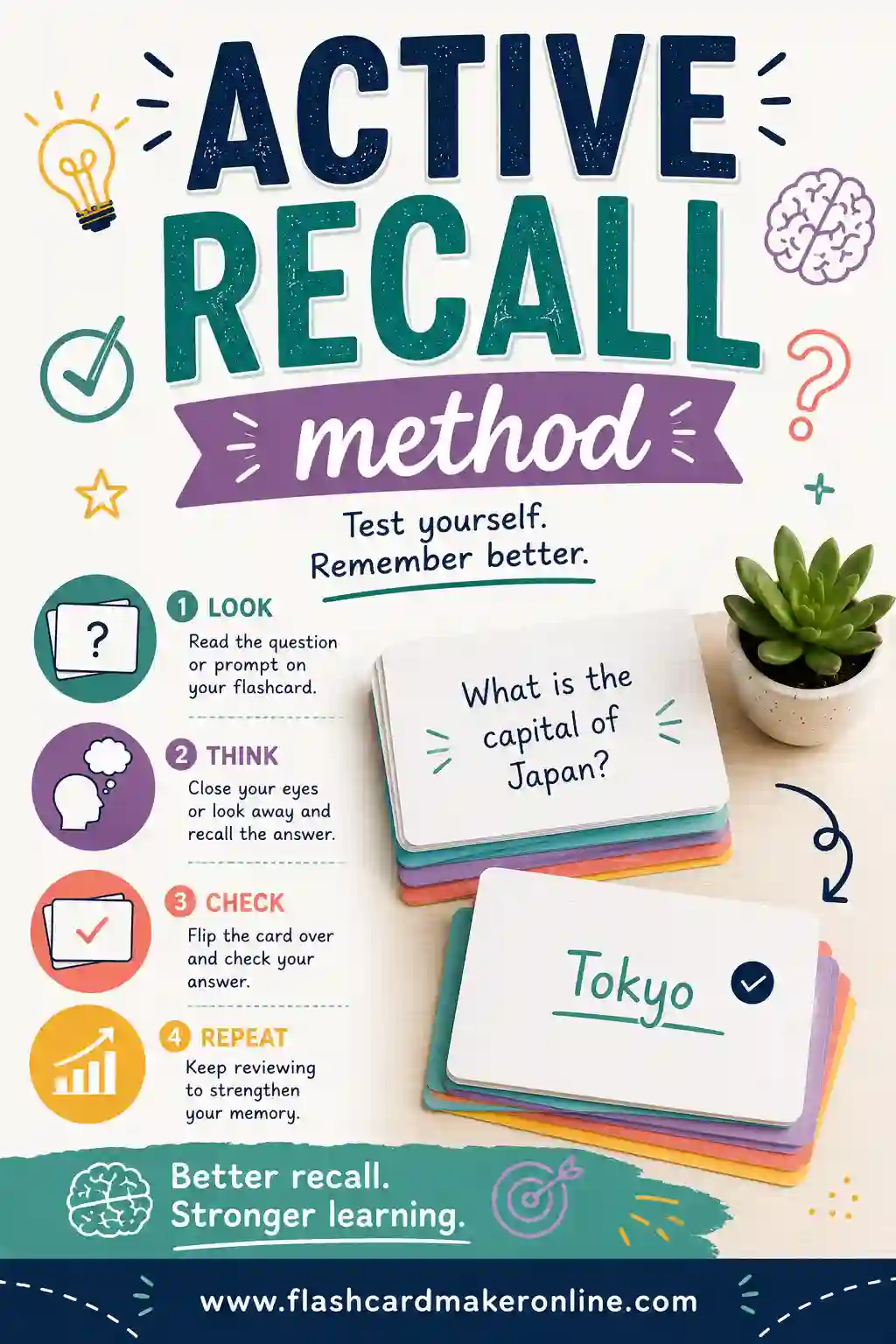
Some cards can simply say "Explain compound interest to a 12-year-old," with your refined explanation on the back. When you review, say your explanation out loud before flipping. This mixes the Feynman technique with active recall, and it fits Fiorella's finding that explaining from memory works better than explaining with notes in front of you.
Keep cards small
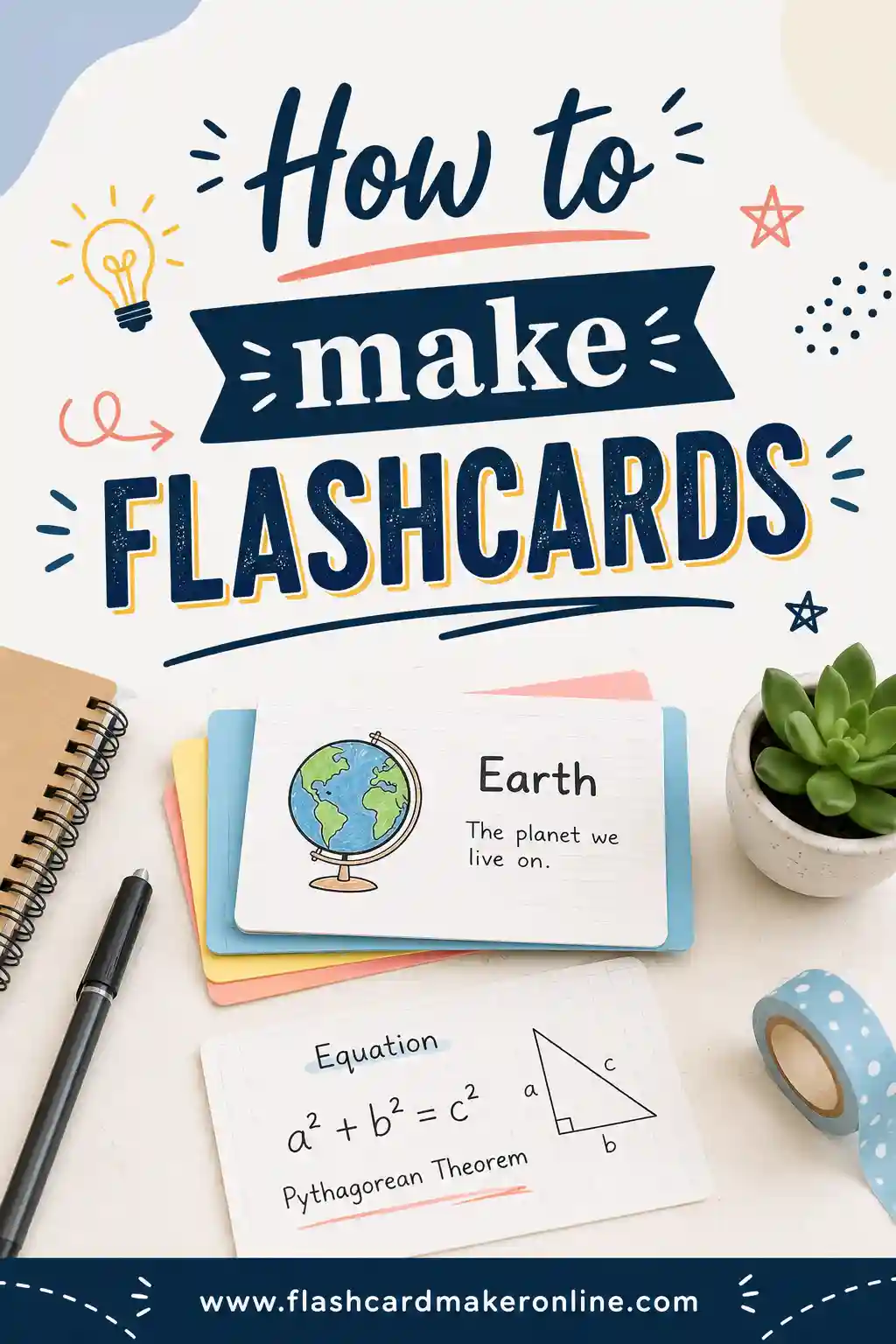
Your full explanation might be a paragraph. Your cards shouldn't be. Break it into separate questions so each card tests one piece. Our guide on how to make flashcards covers this in more detail.
Review over time
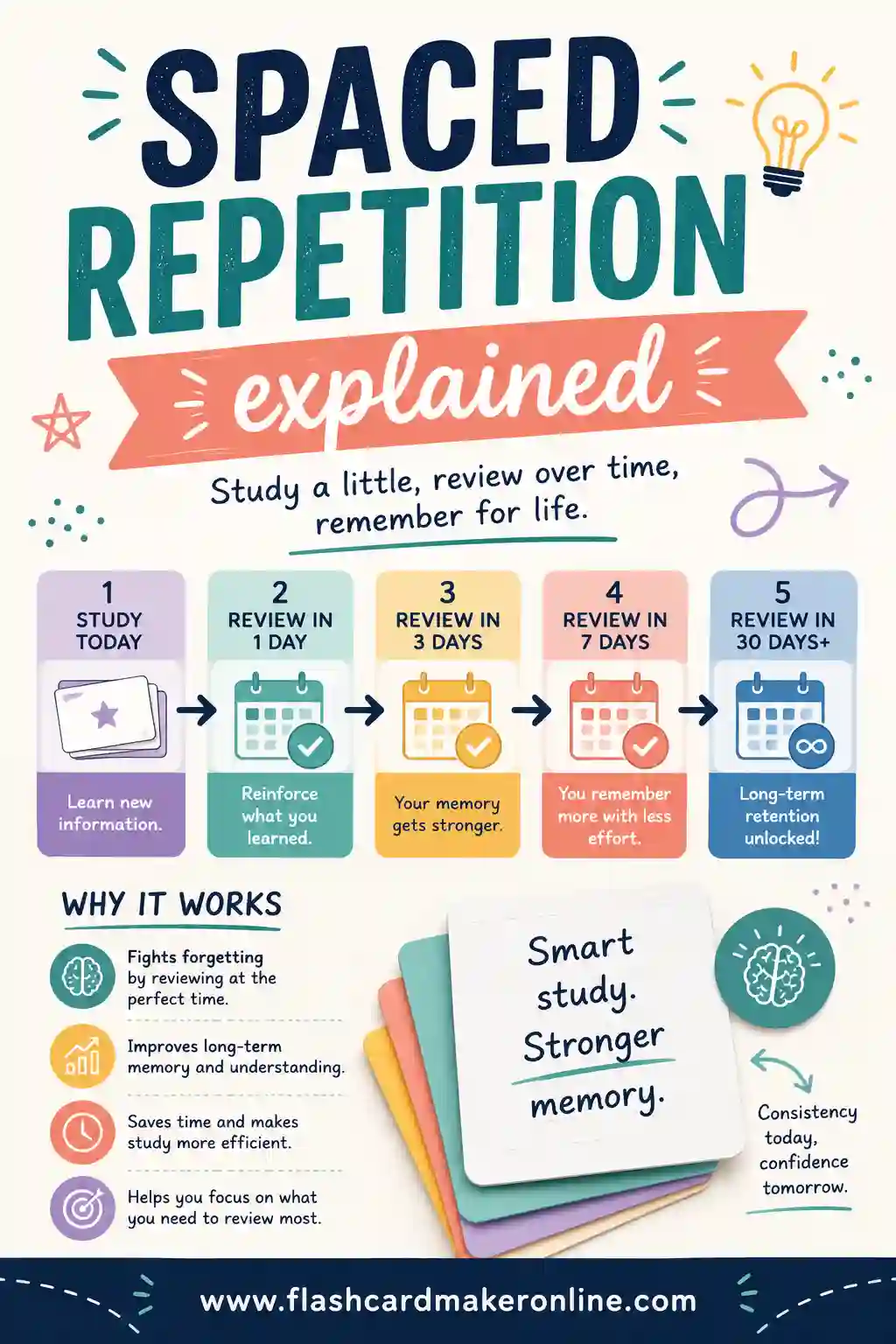
Go back to your cards a day later, then a few days later, then a week later. Spacing out reviews is one of the two techniques rated highest in the Dunlosky review. Our article on spaced repetition explains how to set up a schedule.
The Feynman technique compared with other study methods
| Method | What you do | Main strength | Main limit |
|---|---|---|---|
| Feynman technique | Explain a whole topic simply, find gaps, refine | Reveals what you don't understand; builds connected understanding | Takes time; doesn't by itself keep material in memory over weeks |
| Self-explanation | Explain each step or sentence to yourself as you study | Strong research base; easy to do while reading | Rated moderate utility; works better with some background knowledge |
| Elaborative interrogation | Ask "why is this true?" about individual facts | Quick; great for fact-heavy subjects | Best for isolated facts; needs some prior knowledge |
| Practice testing (flashcards) | Recall answers from memory, then check | Rated high utility; strengthens long-term memory | Can become rote if cards only test definitions |
| Rereading | Read the material again | Easy and familiar | Rated low utility; creates false confidence |
On that last row: a 2006 study by Henry Roediger and Jeffrey Karpicke found that restudying made students more confident than testing did, yet the tested students remembered substantially more a week later. The Feynman technique, done from memory, is a kind of test. Rereading isn't.
When the Feynman technique works best
- Concepts with moving parts: processes, systems, causes and effects. How a vaccine works, why seasons happen, how supply and demand set a price, how a bill becomes a law.
- Topics you've already studied once: you need some material to explain. It's a second-pass method, not a first-pass one.
- Before exams with essay or "explain" questions: it's direct practice for the kind of answer you'll have to write.
- When you suspect you're fooling yourself: if a topic feels familiar but you can't say why something happens, that's the moment to try it.
It's less useful for things that don't have much to explain: vocabulary in a new language, the spelling of a word, a list of dates, or formulas you just need to recall quickly. For those, straightforward flashcard recall and spacing are more efficient.
What it looks like in different subjects
The steps stay the same, but the kind of gap you find changes by subject. Here are short sketches of what a first explanation and its weak spot might look like. These are illustrative examples, not complete lessons.
Biology: why we breathe faster during exercise
A first try might be: "When you exercise, your body needs more oxygen, so you breathe faster." The gap shows up when you ask why the body needs more oxygen. Filling it means connecting muscles, energy and cellular respiration: working muscles use more energy, cells release that energy using oxygen, and they produce more carbon dioxide that has to be breathed out. Once you can tell that full chain in plain words, you understand it. Cards for each link in the chain fit well in a biology flashcard deck.
Physics: why a heavy and a light ball fall at the same rate (ignoring air)
Many people's first explanation stalls immediately, because intuition says heavier things fall faster. Explaining it forces you to deal with the idea that a heavier object is pulled harder by gravity but is also harder to speed up, and the two effects balance. If you can't explain that balance simply, you've found exactly what to review.
History: why a war started
History explanations often start as a list: "There were three causes." The Feynman test is whether you can explain how the causes connected and why they led to war at that moment and not earlier. Turning a list into a cause-and-effect story is where understanding happens.
Math: why a rule works
"To divide fractions, flip the second one and multiply" is a procedure, not an explanation. Try explaining why it works to an imaginary younger student. If you can't, practice problems will still get you the right answers, but you'll be more likely to misapply the rule. For formula-heavy subjects, pair explanation cards with plain recall cards, like the ones in our physics formula flashcards guide.
Choosing your imaginary student
The "explain it to a child" instruction is common, but you don't have to take it literally. What matters is picking a listener who forces you to drop shortcuts.
- A curious 12-year-old works well for most school topics. They know everyday things but not your subject's vocabulary.
- A smart friend in a different major is a good choice for advanced material. You can assume general knowledge, but every technical term needs a plain explanation.
- Yourself before the course is a useful listener too. What would you have needed to hear on day one to follow this?
Some fields can't be fully explained to a child without losing accuracy, and that's fine. Remember that Feynman's own test, as Goodstein told it, was a freshman lecture, not a kindergarten one. Aim for the simplest explanation that's still correct.
A template you can copy
If a blank page feels intimidating, use these prompts. Answer each one in a sentence or two, without notes.
- In one sentence, what is it?
- Why does it matter, or what problem does it solve?
- How does it work, step by step?
- What's an everyday comparison?
- What's a concrete example with real numbers or names?
- What's a common misunderstanding about it?
- Which of my answers above was weakest? That's your Step 3.
Each prompt can become its own flashcard later. For more ideas on writing and reviewing cards, see our flashcard study tips.
Signs your explanation is good enough
How do you know when to stop refining? Here are some practical checks.
- No undefined jargon. Every technical word is either gone or explained the first time it appears.
- Every "because" has a reason after it. Read your explanation and underline each claim. Can you say why each one is true? If not, that's another gap.
- It has at least one concrete example. Abstract explanations can hide confusion. Real numbers, names or situations expose it.
- You can say it out loud without looking. If you need to glance at your written version, the understanding isn't fully yours yet.
- You can answer a "what if" question. Change one detail and predict what would happen. For compound interest: what if the interest were added monthly instead of yearly? If you can reason it out, your understanding is flexible, not memorized.
- It matches a trusted source. Simple and wrong is worse than complicated and right. Do a final check.
How long it takes and how often to do it
A full pass on one concept usually takes 15 to 30 minutes, depending on how big the concept is and how many gaps you find. That's much slower per page than rereading, so use it where it counts.
A practical approach for a typical course:
- Weekly: pick the one or two hardest ideas from that week's material and run them through the Feynman technique.
- Before a unit test: list the five or six big concepts the test covers and do a quick, five-minute spoken explanation of each, from memory. Note which ones fall apart and spend your study time there.
- Daily: review the flashcards you made from your gaps. This is short, and it's what keeps the understanding from fading.
The explaining builds understanding. The flashcards and spacing keep it. Neither does the whole job alone.
Common mistakes and honest limits
- Explaining with the book open. It feels productive, but you're copying, not retrieving. Close your notes first.
- Retelling instead of explaining. If your explanation is just the textbook in a different order, you've hit the knowledge-telling trap. Ask "why" and "how" at each step.
- Oversimplifying until it's wrong. Simple language is the goal, but not at the cost of accuracy. "Electricity is like water in pipes" is a useful start, but know where the comparison breaks down. Check your final version against a reliable source.
- Skipping Step 3. The gap-filling step is where the learning happens. If you never go back to the source, you're just practicing what you already knew.
- Stopping at understanding. Understanding fades too. Turn your explanation into cards and review them.
- Letting it make you anxious. Fiorella notes that in some studies, the prospect of teaching made students anxious enough to cancel out the benefits. The Feynman technique has an advantage here: your "student" is imaginary. No one else needs to see your messy first draft.
- Expecting it to replace practice. Explaining how to solve a type of math problem isn't the same as solving it. Do both.
One more honest point. The research on self-explanation and learning by teaching is encouraging but not unlimited. Effects vary across studies, and many experiments are short. The Feynman technique is best thought of as a sensible way to apply well-supported principles, not as a proven method in its own right, since no study has tested "the Feynman technique" as a four-step package under that name, as far as we could find.
Try it yourself in 15 minutes
- Choose something you "know." Pick a concept from a class you're taking that you feel fairly confident about. How a rainbow forms, why the moon has phases, or what inflation is are good choices.
- Rate yourself. On a scale of 1 to 7, how well do you understand it? Write the number down.
- Close everything and explain. Set a timer for five minutes and write an explanation for a curious 12-year-old. No jargon unless you define it.
- Rate yourself again. Many people's numbers drop here, just as in the Rozenblit and Keil studies.
- Circle the weak spots. Mark every place you hesitated, used a term you couldn't define, or skipped a step.
- Fix them. Spend five minutes with your notes or textbook on just those spots.
- Rewrite. Write a clean version with one example or comparison. Then turn the circled spots into three to five flashcards.
Review those cards tomorrow and again in a few days. That's the whole loop: explain, find gaps, fix, then lock it in.
Using it with a study partner or group
The Feynman technique works on your own, but a real listener adds something. Fiorella's review notes that interacting with learners, answering their questions and clarifying confusion, is another stage of teaching that can add benefits beyond explaining alone.
- Take turns teaching. Each person explains one concept from memory for three minutes. The listener's only job is to ask "why?" or "what does that mean?" whenever something is unclear.
- Swap explanations, then quiz. After each explanation, the listener asks two flashcard-style questions on what they just heard.
- Keep it low-stakes. Nobody should feel graded. The goal is to find gaps, and gaps are expected.
Our guide to flashcards for group study has more ideas for running sessions like this.
Turn your explanations into flashcards
Once you've explained a topic clearly, the next job is keeping it. The free flashcard maker on our homepage lets you add your own words and pictures, study with flip cards on screen, and print your cards double-sided or as cut-out sheets. Put your gap questions and "explain it" prompts on cards, answer them out loud before you flip, and review them over the next few days.
Feynman's own standard, as Goodstein told it, was that if you can't bring an idea down to a beginner's level, you don't understand it yet. You don't need to be a Nobel physicist to use that test. You just need a blank page and the honesty to notice where your explanation falls apart.
The Four Steps and Priya's Example, Step by Step
This table matches each step of the method to what Priya, the made-up student in the worked example, did with compound interest.
| Step | What you do | What Priya did |
|---|---|---|
| 1. Pick a concept | Write its name at the top of a blank page | Wrote "Compound interest" |
| 2. Explain it simply | Teach it in plain language to a curious friend or younger student | Said it is earning interest on your interest, then noticed she used "compounds" to explain "compound" |
| 3. Find the gaps | Go back to your source material wherever you got stuck | Found that each round of interest is added to the balance and the next round is figured on the bigger balance |
| 4. Simplify and refine | Rewrite more clearly, ideally with an example or comparison | Used a snowball rolling downhill, with no jargon |
Frequently Asked Questions
What is the Feynman technique?
The Feynman technique is a study method where you explain a concept in simple words, as if teaching someone with no background, then go back to your notes to fix any parts where your explanation got stuck or vague. Finally, you rewrite the explanation more clearly, often with an example or comparison. The idea is that trying to explain something exposes gaps in your understanding that rereading would hide. It needs only a blank page and some honesty.
Did Richard Feynman create the Feynman technique?
Not as a formal method. Feynman never published a four-step study technique under that name, and we could not find any source where he described one. The label appears to be a modern one, attached to him because of his reputation as an exceptionally clear teacher. A well-documented story told by Caltech physicist David Goodstein captures the spirit: when Feynman could not explain a topic at a freshman level, he took it as a sign the topic was not truly understood yet.
Is the Feynman technique backed by science?
The four-step package itself has not been tested as a named method, as far as we could find. But its core ingredients have solid research behind them. Studies by Michelene Chi and colleagues show that explaining material to yourself improves understanding, and research on learning by teaching shows benefits from preparing to teach and from explaining from memory. A 2013 review rated self-explanation moderate utility, so it works best combined with self-testing and spaced review.
What are the four steps of the Feynman technique?
First, pick a concept and write its name at the top of a page. Second, explain it in plain language as if teaching a curious beginner, avoiding jargon you cannot define. Third, identify the spots where you got stuck or were vague, and go back to your source material to relearn them. Fourth, simplify and refine your explanation, adding an example or comparison, until it flows clearly from start to finish without notes.
How is the Feynman technique different from self-explanation?
They overlap heavily. Self-explanation, as studied by researchers, usually means explaining each sentence or step to yourself while you read or work through examples. The Feynman technique usually means explaining a whole topic after studying it, aimed at an imagined beginner, then fixing the gaps. You can think of the Feynman technique as a structured, after-study version of self-explanation, with an added focus on simple language and on checking your work against a source.
Can I use the Feynman technique with flashcards?
Yes, and the two work well together. The Feynman technique builds understanding, and flashcards help you keep it. Turn each gap you found into a card, such as a question about the step you could not explain. You can also make cards that say explain this concept simply, with your refined explanation on the back. Answer out loud before flipping, keep each card focused on one idea, and review the deck over several days.
What subjects is the Feynman technique best for?
It shines with concepts that have moving parts: processes, systems, causes and effects. Examples include how vaccines work, why seasons change, how supply and demand set prices, and how a bill becomes law. It is also good practice for essay and explain-type exam questions. It is less useful for things with little to explain, such as foreign vocabulary, spellings, lists of dates or formulas you simply need to recall quickly.
Why does explaining something reveal what I do not know?
Most people overestimate how well they understand how things work. In studies by Rozenblit and Keil at Yale, people rated their understanding of devices like zippers and flush toilets, then tried to write step-by-step explanations. Their ratings dropped significantly afterward. The effect was strongest for explanations of how things work and weaker for simple facts. Writing an explanation forces you to fill in each step, so missing links become obvious.
Should I explain from memory or with my notes open?
From memory. Research reviewed by Logan Fiorella found that students who taught a lesson from memory did better on a delayed test than students who taught with their notes available. Explaining from memory works as retrieval practice, which strengthens long-term memory. Close your book, give your best explanation, and only then open your notes to check and fix the gaps. Explaining with the book open mostly turns into copying.
Sources
We checked every source below while writing this guide. Last reviewed October 30, 2026, by Joan Ramos.
- Richard P. Feynman: Facts, Nobel Prize in Physics 1965 (NobelPrize.org)
- Feynman at 100 (Caltech Magazine, California Institute of Technology)
- Self-explanations: How students study and use examples in learning to solve problems (Chi et al., 1989), Cognitive Science (Science Education Resource Center, Carleton College)
- Eliciting Self-Explanations Improves Understanding (Chi et al., 1994), Cognitive Science (Arizona State University)
- Learning by Teaching (Logan Fiorella), in In Their Own Words, APA Division 2, 2023 (University of New Hampshire Teaching and Learning Resource Hub)
- The misunderstood limits of folk science: an illusion of explanatory depth (Rozenblit & Keil, 2002), Cognitive Science (PubMed Central, US National Library of Medicine)
- Improving Students' Learning With Effective Learning Techniques (Dunlosky et al., 2013), Psychological Science in the Public Interest (PubMed, US National Library of Medicine)
- Test-enhanced learning: taking memory tests improves long-term retention (Roediger & Karpicke, 2006), Psychological Science (PubMed, US National Library of Medicine)