Flashcard Study Tips That Actually Make Facts Stick
The best flashcard study tips come down to two ideas: always try to recall the answer before you flip the card, and review your deck across several days instead of cramming it once. That combination, active recall plus spaced repetition, is what moves facts into long-term memory. The rest is about writing clean cards and reviewing them in a smart order.
Want a deck to practice these tips on right away? Open the free flashcard maker, paste in your terms (there's a ready-made sample deck below), and you'll have a study-ready set in minutes. No sign-up, no app to install.
Tip 1: Always Use Active Recall
This is the big one. When you look at the front of a card, don't peek at the back. Force yourself to answer first, out loud or in your head, then flip to check. That tiny moment of effort is the entire point of a flashcard.
Here's why it works. Pulling an answer out of your own memory strengthens the path to that fact, a bit like wearing a trail into the grass by walking it. Rereading your notes feels productive, but it doesn't build that path. Recall does.
So the rule is simple: never flip a card before you've made a real attempt at the answer. If you blank, that's useful information. It tells you exactly which card needs more work.
Tip 2: Space Your Reviews Across Days
Cramming a deck in one long session feels efficient, but most of it fades fast. Spacing the same reviews across several days locks the facts in for far longer, with less total time spent.
The reason is something called the forgetting curve. A fact you learn today starts to fade almost immediately. If you review it just as it begins to slip, the memory rebounds stronger and fades slower next time. Catch it again later, and it sticks even longer.
A simple schedule looks like this:
| When | What to review |
|---|---|
| Same day you make the deck | Everything, once |
| Next day | The whole deck, focus on misses |
| 3 days later | Quick pass, retire easy cards |
| 1 week later | Full review to lock it in |
| Before the test | Only the cards you still miss |
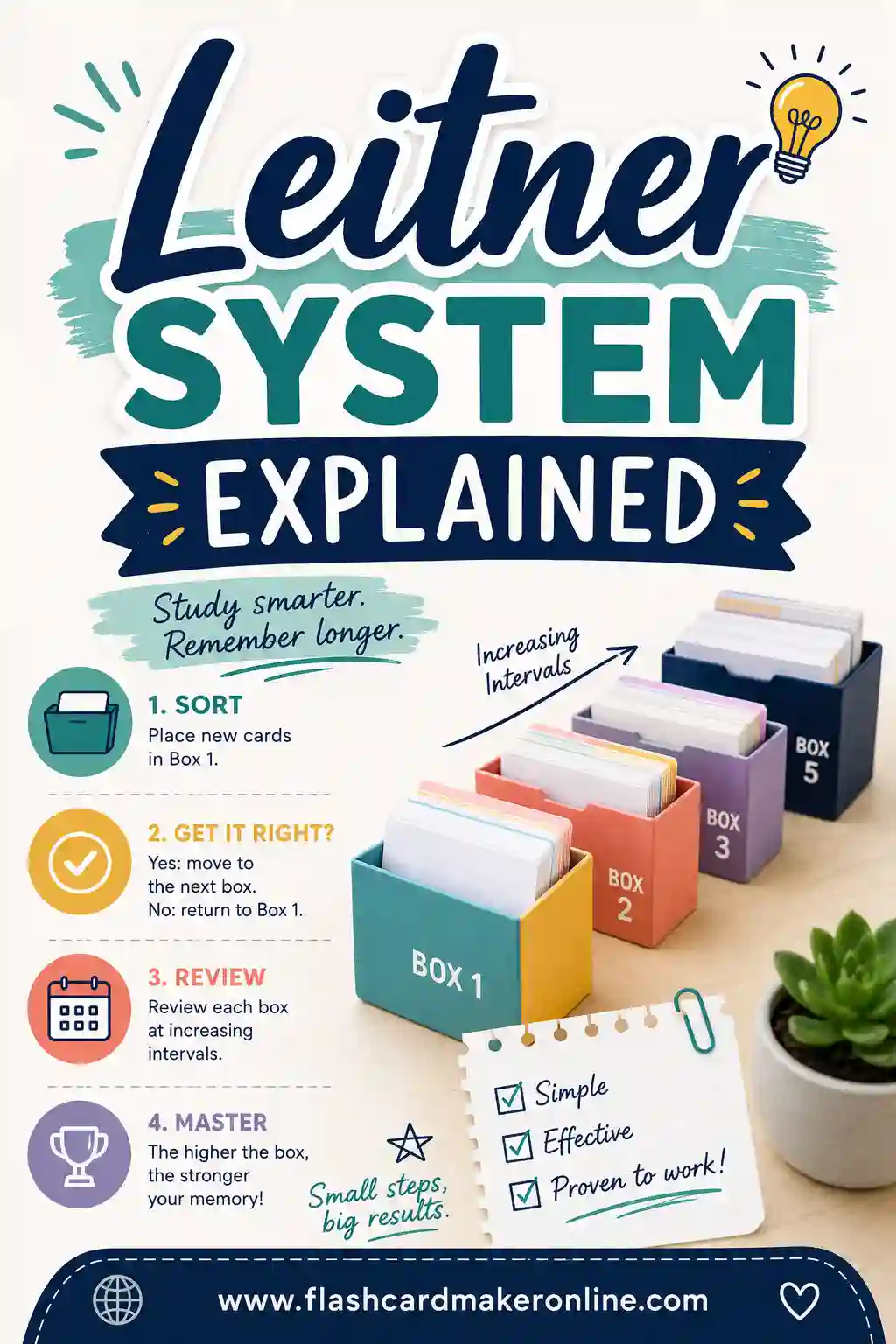
You don't need to be perfect about the dates. Just don't drill a deck once and never come back. For a structured way to handle the spacing automatically, see the Leitner system explained.
Tip 3: Keep One Idea Per Card
A card crammed with five facts teaches you almost nothing, because you can never tell which part you actually know. A clean card with one prompt and one answer teaches you a lot, because the result is honest: you either know it or you don't.
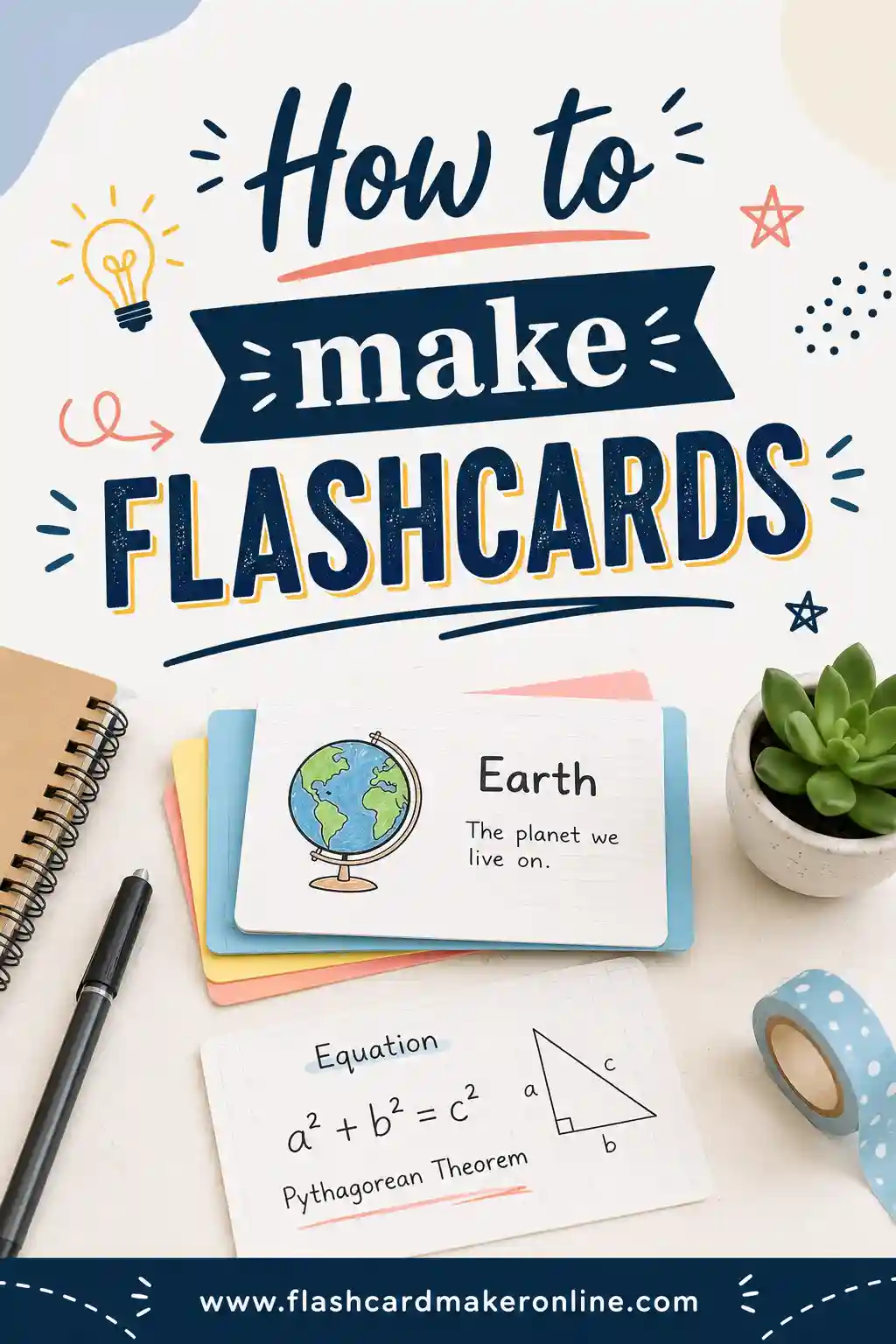
If you're tempted to add a second fact, make a second card. This single habit fixes more weak decks than any other. If you're building a deck now, our guide on how to make flashcards walks through writing clean cards step by step.
Signs a card is doing too much:
- The back runs three lines or more.
- The answer has the word "and" two or three times.
- You sometimes get part of it right and part wrong.
Split those cards. Smaller cards are faster to review and far easier to learn.
Tip 4: Shuffle Every Single Session
If you always review your cards in the same order, your brain quietly memorizes the sequence instead of the facts. You feel confident in your room, then freeze on the test when the questions come scrambled.
The fix is easy: shuffle the deck before every session. A digital flashcard maker does this in one click, which is one of the quiet advantages of studying on a screen. Mix the order, and every card has to stand on its own.
Tip 5: Sort Cards by How Well You Know Them
Not every card needs the same attention. Some you'll nail on the first try. Others will trip you up again and again. Spending equal time on both wastes your effort.
As you review, split your cards into piles:
- Got it cold. You answered instantly. Retire these to a "review later" stack and see them rarely.
- Shaky. You got it, but slowly or with a guess. Keep these in regular rotation.
- Missed it. You blanked or got it wrong. These come back soon and often.
This is the heart of the Leitner system, and it's brutally efficient. You pour your limited study time into the facts that actually need it instead of re-drilling things you already know.
Tip 6: Write Cards in Your Own Words
Copying a definition word-for-word from a textbook is a trap. You can recognize the sentence without understanding the idea. If you can't restate a fact in plain language, you don't truly know it yet.
So when you make a card, rewrite the answer the way you'd explain it to a friend. That act of rephrasing forces real understanding, and the plain-language version is also easier to recall under pressure.
A quick test: cover the textbook and try to write the back from memory. If you can, your card is in your own words. If you have to peek, keep working on understanding it first.
Tip 7: Phrase the Front as a Question
A front that just says "osmosis" is weak, because it doesn't ask you anything. A front that says "What is osmosis?" triggers retrieval. The question mark does real work, it tells your brain to go find an answer.
Avoid yes/no fronts too. "Is Paris the capital of France?" teaches nothing, because you can guess. "Capital of France?" forces an actual recall. Whenever you can, turn a term into a question.
Tip 8: Study in Short, Frequent Sessions
Three focused 15-minute sessions beat one exhausting 45-minute slog. Your attention fades over a long block, and tired review is shallow review. Short bursts keep you sharp and fit easily into a busy day.
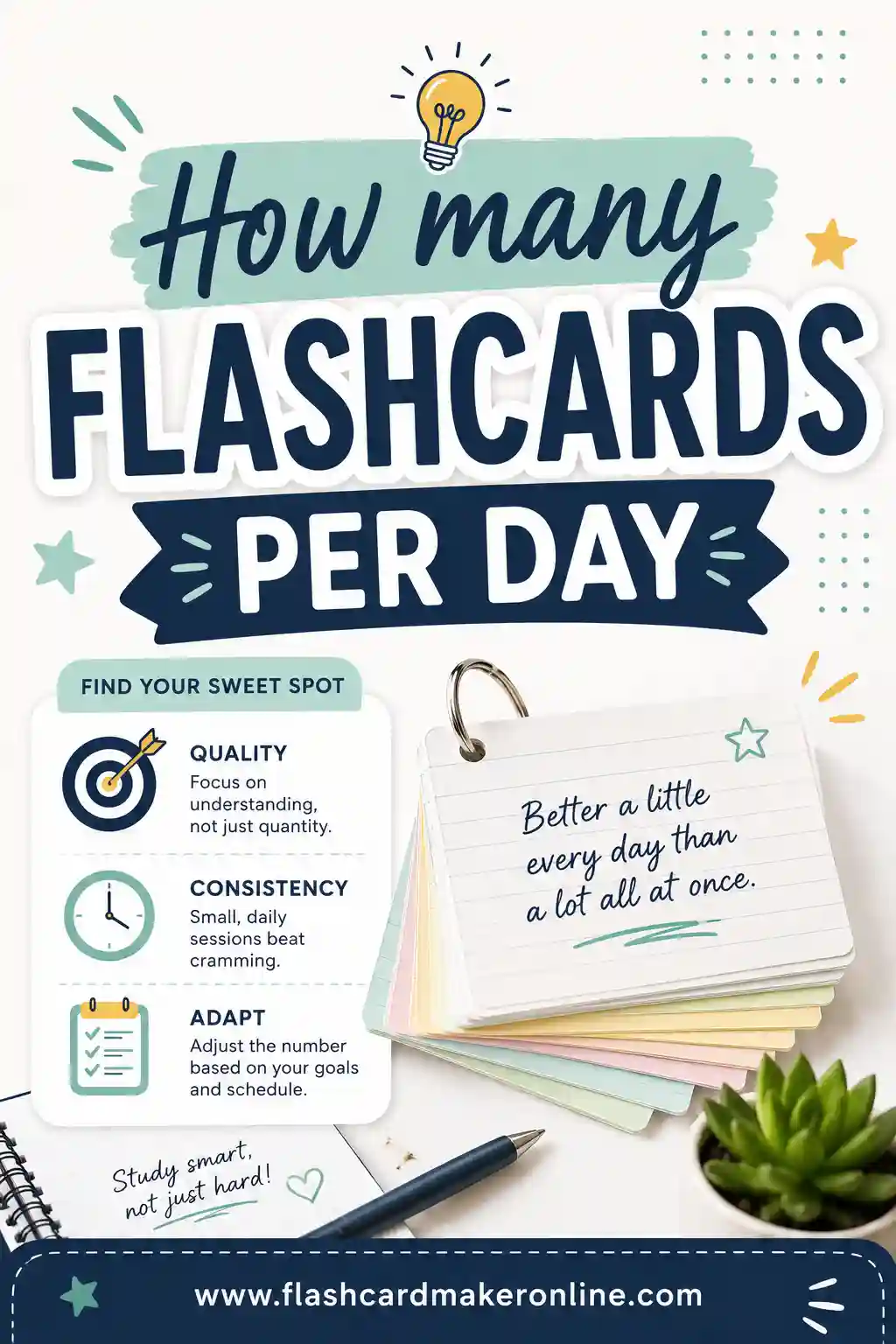
This pairs perfectly with spaced repetition. Instead of one big study night, do a little most days. It feels lighter, and you remember more. Wondering how big each session should be? Our guide on how many flashcards per day gives you concrete numbers to aim for.
A sample daily routine
| Time of day | Session | What to do |
|---|---|---|
| Morning | 10 min | New cards for the day |
| Midday | 5 min | Quick review of yesterday's misses |
| Evening | 15 min | Mixed review of the whole active deck |
Short and steady wins. You'll cover more ground over a week than any single cram could.
Sample Study Deck (Copy & Paste)
Here's a ready-to-use mixed deck so you can put these tips into practice. Copy any rows straight into the flashcard maker and try answering each front before you flip.
| Front (term / question) | Back (answer) |
|---|---|
| What is active recall? | Retrieving an answer from memory |
| What is spaced repetition? | Reviewing at growing time intervals |
| What is the forgetting curve? | How fast we forget without review |
| One idea per card means? | Each card tests a single fact |
| Why shuffle a deck? | To learn facts, not the order |
| Capital of Australia? | Canberra |
| H2O is the formula for? | Water |
| The powerhouse of the cell? | Mitochondria |
| Spanish: "gracias" | Thank you |
| 8 x 7 = ? | 56 |
| Who wrote Hamlet? | William Shakespeare |
| Speed = distance ÷ ? | Time |
| Largest planet? | Jupiter |
| What year did WWII end? | 1945 |
| Freezing point of water (°C)? | 0°C |
| Chemical symbol for sodium? | Na |
| A synonym for "fast"? | Quick / rapid |
| Capital of Canada? | Ottawa |
| What is a noun? | A person, place, thing, or idea |
| Area of a triangle? | ½ × base × height |
Use this deck as a warm-up. As you go, notice how the cards you miss are the ones worth coming back to, and let the easy ones drift to the back.
Frequently Asked Questions
What is the most effective way to study flashcards?
Use active recall and spaced repetition together. Always try to answer the front before you flip, and review your deck across several days instead of cramming. Sort cards by difficulty so you spend the most time on the ones you keep missing.
How long should a flashcard study session be?
Short and frequent beats long and rare. Aim for 10 to 20 minutes per session and do a few sessions across the day or week. Your focus stays sharp, and the spacing helps the facts stick better than one long cram.
Should I shuffle my flashcards?
Yes, every session. If you always study in the same order, you memorize the sequence instead of the facts and freeze when the test scrambles them. A digital flashcard maker shuffles your deck in one click.
How do I remember flashcards faster?
Write clean cards with one idea each, phrase fronts as questions, and use your own words for the answers. Then drill with active recall and spaced repetition, focusing your time on the cards you miss most. Clean cards plus smart review is the fastest path.
Is it better to make my own flashcards or use someone else's?
Making your own is usually better, because writing the cards in your own words is itself a powerful study step. Pre-made decks save time but skip that benefit, and they may not match exactly what you need to learn.
How often should I review my flashcards?
Review a new deck the same day, again the next day, then space the reviews out (a few days, then a week). This spaced schedule keeps facts fresh with far less total study time than reviewing everything every day.
Ready to Put These Tips to Work?
Grab the sample deck above, open the free flashcard maker, and start practicing active recall today. Answer before you flip, shuffle every session, and come back over several days to let spaced repetition do its quiet work. It's free, there's no sign-up, and you can build as many decks as you need. The tips only work when you use them, so make your first deck and start flipping.