Elaborative Interrogation: The Why-Question Study Technique, With Examples
Elaborative interrogation is a study technique where you ask "Why is this true?" about each fact you're learning, then come up with an answer yourself. Instead of just reading "Plants give off oxygen," you stop and explain to yourself why that would be the case. Research going back to the 1980s shows this simple habit can improve memory for facts, especially when you already know a bit about the topic. A major 2013 review rated it "moderate utility": promising and easy to use, but with less classroom evidence than self-testing or spacing.
This guide explains what elaborative interrogation is, the studies behind it, when it works and when it doesn't, and how to turn it into flashcards you can actually use. You'll also find plenty of worked examples across subjects so you can see what a good "why" answer looks like.
What elaborative interrogation means
The name sounds technical, but the idea is simple. "Elaborative" means adding detail and connections. "Interrogation" means questioning. Put together, it's questioning a fact until you've connected it to something you already know.
In the most cited review of study methods, published in 2013 in Psychological Science in the Public Interest, John Dunlosky and four colleagues defined it as generating an explanation for why an explicitly stated fact or concept is true. Dunlosky later wrote a shorter, teacher-friendly version of that review, "Strengthening the Student Toolbox," for the Fall 2013 issue of American Educator, and it includes a nice everyday example.
Imagine a student reading that photosynthesis is a process in which a plant turns carbon dioxide and water into sugar, its food, and gives off oxygen. Using elaborative interrogation, she asks why that's true. She might reason that everything alive needs some kind of food, and sugar is something she eats as food too. As Dunlosky points out, her answer may not be exactly right. But the effort of trying to explain why a fact is true, even when the explanation isn't fully on the mark, can still help understanding and memory.
The two key parts are:
- A clear fact or statement to think about.
- A "why" question that you answer from your own knowledge before checking anything.
That's it. No special materials, no app, no training course. That's a big part of why researchers find it appealing.
Why asking "why" helps you remember
Most forgetting isn't about facts disappearing. It's about facts that were never tied to anything. A random, isolated statement has nothing to hold onto in your memory. When you explain why it's true, you link it to things you already understand, and those links become paths back to the fact later.
Dunlosky's American Educator article puts it this way: elaborative interrogation and its close cousin, self-explanation, encourage students to actively process what they're studying and integrate it with their prior knowledge.
There's also a "doing it yourself" effect at work. UCLA researchers Elizabeth and Robert Bjork describe the generation effect as the long-term benefit of producing an answer or explanation yourself instead of being handed it. When you come up with the "why," you're generating. When you read someone else's explanation, you're not. As you'll see below, that difference showed up clearly in the early studies.
Here's an everyday comparison. Imagine trying to remember that a friend's new apartment is on the fourth floor. If that's all you know, it's easy to forget. But if you know she picked the fourth floor because she wanted a view of the park and didn't want neighbors stomping above her on the top floor, the number is suddenly attached to a story. Ask yourself about it next month and the story helps bring the number back. Elaborative interrogation tries to give every important fact a small story like that.
The "why" question also works as a built-in check. If you can't answer it at all, that's a signal that you may not understand the material as well as you thought. Catching that gap during study is much better than discovering it during the test.
The research behind elaborative interrogation
Elaborative interrogation grew out of research in the late 1980s, much of it led by Michael Pressley and colleagues, including Mark McDaniel, who is now at Washington University in St. Louis.
The "man sentences" study (Pressley and colleagues, 1987)
The classic experiment, published in the Journal of Experimental Psychology: Learning, Memory, and Cognition, used sentences that are deliberately random, like "The fat man read the sign." There's no obvious reason a fat man would read a sign, so the sentence is hard to remember. That's the point.
Across three experiments with adults, people saw sentences in several ways:
- Base sentence only: "The fat man read the sign."
- Sentence with a precise explanation added: "The fat man read the sign warning about thin ice."
- Base sentence plus a "why" question: "Why did that particular man do that?"
Here's what they found. Simply being given a precise explanation had moderate benefits, and only for incidental learning (when people weren't trying to memorize). But generating explanations in response to the "why" question produced much larger gains, for both incidental and intentional learning. In other words, thinking up the reason yourself beat reading a good reason someone else wrote.
Real facts, not just odd sentences (Pressley and colleagues, 1988)
Random sentences are a lab tool. Would the technique work on real information? In a follow-up in the Journal of Educational Psychology, Pressley, Symons, McDaniel, Snyder and Turnure ran four experiments with adults. The first two used arbitrary sentences. The last two used real-world facts that were new to the participants but that they could make sense of with things they already knew.
They compared three approaches: building a reason why each fact makes sense (elaborative interrogation), forming a mental image of each fact, and just reading. Both elaborative methods led to much better recall than reading alone, and they didn't differ reliably from each other. The authors called elaborative interrogation a powerful procedure for learning facts.
The 2013 review: a careful "moderate"
When Dunlosky and colleagues reviewed 10 popular study techniques in 2013, they rated each one high, moderate, or low utility. Elaborative interrogation landed in the middle.
| Rating | Techniques |
|---|---|
| High utility | Practice testing, distributed practice (spacing) |
| Moderate utility | Elaborative interrogation, self-explanation, interleaved practice |
| Low utility | Summarization, highlighting, the keyword mnemonic, imagery for text, rereading |
Why only moderate? Dunlosky explains in his American Educator piece that it wasn't because the technique failed. It was because the team wanted more evidence in key areas before giving it top marks. Only a couple of experiments had shown that elaborative interrogation improves comprehension (as opposed to memory for facts), only a few studies had tested it in real classrooms, and most of the research used isolated facts rather than long texts. He also notes that, as a teacher, he finds its overall promise strong enough to encourage his own students to use it.
That's a fair way to hold it: a well-supported technique for learning facts, with open questions about how far it stretches.
When it works best and when it doesn't
The most important limit is prior knowledge. You can only explain why something is true if you know enough to build an explanation. Dunlosky writes that students with no relevant knowledge of a new subject may find elaborative interrogation difficult or impossible, because they can't generate any explanation for a new fact. As students learn more about a topic, the technique gets easier and supports more learning.
He also notes that research shows students as young as the upper elementary grades can use it successfully, but it may be less useful for younger students with little background knowledge.
| Works well when... | Works poorly when... |
|---|---|
| You know something about the topic already | The topic is brand new and you have nothing to connect it to |
| You're learning facts that have a reason behind them (science, history, economics) | The fact is arbitrary by nature, such as a phone number or a word's spelling |
| You take the time to actually answer the question | You read the "why" prompt and move on without answering |
| You check your answer against a reliable source | You never check, and a wrong explanation sticks |
| You're learning a manageable set of facts | You try to "why" every sentence in a 40-page chapter and run out of time |
A practical rule: if you sit with a "why" for 20 or 30 seconds and have absolutely nothing, don't force it. Look up the reason, read it, then come back the next day and try to explain it in your own words. At that point it becomes a recall exercise, which is useful in its own right.
How to use elaborative interrogation, step by step
- Pick a fact. One clear statement, like "Venus is hotter than Mercury" or "The Senate has two members from each state."
- Ask why. Some useful versions: "Why is this true?" "Why would this make sense?" "Why this and not something else?" "Why would this happen here and not there?"
- Answer it in your own words before looking anything up. Say it out loud or write a sentence or two. A rough guess is fine.
- Check your answer. Look at your textbook, notes or teacher's explanation. Was your reason right, partly right or off?
- Fix and connect. If you were wrong, note the right reason and how it differs from your guess. That contrast is memorable.
- Come back later. Turn the best "why" questions into flashcards and review them over the following days.
Step 3 is where the learning happens. The 1987 study showed that being handed a good explanation helped much less than generating one. So resist the urge to skip straight to the answer.
Worked examples across subjects
Below are examples of what a "why" question and a decent student answer might look like. Each answer is the kind of reasoning a learner might produce, not a perfect textbook explanation, and that's okay. The point is to show the thinking.
Biology
Fact: Cells that need a lot of energy, like muscle cells, tend to have many mitochondria.
Why? "Mitochondria are where cells make most of their usable energy. Muscles use a lot of energy when they contract, so it makes sense that they'd need more energy factories."
Earth science
Fact: Coastal cities usually have milder temperatures than inland cities at the same latitude.
Why? "Water heats up and cools down more slowly than land. So the ocean keeps the air near the coast from getting as hot in summer or as cold in winter."
US history and government
Fact: Each state gets two senators regardless of population.
Why? "Small states would worry about being outvoted by big states. Giving each state equal seats in one chamber protects small states, while the House is based on population. It was a compromise."
Economics
Fact: When the price of a product rises, people usually buy less of it.
Why? "People have limited money. If something costs more, some people switch to a cheaper option or decide they don't need it as much."
Chemistry
Fact: Salt dissolves faster in hot water than in cold water.
Why? "In hot water, the water molecules move faster, so they bump into the salt and pull it apart more often."
Language and grammar
Fact: In Spanish, adjectives usually change their ending to match the noun's gender.
Why? "Spanish nouns are grouped as masculine or feminine, and the language marks which words go together. Matching endings helps show which noun an adjective describes."
Notice that some of these answers simplify things. That's normal. The next step, checking against your textbook, is where you sharpen the explanation.
Turning "why" questions into flashcards
Flashcards and elaborative interrogation fit together naturally. A standard card asks "What?" A "why" card asks you to rebuild the reasoning, which forces deeper processing every time you review.
Three card formats that work
| Format | Front of card | Back of card | Best for |
|---|---|---|---|
| Fact plus why | "Arteries have thicker walls than veins. Why?" | "Arteries carry blood straight from the heart under high pressure, so they need thick, stretchy walls." | Science and cause-and-effect facts |
| Paired what and why | Card 1: "What does the Senate's structure give each state?" Card 2: "Why does each state get two senators?" | Card 1: "Two senators, regardless of population." Card 2: "A compromise to protect smaller states." | When you need both the fact and the reason |
| Why not | "Why don't plants just make food at night as well as by day?" | "Photosynthesis needs light energy, which isn't available at night." | Catching common misunderstandings |
Tips for writing good "why" cards
- Keep one idea per card. A "why" card with five reasons on the back is hard to recall and hard to grade yourself on.
- Write the back in your own words. Copying the textbook word for word turns it back into a reading exercise. Our guide on how to make flashcards has more card-writing tips.
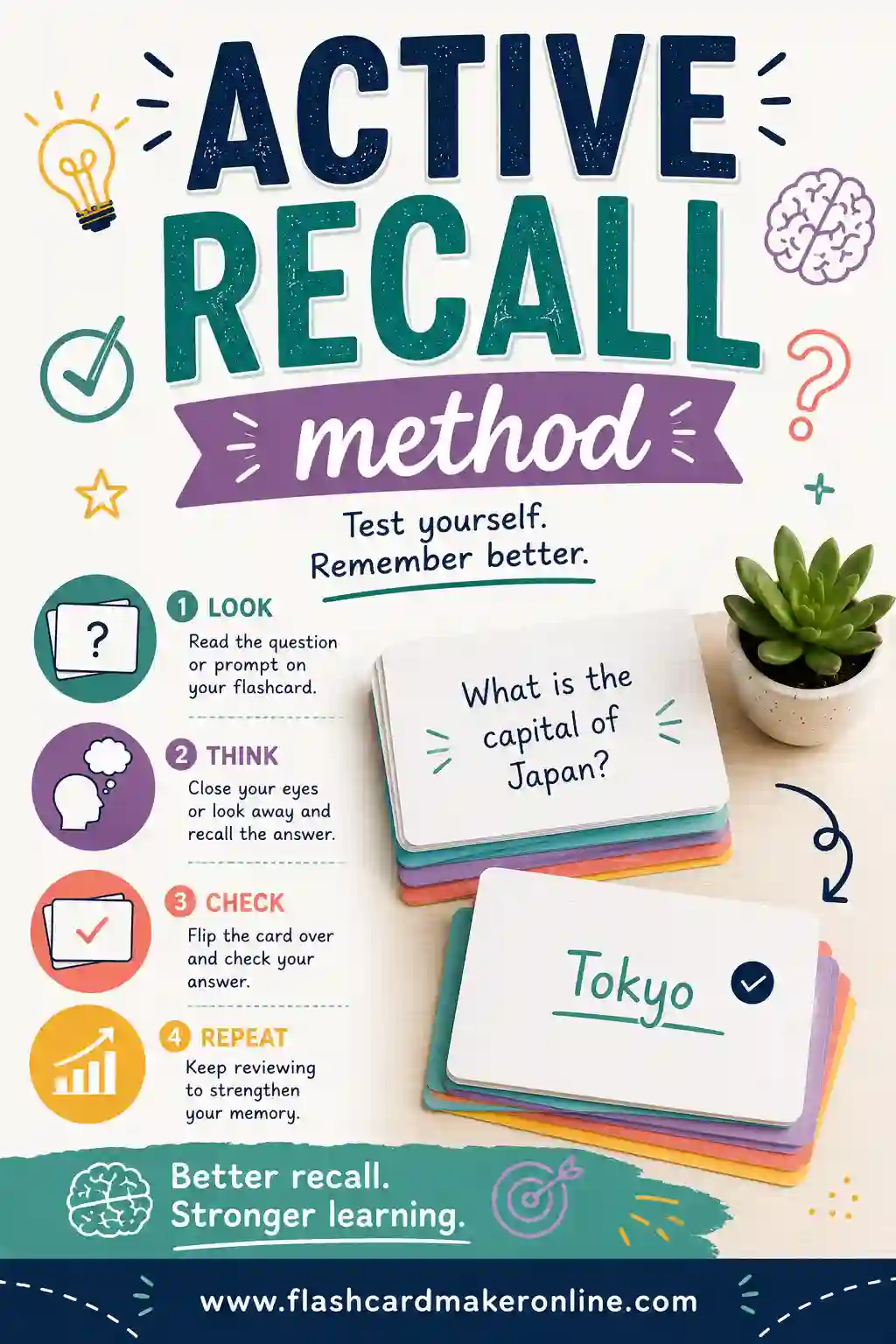
- Answer before you flip. Say your explanation out loud or jot it down, then compare. This combines elaborative interrogation with active recall.
- Grade on the reasoning, not the wording. If your explanation captures the same idea, count it as correct.
- Mix "what" and "why" cards in the same deck. You'll need to recall facts on a test, and you'll understand them better if you also know the reasons.
Elaborative interrogation compared with other methods
It's easy to confuse elaborative interrogation with similar techniques. Here's how they differ.
| Method | What you do | Main question | 2013 review rating |
|---|---|---|---|
| Elaborative interrogation | Explain why a stated fact is true | "Why is this true?" | Moderate |
| Self-explanation | Explain how new information relates to what you know, or explain the steps you took to solve a problem | "How does this connect?" or "Why did I do that step?" | Moderate |
| Practice testing | Recall information from memory, for example with flashcards | "What's the answer?" | High |
| Rereading | Read the material again | None | Low |
| Summarizing | Write a shorter version of the material | "What's the main point?" | Low |
Self-explanation is the closest relative. In a well-known 1994 study in Cognitive Science, Michelene Chi and colleagues asked 14 eighth graders to explain each line of a textbook passage on the circulatory system to themselves, while 10 classmates read the passage twice without prompts. The prompted group gained more from pretest to posttest, and students who produced the most explanations understood the most. It was a small study, but an influential one. The Feynman technique, which asks you to explain a topic in simple words, draws on the same idea.
Dunlosky's American Educator article also notes a key difference from paraphrasing. Self-explaining and elaborating aren't the same as restating the text in other words. If your "why" answer just repeats the fact ("Plants give off oxygen because they release oxygen"), you haven't added anything.
Strong versus weak "why" answers
Not every answer to a "why" question does the same work. A strong answer adds a reason or a mechanism you didn't get from the fact itself. A weak answer restates the fact, appeals to authority, or stays vague. Here's how to tell them apart.
| Fact | Weak answer | Why it's weak | Stronger answer |
|---|---|---|---|
| Deserts can get very cold at night. | "Because nights are colder." | Just restates the fact | "Dry air and clear skies let heat escape quickly after sunset, with little moisture or cloud to hold it in." |
| Ice floats on water. | "My teacher said so." | Appeals to authority, adds no reason | "Ice is less dense than liquid water, so it's pushed up, the same way a piece of wood floats." |
| Vaccines help prevent disease. | "Because they're good for you." | Too vague to connect to anything | "They let the immune system practice recognizing a germ, so it can respond faster if the real germ shows up." |
| Cities near rivers often grew quickly in the past. | "Rivers are important." | True but empty | "Rivers gave people water, food and an easy way to move goods by boat, so trade and settlement gathered there." |
A handy test: after you answer, ask "Could someone who already knew this fact learn something from my answer?" If the answer is no, push one step deeper. Ask "And why is that true?" once more. Two levels of "why" is usually plenty. Going much deeper can eat your study time with little extra payoff.
Combining "why" with self-testing and spacing
Elaborative interrogation helps a fact make sense. That's valuable, but understanding something once doesn't guarantee you'll remember it in three weeks. The 2013 review gave its top rating to two other techniques, practice testing and spacing, and the good news is that they combine easily with "why" questions.
Testing yourself is powerful on its own. In a 2006 study by Henry Roediger and Jeffrey Karpicke, students who took recall tests on prose passages remembered substantially more after two days and a week than students who spent the same time restudying, even though restudying made them feel more confident. When you review a "why" card by explaining the answer from memory before flipping, you're doing both: generating an explanation and practicing retrieval.
Spacing makes it last. Instead of going through your "why" deck five times in one evening, go through it once a day over several days. Each time, the reason will be a little harder to pull up, and that effort helps it stick. Our guide on how to beat the forgetting curve explains why gaps between reviews help.
A simple routine that combines all three:
- First pass: read the material and write "why" cards, answering each one yourself before checking.
- Next day: review the deck, explaining each answer out loud before you flip.
- Following days: review again at growing gaps, focusing on cards you missed.
For more on running review sessions well, see how to study with flashcards.
How teachers can use it in class
One of the strengths of elaborative interrogation is that it needs no preparation. A teacher can use it on the fly.
- Pause after key facts. When a new fact comes up in a lesson, ask the class "Why might that be true?" and give 30 seconds of thinking time before taking answers.
- Use think-pair-share. Students write a one-sentence "why" answer, compare it with a partner, then share the best explanations. Hearing different reasons helps students see what makes an explanation strong.
- Model a good answer. Younger students especially benefit from hearing what a real explanation sounds like versus a restatement. Dunlosky suggests teachers help younger students tell the difference between explaining an idea and paraphrasing it.
- Add "why" prompts to worksheets and reading guides. Instead of only "What is X?", include "Why does X happen?" next to the key facts.
- Turn class answers into a review deck. Collect the best student explanations and use them as the backs of a class set of "why" flashcards.
Dunlosky's own advice to teachers is practical: tell students about the strategy and explain when it's most useful, such as using elaborative interrogation for general facts and self-explanation for reading or practice problems in math and science. A gentle reminder, he writes, may be all most students need to keep using it.
Common mistakes to avoid
- Circular answers. "Water boils at a lower temperature on mountains because the boiling point is lower up there." That's the fact again. Push one step further: what's different on a mountain? (Lower air pressure.)
- Skipping the answer. Reading the question and thinking "I sort of know" isn't the technique. Commit to an explanation, even a rough one.
- Never checking. A confident but wrong explanation can stick. Always compare with a trusted source.
- Using it on arbitrary facts. There's no meaningful "why" behind a country's dialing code or most spellings. For those, use other memory aids. Our memory techniques for studying guide covers options.
- Using it on brand-new topics with no foundation. Get a basic overview first, then start asking why.
- Doing it once and stopping. Elaborating helps the fact make sense. You still need to review it over time. Spreading your "why" cards over several days, as described in our guide to spaced repetition, helps it stay.
Using it with textbooks and lecture notes
Most of the early research used short, separate facts. Real studying usually means long chapters and messy lecture notes. Here's how to adapt the technique without getting bogged down.
With a textbook chapter: Don't ask "why" after every sentence. Read a section first for the big picture. Then go back and pick the three to five statements in that section that a test would most likely ask about, often the bolded terms, the first sentence of a paragraph, or anything stated as a rule or cause. Ask "why" about those. Write your answer in the margin or on a sticky note before you reread to check.
With lecture notes: Right after class, or that evening, skim your notes and put a small question mark next to any fact you wrote down without knowing the reason. Those are your "why" targets. Try to answer each from memory, then check the textbook or ask your teacher. Facts you can't explain are often the ones you'll forget first.
With diagrams and processes: For a diagram of the heart, the water cycle, or a business process, ask why each step comes before the next. "Why does blood go to the lungs before going back out to the body?" Questions about order and sequence are some of the most useful, because they connect separate facts into one story.
If you take notes in a two-column format, the left column is a natural home for "why" questions, with the explanations on the right. Cover the right side and try to answer. Our comparison of flashcards and notes discusses when each format helps most.
What the research still doesn't tell us
It's worth being honest about the gaps, so you use the technique with the right expectations.
- Long texts. As Dunlosky points out, most studies used lists of isolated facts. Whether the same benefits hold for long, connected readings is less well established.
- Comprehension versus memory. The strongest evidence is for remembering facts. Only a couple of experiments, by the 2013 review's account, showed gains in deeper comprehension.
- Classroom settings. Few studies at the time of the review had tested the technique in real classrooms over a full course.
- How long benefits last. Many lab studies tested memory fairly soon after learning. Pairing "why" questions with spaced review is a sensible way to cover that gap.
None of this means the technique doesn't work. It means the best-supported use is learning facts that have reasons behind them, and that it's smart to combine it with self-testing and spacing rather than relying on it alone.
A sample study session
This example is illustrative, with a made-up student. Jordan is a high school sophomore studying a chapter on the water cycle for a quiz in four days.
- Day 1 (25 minutes): Jordan reads the chapter once to get the big picture. Then he goes back through and pulls out 12 key facts. For each, he writes a "why" question and tries to answer it from his own knowledge before rereading the paragraph to check. He gets about half roughly right. For the others, he writes the textbook reason in his own words.
- Day 1, continued: He turns the 12 facts into cards: 8 "fact plus why" cards and 4 plain vocabulary cards (like "transpiration") where there isn't much of a "why."
- Day 2 (10 minutes): He goes through the deck, explaining each answer out loud before flipping. Missed cards go in a separate pile.
- Day 3 (10 minutes): He reviews only the missed pile, then shuffles everything once.
- Day 4 (5 minutes): A final mixed pass before the quiz.
The "why" step on day 1 takes extra time compared with just highlighting. The bet is that it saves time later, because the facts make sense and are easier to recall.
Try it yourself
Here's a quick way to feel the difference. Read these three facts once, the normal way:
- Polar bears have black skin under their fur.
- Camels can go a long time without drinking water.
- Owls can turn their heads much farther than people can.
Now take each one and spend 20 seconds asking "Why would that be useful for this animal?" Write a one-sentence answer. Then look up whether you were right.
Tomorrow, without looking, try to recall all three facts and their reasons. Many people find that the facts they reasoned about come back more easily, with the explanation acting as a hook. Your experience may differ, and this little test isn't a study. But it's a good way to see how the technique feels.
Who should use elaborative interrogation
- High school and college students learning fact-heavy subjects with a lot of cause and effect: biology, chemistry, earth science, history, government, economics and psychology.
- Adult learners picking up a new field at work, where the "why" behind a rule or procedure helps you apply it in new situations.
- Upper elementary and middle school students, with some support. Dunlosky notes that students as young as the upper elementary grades have used it successfully. Teachers and parents can help by modeling a good "why" answer first.
- Teachers who want a quick, no-prep way to deepen review. Asking "Why do you think that's true?" after a fact takes seconds.
It's less helpful for pure memorization tasks, like the order of the alphabet, vocabulary spellings, or math facts that don't need explaining. For those, plain retrieval practice and spacing do the heavy lifting.
Make your own "why" flashcards
The easiest way to start is to take your next chapter, pick 10 facts that have a reason behind them, and write each as a "Why?" card. Answer each one out loud before you flip it, and review the deck over several days. The free flashcard maker on our homepage lets you add your own words and pictures, study with flip cards on screen, and print double-sided or as cut-out sheets, so you can build a "why" deck in a few minutes and take it anywhere.
Asking "why" is something kids do naturally. As Dunlosky points out, the difference for students is taking the time to actually work out the answer.
Four Ways to Meet a New Fact, Compared
The Pressley studies tried several ways of handling a fact. This table sums up what the learner does in each and what the article says the results showed.
| Approach | What the learner does | What the studies found |
|---|---|---|
| Just reading | Sees the fact or sentence as written | Recall was much lower than with the elaborative methods |
| Being handed an explanation | Reads a precise reason added to the fact | Moderate benefits, and only for incidental learning |
| Elaborative interrogation | Asks "why" and answers it before checking | Much better recall than reading alone; generating the reason helped more than being given it |
| Forming a mental image | Pictures the fact in the mind | Also led to much better recall than reading alone |
Frequently Asked Questions
What is elaborative interrogation in simple terms?
Elaborative interrogation means asking yourself why a fact is true and then answering in your own words. For example, if you read that coastal cities have milder weather than inland cities, you stop and explain why, perhaps because the ocean warms and cools slowly. Linking the fact to what you already know gives your memory more ways to find it later. Researchers define it as generating an explanation for why an explicitly stated fact or concept is true.
Is elaborative interrogation effective?
Yes, for learning facts, and especially when you already have some background knowledge. Experiments from the late 1980s by Michael Pressley and colleagues found that answering why questions led to much better recall than simply reading. A major 2013 review by John Dunlosky and colleagues rated it moderate utility. That rating reflects limited evidence for reading comprehension and few classroom studies, not evidence that it fails. It is promising, but practice testing and spacing have stronger support.
What is an example of elaborative interrogation?
Suppose you are learning that muscle cells contain many mitochondria. Instead of just memorizing it, you ask: why would that be? You might answer that mitochondria produce most of a cell's usable energy and muscles use a lot of energy, so they need more of them. Then you check your textbook to confirm or correct your reasoning. On a flashcard, the front might say the fact plus Why, and the back gives the explanation.
What is the difference between elaborative interrogation and self-explanation?
They are close cousins. Elaborative interrogation focuses on explaining why a specific stated fact is true. Self-explanation is broader: you explain how new information connects to what you already know, or why you took each step when solving a problem. Both ask you to actively connect new material to prior knowledge, and the 2013 Dunlosky review rated both as moderate utility. Elaborative interrogation suits fact lists; self-explanation suits texts and problem solving.
Why does elaborative interrogation need prior knowledge?
To explain why a fact is true, you need something to build the explanation from. If a topic is completely new, you may not be able to think of any reason at all, and the technique stalls. Dunlosky notes that students with no relevant knowledge may find it difficult or impossible, while it becomes easier and more useful as they learn more. Get a basic overview of a topic first, then start asking why.
Can kids use elaborative interrogation?
Research summarized by Dunlosky shows students as young as the upper elementary grades can use it successfully. It may be less useful for younger children who have little background knowledge about a topic. Parents and teachers can help by modeling the process: read a fact aloud, wonder why it might be true, offer a guess, then check it together. Keep the facts familiar enough that a child can come up with some reason on their own.
How do I make elaborative interrogation flashcards?
Write one fact on the front followed by the word Why, and a short explanation in your own words on the back. Keep each card to one idea. You can also pair cards, with one asking what the fact is and another asking why it is true. When you review, say your explanation out loud before flipping, then compare. Grade yourself on whether the reasoning matches, not on exact wording, and review the deck over several days.
What if my why answer is wrong?
That is normal and still useful. Studies suggest that trying to explain a fact helps memory even when the explanation is not entirely right, as long as you then check it. Compare your guess with your textbook or notes, write down the correct reason, and notice how it differs from what you thought. That contrast often makes the correct idea more memorable. The risk comes from never checking, which can let a wrong explanation stick.
Does elaborative interrogation take too much time?
It takes longer per fact than reading or highlighting, so use it selectively. Choose the facts that have a meaningful reason behind them and that you are likely to be tested on, rather than every sentence in a chapter. For arbitrary items such as spellings or code numbers, plain recall practice is faster. Many students find the extra minutes up front pay off because facts that make sense are easier to remember and use on tests.
Sources
We checked every source below while writing this guide. Last reviewed October 30, 2026, by Joan Ramos.
- Improving Students' Learning With Effective Learning Techniques (Dunlosky et al., 2013), Psychological Science in the Public Interest (PubMed, US National Library of Medicine)
- Strengthening the Student Toolbox: Study Strategies to Boost Learning (John Dunlosky), American Educator, Fall 2013 (American Federation of Teachers)
- Generation and precision of elaboration: Effects on intentional and incidental learning (Pressley et al., 1987) (Washington University in St. Louis)
- Elaborative interrogation facilitates acquisition of confusing facts (Pressley et al., 1988) (Washington University in St. Louis)
- Eliciting self-explanations improves understanding (Chi et al., 1994), Cognitive Science (Arizona State University, Learning and Cognition Lab)
- Test-enhanced learning: taking memory tests improves long-term retention (Roediger & Karpicke, 2006), Psychological Science (PubMed, US National Library of Medicine)
- Making Things Hard on Yourself, But in a Good Way (Bjork & Bjork, 2011) (Bjork Learning and Forgetting Lab, UCLA)