How to Beat the Forgetting Curve (And Remember More)
You beat the forgetting curve by reviewing material at growing intervals — a day later, then a few days, then a week, then a month — so each review lands right before you'd forget. This is called spaced repetition, and paired with active recall (testing yourself instead of rereading) it turns short-term cramming into long-term memory. The easiest way to run this schedule is with flashcards you can quiz yourself on.
Ready to stop forgetting? Open the free flashcard maker, build a deck from whatever you're studying, and start reviewing on a spaced schedule. It's free, no sign-up, and you can study on any device or print the cards for offline review.
What Is the Forgetting Curve?
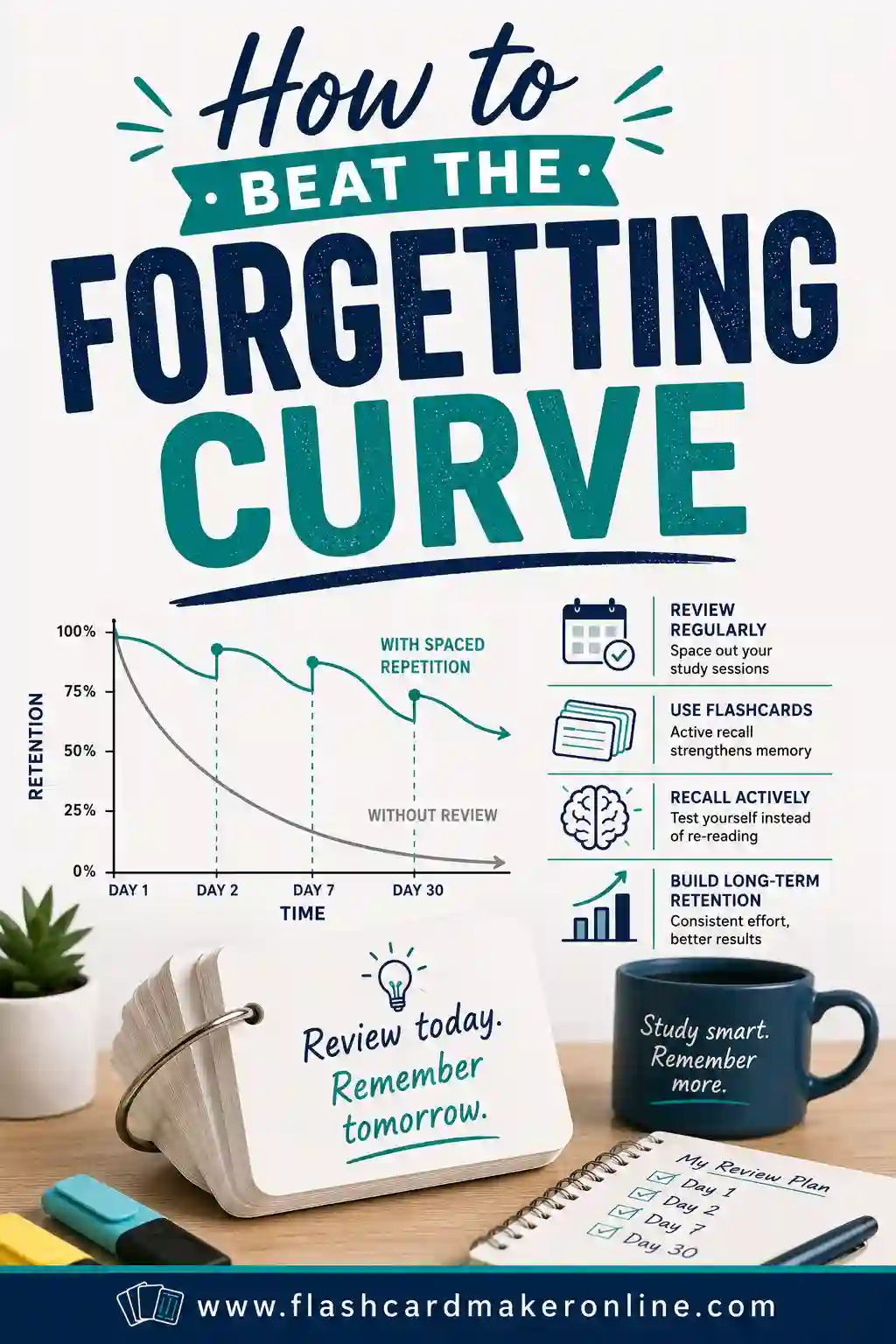
Back in the 1880s, a researcher named Hermann Ebbinghaus ran a now-famous experiment on himself. He memorized lists of nonsense syllables, then tracked how much he could recall as time passed. The result was a curve that drops fast at first and then levels off.
That curve is the forgetting curve, and it describes something you already know from experience: you forget most of what you learn, surprisingly quickly. Within a day you've lost a big chunk. Within a week, even more. By the time the test rolls around, the cramming you did last night has mostly evaporated.
The good news is the curve isn't fixed. Every time you successfully recall something, the curve resets and gets shallower. Forget less each time, and the memory eventually sticks for good. That's the whole game.
Why You Forget So Fast
Your brain is not a hard drive. It's more like a busy editor, constantly deciding what's worth keeping. Anything it judges unimportant gets weakened to make room for what matters.
So how does your brain decide what matters? Mostly by how often you use it. A fact you encounter once and never again looks like noise, so it fades. A fact you keep retrieving looks important, so it gets reinforced. Forgetting isn't a flaw — it's your brain doing its job. Your task is to send the right signal.
The signal that says "keep this" is retrieval. Every time you pull a memory back out, you tell your brain it's worth holding onto. That's why testing beats rereading every time.
The Core Fix: Spaced Repetition
Spaced repetition is the single most powerful way to flatten the forgetting curve. Instead of reviewing everything in one marathon session, you spread short reviews across days and weeks, timing each one for the moment you're about to forget.
Here's why it works. The first time you learn something, the memory is fragile and fades fast. Review it just before it disappears, and the next forgetting curve is shallower — the memory now lasts longer. Repeat, and the gaps between reviews can keep growing: one day, three days, a week, two weeks, a month. Eventually the fact is rock solid and you barely need to review it at all.
The result feels almost like cheating. You study less over time while remembering more. Five-minute reviews spread over two weeks crush a single two-hour cram. We cover the underlying study methods in our guide to memory techniques for studying.
A Simple Spaced-Review Schedule
You don't need software to start. Here's a schedule that works for most material.
| Review | When to do it | What it does |
|---|---|---|
| 1st review | Same day you learn it | Locks in the first impression |
| 2nd review | 1 day later | Catches the steepest drop |
| 3rd review | 3 days later | Stretches the memory longer |
| 4th review | 1 week later | Confirms it's holding |
| 5th review | 2 weeks later | Pushes it toward long-term |
| 6th review | 1 month later | Cements it for good |
Each time you recall a card correctly, you can wait longer before the next review. Miss a card, and you reset it to the start of the schedule. That simple rule — slow down winners, restart losers — is the heart of every spaced-repetition system.
Doing it with paper flashcards: the Leitner box
No app needed. The Leitner system uses a few boxes or piles:
- Box 1 — review every day.
- Box 2 — review every three days.
- Box 3 — review weekly.
Get a card right, promote it to a slower box. Get it wrong, send it back to Box 1. Over a couple of weeks, your easy cards drift to Box 3 and your tricky ones stay in Box 1 where they get the most attention. It's spaced repetition with nothing but index cards.
Pair It With Active Recall
Spacing tells you when to review. Active recall tells you how. Together they're far stronger than either alone.
Active recall means trying to produce the answer from memory before you check it. With flashcards, that's automatic: you read the front, guess, then flip. Don't peek. The little struggle of reaching for the answer is exactly what strengthens the memory and flattens the curve.
If you review by just rereading your cards instead of testing yourself, you lose most of the benefit. The whole point is the effort. So always guess first, even when you're not sure. A wrong guess followed by the correct answer still teaches your brain more than passively reading the right answer ever could.
A Sample Deck to Practice On
Want to learn the forgetting curve by beating it? Here's a starter deck on the concept itself. Drop it into the flashcard maker and run it through the spaced schedule above.
| Term | Definition |
|---|---|
| Forgetting curve | How memory fades over time without review |
| Ebbinghaus | Researcher who first measured the forgetting curve |
| Nonsense syllables | Random letter strings used in his memory experiments |
| Spaced repetition | Reviewing at increasing intervals to slow forgetting |
| Active recall | Retrieving an answer from memory, not rereading |
| Retrieval | Pulling a memory back out, which strengthens it |
| Review interval | The time gap between two study sessions |
| Leitner system | Box-based paper method for spaced repetition |
| Retention | Percentage of material you still remember later |
| Decay | The gradual weakening of an unused memory |
| Consolidation | The brain's process of stabilizing a new memory |
| Overlearning | Continuing to review after first mastering material |
| Cramming | Massing all study into one session before a deadline |
| Distributed practice | Spreading study sessions across many days |
| Cue | A prompt that triggers recall of a stored memory |
| Reactivation | Recalling a memory to reset its forgetting curve |
| Long-term memory | Storage that can last years with periodic review |
| Spacing effect | The finding that spaced study beats massed study |
| Testing effect | The finding that self-testing boosts retention |
| Desirable difficulty | Effortful study that builds stronger memory |
Eighteen cards on the science of remembering — review them on schedule and watch the concept stick.
How to Make the Schedule a Habit
The schedule only works if you actually run it. A few tips to keep it going:
- Review at the same time daily. Pin it to coffee, the bus, or right before bed. A fixed slot beats willpower.
- Keep sessions short. Ten to fifteen minutes is plenty. Long sessions get skipped; short ones get done.
- Only review what's due. You don't restudy the whole deck every day — just the cards the schedule calls up. That's what keeps the workload tiny.
- Mark misses honestly. If you peeked or half-guessed, count it as a miss and reset the card. Honesty now means real memory later.
- Front-load the start. New material needs the most frequent reviews, so do those first while you're fresh.
Common Mistakes That Keep You Forgetting
- One huge cram session. It feels productive but the curve erases it in days. Spread it out.
- Rereading instead of testing. Recognition isn't recall. Always guess before flipping.
- Reviewing everything every day. That's exhausting and unsustainable. Let mastered cards space out.
- Skipping the schedule when you're busy. Even five minutes keeps the chain alive. Missing days lets the curve reclaim your work.
- Never retiring cards. Once a card is truly automatic, retire it so your time goes to weaker material.
Frequently Asked Questions
What exactly is the forgetting curve?
It's a graph, first measured by Hermann Ebbinghaus, showing how fast we forget new information without review. Memory drops steeply within the first day and keeps fading after that. Each successful review resets and flattens the curve, so the memory lasts longer.
How do I beat the forgetting curve?
Review material at growing intervals — same day, one day, three days, a week, two weeks, a month — and test yourself from memory each time rather than rereading. This combination of spaced repetition and active recall flattens the curve and moves facts into long-term memory.
How soon should I do my first review?
Do a quick first review the same day you learn the material, then again about a day later. That early review catches the steepest part of the curve, where forgetting is fastest. After that, you can stretch the gaps wider with each successful recall.
Can I beat the forgetting curve with paper flashcards?
Absolutely. The Leitner box system uses a few piles reviewed on different schedules — daily, every few days, weekly — and you move cards based on whether you recalled them. It's spaced repetition with nothing but index cards, and it works beautifully.
Why does spaced repetition work better than cramming?
Cramming packs everything into one session, which the forgetting curve quickly erases. Spaced repetition reactivates each memory just before it fades, strengthening it a little more each time. You end up studying less total time while remembering far more.
How long until material becomes permanent?
It varies, but after about five or six well-spaced reviews over a month, most facts move firmly into long-term memory and need only occasional refreshing. The key is consistency — short reviews on schedule beat heroic last-minute effort every time.
Start Beating the Forgetting Curve Today
Forgetting is normal, but it's not the end of the story. Review at growing intervals, test yourself instead of rereading, and the curve flattens until your facts stick for good. The simplest way to run the whole system is to open the free flashcard maker, build a deck, and review it on the schedule above.
Keep going with our guides to memory techniques for studying, how to review flashcards efficiently, and how to make flashcards stick. A few minutes a day is all it takes to remember things that used to slip away.