Sleep and Memory Consolidation: What Happens to What You Studied Overnight
Here's the short answer: sleep and memory consolidation are tightly linked. When you study, your brain makes a fresh, fragile record of what you learned. While you sleep, especially during deep slow-wave sleep, the brain replays that record and moves it into longer-lasting storage. Skip the sleep and you lose part of that overnight upgrade, and you also start the next day with a brain that's worse at taking in anything new.
That's the headline. The rest of this guide explains what researchers actually found, where the science is still debated, and how to plan your study sessions, flashcard reviews and bedtimes so your brain can do its overnight work. You'll also find a sample study week, a comparison of naps and all-nighters, and a list of common myths.
A quick note before we start: this article is general information about learning and sleep, not medical advice. If you have ongoing trouble sleeping, there's a short section near the end on when to talk to a professional.
What memory consolidation means
Memory consolidation is the process that turns a new, easily disrupted memory into a stable one you can pull up days, months or years later. Think of it like wet cement. Right after you learn something, the memory is still soft. Over the next hours and nights, it sets.
Researchers usually split the process into two parts:
- Synaptic consolidation: changes at the connections between nerve cells (synapses) that make a new memory trace physically sturdier. This happens over minutes to hours.
- Systems consolidation: a slower reorganization in which memories that first depend on the hippocampus (a seahorse-shaped structure deep in the brain that's key for new facts and events) become stored more widely in the neocortex (the brain's wrinkled outer layer, where long-term knowledge lives).
A widely cited review by Susanne Diekelmann and Jan Born in Nature Reviews Neuroscience ties these two parts to different sleep stages. In their 2010 review of the memory function of sleep, they link systems consolidation to slow-wave sleep and suggest that REM sleep may support the synaptic side. They frame the REM piece more cautiously, as something that "might" help, and that hedge matters. We'll come back to it.
It also helps to know the three broad stages any memory goes through:
- Encoding: taking information in, like reading a flashcard or hearing a lecture.
- Consolidation: stabilizing and reorganizing that information offline, much of it during sleep.
- Retrieval: pulling the information back out, like answering a quiz question.
Sleep touches all three. Sleep before learning helps encoding, sleep after learning helps consolidation, and being rested helps retrieval on test day.
How sleep and memory consolidation work together
Sleep isn't one uniform state. Through the night, your brain cycles through lighter non-REM sleep, deep non-REM sleep (also called slow-wave sleep, because brain waves become large and slow), and REM sleep (rapid eye movement sleep, the stage most linked with vivid dreaming).
For a long time, scientists thought sleep helped memory only in a passive way. If you were asleep, nothing new could come in and interfere with what you had just learned. Björn Rasch and Jan Born's large review in Physiological Reviews traces how that view changed. In "About sleep's role in memory" (2013), they note that the benefit of sleep for retention has been documented for more than a century, and that today's leading theory is active system consolidation. In their words, sleep is "a brain state optimizing memory consolidation," while the waking brain is better tuned for taking in new information.
Here's the active version of the story, in plain terms:
- During the day, you study. The hippocampus quickly stores a rough index of what you learned.
- During slow-wave sleep, the brain replays, or reactivates, the patterns of activity from learning.
- That replay is coordinated by three kinds of rhythms: slow oscillations (big, slow waves), sleep spindles (short bursts of faster activity) and hippocampal ripples (very brief, high-frequency bursts). Diekelmann and Born describe these working together to redistribute hippocampus-dependent memories to the neocortex.
- Rasch and Born add that the REM sleep that follows may help stabilize the newly reorganized memories.
You can picture it like a night shift at a library. During the day, new books get stacked on a cart by the front desk (the hippocampus). At night, staff reshelve them into the right sections (the neocortex) and update the catalog so you can find them later.
The odor experiment that showed replay matters
One of the most striking tests of this idea came from a study in Science. Rasch and colleagues had people learn card locations, a bit like the game Memory, while a rose scent was in the air. Later, during sleep, some participants smelled the same scent again. In the 2007 odor-cue study, re-presenting the scent during slow-wave sleep improved later recall of the card locations. It didn't help when the scent came during REM sleep or while people were awake, and it didn't help when the scent hadn't been present during learning. Brain scans showed more hippocampal activity when the scent returned during slow-wave sleep.
Why does that matter for you? It suggests that what happens during deep sleep isn't just rest. The brain is actively reprocessing specific recent memories. (Don't run out and buy a diffuser just yet. This was a carefully controlled lab study, and it doesn't mean a scented room will raise your grades.)
Sleep stages and what each one seems to do
The table below sums up the main stages and the memory roles researchers most often link to them. The roles are a simplified summary of the reviews cited above, not settled law.
| Sleep stage | What it's like | Memory role researchers propose | How confident is the science? |
|---|---|---|---|
| Light non-REM sleep | Transition into sleep; easy to wake | Contains sleep spindles, which are linked with consolidation | Moderate |
| Slow-wave (deep) sleep | Large, slow brain waves; hard to wake | Replay and transfer of fact-type (declarative) memories from hippocampus to neocortex | Strongest evidence, including the odor-cue study |
| REM sleep | Active brain, vivid dreams, relaxed muscles | May stabilize reorganized memories; possibly supports skills and emotional memory | More debated |
| Being awake | Alert, taking in the world | Encoding new information | Well supported |
Two terms show up a lot in this research:
- Declarative memory: facts and events you can state out loud, like vocabulary words or the causes of a war. Most flashcard material is declarative.
- Procedural memory: skills and "how-to" knowledge, like typing, playing scales or shooting free throws.
The odor study found a benefit for declarative memory (card locations) but not for a procedural finger-tapping skill. That's a good reminder that "sleep helps memory" is a family of findings, not one single effect.
Sleep before learning: getting ready to remember
Most people think about sleep as something that helps after studying. But sleep the night before also matters, because a tired brain is worse at encoding new information in the first place.
A 2007 study in Nature Neuroscience led by Seung-Schik Yoo and Matthew Walker tested this directly. In "A deficit in the ability to form new human memories without sleep", one night of sleep deprivation produced what the authors called a significant deficit in hippocampal activity while people were trying to learn new material. That showed up as poorer retention later. The authors concluded that prior sleep helps prepare the brain for forming new memories the next day.
Back to the library picture: if the overnight staff never reshelves yesterday's cart, there's no room on it for today's books. A short night before a big lecture or a new chapter means you're trying to load new books onto a cart that's already full.
What this means in practice: an all-nighter before an exam costs you twice. You lose the consolidation of whatever you studied that night, and you walk into the test with a brain that's worse at holding new information, like the wording of an unfamiliar question.
Sleep after learning: the overnight upgrade
This is the side most people have heard about. The core finding, repeated across many studies, is that people who sleep after learning usually remember more the next day than people who stay awake for the same amount of time.
Matthew Walker and Robert Stickgold's review in Neuron, "Sleep-dependent learning and memory consolidation" (2004), pulled together evidence from human studies, animal studies, brain imaging and molecular biology. They called sleep's role in memory "one of the most exciting and contentious hypotheses" in the field, and they gave a full section to unanswered questions and arguments against it. That honesty is worth noting.
Several kinds of learning seem to benefit:
- Facts and word pairs, the bread and butter of flashcards.
- Perceptual skills, like spotting fine visual differences.
- Motor skills, like finger-tapping sequences, which in some studies improve after sleep without extra practice.
The practical point is simple: the hours between your last study session and the next morning aren't dead time. If you sleep, your brain keeps working on the material.
The debate: is sleep really doing the work?
A trustworthy guide should tell you where scientists disagree, and there's a real debate here.
In the same 2004 issue of Neuron, Robert Vertes argued the opposite case. In "Memory consolidation in sleep; dream or reality", he pointed out that suppressing REM sleep with antidepressant medications, or losing it to certain brainstem injuries, doesn't seem to damage people's memory or thinking. He concluded that there was no compelling evidence of a special link between sleep and memory consolidation, and he suggested consolidation might begin while you're awake and simply continue during sleep.
How do these views fit together? Here's a fair summary:
- Much of Vertes's critique focused on REM sleep. Later work, as Rasch and Born's 2013 review describes, shifted attention toward slow-wave sleep as the more important stage for fact-type memories. That shift weakens the REM-based objection.
- Even skeptics agree that consolidation happens over time and that sleep doesn't harm it. The disagreement is about whether sleep plays a unique role or is just a good, quiet time for a process that would happen anyway.
- For a student, the practical advice is the same either way. Getting enough sleep supports learning, and losing sleep hurts it, especially through the encoding problem shown by Yoo and colleagues.
So you can feel confident about the basic advice while knowing that the details of the brain mechanism are still being worked out.
Naps: can a short sleep help
Yes, at least for some kinds of learning. A short 2003 paper in Nature Neuroscience by Sara Mednick, Ken Nakayama and Robert Stickgold has a memorable title: "Sleep-dependent learning: a nap is as good as a night". People practiced a visual texture-discrimination task. Those who took a 60- to 90-minute nap that included both slow-wave and REM sleep improved about as much as people in earlier studies who'd had a full night of sleep. The nap benefit also added to the improvement from the following night.
Keep the limits in mind:
- This was one specific perceptual task, not vocabulary or history facts.
- The naps were long enough to include both slow-wave and REM sleep. A 15-minute doze is a different thing.
- A nap is a supplement, not a replacement for regular nighttime sleep.
If you're a student with a free afternoon block, a nap after a heavy study session is a reasonable thing to try. Just don't let a late or very long nap push your bedtime back so far that you lose nighttime sleep.
How much sleep you need, by age
The CDC's guidance on how much sleep people need is the simplest place to start. These are the CDC's recommended totals per day:
| Age group | Recommended sleep (CDC) |
|---|---|
| Newborns (0 to 3 months) | 14 to 17 hours |
| Infants (4 to 12 months) | 12 to 16 hours, including naps |
| Toddlers (1 to 2 years) | 11 to 14 hours, including naps |
| Preschoolers (3 to 5 years) | 10 to 13 hours, including naps |
| School-age children (6 to 12 years) | 9 to 12 hours |
| Teens (13 to 17 years) | 8 to 10 hours |
| Adults (18 to 60 years) | 7 or more hours |
| Adults (61 to 64 years) | 7 to 9 hours |
| Adults (65 and older) | 7 to 8 hours |
The American Academy of Sleep Medicine (AASM) published its own consensus statement on sleep for children and teens in 2016, and its teen range of 8 to 10 hours per 24 hours matches the CDC's. The AASM statement is endorsed by other groups, including the American Academy of Pediatrics.
Notice the teen range. A high schooler who gets up at 6:30 a.m. would need to fall asleep by 10:30 p.m. to get 8 hours (6:30 a.m. minus 8 hours), and by 8:30 p.m. to get 10. That's a tall order for many teens, whose body clocks naturally drift later during adolescence. It's one reason teen sleep debt is so common, and why protecting study-night sleep matters so much in high school.
What a study of real college students found
Lab studies are tidy. Real life is messy. So it's useful that a team at MIT looked at sleep and grades in an actual course.
Kana Okano, John Gabrieli, Jeffrey Grossman and colleagues gave wearable activity trackers to 100 students in an introductory college chemistry class, and 88 completed the study. Their paper in npj Science of Learning, "Sleep quality, duration, and consistency are associated with better academic performance in college students" (2019), found that students who slept longer, slept better and kept more consistent sleep schedules tended to earn better grades. Sleep measures accounted for nearly a quarter of the differences in performance.
Two details stand out:
- The night before the test didn't predict scores. Sleep over the previous week and month did. In other words, the sleep during the days of learning seems to be what counts.
- Consistency mattered, not just total hours. Students whose sleep was more regular from night to night tended to do better, which matches the CDC's advice to keep the same bedtime and wake time every day.
This was a correlation study, so it can't prove that sleep caused the better grades. Students who sleep well may also differ in other ways. But it fits neatly with the lab research: memories are consolidated over many nights, so cramming a good night's sleep in right before the exam can't make up for weeks of short nights.
Follow one flashcard through a night of sleep
Research summaries can feel abstract, so let's trace a single card through a day and a night. This is an illustrative walk-through that strings together the findings above. It isn't a recording of what happens in any one person's brain.
4:00 p.m.: first look. You write a card that asks "What does the mitochondrion do?" with the answer "Makes most of the cell's usable energy (ATP)." The first time you read it, your hippocampus forms a quick, rough trace. If someone quizzed you five minutes later, you'd probably get it right. That doesn't mean it's stored for the long haul yet.
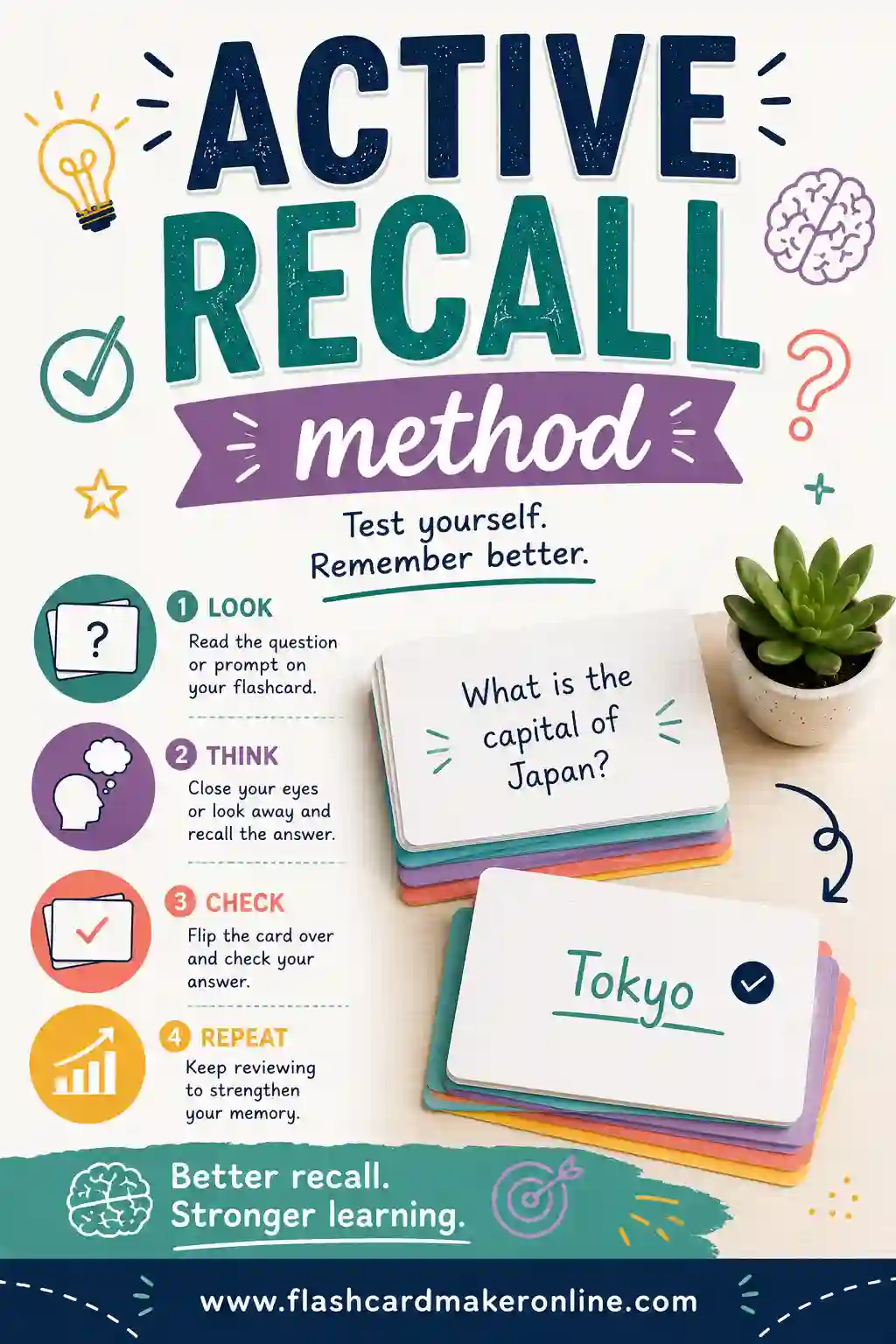
7:30 p.m.: first recall. You go through your deck and try to answer the card before flipping it. You hesitate, then get it. That effortful retrieval strengthens the trace and, according to the replay research, gives your brain a "this one matters" signal. You put the card in the "review again tomorrow" pile.
10:00 p.m.: short bedtime round. A quick pass through the day's hardest cards. You stop at 10:15 p.m. and put your phone away, following the CDC's screen-free half hour.
Early in the night: deep sleep. During slow-wave sleep, the research suggests, the brain reactivates patterns from the day's learning, including your session with the mitochondrion card. Slow oscillations, spindles and ripples coordinate that replay so the memory starts to be stored more widely in the neocortex instead of leaning only on the hippocampus.
Later in the night: REM sleep. Rasch and Born's review suggests REM sleep may help stabilize the reorganized memory. This part of the story is less certain, but a full night gives you all the stages anyway.
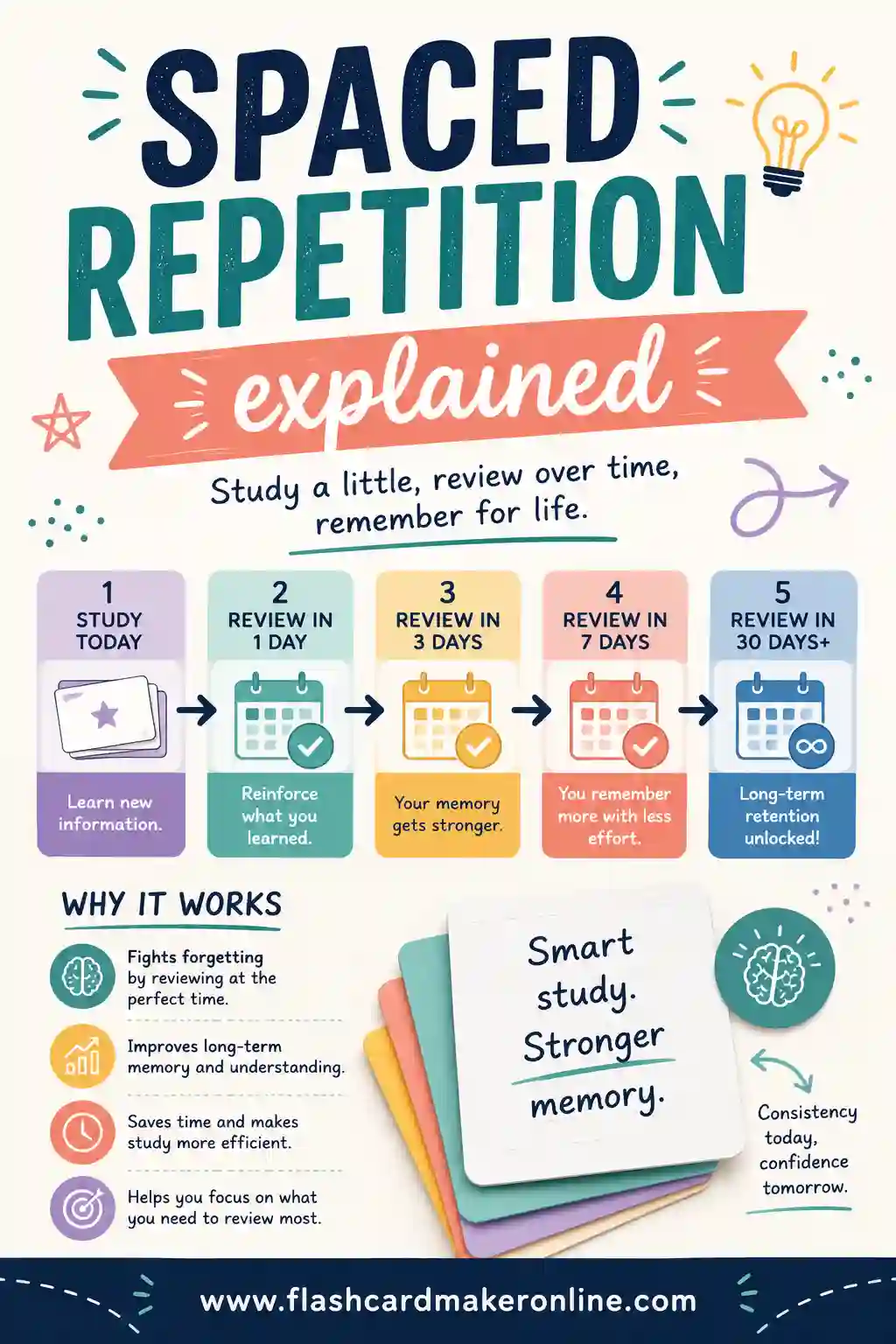
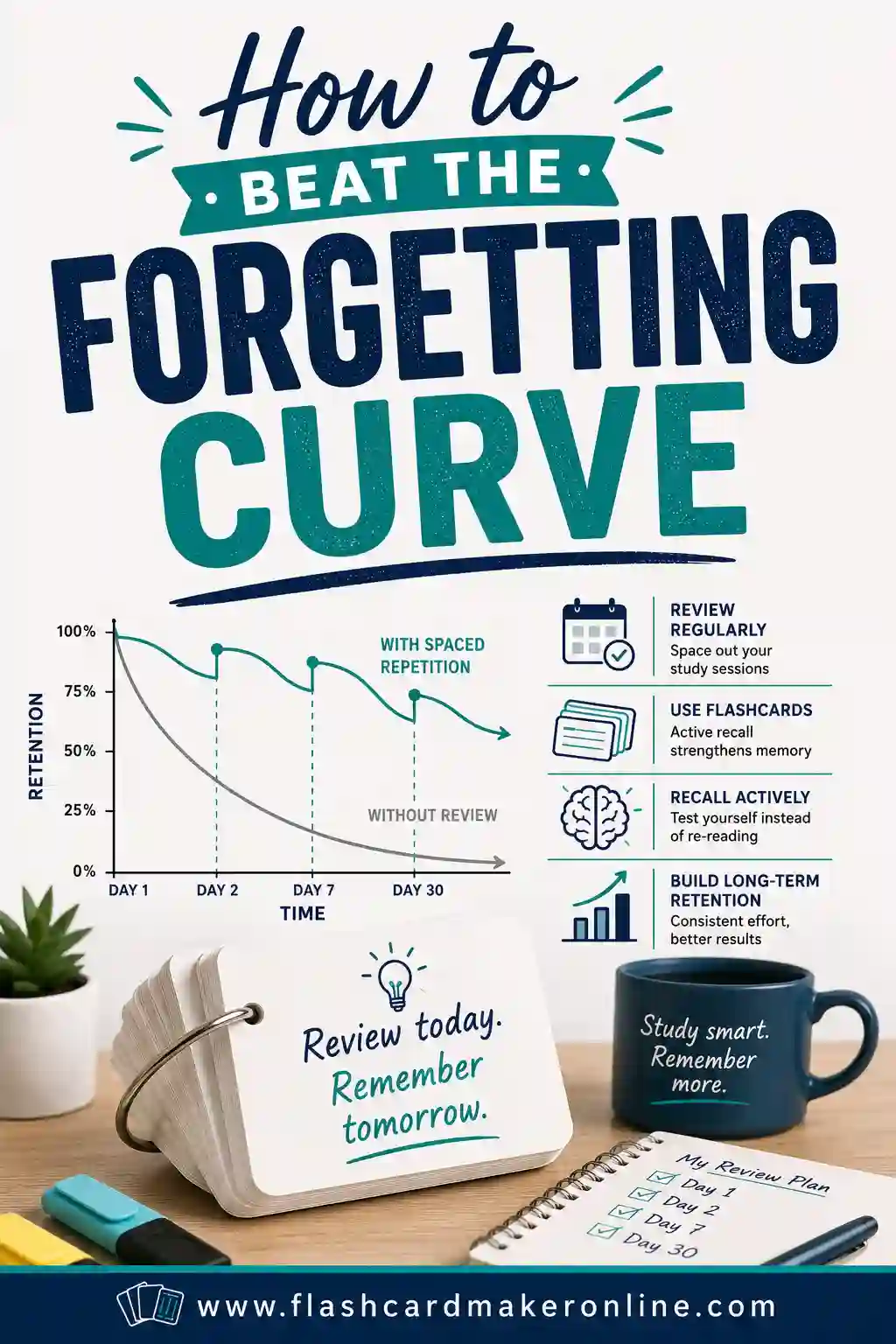
7:30 a.m.: morning check. You flip through yesterday's deck over breakfast. The mitochondrion card comes back more easily than it did last night. A card you missed goes back into the short-interval pile, and the ones you knew get pushed further out, the way spaced reviews beat the forgetting curve.
The next evening: a new card. Because you slept, your hippocampus is ready to encode today's new cards well. That's the "sleep before learning" benefit from the Yoo study. The cycle repeats, and each night adds another round of consolidation.
Now picture the same card on an all-nighter schedule. You'd meet it at 1 a.m., review it at 4 a.m., and take the test at 9 a.m. with no slow-wave sleep in between, plus a tired brain trying to read unfamiliar question wording. Same card, very different odds.
Signs your sleep is getting in the way of your studying
It's not always obvious that sleep is the problem. Here are some practical warning signs worth noticing. None of these is a diagnosis; they're prompts to look at your schedule.
- You reread the same paragraph three times and still can't say what it was about. Trouble encoding new material is exactly what the sleep-deprivation research predicts.
- Cards you "knew" last night are blank the next morning, again and again. Some forgetting is normal, but a pattern can mean short or irregular nights.
- Your study sessions keep drifting later. If your last session often ends after midnight, your bedtime is being set by your to-do list instead of by your body.
- You rely on long weekend sleep-ins to catch up. Big swings between short weeknights and long weekends point to an inconsistent schedule, which the MIT study linked with lower grades.
- You need caffeine late in the day to keep going. The CDC advises limiting caffeine in the afternoon and evening because it can make sleep harder.
- You feel tired even after what should be enough sleep. The CDC lists this as a possible sign of a sleep problem worth raising with a healthcare provider.
If two or three of these sound familiar, try a two-week experiment: set a fixed "study stops here" time and a fixed bedtime, keep your flashcard reviews short and earlier, and see whether your morning recall improves.
Planning exam season around sleep
Exam season is when sleep gets squeezed hardest, so it pays to plan ahead. A few questions to ask yourself a month out:
- How many nights do I have before each exam? Count them. Each one is a free consolidation session if you start early.
- Which exams overlap? If two tests fall on the same day, start one subject's deck a week earlier so you aren't learning two subjects from scratch in the same final week.
- What's my fixed bedtime? Pick it now and work backward. If you need 8 hours and get up at 7 a.m., lights out is 11 p.m.
- When is my last heavy study block each day? End it at least 45 minutes before bed so there's time for a light recall round and a screen-free wind-down.
- What will I do the night before each exam? Plan a light review and a normal bedtime. Write it on your calendar so it doesn't turn into a cram session by default.
If you're studying with classmates, agree on an end time for group sessions too. A study group that runs until 1 a.m. can quietly undo a week of good habits.
Common myths about sleep and studying
| Myth | What the research suggests |
|---|---|
| "An all-nighter gives me more study time, so it's worth it." | You lose consolidation of what you studied and start the test with weaker encoding, as Yoo and colleagues showed. |
| "One good night before the exam is enough." | In the MIT study, sleep over the prior week and month predicted grades, while the single night before did not. |
| "You can learn new facts by playing recordings while you sleep." | The odor study cued memories that were already learned while awake. It didn't teach anything new. |
| "Only REM sleep matters for memory." | Newer reviews point to slow-wave sleep as especially important for fact-type memories. |
| "Any nap is as good as a night." | The nap study used 60- to 90-minute naps on one perceptual task. Short dozes aren't the same. |
| "Weekend catch-up sleep resets everything." | Consistency itself was linked with better grades in the MIT study, so swinging between short and long nights isn't ideal. |
A sleep-smart study plan, step by step
Here's how to turn the research into a routine. It pairs well with spaced repetition, because every space between sessions includes at least one night of sleep.
- Start early enough to get several nights. If a test is in two weeks, you have about 14 nights of consolidation available. If you start the night before, you have zero. Begin your flashcard deck as soon as new material is taught.
- Study new or hard material earlier in the evening, not at 2 a.m. Then stop. Give yourself a wind-down period before bed. The CDC suggests putting electronic devices away about 30 minutes before bed.
- Do a short recall round before bed. Flip through the day's cards and try to answer each one before you look. This is active recall, and it tells your brain which memories need attention. Keep it short so it doesn't eat into sleep.
- Protect a consistent bedtime and wake time. The CDC recommends going to bed and getting up at the same time every day, including weekends.
- Review again the next day. Morning reviews show you what stuck overnight. Cards you missed go into a shorter review pile, as in the Leitner system.
- Use a nap wisely. If you have a long afternoon block after a heavy morning, a nap can help, as long as it doesn't push your bedtime late.
- Taper before the exam, don't cram. The last night should be a light review and a full night of sleep.
Try it yourself: a sample study week
This is an illustrative plan for a made-up student, Maya, who has a biology quiz on Friday morning and a 10:30 p.m. target bedtime.
| Day | Study (evening) | Before bed | Sleep |
|---|---|---|---|
| Monday | Make 30 cards from the week's notes; first pass through all of them | 5-minute recall of the hardest 10 | Lights out 10:30 p.m. |
| Tuesday | Review all 30; move misses to the "again" pile | Recall the "again" pile | Lights out 10:30 p.m. |
| Wednesday | Add 10 new cards from Wednesday's lesson; review the "again" pile | Quick recall of new cards | Lights out 10:30 p.m. |
| Thursday | One full mixed review of all 40 cards | Light pass over the few cards still missed | Lights out 10:30 p.m.; no all-nighter |
| Friday | Quick 10-minute warm-up review before the quiz | None | Normal bedtime |
Notice that Maya gets four nights of consolidation between Monday's first study session and Friday's quiz, and she never trades sleep for study time. Her Thursday session is a final check, not a cram. For more on pacing your daily reviews, see how many flashcards per day makes sense.
Everyday habits that support good sleep
You don't need fancy gadgets. The CDC's own tips are simple and practical:
- Keep the same bedtime and wake time every day.
- Make your bedroom quiet, relaxing and cool.
- Turn off electronic devices about half an hour before bed.
- Avoid large meals close to bedtime.
- Limit caffeine in the afternoon and evening.
- Get regular physical activity and eat a healthy diet.
For students, one more tip helps a lot: decide on your "study stops here" time in advance. If your bedtime is 11 p.m., set your last study block to end around 10:15 p.m. That leaves time for a short recall round, a wind-down and the CDC's screen-free half hour.
Special cases: shift schedules, travel and young kids
Students who work late shifts. If your job ends late, plan your heavier study sessions for days off or earlier in the day, and keep weeknight reviews short. A consistent sleep window still matters, even if it's shifted later.
Travel and time zones. Jet lag throws off your sleep timing. If you're traveling before an exam, try to arrive early enough to get at least a couple of normal nights first, and avoid learning brand-new material on the first tired day.
Young children learning with flashcards. Little kids need far more sleep than teens or adults, as the CDC table shows. Short, playful card sessions earlier in the day fit young children better than bedtime drills. Bedtime should stay calm.
Older adults. The CDC still recommends 7 to 9 hours for adults 61 to 64 and 7 to 8 hours for those 65 and older. Learning something new at any age benefits from the same pattern of spaced study and steady sleep.
When to talk to a professional
This guide is general information, not medical advice. If you regularly have trouble falling asleep, wake up often during the night, snore loudly, or feel very tired even after what should be enough sleep, talk to a doctor or other healthcare provider. The CDC notes that a provider may ask you to keep a sleep diary or may order tests such as a sleep study. For children and teens, a pediatrician or school nurse is a good first stop. Health guidance and school policies, such as start times, also vary by place, so check what applies where you live.
Bringing it together with flashcards
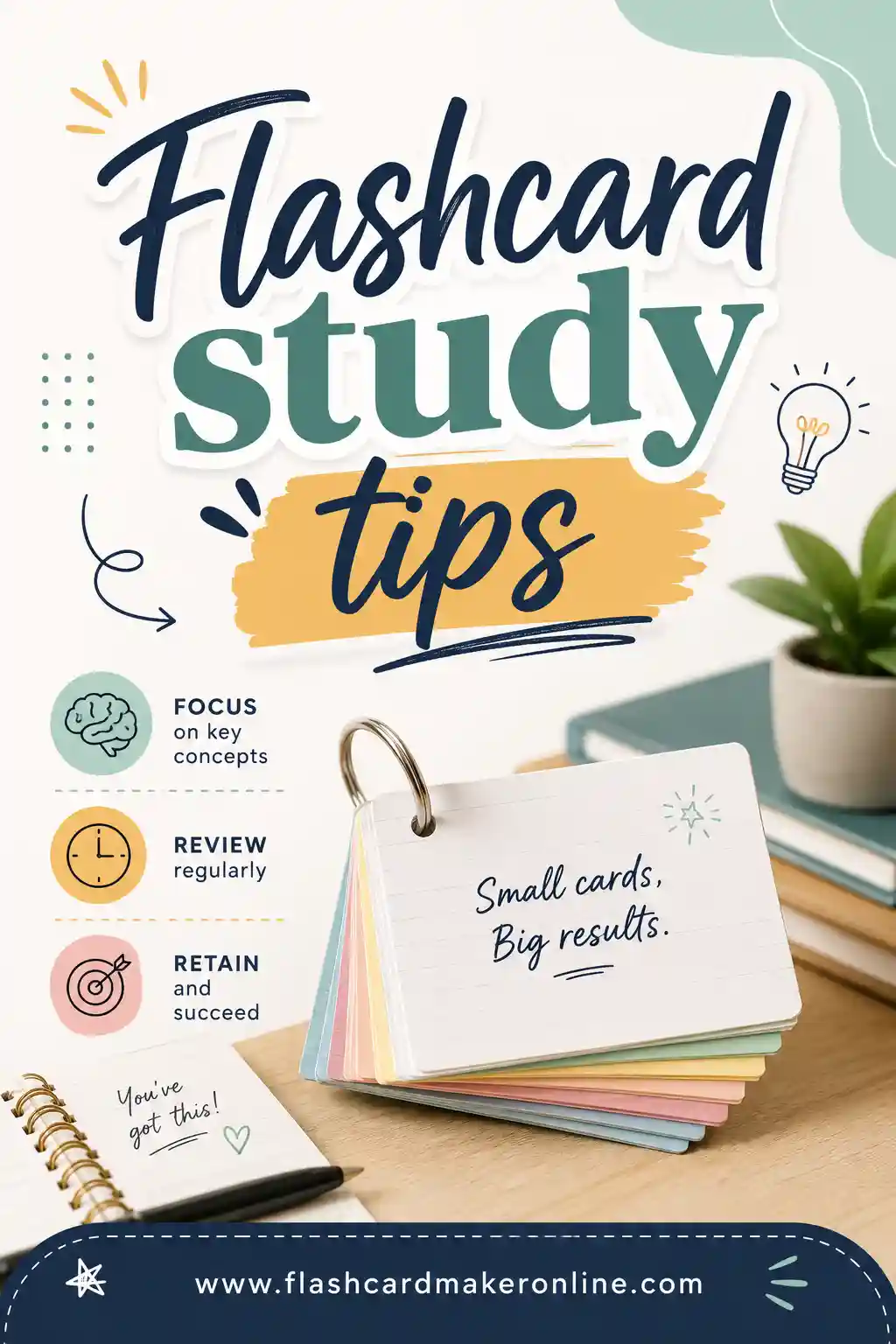
The simplest way to put this research to work is to spread your studying across many days so that every gap includes a full night of sleep, and to use short recall rounds instead of rereading. Flashcards are made for that pattern. For ideas on keeping each review session efficient, see our flashcard study tips. And if you want to start tonight's deck, our free flashcard maker lets you add words and your own pictures, study with flip cards on screen, and print your cards double-sided or as cut-out sheets. Make the cards, review them early in the evening, then go to bed and let your brain do the rest.
Sleep Before, After and During a Nap Compared
Sleep can help at different points in the learning process. This table lines up what the article says about each one.
| When | What the research suggests | Practical point |
|---|---|---|
| Sleep before learning | One night of sleep deprivation hurt the ability to form new memories (Yoo and Walker, 2007) | A tired brain is worse at encoding, so protect the night before a big lecture or chapter |
| Sleep after learning | People who sleep after learning usually remember more the next day than people who stay awake | The hours between your last study session and morning aren't dead time |
| A nap | A nap helped on one perceptual task, and the naps included both slow-wave and REM sleep | A supplement, not a replacement for regular nighttime sleep |
| An all-nighter | You lose the consolidation of what you studied that night | It costs you twice, because you also arrive with a brain that's worse at holding new information |
Frequently Asked Questions
Does sleep really help you remember what you studied?
For most kinds of learning, yes. Many studies find that people who sleep after learning remember more the next day than people who stay awake for the same amount of time. Reviews in journals such as Nature Reviews Neuroscience and Physiological Reviews describe sleep, especially deep slow-wave sleep, as a time when the brain replays and reorganizes recent memories. Some researchers argue that sleep isn't uniquely responsible and that consolidation simply continues during sleep. Either way, the practical advice is the same: getting enough sleep supports learning, and losing sleep works against it.
Is it better to study at night or in the morning?
There isn't one perfect time for everyone, but two points are useful. Studying earlier in the evening and then sleeping lets your brain consolidate that material overnight. Studying very late, though, cuts into your sleep and tends to make your schedule irregular. In an MIT study of college students who wore sleep trackers, longer, better and more consistent sleep was linked with better grades. A good compromise is to do your heaviest studying in the afternoon or early evening, finish with a short recall round, and keep a steady bedtime.
Are all-nighters ever worth it before an exam?
Research suggests they usually backfire. Staying up all night means you lose the overnight consolidation of what you studied, and a study in Nature Neuroscience found that one night without sleep reduced hippocampal activity during learning, which led to poorer retention. You'd walk into the test with a brain that's less able to handle new wording or tricky questions. Spreading your studying over several days, with a full night of sleep before the exam, is a far safer plan.
How much sleep do teenagers need for learning?
The CDC recommends 8 to 10 hours of sleep per day for teens ages 13 to 17, and the American Academy of Sleep Medicine's 2016 consensus statement gives the same 8 to 10 hour range for teens. Many teens fall short, partly because their body clocks naturally shift later during adolescence while school still starts early. Protecting sleep on study nights and keeping bedtimes consistent across the week are two of the most useful steps a teen can take for both health and grades.
Can a nap help me remember what I studied?
It can, at least for some tasks. A 2003 study by Mednick, Nakayama and Stickgold found that a 60 to 90 minute nap containing both slow-wave and REM sleep improved performance on a visual learning task about as much as a full night of sleep had in earlier studies. That was one specific perceptual task, so results may differ for facts or vocabulary. Treat naps as a bonus, and avoid long or late naps that push your bedtime back and cost you nighttime sleep.
Can I learn new things by listening to recordings while I sleep?
There's no good evidence that you can learn brand-new facts that way. What researchers have shown is narrower. In a 2007 study in Science, a scent present during learning was presented again during slow-wave sleep, and that improved recall of material people had already learned while awake. The cue strengthened an existing memory; it didn't teach anything new. Your study time is better spent learning while awake with active recall, then getting a full night of sleep.
Does the night before a test matter most?
Not as much as people think. In a study of college chemistry students who wore sleep trackers, sleep during the week and the month before a test was linked to scores, but sleep on the single night before the test was not. That fits the lab research: memories are consolidated over many nights after you learn them. A good night before the exam still helps you stay alert, but it can't replace steady sleep during the weeks when you were actually learning the material.
Which sleep stage is most important for memory?
For fact-type memories, such as vocabulary, definitions and dates, recent reviews point to slow-wave sleep, the deep stage with large, slow brain waves. During slow-wave sleep the brain appears to replay recent learning and move it from the hippocampus toward longer-term storage in the neocortex. REM sleep may help stabilize those reorganized memories and may matter for some skills, though its role is more debated. Since a normal night includes all the stages, the practical goal is simply enough regular, good-quality sleep.
When should I see a doctor about sleep problems?
Talk to a doctor or other healthcare provider if you often have trouble falling asleep, wake up many times during the night, snore loudly, or feel very tired during the day even after what should be enough sleep. The CDC notes that a provider may ask you to keep a sleep diary or may suggest a sleep study. For children and teens, a pediatrician is a good first contact. This article is general information only and isn't a substitute for advice from a professional who knows your situation.
Sources
We checked every source below while writing this guide. Last reviewed October 30, 2026, by Joan Ramos.
- The memory function of sleep (Diekelmann & Born, Nature Reviews Neuroscience, 2010) (PubMed, National Library of Medicine)
- About sleep's role in memory (Rasch & Born, Physiological Reviews, 2013) (PubMed, National Library of Medicine)
- Odor cues during slow-wave sleep prompt declarative memory consolidation (Rasch et al., Science, 2007) (PubMed, National Library of Medicine)
- A deficit in the ability to form new human memories without sleep (Yoo et al., Nature Neuroscience, 2007) (PubMed, National Library of Medicine)
- Sleep-dependent learning and memory consolidation (Walker & Stickgold, Neuron, 2004) (PubMed, National Library of Medicine)
- Memory consolidation in sleep; dream or reality (Vertes, Neuron, 2004) (PubMed, National Library of Medicine)
- Sleep-dependent learning: a nap is as good as a night (Mednick, Nakayama & Stickgold, Nature Neuroscience, 2003) (PubMed, National Library of Medicine)
- About Sleep (Centers for Disease Control and Prevention)
- Recommended Amount of Sleep for Pediatric Populations: A Consensus Statement of the American Academy of Sleep Medicine (Paruthi et al., 2016) (PubMed, National Library of Medicine)
- Sleep quality, duration, and consistency are associated with better academic performance in college students (Okano et al., npj Science of Learning, 2019) (PubMed, National Library of Medicine)