The Leitner System Explained: Spaced Repetition for Flashcards
The Leitner system is a simple spaced-repetition method for studying flashcards using a row of boxes. Cards you get right move forward to a box you review less often; cards you miss go back to box one and come up again soon. Over time, the stuff you already know quietly fades into the background while the tricky cards keep showing up, so you spend your effort exactly where it's needed. The fastest way to try it is to make a free deck of flashcards, print or flip through them, and sort them into your boxes as you go.
Want to start right now? Open the free flashcard maker, type in your terms and definitions, and you'll have a clean deck ready to drop into a Leitner box in a couple of minutes. No sign-up, no app to install.
What Is the Leitner System?
The Leitner system was created in the 1970s by a German journalist named Sebastian Leitner. The idea is almost embarrassingly simple, which is exactly why it works. You line up a few boxes (or labeled envelopes, or sections of a folder) and number them. Every flashcard lives in one box at a time.
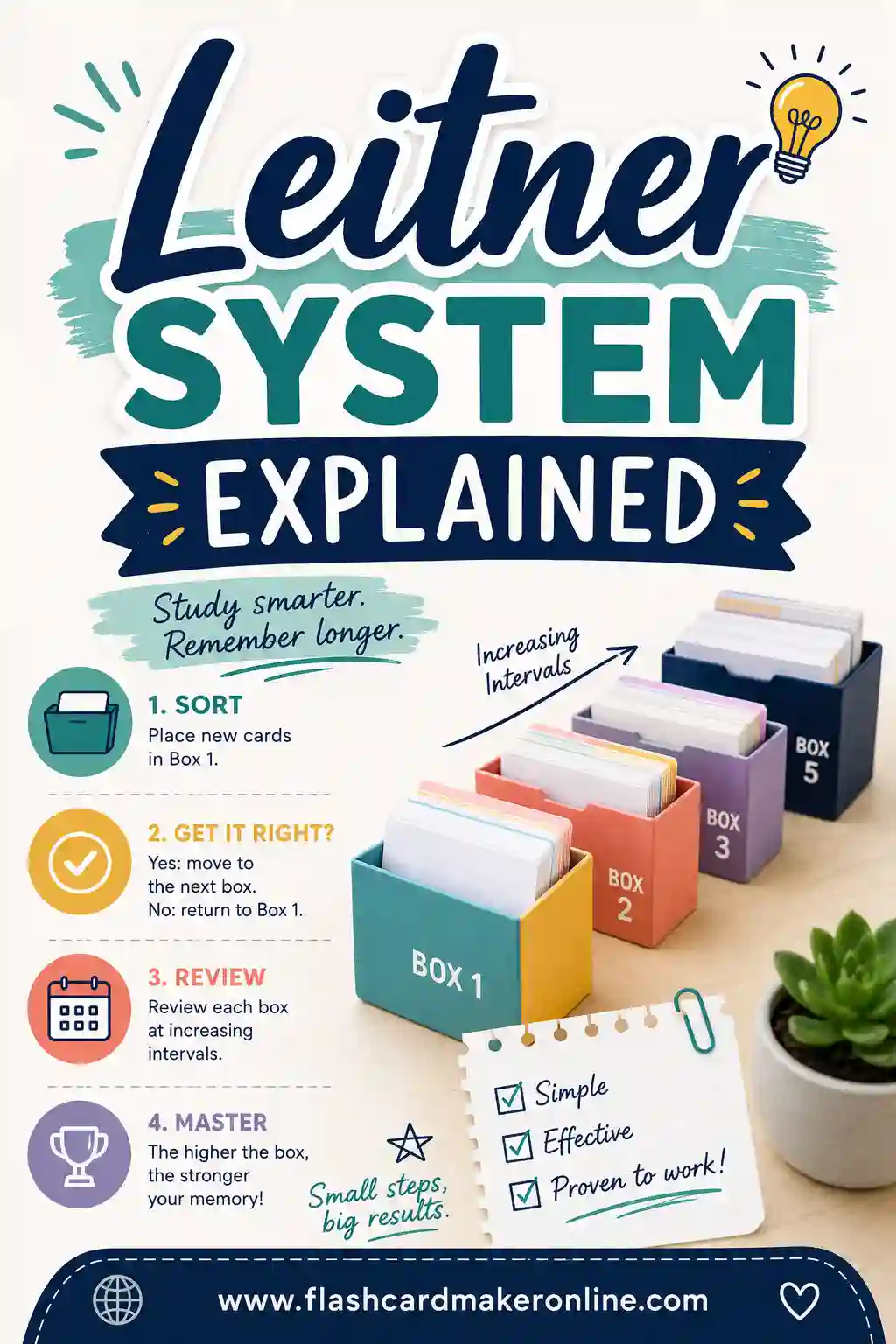
When you review a card and get it right, it moves up one box. When you get it wrong, it goes all the way back to box one. The catch is that each box gets reviewed on a different schedule. Box one comes up every day. Box two maybe every other day. Box three every few days, and so on. The further a card travels, the less often you see it.
The result is a study system that automatically focuses on your weak spots. You're not wasting time re-reading cards you've already nailed. You're spending your minutes on the handful of terms that keep slipping away.
The core idea in one sentence
Review hard cards often and easy cards rarely, and let the cards sort themselves into those two groups based on how you actually perform.
Why the Leitner System Works So Well
Two well-studied learning ideas sit underneath this method, and both are worth knowing.
Spaced repetition. Memory fades on a predictable curve. If you review something right before you'd forget it, the memory gets stronger and the next "right before forgetting" point stretches further out. The Leitner boxes are a low-tech way to space your reviews out at growing intervals.
Active recall. Flipping a card and forcing yourself to answer before you peek is far more powerful than re-reading notes. The struggle to remember is what cements the memory. The Leitner system is built entirely around this flip-then-check motion.
Put those two together and you get a study routine that's both efficient and durable. You remember more, and you remember it for longer, while spending less total time than blunt cram sessions.
How Many Boxes Do You Need?
There's no magic number, but most people land between three and five boxes. Here's a common five-box setup and how often to review each.
| Box | Review every | What lives here |
|---|---|---|
| Box 1 | Every day | New cards and anything you just missed |
| Box 2 | Every 2 days | Cards you got right once |
| Box 3 | Every 4 days | Cards you're getting comfortable with |
| Box 4 | Every 9 days | Cards you rarely miss |
| Box 5 | Every 14 days | Nearly mastered cards |
If a card in box 5 finally comes up and you still know it, you can "graduate" it out of the deck entirely. If you miss any card in any box, it tumbles straight back to box one. That fall-back rule is the engine of the whole system. It guarantees that anything you don't truly know keeps circling back fast.
Starting smaller
New to this? Start with three boxes (daily, every three days, weekly). It's less to track and still gives you most of the benefit. You can always add boxes later once the habit sticks.
How to Set Up the Leitner System Step by Step
You don't need anything fancy. Here's the whole process from scratch.
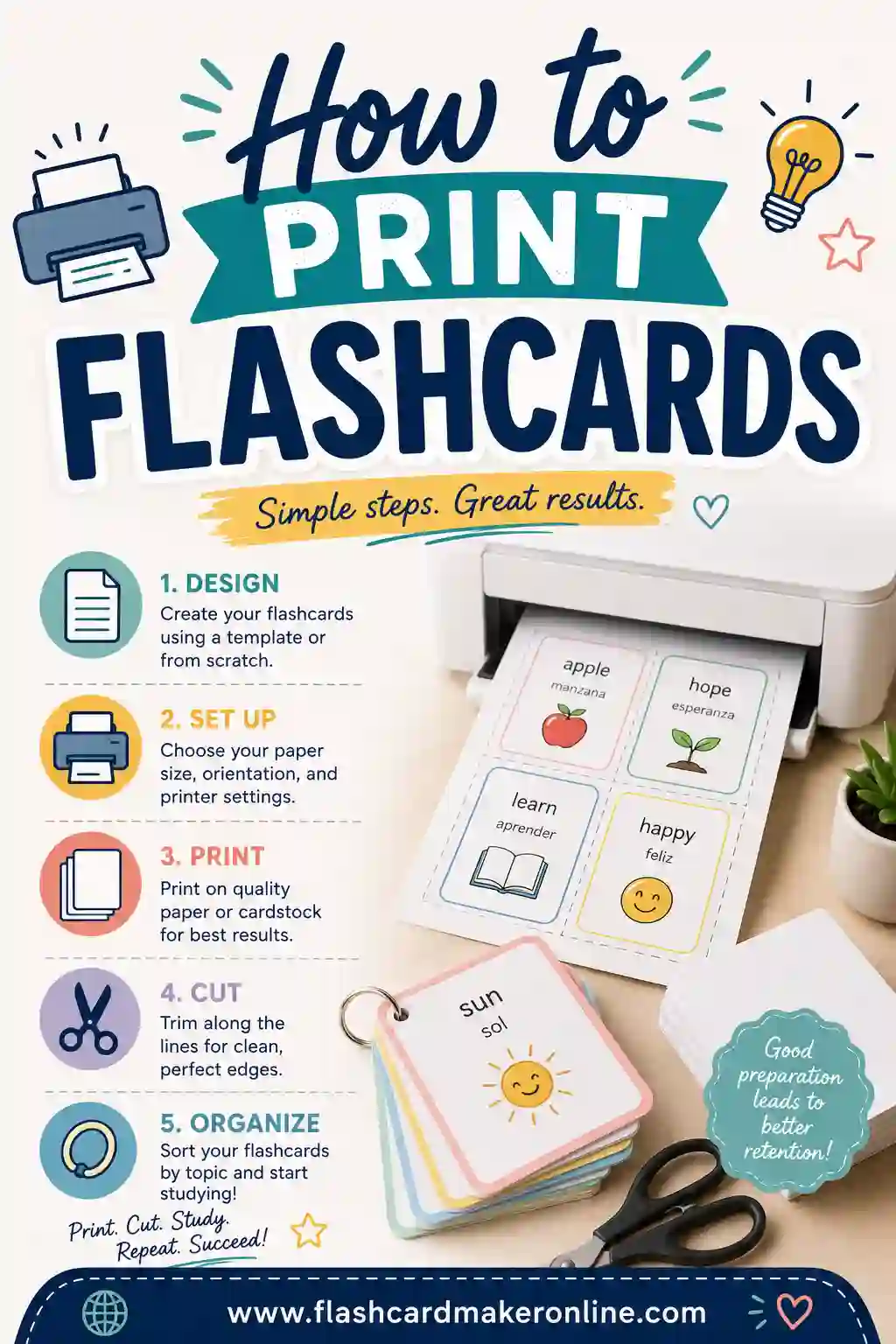
- Make your deck. Write a term on the front of each card and its definition or answer on the back. The free flashcard maker lets you type a list and print a clean stack in minutes.
- Grab your boxes. Use a shoebox with dividers, five envelopes, a recipe box, or even five labeled rubber-banded piles. Number them 1 to 5.
- Put every card in box 1. Everything starts as "unlearned."
- Review box 1 daily. Flip each card, answer out loud, then check. Right cards move to box 2. Wrong cards stay in box 1.
- Follow the schedule. Each day, review whichever boxes are due. Right cards move up one box; wrong cards drop to box 1.
- Graduate mastered cards. When a card clears your last box, retire it. You've learned it.
Keep a small calendar or a sticky note with your box schedule so you know which boxes are due on any given day. That's honestly the only "admin" the system requires.
Sample Deck: Spaced-Repetition Vocabulary
Want a ready-made set to practice the method on? Here's a 20-card deck about studying and memory itself. Type these into the flashcard maker, print them, and run them through your boxes.
| Term | Definition |
|---|---|
| Leitner system | A boxed method for scheduling flashcard reviews |
| Spaced repetition | Reviewing material at increasing time gaps |
| Active recall | Retrieving an answer from memory instead of re-reading |
| Forgetting curve | How fast memory fades without review |
| Retention | How much you remember after time passes |
| Interleaving | Mixing different topics in one study session |
| Chunking | Grouping small facts into bigger meaningful units |
| Box 1 | The daily-review pile for new or missed cards |
| Graduation | Retiring a card you've fully mastered |
| Cramming | Massed last-minute study with poor long-term recall |
| Cue | The prompt on the front of a flashcard |
| Recall failure | Not remembering a card, sending it back to box 1 |
| Mnemonic | A memory aid like a rhyme or acronym |
| Distributed practice | Spreading study across many short sessions |
| Massed practice | Doing all your study in one long block |
| Encoding | Turning new information into a memory |
| Retrieval | Pulling stored information back out |
| Confidence trap | Re-reading and feeling you know more than you do |
| Review interval | The gap between two reviews of the same card |
| Mastery | Reliable recall over a long delay |
Notice how studying the vocabulary of studying is a sneaky way to learn the method while you use it.
Paper Boxes vs. Apps
People often ask whether to go physical or digital. Both work; they just suit different brains.
When physical boxes win
- You stare at screens all day and want a break from one.
- You like the tactile feel of sorting cards by hand.
- You're studying somewhere with no devices allowed, like certain exams' prep settings.
- You find the physical "drop it back to box 1" motion satisfying and motivating.
When a digital deck wins
- You have hundreds of cards and don't want to carry them.
- You want the scheduling handled automatically.
- You study on the go, in line or on the bus.
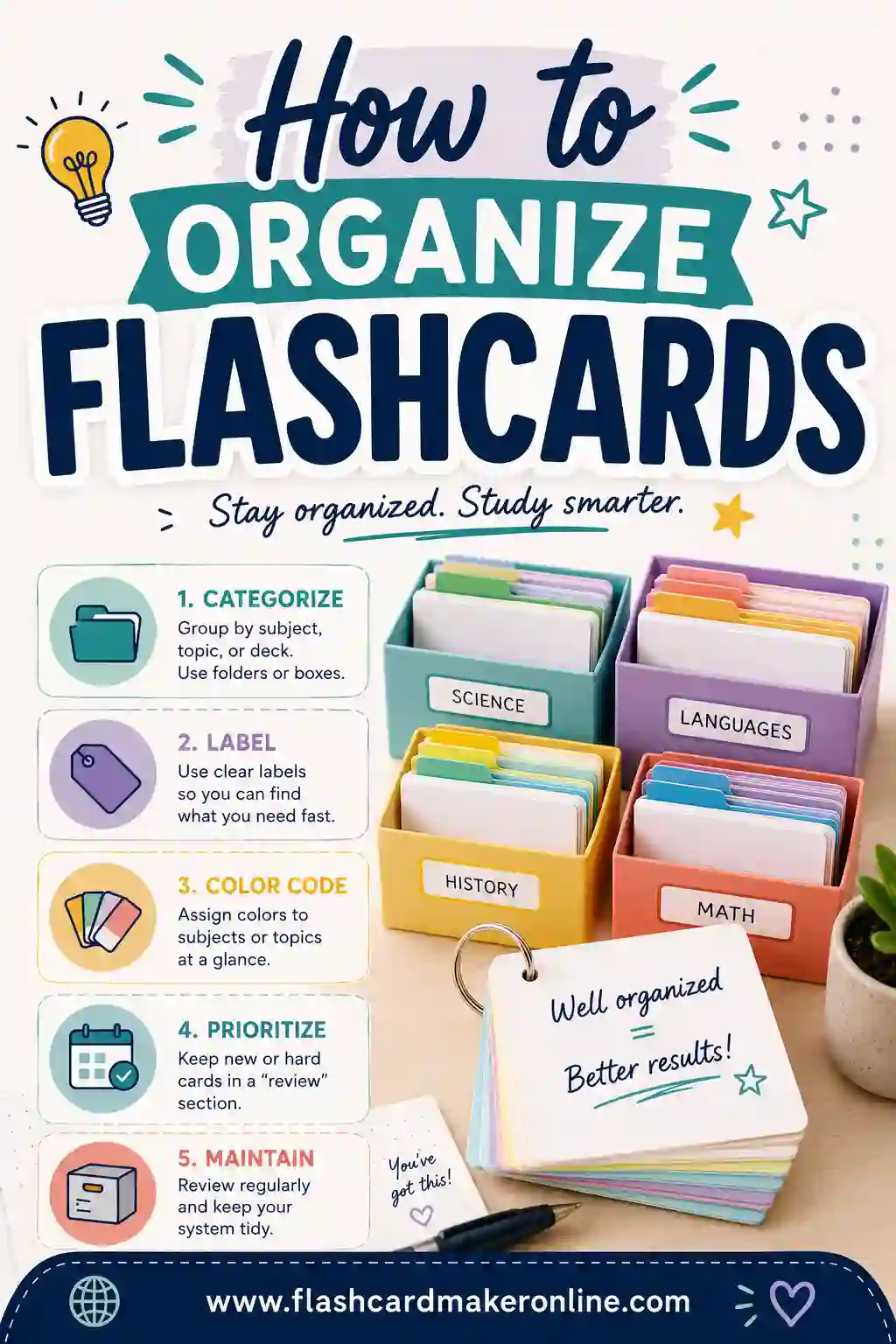
A nice middle path: build and print your deck with a free tool, study it on paper in real Leitner boxes, and keep the digital version as a backup you can reprint anytime. If you go this route, it helps to know how to organize flashcards so each subject has its own box set.
Common Mistakes With the Leitner System
A few small habits make or break the method.
- Skipping the daily box. Box 1 is the heartbeat. Miss it for a week and missed cards pile up. Keep it short and do it every day.
- Not actually recalling first. If you flip the card before trying to answer, you lose the active-recall benefit. Always guess first, even if you're wrong.
- Letting boxes get huge. If box 1 swells past what you can review in one sitting, you've added cards too fast. Slow your intake.
- Being too generous. "Eh, close enough" keeps weak cards moving forward. If you fumbled it, send it back to box 1. Honesty is what makes the system work.
Frequently Asked Questions
How many boxes does the Leitner system use?
Most setups use three to five boxes, each reviewed on a longer schedule than the last. Three boxes (daily, every few days, weekly) is plenty for beginners. Five boxes give finer control for big decks.
What happens when I get a card wrong?
It goes straight back to box 1, no matter which box it was in. That fall-back rule is the whole point. It guarantees anything you don't truly know comes back around quickly.
Is the Leitner system the same as spaced repetition?
It's a simple, manual form of spaced repetition. Apps use algorithms to fine-tune the timing per card, but the Leitner boxes capture the same core idea with nothing but envelopes and a schedule.
How long until I see results?
Most people feel the difference within a week or two. Because the system constantly recycles your weak cards, the terms that used to slip away start sticking, and your daily box shrinks as cards graduate.
Can I use the Leitner system for any subject?
Yes. It works for language vocabulary, anatomy, legal terms, formulas, historical dates, music theory, anything that fits on a flashcard. Just build a deck and start sorting.
Do I need special boxes?
Not at all. Five envelopes, a divided shoebox, or even five labeled piles held with rubber bands all work fine. The method matters far more than the container.
Ready to Try the Leitner System?
The Leitner system turns a plain stack of cards into a self-correcting study machine. The setup takes ten minutes, and the payoff is remembering more with less wasted effort. Open the free flashcard maker, build your deck, print it, and sort every card into box one to begin. From there, just trust the boxes, and watch the hard cards slowly become the easy ones.