Successive Relearning: Combining Retrieval and Spacing Until It Sticks
Successive relearning is a study method with a simple recipe: quiz yourself on each item until you get it right, then come back in later sessions, spaced apart, and quiz yourself until you get it right again. It combines two of the best-supported study strategies, retrieval practice and spaced practice, into one routine. In classroom studies, it has raised exam scores by about a letter grade and led to much better memory weeks later. And it fits flashcards perfectly.
This guide explains how successive relearning works, what the research shows, how many correct answers and sessions you need, and how to set it up with paper cards or an app. You'll find a ready-to-use schedule, worked examples and a list of common mistakes.
What successive relearning means
The name sounds technical, but each word does a job:
- Relearning means you come back to material you've already learned and bring it back up to standard after some forgetting has happened.
- Successive means you do that more than once, in a series of separate sessions.
Put together, the method has two parts:
- Initial learning to a criterion. In your first session, you practice retrieving each item (answering from memory, not rereading) until you've answered it correctly a set number of times. That target number is called the criterion.
- Relearning sessions. In each later session, spaced days or weeks apart, you practice each item again until you get it right again, usually at least once.
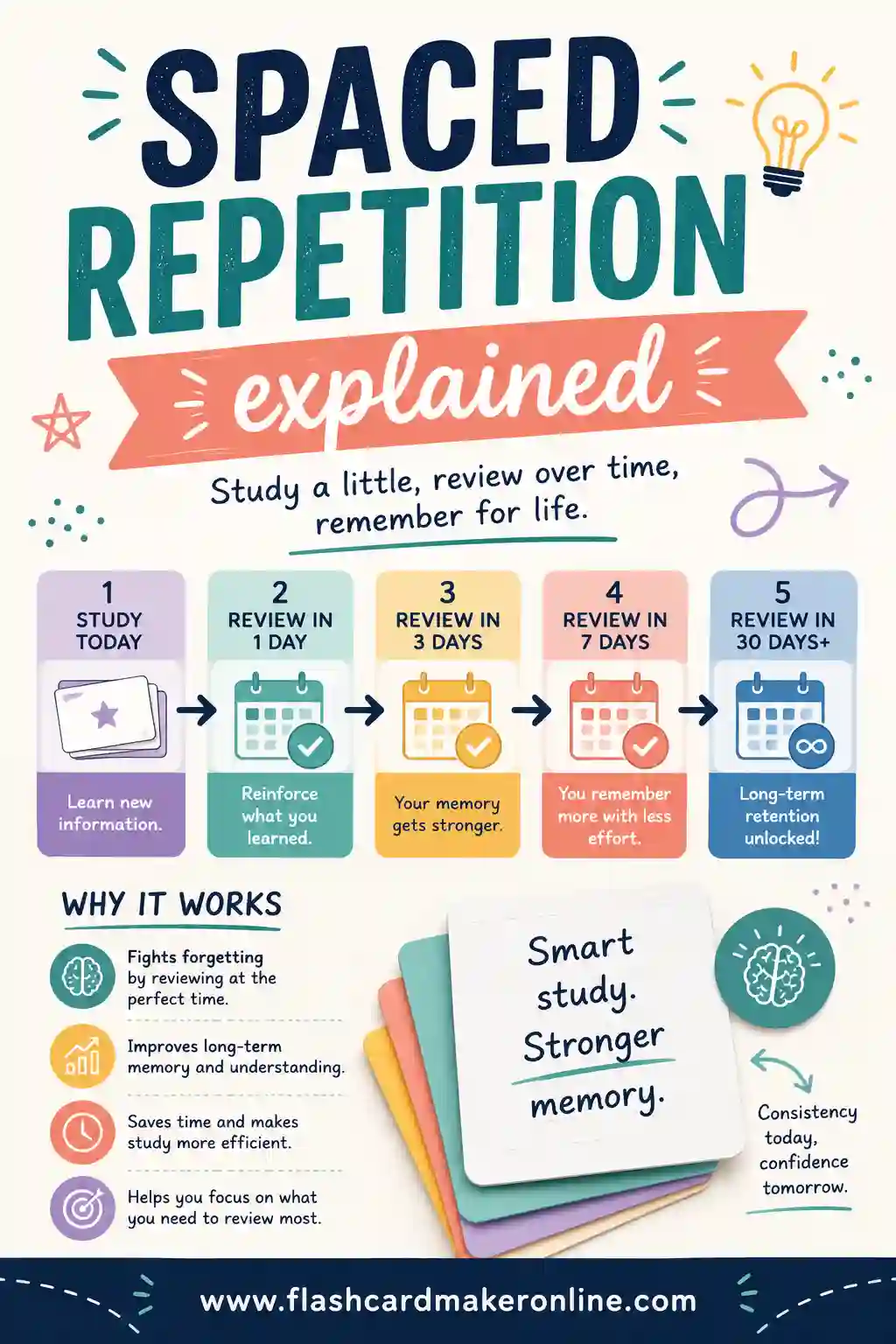
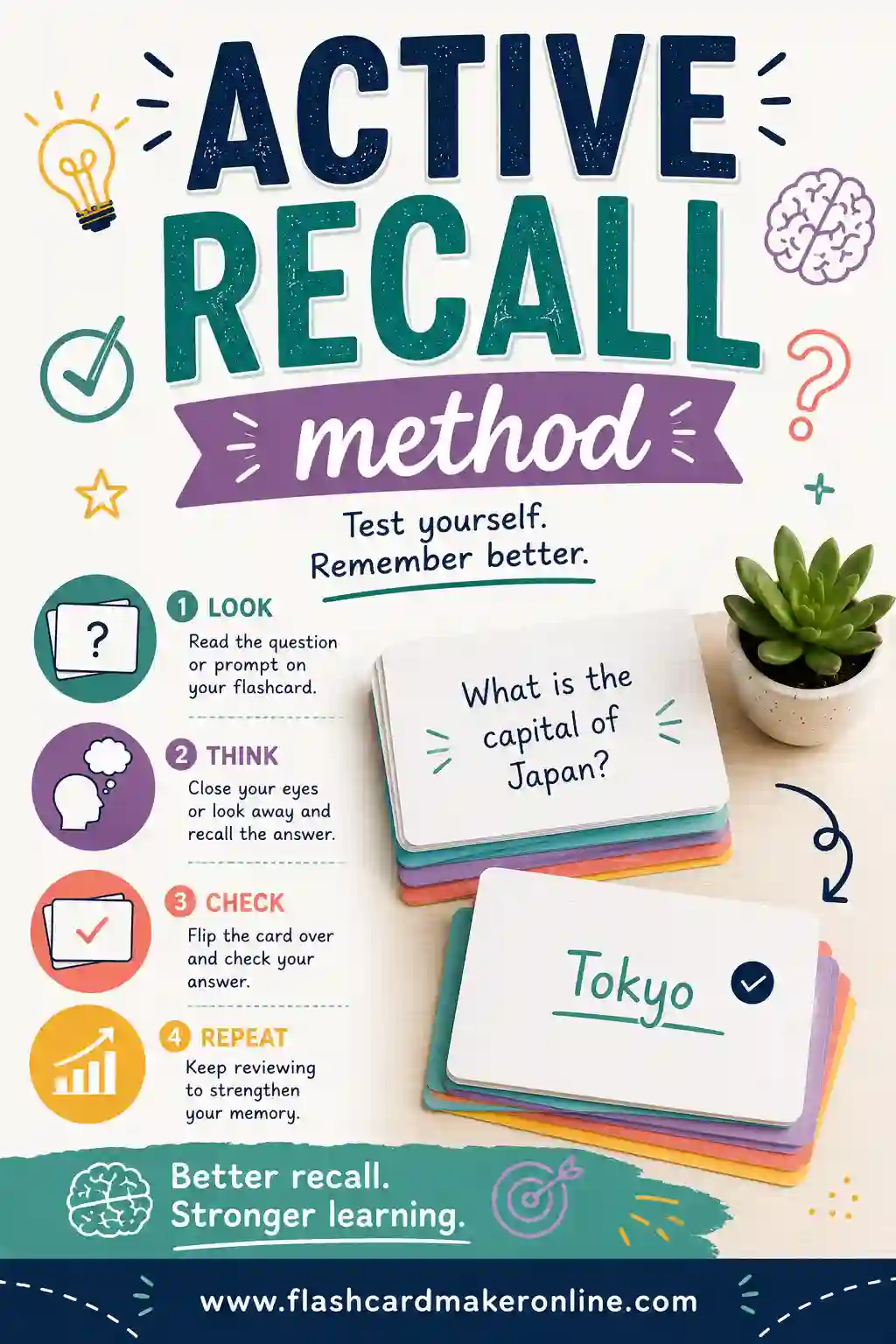
The magic is in the combination. Retrieval practice means pulling information out of memory, as on a quiz. Spaced practice means spreading study over time instead of cramming. In their major 2013 review, John Dunlosky and colleagues rated these two strategies as the only "high utility" techniques among the ten they examined. In "Improving Students' Learning With Effective Learning Techniques", they found that practice testing and distributed practice worked across ages, abilities and many kinds of tests, while techniques like rereading and highlighting earned "low utility" ratings. Successive relearning is what you get when you join those two winners into one plan.
If you already use active recall and spaced repetition, you're most of the way there. Successive relearning adds one important rule: in every session, you keep going until you actually get each item right.
Where the idea came from
The phrase has roots in the long-term memory research of Harry Bahrick. In a landmark 1984 study, "Semantic memory content in permastore: Fifty years of memory for Spanish learned in school", Bahrick tested 733 people on Spanish they had learned in school, with gaps of up to 50 years since they had studied it. Their memory declined for the first three to six years, then stayed remarkably stable for up to 30 years before a final decline. How much people kept was predictable from how well they'd learned it in the first place.
Bahrick called the stable, long-lasting portion permastore. In that same paper, he wrote that analyzing "successive relearning processes over extended time periods" was essential to understanding memory that lasts. In other words, he suspected that the way people relearn material over and over is part of how knowledge becomes nearly permanent.
Decades later, Katherine Rawson and John Dunlosky turned that idea into a practical study method and tested it in lab and classroom experiments. Most of what we know about successive relearning today comes from their research program and from teams that built on it.
What the research on successive relearning shows
Here are the key studies, in plain terms.
How much is enough? (Rawson and Dunlosky, 2011)
In "Optimizing schedules of retrieval practice for durable and efficient learning: how much is enough?", Rawson and Dunlosky ran three experiments with 533 college students. Students practiced key concepts until they recalled each one correctly 1, 2, 3 or 4 times in the first session. Then they relearned the items, to one correct recall, in 1 to 5 later sessions. The researchers hand-scored more than 100,000 short answers and tested memory 1 to 4 months later.
Two findings matter most:
- The initial criterion had a big effect at first, but that effect shrank as students did more relearning sessions. In other words, relearning sessions mattered more than squeezing extra correct answers into the first session.
- Their practical recommendation was to practice to 3 correct recalls in the first session, then relearn 3 times at widely spaced intervals.
That "3 plus 3" rule of thumb is a great starting point for anyone using flashcards.
Relearning evens out early mistakes (2013 and 2016)
In "Relearning attenuates the benefits and costs of spacing" (2013), Rawson and Dunlosky ran three more experiments with 567 students and hand-scored nearly 40,000 responses. Students learned items with either massed practice (repetitions bunched together) or spaced practice in the first session, then completed 2 or 3 relearning sessions. Spacing in the first session helped a lot at first, but after relearning, the gap between the two groups shrank considerably. And the extra time that spaced initial practice cost was largely made up by faster relearning later.
Katherine Vaughn, Dunlosky and Rawson found something similar for the initial criterion. In "Effects of successive relearning on recall: Does relearning override the effects of initial learning criterion?" (2016), students learned Swahili-English word pairs to anywhere from 1 to 7 correct recalls, then relearned them to one correct recall in sessions one week apart, four or five times. The early advantage of a higher criterion didn't last across relearning, and that held at a one-month test too. The researchers called this the relearning-override effect.
That's encouraging news. If your first session wasn't perfect, the relearning sessions can make up for it.
How big is the benefit? (2018)
In "Investigating and explaining the effects of successive relearning on long-term retention" (2018), Rawson, Vaughn, Walsh and Dunlosky compared successive relearning with learning in a single session. They measured the difference with an effect size called d, a standard way to describe how far apart two groups are, measured in units of how spread out the scores are. A d of 1 means the groups differ by a full spread unit. The advantage of successive relearning ranged from d = 1.52 to d = 4.19, which is very large by any standard. They also proposed a model they call "relearning attenuates decay," meaning that each relearning session slows down how fast you forget.
Successive relearning in real classrooms
Lab results are good, but students want to know: does it work in a real course with real exams?
About a letter grade higher
Rawson, Dunlosky and Sharon Sciartelli tested the method in an actual college course in 2013. As the Association for Psychological Science summarized in its Observer teaching column (2022), students scored about 10% higher on exam material they had learned through successive relearning than on material they studied on their own. That's about a full letter grade. Nearly a month later, the gap had grown: scores on the successively relearned material were about 40% higher.
The same column highlights another finding from this line of research: getting one correct recall in each of three spaced sessions led to more than twice the recall of getting three correct recalls in a single session. Same number of correct answers, very different result, all because of the spacing.
Better recall, better confidence (Higham and colleagues, 2022)
Philip Higham, Bettina Zengel, Laura Bartlett and Julie Hadwin ran a carefully controlled classroom study in an introductory psychology course. In "The benefits of successive relearning on multiple learning outcomes" (2022), students got email links to three practice sessions after each weekly lecture, each two days apart. In relearning weeks, they answered 20 fill-in-the-blank questions with feedback, and any they missed came back up to two more times in that session. In restudy weeks, they reread the same 20 sentences without blanks. The researchers matched the amount of time spent in each condition, something earlier studies hadn't done.
Over the remaining 10 weeks of the term, students alternated between the two approaches. At the end of the semester, they remembered the relearned material better. Students who recalled more during relearning sessions also showed better metacognition (awareness of what they know and don't know), a stronger sense of mastery, better attention control and lower anxiety. And students described the method as enjoyable and valuable, which matters, since a method you hate is one you'll quit.
Successive relearning compared with other ways to study
| Method | What you do | Retrieval? | Spacing? | Criterion each session? | Research support |
|---|---|---|---|---|---|
| Rereading | Read notes again | No | Sometimes | No | Rated low utility by Dunlosky et al. |
| Cramming | One long session right before the test | Sometimes | No | Sometimes | Short-lived memory |
| Practice testing alone | Quiz yourself once or twice | Yes | Not necessarily | No | High utility |
| Spaced restudy | Reread over several days | No | Yes | No | Helps, but Higham et al. found relearning beat restudy with time matched |
| Successive relearning | Quiz to criterion, then requiz to criterion in spaced sessions | Yes | Yes | Yes | Strong lab and classroom evidence |
The column that sets successive relearning apart is the last "yes": you don't just look at the cards in each session; you keep going until you've actually retrieved each one correctly.
How to do successive relearning with flashcards, step by step
Here's a practical version of the method, built from the research recommendations above.
- Make good cards. Each card should ask one clear question with one short answer. Our sibling article on the minimum information principle explains why small cards work best. If you're new to making cards, start with our guide on how to make flashcards.
- Session 1: learn to 3 correct. Go through the deck. For each card, try to answer before flipping. If you're wrong, put it back near the end of the pile. Keep cycling until you've answered each card correctly three times in the session. Use tally marks on a sheet or small dots on the card corner to keep count.
- Wait. Let at least a day or two pass. The research schedules spaced sessions days to a week apart.
- Session 2: relearn to 1 correct. Shuffle the deck. Go through every card. Any card you miss goes back into the pile until you get it right once.
- Wait longer. Space the next session further out if your exam allows it.
- Sessions 3 and 4: relearn to 1 correct again. Same process. You'll notice that each session goes faster, because more cards come back right on the first try.
- Keep the whole deck. Unlike some systems that retire easy cards, successive relearning reviews every card in each session, so nothing slides out of reach.
Rawson and Dunlosky's "3 correct, then 3 relearning sessions" is the core. If you have more time, more spaced sessions are fine; the APS column notes that research hasn't pinned down exactly how many sessions are ideal, and that three may be enough for strong benefits depending on when the test is.
Paper cards: a simple setup
- Two piles. "Not yet" and "done for today." Every card starts in "not yet."
- A tally sheet for session 1. Write each card's number and mark each correct answer. A card moves to "done for today" after three marks.
- Session 2 and later. A card moves to "done for today" the first time you get it right.
- A calendar note. Write the next session date on a sticky note on the deck's rubber band.
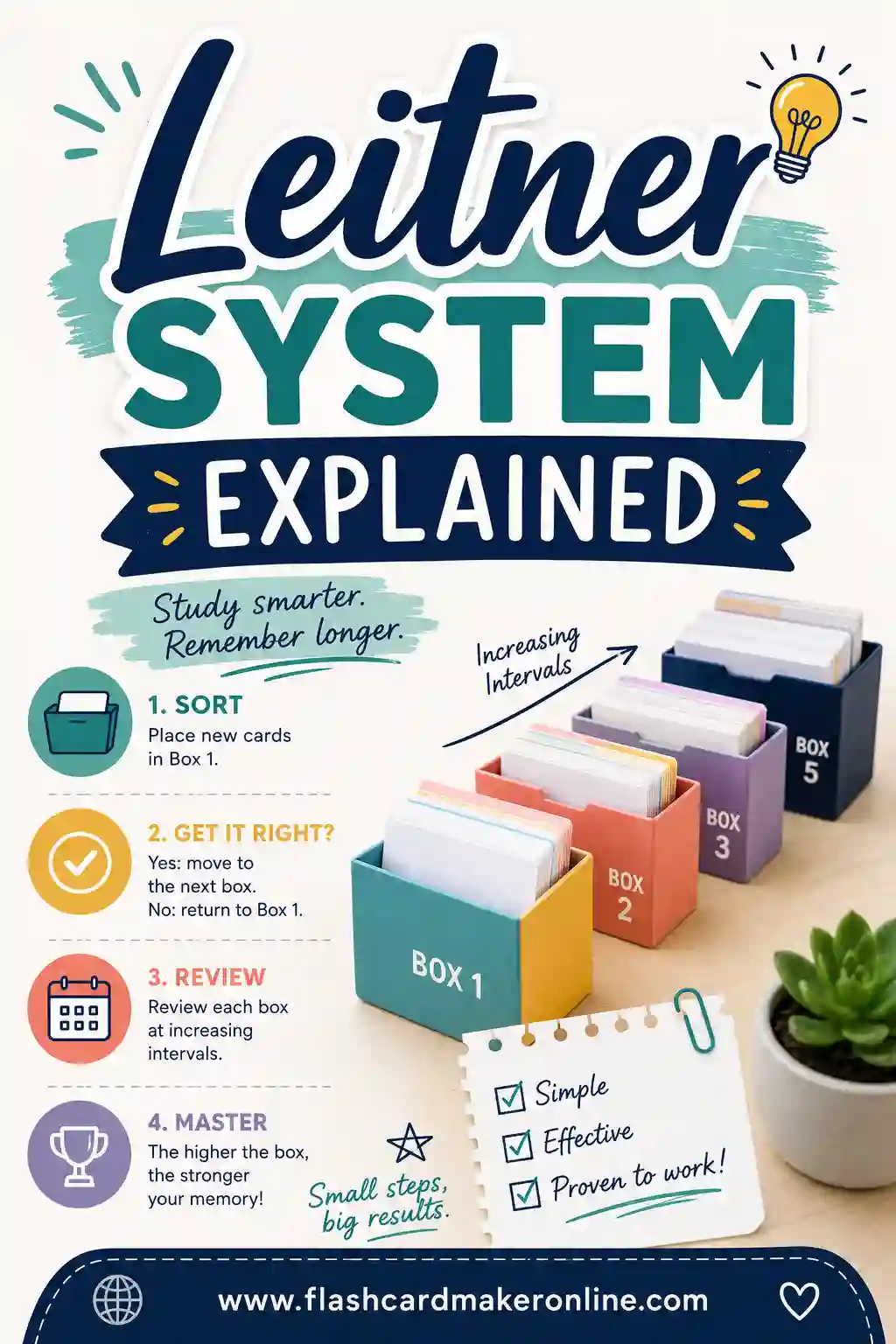
If you already use a box system, you can adapt the Leitner system by adding one rule: in each session, recycle missed cards until you get them right before you put them away.
Apps: what to check
Many flashcard apps already re-show missed cards within a session, which handles the "keep going until correct" part. Check that the app lets you require more than one correct answer on the first day, or simply run through new cards a few times yourself. For spacing, either let the app schedule reviews or set your own session dates.
A sample schedule for a test in three weeks
This is an illustrative plan for a made-up student, Leo, who has 40 vocabulary cards and an exam 21 days away.
| Day | Session | Goal | What Leo notices |
|---|---|---|---|
| 1 | Initial learning | Each card correct 3 times | Takes the longest; several passes through the deck |
| 3 | Relearning 1 | Each card correct once | Forgets a fair number; relearns them quickly |
| 8 | Relearning 2 | Each card correct once | Fewer misses; session is shorter |
| 15 | Relearning 3 | Each card correct once | Most cards right on the first try |
| 20 | Light final check | Each card correct once | Quick; confirms what's ready |
| 21 | Exam | None | Gets a full night of sleep beforehand |
Look at the gaps: 2 days, then 5, then 7, then 5 before the final check. They grow as Leo's memory gets stronger, with the last gap shortened only because the exam date is fixed. That growing gap is the same principle behind beating the forgetting curve.
Worked example: one card across four sessions
Here's an illustrative look at what happens to a single card. The student and the details are made up to show the process.
The card. Front: "What is the function of the kidneys' nephron?" Back: "Filters blood and forms urine."
Session 1 (Monday). Priya sees the card and has no idea. She flips it, reads the answer and puts the card near the bottom of the pile. A few cards later it comes back. She gets "filters blood" but forgets the second half. She counts that as wrong, since a partial answer doesn't earn a tally mark. The third time, she gets it fully right: one mark. The card cycles through twice more, and she gets it right both times. Three marks, so it goes in the "done for today" pile.
Session 2 (Wednesday). Two days later, she's forgotten the "forms urine" part again. That's normal; some forgetting is the point of spacing. She puts the card back, and on the next pass she gets it right. One correct answer, so it's done for the day. The whole session takes much less time than Monday's.
Session 3 (the next Monday). A week later, she pauses for a second, then answers fully. Right on the first try. Done.
Session 4 (two weeks later). Instant, complete answer. She barely has to think.
Notice the pattern. Each session starts with a bit of forgetting, but the forgetting gets smaller and the relearning gets faster. That's the "relearning attenuates decay" idea in action, and it's why later sessions take so little time compared with the first.
Planning a whole semester with successive relearning
Successive relearning really shines when you use it across a full course. Here's an illustrative plan for a 12-week class with a unit test every four weeks and a cumulative final.
| Weeks | New material | Relearning sessions | Goal |
|---|---|---|---|
| 1 to 4 | Unit 1 deck, built week by week | Each week's cards relearned two or three times before the unit test | Unit 1 test ready |
| 5 to 8 | Unit 2 deck | Unit 2 cards relearned two or three times; one quick Unit 1 session | Unit 2 test ready, Unit 1 maintained |
| 9 to 12 | Unit 3 deck | Unit 3 cards relearned two or three times; one quick session each for Units 1 and 2 | Unit 3 test ready, earlier units maintained |
| Finals week | None | One relearning session per unit, spread over several days | Whole course ready, no cramming |
The older units take very little time by the end, because most cards come back right on the first try. That's the payoff: the work you do early in the term keeps paying off at the final, instead of evaporating after each unit test.
For teachers: building it into a course
Teachers can make successive relearning part of a class without much extra work. The Higham study offers a practical model: after each weekly lecture, students received links to three short practice sessions, two days apart. Each session had 20 fill-in-the-blank questions with feedback, and missed questions came back until students answered them.
The APS Observer column also suggests a classroom demonstration that doubles as a lesson in how learning works:
- Make flashcards for some, but not all, of a unit's key concepts.
- Have students learn those cards until they can recall each one three times.
- Have them recall each card once in each of at least three later sessions, timing how long each session takes.
- On the unit test, include both practiced and unpracticed concepts.
- Afterward, let students compare their scores on the two kinds of questions and look at how their session times shrank.
Students who see the difference in their own results are much more likely to keep using the method on their own. That matters, because the APS column points out that the method takes time and can feel cumbersome to students. Building short sessions into the course structure, rather than leaving them entirely optional, makes it easier for students to actually do them.
Signs it's working
How can you tell successive relearning is doing its job? Watch for these signs over your first few weeks:
- Sessions get shorter. Your first session might take a while. By the third or fourth, most cards come back right on the first try.
- Fewer cards need a second pass. The "not yet" pile shrinks each session.
- You answer faster. Quick, confident answers are a sign the memory is getting stronger, not just correct.
- Test questions feel familiar. On quizzes, you recognize the ideas immediately instead of searching for them.
- Old material stays put. A month after a unit test, you can still answer most of its cards.
If sessions aren't getting shorter, check two things: whether your cards are small and clear, and whether you're really waiting days between sessions instead of hours.
Why successive relearning works so well
Researchers have a few explanations, and they fit together:
- Retrieval strengthens memory more than rereading. Pulling an answer out of memory changes the memory itself, making it easier to retrieve next time.
- Spacing lets some forgetting happen first. Retrieving something you've partly forgotten takes more effort, and that effort seems to make the memory more durable. Successive relearning builds that into every session.
- The criterion guarantees success. You don't stop at a failed attempt. Every session ends with every item retrieved correctly, so you never leave a card in a "wrong" state.
- Each session slows forgetting. The 2018 study's "relearning attenuates decay" model proposes that every relearning session makes the next drop in memory shallower.
- It gives honest feedback. You find out which items you really know, which helps you avoid the trap of feeling ready when you aren't. That fits the Higham study's link between relearning and better metacognition.
Common mistakes with successive relearning
- Stopping after a wrong answer. Seeing the answer isn't the same as retrieving it. Put the card back and try again until you get it right.
- Checking the answer too soon. Give yourself a real attempt before flipping. Saying "I knew that" after peeking doesn't count.
- Doing all the sessions in one weekend. The research benefit depends on spacing. Three sessions on three back-to-back evenings is far less effective than three sessions spread over weeks.
- Grading yourself too generously. If your answer was only partly right, count it as wrong. Small, clear cards make grading easier.
- Dropping "easy" cards. In successive relearning, every card comes back each session. That's what keeps knowledge from quietly fading.
- Making the deck too big for the time you have. If each session takes hours, you'll skip sessions. Split a big topic into smaller decks, and see how many flashcards per day is realistic.
- Starting too late. If the exam is in two days, you can't fit in spaced sessions. Start successive relearning as soon as the material is taught.
Using successive relearning in different subjects
The method is the same everywhere, but the cards look a little different by subject. These are illustrative examples.
Languages
Vocabulary is the classic use, and several of the key studies used word pairs. Make cards in both directions (Spanish to English and English to Spanish) as separate cards, because recognizing a word and producing it are different skills. Count a card as correct only if the spelling and any accent marks are right.
Science
Turn definitions, functions and relationships into short questions: "What does an enzyme do to activation energy?" rather than "Explain enzymes." For processes with several steps, make one card per step plus one card that asks for the order. That keeps each answer easy to judge as right or wrong.
History and social studies
Cards that link a cause to an effect, a person to an action, or a date to an event all work well. Avoid giant cards like "Causes of the war." Break them into one card per cause, then add a single card that asks how many main causes there were and what they had in common.
Math
Successive relearning works for facts and formulas, such as the area of a circle or a trigonometric identity. For problem solving, put a short problem on the front and the answer on the back, and count it correct only if you reach the right answer without looking. Mix in new versions of a problem type so you're practicing the method, not memorizing one answer.
Professional exams
Nursing, law, medicine and certification exams involve huge amounts of material, which makes the "keep the whole deck" rule more demanding. Divide the material into units and relearn each unit on its own schedule, so no single session gets too long.
Questions to ask before you start
- When is my test? Count the days and sketch where three or four spaced sessions can fit.
- How big is my deck? If your first session would take more than about an hour, split the deck into smaller sets and start them on different days.
- Are my cards clear? Each card should have one answer you can grade as right or wrong in a second.
- How will I track correct answers? Decide on tally marks, piles or an app before you start, so counting doesn't slow you down.
- What will I do with stubborn cards? Plan to rewrite any card you miss in three sessions in a row.
- Where will sessions go on my calendar? Put every session date on your calendar now, the same way you'd schedule a class. Sessions that live only in your head tend to get skipped when the week gets busy, and skipped sessions are where the method's benefit leaks away.
Special cases and adjustments
Big, cumulative exams. For finals or licensing exams, run successive relearning on each unit as you go, then keep spacing out sessions for older units. Old decks need only quick sessions once most cards come back right. Our guide on flashcards for exams has more on planning.
Concepts, not just vocabulary. The APS column lists studies on psychology and statistics terms and probability concepts, not just vocabulary, so the method works for concepts too. Keep answers short enough that you can judge them fairly.
Younger students. The APS column notes that most studies used college students, with some evidence for middle schoolers. For kids, keep decks small, sessions short and the "3 correct" rule playful, such as earning three stickers per card.
Very short timelines. If you have only a few days, you can still do a compressed version: learn to criterion on day 1, relearn on day 2 or 3, and do a final relearning the day before the test. It won't match a multi-week schedule, but it beats cramming.
Lots of time between courses. For material you want to keep for years, like a language, keep stretching the gaps to months. Bahrick's work suggests that well-learned, repeatedly relearned knowledge can last a very long time.
Try it yourself this week
Here's a mini experiment to see the method work for you:
- Pick 20 facts from a class you're taking and make 20 cards.
- Split them into two sets of 10. Set A gets successive relearning. Set B gets your usual method.
- Day 1: learn Set A to 3 correct each. Study Set B however you normally would, for about the same amount of time.
- Day 3 and Day 7: relearn Set A to 1 correct each. Study Set B your usual way, again for a similar time.
- Day 14: test yourself on all 20 cards without studying first. Count how many you get right from each set.
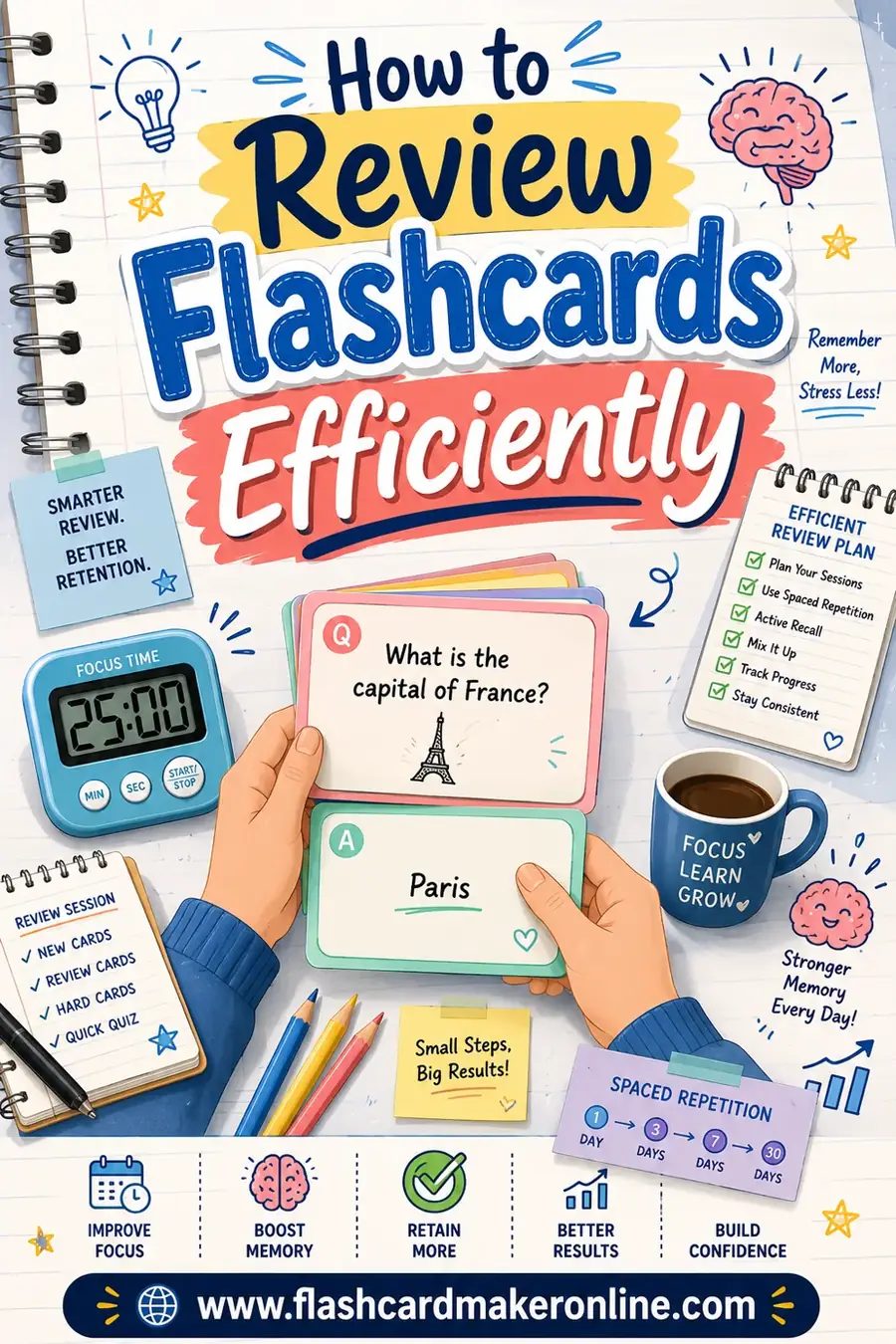
It's a small test, not a scientific study, but many students find the difference convincing enough to switch. If your results surprise you, try the same experiment with a bigger deck. For tips on running efficient review sessions, see how to review flashcards efficiently.
Start your first relearning deck
Successive relearning isn't complicated: quiz yourself until each answer is right, come back days later and do it again, and repeat a few times with growing gaps. The research shows it beats rereading and one-time studying by a wide margin, and it's a natural fit for flashcards. To get started, our free flashcard maker lets you add words and your own pictures, study with flip cards on screen, and print your deck double-sided or as cut-out sheets. Make your cards today, learn them to three correct, and put your first relearning session on the calendar.
What Each Relearning Study Found
This table puts the main studies from the article side by side, showing who took part and the main lesson from each.
| Study | Setting | Main lesson |
|---|---|---|
| Rawson and Dunlosky (2011) | Three experiments with 533 college students | Relearning sessions mattered more than extra correct answers in session one; a good starting point is 3 correct recalls, then 3 spaced relearning sessions |
| Rawson and Dunlosky (2013) | Three experiments with 567 students and nearly 40,000 scored responses | Relearning evens out the effects of how items were first practiced |
| Vaughn, Dunlosky and Rawson (2016) | Students learning Swahili-English pairs | Relearning can make up for an imperfect first session |
| Rawson, Dunlosky and Sciartelli (2013) | An actual college course | Students scored about 10% higher on exam material, roughly a letter grade |
| Higham and colleagues (2022) | An introductory psychology course | Students remembered the relearned material better at the end of the semester |
Frequently Asked Questions
What is successive relearning in simple terms?
Successive relearning is a study method where you quiz yourself on each item until you answer it correctly, then return in later sessions, spaced days or weeks apart, and quiz yourself until you get each item right again. It combines retrieval practice, which means answering from memory, with spaced practice, which means spreading study over time. Those two strategies were the only ones rated high utility in a major 2013 review of study techniques. Successive relearning joins them into one routine that works naturally with flashcards.
How many times should I get a flashcard right in the first session?
Research by Katherine Rawson and John Dunlosky suggests aiming for three correct recalls per item in your first session. In their 2011 experiments with 533 college students, the benefit of extra correct answers in the first session shrank as students completed more relearning sessions. Their practical recommendation was three correct recalls at first, followed by three relearning sessions at widely spaced intervals. If your first session falls short of that goal, later relearning sessions can largely make up the difference.
How many relearning sessions do I need?
A good starting point is three relearning sessions after your first learning session, as Rawson and Dunlosky recommended in 2011. The Association for Psychological Science notes that research hasn't settled exactly how many sessions are ideal, and that three may be enough for strong benefits depending on when your test falls. If you need to keep the material for a long time, such as for a cumulative final or a language, keep adding sessions with longer and longer gaps between them.
How far apart should relearning sessions be?
Leave at least a day or two between sessions, and let the gaps grow as the material gets easier. Several of the key studies spaced sessions about a week apart, and the method's benefit depends on that spacing. Doing three sessions on three back-to-back evenings gives you much less benefit than spreading them over a few weeks. Work backward from your exam date: plan the first session as early as you can, then fit two or three relearning sessions into the time before the test.
Is successive relearning the same as spaced repetition?
They're closely related but not identical. Spaced repetition is the broad idea of reviewing material at increasing intervals, and many flashcard apps use it. Successive relearning adds a specific rule: in every session, you keep practicing each item until you retrieve it correctly, and you review the whole set each time instead of retiring easy items. You can think of successive relearning as a structured, research-tested way of doing spaced retrieval practice, with a clear target for every session.
Does successive relearning work in real classes?
Yes. In a 2013 classroom study by Rawson, Dunlosky and Sciartelli, students scored about 10 percent higher, roughly a letter grade, on material they'd learned through successive relearning, and nearly a month later the advantage had grown to about 40 percent. A 2022 study by Higham and colleagues in an introductory psychology course found better end-of-semester recall after relearning than after restudying for the same amount of time, along with lower anxiety and a stronger sense of mastery.
What if I keep getting the same card wrong?
Keep putting it back in the pile until you get it right, since that's the core rule of the method. If a card stays stubborn across several sessions, look at the card itself. It may be asking for too much at once, it may be worded unclearly, or it may be easy to confuse with a similar card. Split long answers into smaller cards, add a short example or picture, and make sure you understand the idea rather than just the words.
Can I use successive relearning with paper flashcards?
Absolutely. Use two piles, one for cards you haven't yet answered correctly in the current session and one for cards that are done for the day. In your first session, keep a tally sheet and move a card to the done pile after three correct answers. In later sessions, move it after one correct answer. Write the date of your next session on a sticky note attached to the deck so you don't lose track of the schedule.
Is successive relearning good for kids?
Most research on successive relearning has been done with college students, though the Association for Psychological Science notes some evidence with middle schoolers. The basic ideas of answering from memory, getting it right and coming back later are sensible at any age. For children, keep decks small and sessions short, use simple goals such as three correct answers per card, and make it playful with stickers or a game. A teacher can help adjust the plan for a child's age and needs.
Sources
We checked every source below while writing this guide. Last reviewed October 30, 2026, by Joan Ramos.
- Improving Students' Learning With Effective Learning Techniques (Dunlosky et al., Psychological Science in the Public Interest, 2013) (PubMed, National Library of Medicine)
- Semantic memory content in permastore: Fifty years of memory for Spanish learned in school (Bahrick, Journal of Experimental Psychology: General, 1984) (PubMed, National Library of Medicine)
- Optimizing schedules of retrieval practice for durable and efficient learning: how much is enough? (Rawson & Dunlosky, Journal of Experimental Psychology: General, 2011) (PubMed, National Library of Medicine)
- Relearning attenuates the benefits and costs of spacing (Rawson & Dunlosky, Journal of Experimental Psychology: General, 2013) (PubMed, National Library of Medicine)
- Effects of successive relearning on recall: Does relearning override the effects of initial learning criterion? (Vaughn, Dunlosky & Rawson, Memory & Cognition, 2016) (PubMed, National Library of Medicine)
- Investigating and explaining the effects of successive relearning on long-term retention (Rawson, Vaughn, Walsh & Dunlosky, Journal of Experimental Psychology: Applied, 2018) (PubMed, National Library of Medicine)
- Teaching: Successive Relearning (May & Scullin, Observer, 2022) (Association for Psychological Science)
- The benefits of successive relearning on multiple learning outcomes (Higham, Zengel, Bartlett & Hadwin, Journal of Educational Psychology, 2022) (LSE Research Online, London School of Economics)