Flashcards for Exams: Study Smarter and Score Higher
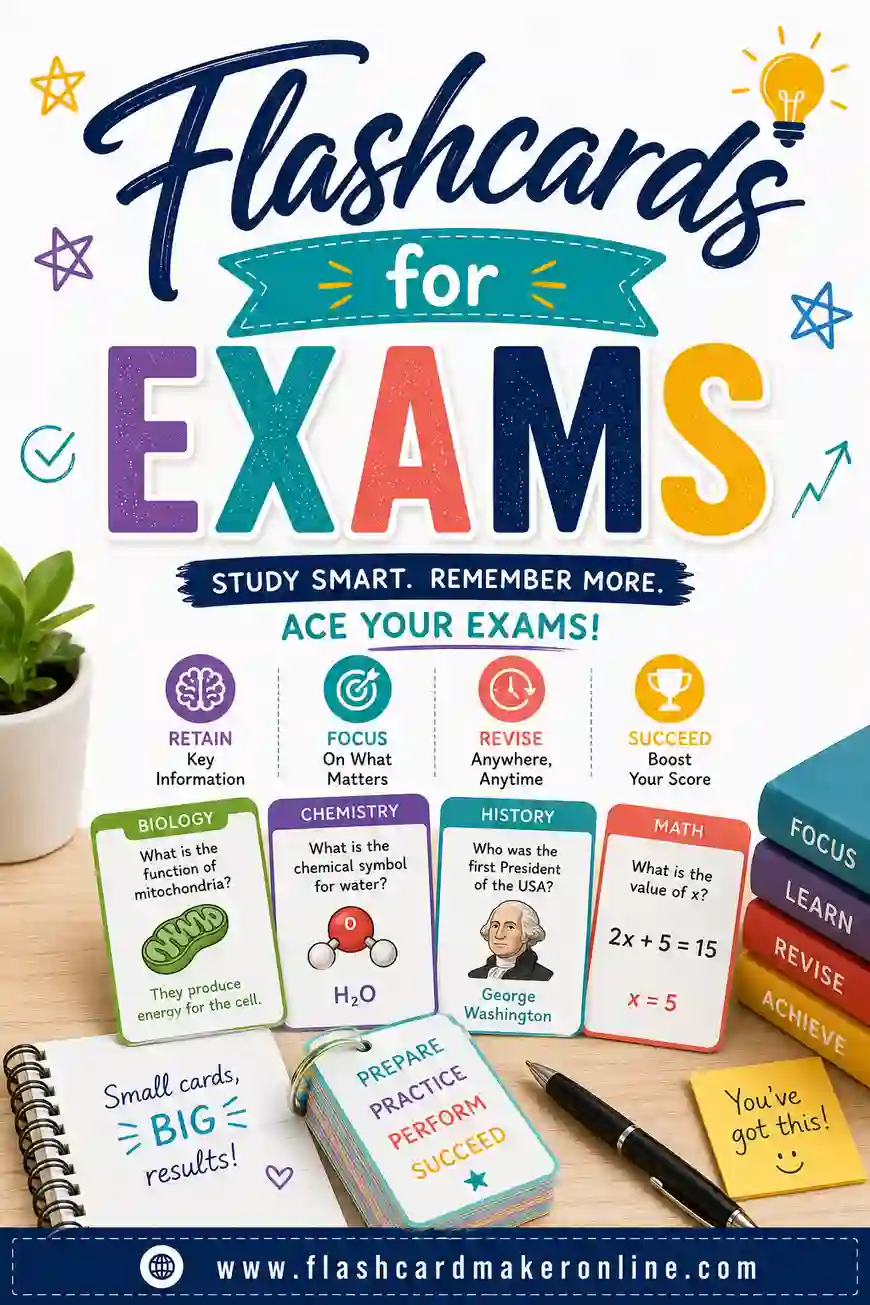
Flashcards for exams work because they force your brain to pull an answer out of memory instead of just rereading it. That act of retrieval, repeated over a few days, is what makes facts stick when you sit down to take the test. The fastest way to build a set is to use a free flashcard maker that lets you type your terms, flip through them, and print a stack to carry anywhere.
Want to start right now? Open the free flashcard maker, type your first ten terms and their answers, and you'll have a study deck in a couple of minutes. No sign-up, no app to install, nothing to pay.
Why Flashcards Beat Rereading Your Notes
Most students study by reading notes over and over. It feels productive, but it's one of the weakest ways to learn. Your eyes glide over familiar words and your brain ticks a box that says "I know this," when really you just recognize it.
Flashcards flip that. When you see the front of a card and try to say the answer before you flip it, you're doing what scientists call active recall. You're practicing the exact thing the exam asks you to do: produce the answer from memory. Every time you struggle a little and then get it right, the memory gets stronger.
There's a second piece that makes flashcards so good for exams: spaced repetition. Instead of cramming everything in one night, you review cards over several days, focusing more on the ones you keep missing. Spacing your reviews out beats one long session almost every time.
What Makes a Good Exam Flashcard
A great flashcard is short, clear, and tests one thing. If your card has a whole paragraph on the back, your brain can't grade itself cleanly, and that's the whole point.
Keep these rules in mind:
- One idea per card. If a term has three parts, make three cards.
- Put a question or term on the front, the answer on the back. Not a wall of text.
- Use your own words on the back. Rewriting forces you to actually understand it.
- Add a hint or example when it helps. "Onomatopoeia (buzz, splash)" is easier to lock in than the definition alone.
- Cut filler words. "What is photosynthesis" beats "Can you please describe the process by which..."
Cards that follow these rules are faster to review and far more honest about what you really know.
A Ready-Made Sample Deck
Here's a sample deck pulled from common exam subjects so you can see the right level of detail. Copy the format, swap in your own material, and you're set. Each row is one card: the term goes on the front, the definition on the back.
| Term (front) | Definition (back) |
|---|---|
| Mitochondria | The powerhouse of the cell; produces ATP energy |
| Photosynthesis | Plants converting sunlight, water, and CO2 into sugar |
| Newton's first law | An object stays still or in motion unless a force acts on it |
| Supply and demand | Price shifts until quantity wanted equals quantity available |
| Onomatopoeia | A word that imitates a sound, like buzz or splash |
| Cellular respiration | Cells breaking down glucose to release energy |
| Mean | The average; add the values, divide by how many there are |
| Median | The middle value when numbers are lined up in order |
| Thesis statement | One sentence that states the main argument of an essay |
| Inertia | An object's resistance to a change in its motion |
| Osmosis | Water moving across a membrane to balance concentration |
| Inflation | A general rise in prices over time |
| Simile | A comparison using "like" or "as" |
| Catalyst | A substance that speeds up a reaction without being used up |
| GDP | The total value of goods and services a country produces |
| Hypothesis | A testable prediction you can prove or disprove |
| Pythagorean theorem | a squared plus b squared equals c squared |
| Metaphor | A direct comparison that does not use "like" or "as" |
| Ecosystem | A community of living things and their environment |
| Denominator | The bottom number in a fraction |
Twenty cards like this take about three minutes to type into the flashcard maker, and you can print the whole set on a single page.
How to Study With Flashcards Before an Exam
A deck only helps if you use it the right way. Here's a simple routine that works for almost any test.
- Build your deck early. The day you start a unit, make a few cards. Don't wait until the night before.
- Do a first pass out loud. Say the answer before you flip. Speaking it locks it in better than thinking it.
- Sort into "got it" and "missed it." Set aside the cards you nailed. Keep grinding the misses.
- Review the misses again the next day. This is spaced repetition in action.
- Shuffle before each session. If you always study in the same order, you memorize the order, not the material.
- Do a full run-through the day before. One clean pass through every card confirms what's solid and what still needs work.
How many cards a day?
Don't try to learn 100 cards in one sitting. Aim for 15 to 25 new cards a day, then keep reviewing older ones. Small, daily sessions beat one giant cram night because your brain needs sleep to file memories away.
Spaced Repetition: A Simple Schedule
You don't need fancy software to space out your reviews. This schedule works with a printed stack and a calendar.
| When | What to review |
|---|---|
| Day 1 | Learn the new cards |
| Day 2 | Review yesterday's misses |
| Day 4 | Review the full set, mark misses |
| Day 7 | Review misses only |
| Day before exam | One full run-through |
The trick is honesty. When you flip a card and you weren't sure, count it as a miss. Half-remembering on day four turns into a blank on test day if you don't catch it.
Flashcards for Different Subjects
The same tool works across your whole schedule, but each subject has a sweet spot.
Languages and vocabulary
This is flashcards' home turf. Word on the front, meaning on the back. Add a sample sentence on the back to remember how the word is actually used.
Science and math
Put a term or formula on the front and the meaning, units, or worked example on the back. For formulas, write the formula on the front and "what each letter means" on the back so you understand it, not just copy it.
History and dates
Pair an event with its date, cause, or result. "Treaty of Versailles" on the front, "1919, ended WWI, set harsh terms on Germany" on the back. Link facts together so they stick as a story, not loose trivia.
Definitions and terms
Any class with a glossary is perfect. Term up front, your-own-words definition on the back. If you can explain it simply, you understand it.
Print Them or Study on Screen
You've got two good ways to use your deck, and the best students often use both.
- On screen. Flip through your cards on a laptop or phone during short breaks. Great for the bus, a lunch line, or five minutes before class.
- Printed. A printed stack has no notifications and no temptation to switch tabs. Many people focus better on paper, and you can carry a deck in your pocket.
To print, build your set in the flashcard maker and hit print. Use cardstock if you want them to last, and cut along the lines for a real stack you can shuffle.
Common Mistakes to Avoid
A few habits quietly sabotage flashcard study. Watch for these:
- Cramming the night before. Flashcards reward spacing. One late night can't replace four short sessions.
- Cards that are too long. If the back is a paragraph, you can't grade yourself. Split it up.
- Only reviewing cards you know. It feels good, but it wastes time. Spend most of your effort on the misses.
- Studying in the same order. Shuffle every time so you learn the material, not the sequence.
- Copying definitions word for word. Rewriting in your own words is where the learning happens.
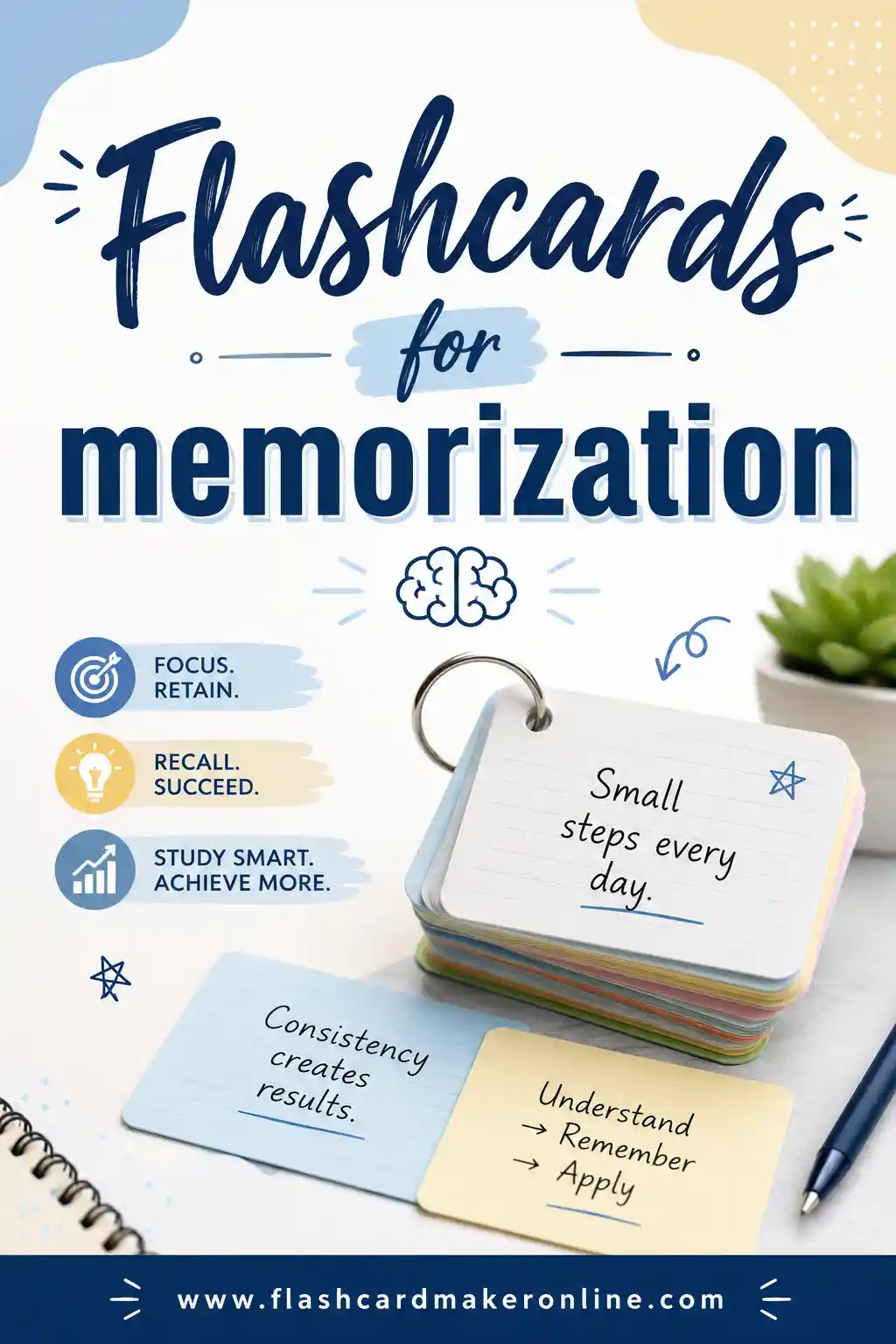
If you want to push your memory even further, our guide on flashcards for memorization digs into the techniques that make facts stick for the long haul.
Frequently Asked Questions
How far in advance should I make exam flashcards?
Start the day you begin a new topic, then add cards as you go. By exam week you want a finished deck you can simply review, not build from scratch. A week of short daily sessions beats one all-nighter every time.
How many flashcards do I need for an exam?
It depends on the material, but most students do well with 20 to 60 cards per subject. Focus on the facts, terms, and formulas most likely to be tested rather than trying to capture every line of your notes.
Are flashcards good for math exams?
Yes, for the parts that rely on memory: formulas, definitions, and key steps. Put the formula on the front and what each symbol means on the back. Pair your cards with practice problems, since math also needs hands-on solving.
Should I make my own flashcards or use someone else's?
Making your own is better. The act of writing each card is itself a study session, and you'll word things in a way that makes sense to you. The free flashcard maker lets you build a custom set in minutes.
Is it better to study flashcards on paper or on a screen?
Both work. Screens are handy for quick reviews on the go. Paper removes distractions and many people focus better on it. Try both and use whichever keeps you reviewing consistently.
How do I stop forgetting cards I already learned?
Keep reviewing them on a spacing schedule instead of dropping them once they feel easy. Quick refreshers every few days hold a memory far longer than learning it once and moving on.
Ready to Build Your Exam Deck?
Strong exam scores come from steady retrieval practice, not last-minute cramming. Pick your toughest subject, open the free flashcard maker, and turn your notes into a deck you can flip through anywhere. It's free, there's no sign-up, and you can print your cards or study them on screen. Start a few cards today, review a little each day, and walk into the exam knowing the answers cold.