Context-Dependent Memory: Does Where You Study Change What You Recall?
Context dependent memory (usually written "context-dependent memory") is the finding that you often recall something better when you're in the same setting where you learned it. The setting can be a room, a sound, a smell or even being underwater. So yes, where you study can change what you recall, but the effect is usually modest, it shows up mainly when you have to recall without hints, and there are simple ways to make your memory less tied to one spot.
This guide explains the famous experiment with scuba divers, what a big review of the research found, why one modern attempt to repeat the diver study didn't work out, and what all of it means for real studying. The practical takeaways are reassuring. You don't need to take your test in your bedroom. You do need to practice recalling, and it helps to study in more than one place.
What context dependent memory means
Psychologists use context to mean everything around the thing you're trying to learn. When you study a list of French verbs at the kitchen table, the verbs are the target. The kitchen, the hum of the fridge, the smell of coffee and the time of day are the context. You aren't trying to learn any of that, but your brain may store some of it anyway, tangled up with the verbs.
Later, when you try to remember the verbs, the context can act as a cue. If you're back at the kitchen table, those background details are there to nudge your memory along. If you're somewhere new, those nudges are missing, and recall can be a little harder. That drop is what researchers call context-dependent forgetting.
There are a few related terms you'll see:
- Environmental context: the physical setting, such as a room, a place or background sounds. This is what most of the research below is about.
- State-dependent memory: the idea that your internal state, such as your mood or alertness, works as a kind of context too.
- Encoding specificity: the broader principle that memory works best when the cues available at recall match what was stored at learning. Steven Smith and Edward Vela describe it in their 2001 review as the idea that "episodic remembering can be cued by information encoded in the sought after memory trace," crediting Endel Tulving and Donald Thomson's 1973 work.
- Reinstatement: putting the original context back, either physically by returning to the place, or mentally by picturing it.
The famous diver study
The experiment everyone mentions was published in 1975 by Duncan Godden and Alan Baddeley in the British Journal of Psychology. They wanted a test where the two settings were as different as possible, so they used scuba divers.
According to Jaap Murre's 2021 description of the original in his replication paper in Royal Society Open Science, the setup worked like this:
- Divers listened to lists of words either on land or underwater.
- After a few minutes, they tried to recall the words, either in the same setting or in the other one.
- Every diver did all four combinations: learn on land and recall on land, learn on land and recall underwater, learn underwater and recall underwater, and learn underwater and recall on land.
- The testing took place in open water near Oban, Scotland, spread over four days.
The headline result: divers recalled more words when they were tested in the same environment where they had learned them. Words learned underwater came back better underwater, and words learned on land came back better on land. The study became a textbook classic because it's so easy to picture.
The follow-up that's often left out
Godden and Baddeley ran a second study, published in 1980, that tested recognition instead of recall. Recall means producing the answer from memory with no hints. Recognition means picking the right answer from options, like on a multiple-choice test. As Smith and Vela's review notes, the context effect that showed up for recall didn't show up for recognition in that study. In their table of studies, the 1980 recognition result has an effect size of exactly zero.
That detail matters a lot for students. If your test is mostly multiple choice, changing rooms probably matters even less than the diver study suggests.
What decades of studies found
One study, no matter how memorable, doesn't settle a question. So in 2001, Steven Smith of Texas A&M University and Edward Vela published a big review and meta-analysis in Psychonomic Bulletin & Review. A meta-analysis is a study of studies: it pools results from many experiments to estimate how large an effect really is and what makes it bigger or smaller.
According to Smith and Vela's paper, "Environmental context-dependent memory: A review and meta-analysis", they calculated 93 separate effect sizes from 75 studies reported in 41 articles, covering research from 1935 to 1997. Their main conclusions:
- Across all the studies, environmental context effects were reliable. Changing the setting between learning and testing really does tend to lower recall.
- The average effect was modest. For studies where people were physically returned to the original setting, the average effect size was about 0.28.
- The effect shrank when people focused on meaningful connections between the items they were learning (the authors call this overshadowing) or when they had other strong cues at test (outshining).
- The effect also shrank when people mentally reinstated the learning setting, meaning they pictured the original room while trying to remember.
What does an effect size of about 0.28 mean? An effect size (here, a value called d) describes how far apart two groups' average scores are, measured in units of how spread out the scores are. Bigger numbers mean the groups are further apart, and a value well under 1 means the two groups overlap a lot. Most people in the "different room" group did about as well as many people in the "same room" group. So the typical context effect is real but on the small side. Murre's 2021 paper describes the effect for free recall as often weak, with a d "of around 0.25."
The effect may grow with time
One of the most interesting findings in the meta-analysis concerns the gap between learning and testing. Smith and Vela grouped studies by that delay. Here's what they reported:
| Time between learning and test | Average effect size (d) | Number of effect sizes |
|---|---|---|
| Less than 5 minutes | 0.27 | 26 |
| 5 minutes to 1 hour | 0.22 | 30 |
| 1 hour to 1 day | 0.28 | 21 |
| 1 day to 1 week | 0.63 | 6 |
The longest delay produced the largest average effect, and the authors' statistical test found that difference was significant. There were only six effect sizes in that group, so it's not the final word. But it's a hint that context may matter more when you're trying to recall something you learned days ago, which is exactly the situation of a student taking an exam.
Other details from the review
Smith and Vela also found that when researchers used a different experimenter for the different-room test, the average effect jumped from about 0.26 to about 0.62. That makes sense: the person running the session is part of the context too. And studies that had people imagine the learning room produced effects of about the same size as studies that physically moved them back, around 0.26. Picturing a place can do a surprising amount of the work of being there.
Key studies at a glance
Here's a quick summary of the main studies discussed in this article, so you can see how the evidence fits together.
| Study | What they did | What they found |
|---|---|---|
| Godden & Baddeley (1975) | Divers learned and recalled words on land or underwater | Better recall in the same setting as learning |
| Smith, Glenberg & Bjork (1978) | Changed rooms between study and test, and tested studying in more than one room | Context affected recall but not recognition |
| Smith (1979) | Asked people tested in a new room to picture the original room | Mental reinstatement helped recall |
| Godden & Baddeley (1980) | Same land and underwater setup, but a recognition test | No context effect on recognition |
| Saufley, Otaka & Bavaresco (1985) | Classroom field experiments with exams in familiar or different rooms | Did not support context-dependent memory for class exams |
| Smith & Vela (2001) | Meta-analysis of 93 effect sizes from 75 studies | Reliable but modest effect, reduced by mental reinstatement and strong cues |
| Murre (2021) | Repeated the diver study with 16 divers in an indoor pool | Did not reproduce the original pattern |
The Smith, Glenberg and Bjork, Smith (1979), and Saufley studies are described here as Smith and Vela summarized them in their review. You can find the full list of Steven Smith's papers on context and memory, including later work on background music, multiple study contexts and eyewitness memory, on his Texas A&M publications page.
When researchers tried the diver study again
In 2021, Jaap Murre of the University of Amsterdam published an attempt to repeat the Godden and Baddeley experiment. His team used 16 divers, the same number implied in the original, and a similar design where each diver did all four land and water combinations with lists of 36 Dutch words.
The result: the replication did not find that recalling in the same setting beat recalling in the other setting. Words learned on land were recalled about equally well on land and underwater. Words learned underwater were actually recalled better on land. Murre wrote that the results "do not even have a trend in the same direction" as the original.
Murre was careful to point out differences between his study and the original, which might explain the gap:
- His divers did all their sessions in a single day, while the original spread them over four days. Doing several lists in a row can cause earlier lists to interfere with later ones.
- The session was filmed for a TV program, which could have been distracting.
- His study used a shallow, heated indoor pool about 180 centimeters deep, instead of cold open water. The two settings may simply have felt less different.
- An underwater speaker system may have made words harder to hear underwater.
Later, Murre published an addendum correcting the analysis. With the corrected method, one statistical interaction did reach significance, but the pattern of results still didn't match what the original study predicted. His conclusion stayed the same: the study was not a successful replication of Godden and Baddeley.
What a failed replication does and doesn't mean
A single failed replication doesn't erase decades of research. The meta-analysis included many studies besides the diver experiment, and it still found a reliable effect. But the replication is a useful reminder of two things. First, the effect is small enough that it can disappear when conditions change. Second, the diver study is a vivid story, and vivid stories tend to get retold as if they were bigger than they are. Context matters some of the time, under some conditions, by a modest amount.
Why context dependent memory happens
Smith and Vela tie their findings to a simple idea: memory works by matching. When you try to remember something, your brain compares the cues you have right now with what was stored. The more features match, the more likely the memory comes back. Background details like the room are just one set of features among many.
That idea explains the main patterns:
- Why recall shows the effect more than recognition: In free recall, you have few other cues, so background details carry more weight. On a multiple-choice test, the answer options are strong cues themselves and can "outshine" the room.
- Why deep studying reduces the effect: When you connect new facts to each other and to what you already know, those connections become strong cues. The room becomes less important. Smith and Vela call this overshadowing.
- Why picturing the room helps: Imagining the original setting brings back some of those background cues in your mind, even if you're physically somewhere else.
- Why changing the experimenter matters: People are part of the context. A different face in the room removes another set of cues.
State-dependent memory
Smith and Vela mention that researchers also study internal states, such as mood, as a kind of context. The idea is the same: if you learned something while feeling a certain way, being in a similar state at recall may help. Murre also raised this possibility for the diver study, since being deep underwater changes how your body feels. For students, the practical point is simple. If you always study while relaxed and alert, being stressed and tired on test day is a kind of context change too. Getting enough sleep and practicing under slightly test-like conditions may help, though those are general study tips rather than specific findings from this research.
What context dependent memory means for studying
Here's where the research turns into advice. The good news is that most of the useful moves are easy, and none require you to take your exam in your bedroom.
1. Don't stress about the exam room
Smith and Vela note that classroom field experiments by Saufley and colleagues did not find that taking exams in an unfamiliar room hurt scores. The effect is modest in general, and class exams usually provide lots of cues in the questions themselves. If your final is in a big gym instead of your usual classroom, that's not a reason to panic.
2. Study in more than one place
One of the more practical ideas from this research is to vary where you study. Smith's publications include a 1982 paper titled "Enhancement of recall using multiple environmental contexts during learning," and Smith and Vela's table lists experiments where studying in more than one context produced positive effects on later recall. The logic is that if you've learned material in several places, your memory isn't tied to any one of them. Try reviewing the same flashcards at your desk, at the library and on the bus.
3. Picture your study spot during the test
If you're stuck on a question, take a few seconds to picture where you studied that material. What did your desk look like? What was on the wall? Smith and Vela found that imagined reinstatement produced effects about as large as physically returning to the room. This is free, quick and doesn't distract anyone else.
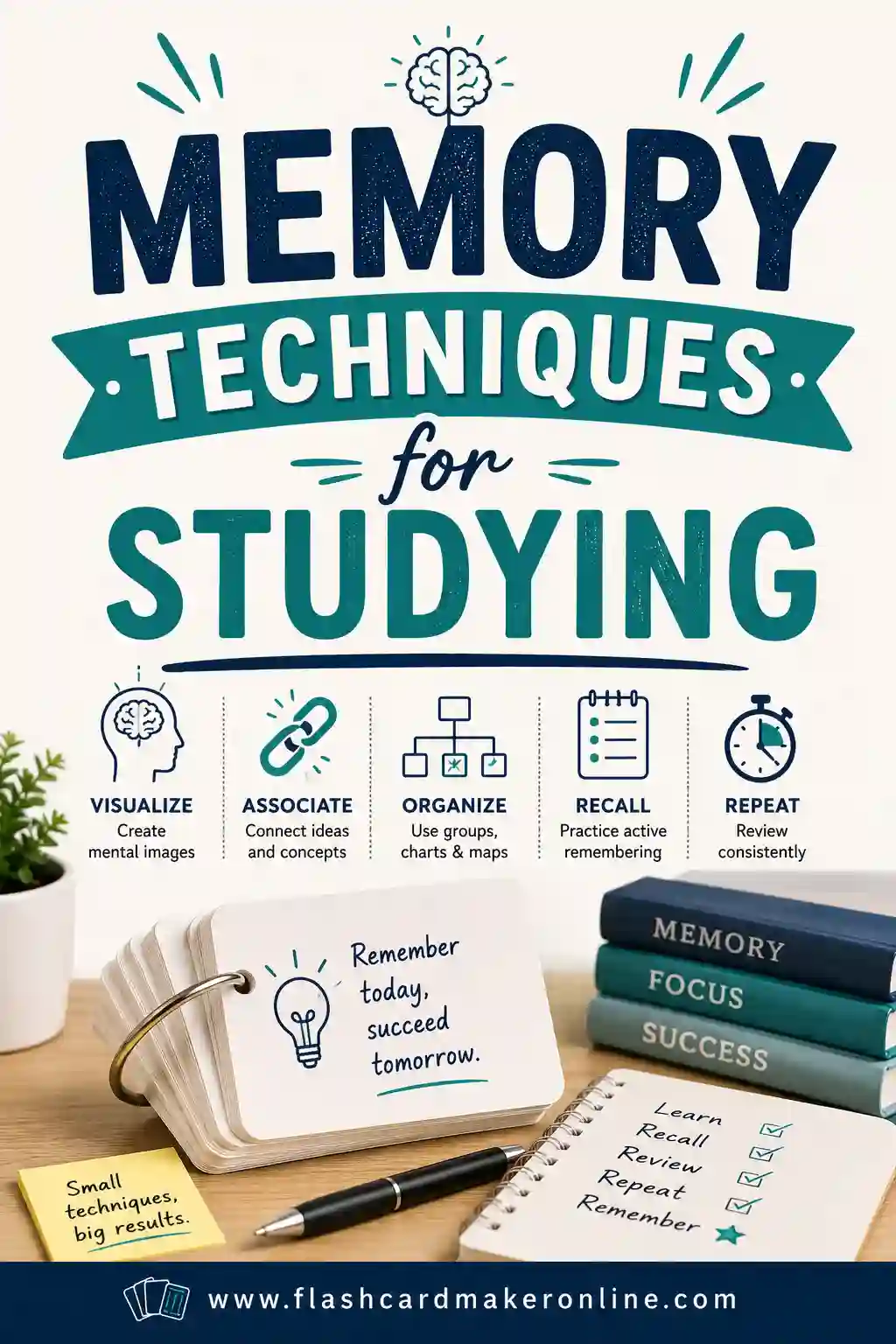
4. Build strong cues inside the material
The overshadowing and outshining findings suggest that the more tightly you connect facts to each other, the less the room matters. Ask "why" and "how" questions, link new facts to old ones, and use memory techniques that create meaningful connections. Our guide to memory techniques for studying has several options.
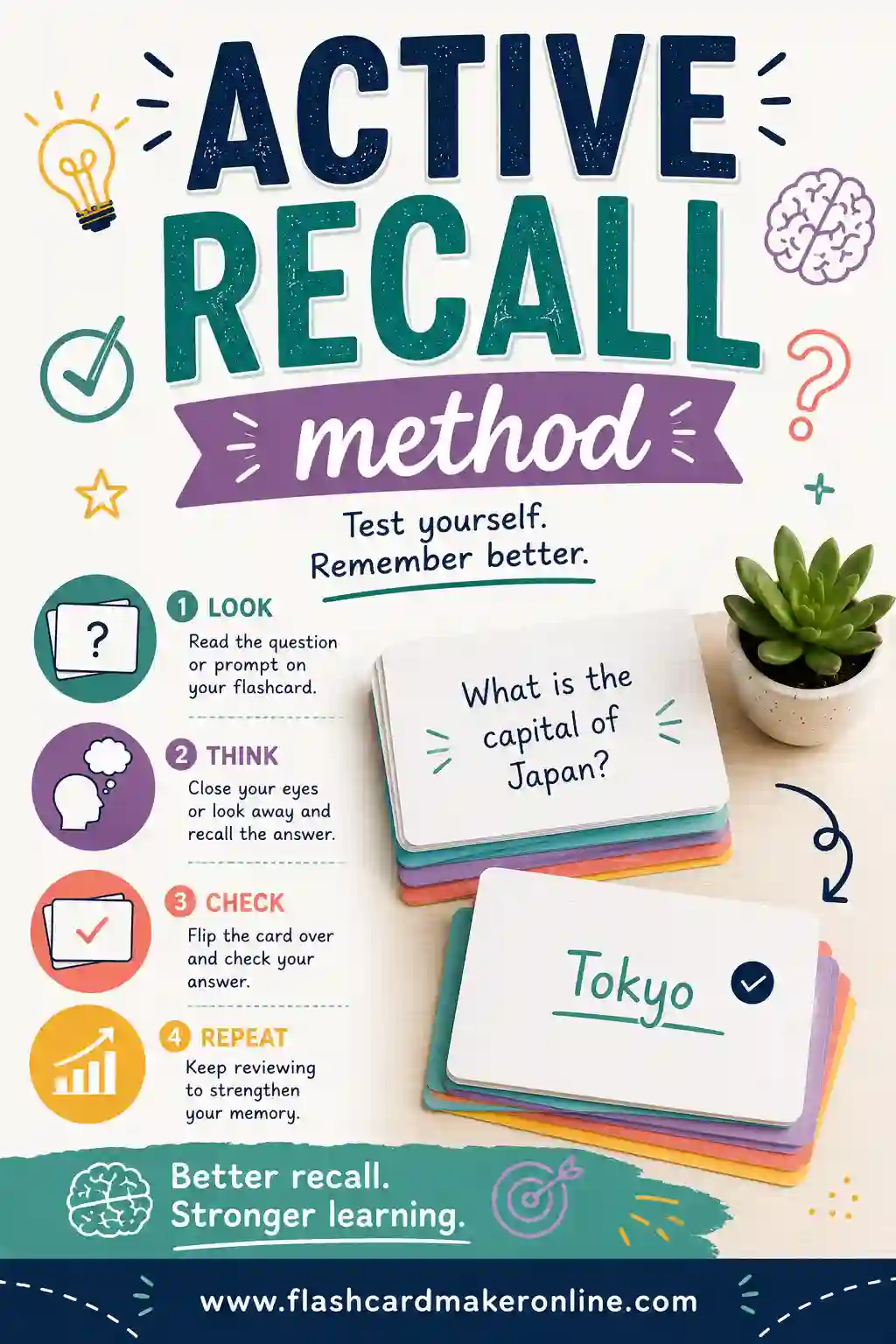
5. Practice recall, not just review
Recall without hints is where context matters most, and it's also what many tests demand. The best way to prepare is to practice exactly that. In Henry Roediger and Jeffrey Karpicke's well-known 2006 study, practicing recall led to much better retention after two days and one week than restudying did. Flashcards are a natural tool for this. Our page on the active recall method explains how to set up recall practice.
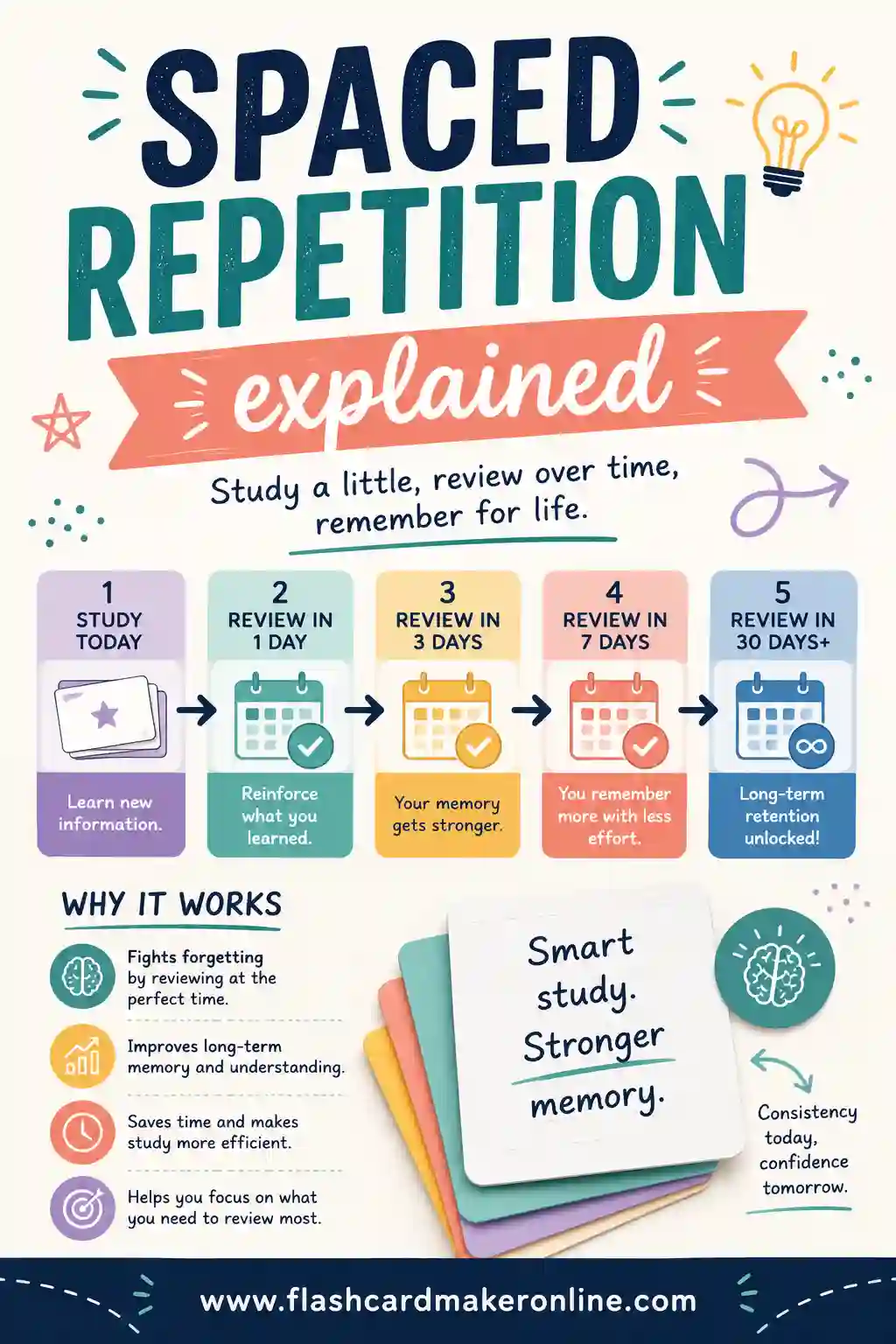
6. Spread your study out
Spacing your reviews across several days is one of the two techniques rated "high utility" in John Dunlosky and colleagues' 2013 review of study methods, along with practice testing. Spacing also has a bonus here: if you study on different days, you naturally study in slightly different contexts, with different moods, times and surroundings. Our guide to spaced repetition walks through simple schedules.
A practical plan for flashcard study
Here's how the context research and the broader study research fit together in a simple routine. This table sums it up.
| What to do | Why it helps | How to do it with flashcards |
|---|---|---|
| Vary your study spots | Keeps memory from depending on one setting | Review the same deck in two or three places each week |
| Practice recall | Recall is where context matters most, and practice strengthens it | Answer each card before flipping; say it out loud or write it |
| Space your sessions | Strengthens long-term memory and varies context naturally | Short reviews over several days instead of one long session |
| Connect ideas | Strong internal cues reduce reliance on the room | Add "why" and "how" cards, not just "what" cards |
| Rehearse test-like conditions | Makes test day feel more familiar | Do a timed, silent review at a desk once before the exam |
| Picture the study spot when stuck | Mental reinstatement can bring back cues | On test day, pause and imagine where you reviewed that card |
A worked example
Here's an illustrative example with a made-up student. Priya has a biology final in two weeks and a deck of 120 flashcards. She used to study only at her bedroom desk, late at night, with music on. Here's how she adjusts:
- Week 1: She splits the deck into four chunks of 30. She reviews at her desk on Monday, in the library on Wednesday and at the kitchen table on Saturday. Each session, she answers cards out loud before flipping.
- Week 2: She shuffles all 120 cards together and reviews the ones she missed most. She does one session on the bus, one in an empty classroom after school, and one at her desk with the music off.
- Two days before the exam: She does a timed, silent run-through at a desk, like the test setting.
- On test day: When she blanks on a question about enzymes, she takes a breath and pictures the library table where she first drilled those cards. The answer comes back.
None of this requires knowing where the exam will be. The goal is to make her memory flexible enough to work anywhere.
Is context really the problem? A quick check
When you blank on a test, it's tempting to blame the unfamiliar room. Sometimes that's part of it. More often, something else is going on. Before you rearrange your study life around context, run through these questions.
- Could you recall it at home without looking? If you only ever reread or recognized the answer at home, you may never have practiced recalling it. That's a recall gap, not a context gap.
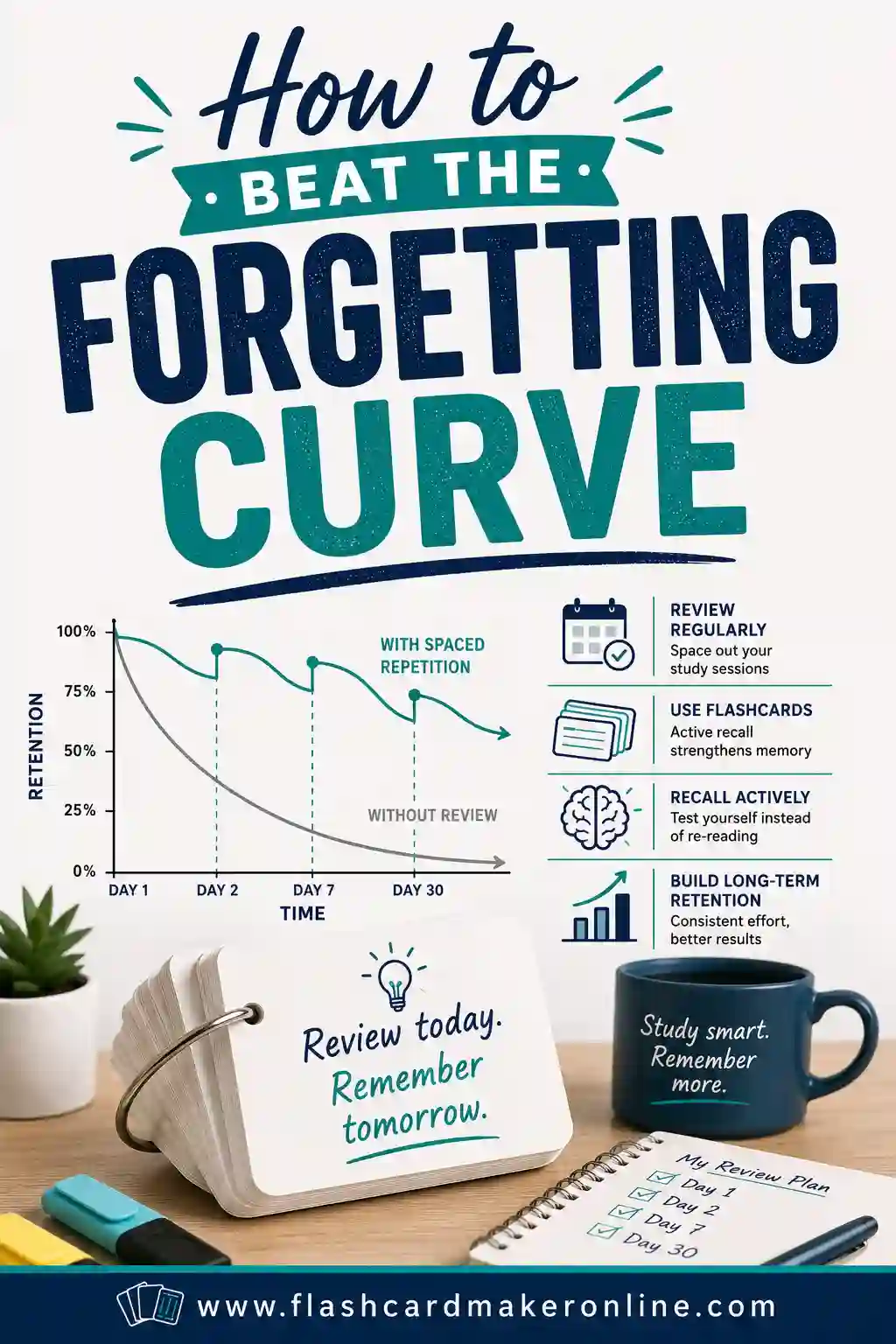
- Did you learn it once, a long time ago? Memories fade without review. Spacing your reviews matters more than where you do them.
- Was the test question worded differently? If your flashcards always asked "What is osmosis?" and the test asked you to explain what happens to a cell in salt water, the cue changed. Practice with varied questions.
- Were you anxious or exhausted? A very different internal state can make recall harder. Sleep, a steady routine and calm preparation help more than matching rooms.
- Did it come back later? If the answer popped into your head after the test, the memory was there but the cues weren't strong enough. That's a sign to build more connections and practice more recall, not a sign to study in the exam hall.
If you answer "yes" to the first question and "no" to the rest, context might be playing a role. In that case, the fixes in this article, varying study spots and picturing your study place, are the right tools.
Context in language learning, sports and performance
The research above mostly used word lists, but the same logic applies to other skills where you need to recall on demand.
Learning a language
Many learners notice they can remember vocabulary at their desk but struggle in a real conversation. Part of that is the difference between recognizing a word on a card and producing it under pressure. Part of it may be context. Practicing in varied settings helps: review cards while walking, label objects around the house, and say phrases out loud in different rooms. Our guide to flashcards for language learners has more ideas for moving words from cards into speech.
Music, speeches and sports
Performers often rehearse in the actual venue when they can, and coaches often run practices that imitate game conditions. That's partly about nerves and logistics, but it fits the idea that practicing in conditions like the real event makes recall more reliable. If you can't get into the real space, varying your practice settings is the next best thing. Rehearse a speech in your bedroom, then in the kitchen, then in front of a friend.
Work training and certifications
Adults studying for job tests often review in one spot, such as a desk after work. Mixing in short reviews during a lunch break or a commute adds variety to the context and also spreads out the study sessions, which is good for long-term memory either way.
For teachers and parents
If you're helping students prepare for tests, the context research offers a few easy, low-cost ideas.
- Vary review settings. Run quick review games in different parts of the room, outside, or in the library. It keeps students engaged and varies the context.
- Practice recall without hints. Low-stakes quizzes where students write answers from memory build the kind of retrieval that context affects most.
- Teach the "picture it" trick. Tell students that if they blank, they can close their eyes and picture where they learned the material. It's a small tool that helps some students stay calm.
- Don't overpromise. Avoid telling students they must test in their classroom to do well. The effect is modest, and that message can make an unfamiliar exam room feel scarier than it is.
Common misunderstandings about context and memory
"I should study in the exam room."
If it's easy, it can't hurt, and a familiar room may feel calmer. But it's not necessary, and for most students it isn't possible. Varying your study spots and practicing recall are more reliable strategies.
"Studying in the same spot every time is best."
A consistent spot can help you build a habit and avoid distractions, which is useful. But from a memory point of view, a single spot may tie your recall to that setting. A good compromise: keep a regular home base for focus, and also review in a few other places.
"Chewing the same gum during studying and the test will help."
Some studies have explored smells, flavors and sounds as context, and Smith's own work includes a study of background music. But the effects of any one cue tend to be small and inconsistent. It's not a substitute for actually practicing recall.
"The diver study proves that location is crucial."
The diver study showed a striking effect under extreme conditions, and it's a great teaching example. But the effect didn't show up for recognition, a modern replication didn't reproduce it, and the broader research shows a modest average effect. Location can matter. It's rarely the most important factor.
"If I study with music, I need music during the test."
Background sound is part of context, and Steven Smith published a 1985 paper specifically on background music and context-dependent memory. But you usually can't play music during an exam, so it makes sense not to depend on it. If you like studying with music, that's fine for some sessions. Just make sure a few of your review sessions, especially the last ones before the test, happen in quiet conditions. That way, silence on test day won't feel like a big change. Music with lyrics can also compete for attention when you're reading or writing, so many students find instrumental music or quiet works better for heavy reading anyway. Try both and check which sessions you actually remember better a few days later.
"Context only means the room."
Context includes the people around you, sounds, time of day and your own mood and alertness. That's why spacing your study across different days and situations helps: it varies many parts of the context at once.
Try it yourself: a context experiment
You can explore this effect with a friend or on your own. It won't be a formal study, but it's a fun way to see how memory works.
- Make two lists of 20 words each. Pick simple, unrelated nouns like "candle," "river," "ladder."
- Learn list A in one room. Spend five minutes reading it over, then put it away.
- Learn list B in a very different place. Outside, in a car or in a noisy kitchen. Again, five minutes.
- Wait a day.
- Recall both lists in the first room. Write down every word you remember from each list, without looking.
- Compare. Did you remember more from the list you learned in that room?
- Try the twist. Next time, before recalling the "other place" list, close your eyes and picture that place for 30 seconds. Did it help?
Don't be surprised if you don't see a big difference. The research says the effect is often modest, and a two-list test is very small. The more interesting lesson is noticing which strategies, like picturing the place or linking the words into a story, make the biggest difference for you.
Making your memory work anywhere
Context dependent memory is real: background details get stored along with what you learn, and recall can be a bit easier in the original setting. But the effect is usually modest, it shows up mostly in recall without hints, and it shrinks when you connect ideas well, have other strong cues, or simply picture where you studied. One modern attempt to repeat the famous diver experiment didn't reproduce the original result, which is a good reminder not to overstate it.
For students, the takeaway is practical. Study in a few different places, space your reviews over several days, practice recall instead of rereading, and if you blank during a test, picture where you learned it. For more on keeping memories strong over time, see our guide to beating the forgetting curve, and for exam season, our page on flashcards for exams.
Flashcards make this easy because they travel well. With the free flashcard maker on our homepage, you can add words and your own pictures, study with flip cards on screen wherever you are, and print your deck double-sided or as cut-out sheets to review at a desk, a library table or on the bus.
Four Context Terms Compared
Researchers use several related terms for how surroundings and states affect memory. This table puts them side by side with an example of each.
| Term | What it means | Example |
|---|---|---|
| Environmental context | The physical setting, such as a room, a place or background sounds | Studying French verbs at the kitchen table, with the fridge humming |
| State-dependent memory | Your internal state, such as mood or alertness, works as a kind of context | Learning something while feeling a certain way, then recalling it in a similar state |
| Encoding specificity | Memory works best when the cues at recall match what was stored at learning | Divers recalling words better in the same setting where they learned them |
| Reinstatement | Putting the original context back, physically or mentally | Picturing the original room while trying to remember in a new one |
Frequently Asked Questions
What is an example of context-dependent memory?
The classic example is a 1975 study by Godden and Baddeley. Scuba divers learned lists of words either on land or underwater, then tried to recall them in the same setting or the other one. They recalled more when the setting matched. An everyday example is walking into a room, forgetting why you came, then remembering once you go back to where you had the thought. The original place supplies cues that help bring the memory back.
Is context-dependent memory real?
Yes, but it's usually modest. A 2001 meta-analysis by Smith and Vela pooled 93 effect sizes from 75 studies and found context effects were reliable but on the small side, with an average effect size of about 0.28 for physical reinstatement. The effect shrank when people pictured the original setting or had other strong cues. A 2021 attempt to repeat the famous diver study did not reproduce the original result, which is a reminder not to overstate it.
What is the difference between context-dependent and state-dependent memory?
Context-dependent memory usually refers to the outside setting, such as a room, place or background sounds. State-dependent memory refers to your inside state, such as your mood or how alert you feel. Both follow the same basic idea: recall tends to be easier when the conditions at recall match the conditions at learning. Researchers often treat internal states as one more kind of context that can be stored along with what you learn.
Should I study in the same room where I'll take the test?
It isn't necessary. Classroom field experiments described in Smith and Vela's review did not find that taking exams in an unfamiliar room hurt scores, and test questions themselves provide strong cues. A better plan is to study in several different places, practice recalling answers without looking, and spread your study over several days. If you blank during the test, try picturing where you studied the material, which research suggests can help almost as much as being there.
Does changing where you study help memory?
It may. Steven Smith published research on enhancing recall by using multiple environmental contexts during learning, and his review lists experiments where studying in more than one place had positive effects on later recall. The idea is that memory learned in several settings isn't tied to any single one. Varying your study spots is easy, costs nothing, and pairs well with spacing your sessions over several days, which strongly supports long-term memory.
Does context-dependent memory affect multiple-choice tests?
Much less than recall tests, as far as research shows. In Godden and Baddeley's 1980 follow-up, the land-versus-underwater change had no effect on recognition, which is the kind of memory a multiple-choice test uses. Smith and colleagues also reported that changing rooms affected recall but not recognition in their 1978 work. The answer options act as strong cues and can outshine the background, so the room matters less.
Why did the diver study fail to replicate?
Jaap Murre's 2021 replication used 16 divers but differed from the original in several ways. All sessions ran in a single day instead of over four days, a TV crew filmed the session, the setting was a shallow heated indoor pool instead of cold open water, and an underwater speaker may have made words harder to hear. Any of these could have weakened the effect. Murre concluded the study was not a successful replication, even after correcting his analysis.
How can I use mental reinstatement during an exam?
When you can't recall an answer, pause and picture where you studied that material. Think about the desk, the light, the sounds and what you were doing. Smith and Vela's meta-analysis found that imagined reinstatement produced effects about as large as physically returning to the original room. It takes only a few seconds, it's silent, and you can use it on any question. If it doesn't work, move on and come back to the question later.
What is encoding specificity?
Encoding specificity is the principle that memory works best when the cues available at recall match the information stored when you learned something. It's usually credited to Endel Tulving and Donald Thomson's 1973 work. Context-dependent memory is one example of it, since the room or setting becomes part of what's stored. The principle also explains why practicing recall in the same way you'll be tested, and linking facts to each other, makes memories easier to retrieve later.
Sources
We checked every source below while writing this guide. Last reviewed October 30, 2026, by Joan Ramos.
- Environmental context-dependent memory: A review and meta-analysis (Smith & Vela, 2001) (Psychonomic Bulletin & Review, via Texas A&M University)
- The Godden and Baddeley (1975) experiment on context-dependent memory on land and underwater: a replication (Murre, 2021) (Royal Society Open Science, via PubMed Central)
- Addendum to: Murre (2021). The Godden and Baddeley (1975) experiment on context-dependent memory on land and underwater: a replication (Royal Society Open Science, via PubMed Central)
- Steven M. Smith: Memory Publications (Texas A&M University)
- Test-Enhanced Learning: Taking Memory Tests Improves Long-Term Retention (Roediger & Karpicke, 2006) (Psychological Science, via PubMed)
- Improving Students' Learning With Effective Learning Techniques (Dunlosky et al., 2013) (Psychological Science in the Public Interest, via PubMed)