Flashcards for Language Learners: Build Vocabulary Fast
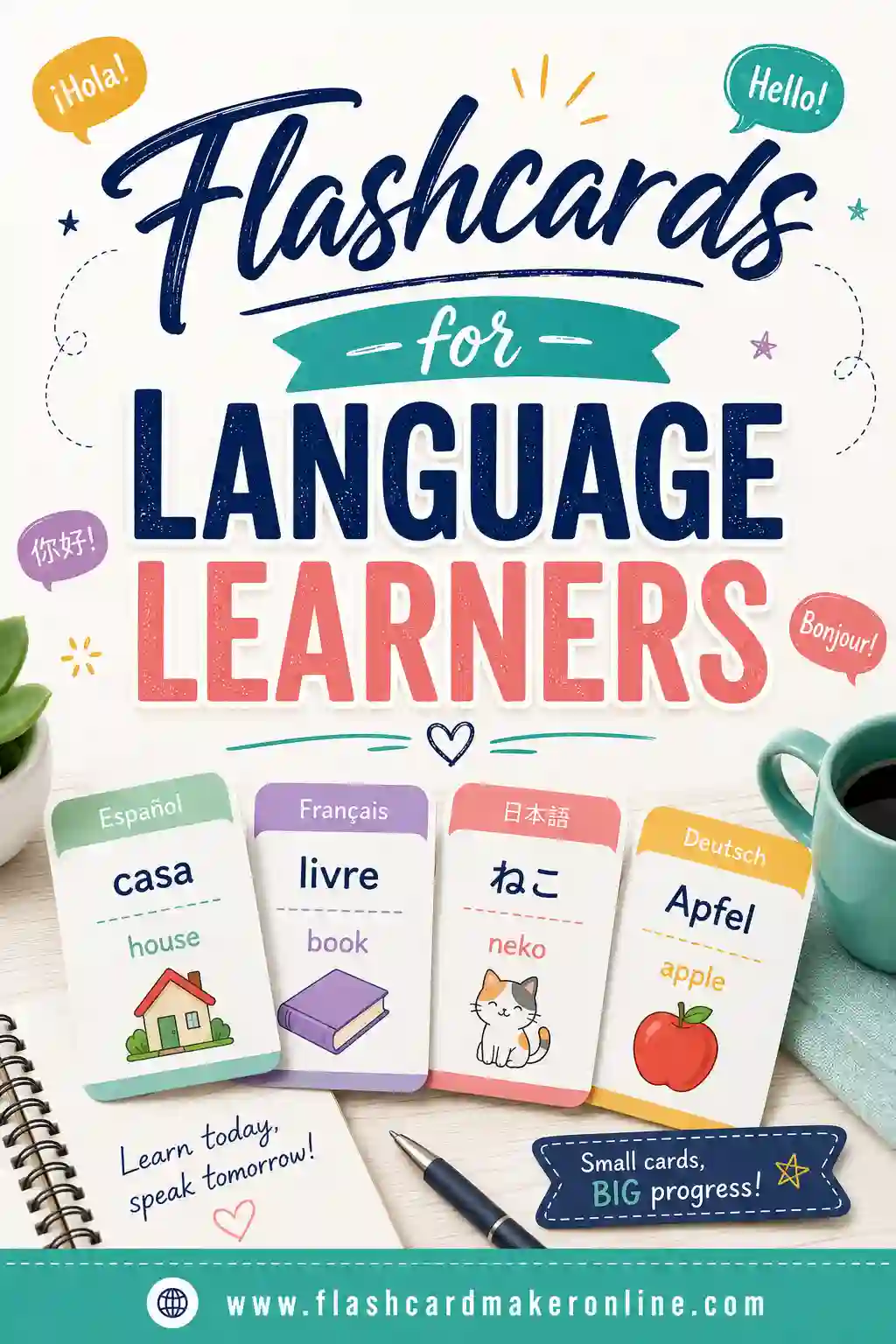
Flashcards for language learners are simple two-sided cards — the word in your target language on one side, the meaning (or a picture) on the other — that you flip to test yourself again and again. They're the fastest, most proven way to build vocabulary because they harness active recall and spaced repetition: you retrieve the word from memory instead of just rereading it, and you review each word right before you'd forget it. The easiest way to start is to build your own deck with a free flashcard maker so every card matches the words you actually need.
Ready to learn some words right now? Open the free flashcard maker, put the foreign word on the front and the translation on the back, and you've got a deck you can flip on your phone or print for the fridge. No sign-up, no app, no fee.
Why Flashcards Are Perfect for Learning a Language
Vocabulary is the part of language learning that's pure memory. Grammar you can reason through; words you simply have to know. And that's exactly the job flashcards were made for.
Two things make them so effective:
- Active recall. Seeing "la casa" and forcing yourself to remember "the house" builds a much stronger memory than reading a vocab list. The struggle to retrieve is the workout.
- Spaced repetition. A new word shows up often at first, then less and less as it sticks. You spend your time on the words you're about to forget instead of the ones you already know cold.
Together they let you learn hundreds of words without endless re-reading. That's why flashcards are a staple for everyone from casual app users to serious polyglots.
What to Put on a Language Flashcard
The classic setup is word on the front, meaning on the back. But a few smart choices make your cards far more powerful.
- Use a picture instead of a translation when you can. Linking "el perro" directly to an image of a dog (rather than the English word) trains you to think in the language.
- Add a sample sentence. A word in context sticks better and teaches you how it's actually used.
- Mark the gender or part of speech. For languages with grammatical gender, learn "la casa" — not just "casa" — from day one.
- Keep one word per card. Don't pile a whole phrase list onto a single card.
- Test both directions. Flip some cards target-to-native and others native-to-target so you can both understand and produce the word.
A Sample Spanish Vocabulary Deck (Copy & Adapt)
Here's a ready-made starter deck of everyday Spanish words. Drop these into the flashcard maker and add your own as you learn. The front is the Spanish word; the back is the English meaning. (The same approach works for any language — just swap the words.)
| Term (Front) | Definition (Back) |
|---|---|
| la casa | the house |
| el agua | water |
| el perro | the dog |
| el gato | the cat |
| comer | to eat |
| beber | to drink |
| la comida | food |
| gracias | thank you |
| por favor | please |
| hola | hello |
| adios | goodbye |
| rojo | red |
| azul | blue |
| grande | big |
| pequeno | small |
| hoy | today |
| manana | tomorrow |
| el libro | the book |
| la escuela | the school |
| el amigo | the friend |
| trabajar | to work |
| dormir | to sleep |
| la familia | the family |
| feliz | happy |
That's 24 cards to start. The real magic happens when you build a deck from the words you meet in your own reading, shows, and conversations.
How to Study Language Flashcards the Right Way
Owning a deck isn't enough — how you review it decides how fast you learn.
- Review a little every day. Ten focused minutes daily beats a two-hour cram once a week. Spaced repetition only works if you show up regularly.
- Say the word out loud. Speaking it trains pronunciation and locks the sound to the meaning.
- Sort as you go. Keep two piles (or two stacks digitally): "got it" and "review again." Spend your energy on the second pile.
- Don't just recognize — produce. Try to recall the foreign word from the English, not only the other way around. Producing is harder and more useful.
- Retire mastered cards. Once a word is automatic, pull it from active rotation so you focus on new material.
A weekly study rhythm
| Day | Focus |
|---|---|
| Monday | Add 10–15 new words from your lessons |
| Tuesday–Thursday | Review due cards + add a few new ones |
| Friday | Test only your "review again" pile |
| Weekend | Mixed review; practice sentences with new words |
Themed Decks That Speed Up Learning
Grouping words by theme helps your brain build connections. A few decks worth making early:
- Survival phrases. Hello, please, thank you, where is, how much — the words you need on day one of a trip.
- Food and drink. Restaurant words pay off fast and are fun to practice.
- Numbers, days, and time. Used constantly, so high return on effort.
- Family and people. Mother, father, friend, neighbor — the social core of any language.
- Verbs you'll actually use. Eat, go, want, have, can. A handful of common verbs unlocks tons of sentences.
Building a focused deck per theme also makes review sessions feel manageable instead of overwhelming.
Memory Tricks to Make Vocabulary Stick
Flashcards do most of the work, but a few simple memory tricks make each word far easier to recall. Build them right into your cards.
- Link words to images. Picture the thing, not the translation. When you see "el perro," imagine an actual dog, not the English word "dog." That direct link is how fluent speakers think.
- Use sound-alikes. Connect a foreign word to a similar-sounding word in your language plus a silly image. The Spanish "huevo" (egg) sounds a bit like "where-vo" — picture asking "where's my egg?" Goofy, but it sticks.
- Group by theme. Words in a related cluster reinforce each other. Learn kitchen words together and they prop each other up in memory.
- Build mini-stories. String a few new words into one absurd sentence. Stories are far stickier than isolated words.
- Add the article and gender. For gendered languages, always learn "la casa," never just "casa." Learning the wrong gender later is painful to unlearn.
The aim isn't to memorize words in a vacuum — it's to make each word easy to grab when you actually need it in conversation.
How Flashcards Fit Your Wider Language Routine
Flashcards are powerful, but they're one piece of a bigger puzzle. They build the raw vocabulary; the rest of your routine teaches you to use it.
Think of cards as your daily vocabulary workout. Ten or fifteen minutes of review keeps new words fresh and feeds them into long-term memory. But to turn that vocabulary into real ability, pair your cards with input and output.
For input, read and listen at your level — graded readers, podcasts, kids' shows, song lyrics. Every time you meet a word you've carded, the connection gets stronger, and every new word you meet becomes a fresh card. Your reading feeds your deck, and your deck makes your reading easier. It's a virtuous loop.
For output, speak and write. Try to use this week's words in a journal entry, a chat with a language partner, or even talking to yourself. The moment you reach for a word and find it, you'll know it has truly stuck. Words you can recall in conversation are words you own — and flashcards are the fastest way to get them there.
Digital vs. Printed Flashcards for Languages
You don't have to choose just one — most learners benefit from both.
Digital cards travel with you and are perfect for daily spaced-repetition review on your phone. You can edit them instantly when you spot a mistake.
Printed cards are wonderful for screen-free practice, for sticking on objects around your home (a card that says "la puerta" taped to the door), and for visual learners who like to physically sort piles. With a free flashcard maker you build the deck once and do both — flip on your phone, then print a set for hands-on practice.
Printing tips
- Print double-sided so the translation lands on the back.
- Use cardstock for cards that survive daily handling.
- Print small (8 per page) for pocket-sized review cards.
- Make a "label the house" set you can tape to real objects.
Common Mistakes Language Learners Make
A few habits quietly slow people down. Avoid these:
- Learning words in isolation. A word with no context is hard to use. Add a quick example sentence.
- Only studying recognition. If you can read "manana" but can't recall it when you need it, you've only done half the job. Practice both directions.
- Letting reviews pile up. Skip a week and you'll face a daunting backlog. A little daily upkeep keeps it light.
- Cramming long lists. Twenty new words a day, reviewed steadily, beats a hundred you forget by morning.
- Ignoring pronunciation. Cards reinforce meaning, but say the word aloud so you also learn how it sounds.
Frequently Asked Questions
Do flashcards really help with learning a language?
Yes. Flashcards are one of the most effective vocabulary tools available because they combine active recall and spaced repetition. Both are strongly supported by memory research, and together they let you learn and retain far more words than passive reading or listening alone.
How many words should I learn per day with flashcards?
For most learners, 10–20 new words a day is a sustainable pace that adds up to thousands over a few months. What matters more than the number of new cards is reviewing your existing ones daily so the words actually stick.
Should I put a translation or a picture on the back?
Both work, but pictures are often better because they let you connect the foreign word directly to its meaning without routing through your native language. Pictures are ideal for concrete nouns; translations work fine for abstract words and verbs.
Is it better to make my own cards or use a pre-made deck?
Making your own is usually more effective, because writing the card is itself practice and the words match exactly what you're learning. Pre-made decks are a fine starting point — many learners use one as a base and add personal cards for the words they keep meeting.
Can I print my language flashcards?
Yes. Build your deck in the free flashcard maker and print a double-sided set on cardstock. Printed cards are great for screen-free practice and for sticking around your home to label real objects.
Ready to Build Your Language Flashcards?
You've got the method, a starter deck, and a study rhythm that works. Now open the free flashcard maker, turn the words you're learning into a stack of cards, and start building your vocabulary today. It's free, there's no sign-up, and you can flip on your phone or print for hands-on practice. Want more ideas? Check out our guides on flashcards for medical students, flashcards for ESL, and flashcards for kids. Happy studying — you'll be surprised how fast the words add up.