Cloze Deletion: How to Write Fill-in-the-Blank Flashcards That Work
A cloze deletion is a fill-in-the-blank flashcard: you take a sentence that contains a fact, hide one key word or phrase, and ask yourself to supply it. "The powerhouse of the cell is the [...]" is a classic example. Cloze deletion is one of the fastest ways to turn notes and textbook sentences into flashcards, and when it's done well, it gives you exactly the kind of effortful recall that research links to long-lasting memory. When it's done badly, it turns into a guessing game you can win without knowing anything.
This guide covers where the idea came from (a 1953 newspaper-readability study, of all places), why fill-in-the-blank cards work, the rules for writing good ones, common mistakes with before-and-after fixes, and worked examples for languages, science, history, medicine, math and law. By the end, you'll be able to look at any sentence and know whether it should become a cloze card, and which word to hide.
What Is a Cloze Deletion?
A cloze deletion (pronounced "close," not "clozey") is a piece of text with one or more parts removed and replaced by a blank, brackets or three dots. Your job is to recall what's missing. On a flashcard, the front shows the sentence with the gap, and the back shows the complete sentence with the answer filled in.
Here's a simple example:
- Front: The Treaty of Paris that ended the American Revolutionary War was signed in [...].
- Back: The Treaty of Paris that ended the American Revolutionary War was signed in 1783.
A few related terms are worth knowing:
- Cloze card: a flashcard built around a cloze deletion.
- Cue: the visible part of the sentence that helps you find the answer.
- Overlapping cloze: several cards made from the same text, each hiding a different part. Useful for lists and sequences.
- Graphic deletion: the picture version, where part of a diagram is covered and you name what's hidden.
Where Cloze Deletion Came From
The word "cloze" was invented by Wilson L. Taylor in a 1953 article in Journalism Quarterly titled "Cloze Procedure: A New Tool for Measuring Readability." Taylor wanted a better way to measure how easy a piece of writing was to read. Older readability formulas just counted things like word length and sentence length. Taylor's idea was to involve real readers.
His method was simple: take a passage, delete words at regular intervals, and ask readers to fill in the blanks. The more blanks people filled correctly, the more readable the passage. According to a 1974 historical overview of the cloze procedure by Richard Walter of Kean College, archived by the U.S. Department of Education's ERIC database, Taylor explained that the word was pronounced like "close" and came from "closure," a term from Gestalt psychology. Closure describes our tendency to mentally complete something that's unfinished, like seeing a full circle when a small part of it is missing.
Walter's review notes that Taylor's original method deleted every fifth word. That rate was fairly arbitrary at first, but later work supported it because blanks spaced that far apart behave more or less independently of each other. Over the following decades, researchers found that cloze tests also measured reading comprehension, and the method spread into reading assessment and language teaching. Walter summarizes work by Bormuth suggesting that a cloze score of about 38 percent corresponded to about 75 percent on traditional comprehension questions, which shows how much harder it is to produce an exact missing word than to recognize a right answer.
Decades later, the idea moved from testing to studying. Piotr Wozniak, the creator of the SuperMemo spaced-repetition software, listed it as rule 5 in his widely read 1999 article "Effective Learning: Twenty Rules of Formulating Knowledge." The rule's title says it plainly: "Cloze deletion is easy and effective." Wozniak described it as a quick way to convert textbook knowledge into items for spaced repetition and said it's especially useful for beginners. Today, nearly every flashcard app supports some version of cloze cards.
| Year | Milestone |
|---|---|
| 1953 | Wilson Taylor introduces the "cloze procedure" in Journalism Quarterly as a readability measure, deleting every fifth word |
| 1950s to 1970s | Researchers adapt cloze tests to measure reading comprehension and students' reading levels |
| 1974 | Walter's ERIC review summarizes two decades of cloze research and its methods |
| 1999 | Wozniak's "Twenty Rules" recommends cloze deletion for turning text into spaced-repetition flashcards |
| Today | Cloze cards are a standard card type in study apps, language courses and printed worksheets |
Cloze Tests vs. Cloze Flashcards: Same Name, Different Jobs
If you've seen the word "cloze" on a reading worksheet or a language exam, you may wonder whether it's the same thing as a cloze flashcard. They share a name and a format, but they do different jobs.
A cloze test is an assessment. A teacher takes a passage, removes words at a regular interval, and uses the share of correct answers to estimate how well a student can read that kind of text. Walter's ERIC review describes how researchers in the two decades after Taylor's article used cloze scores to place students at reading levels, while also warning that many studies described their methods poorly and that more needed to be known about what cloze tests really measure.
A cloze flashcard is a study tool. You pick which word to hide, and you pick it on purpose: the key fact you need to remember. You aren't measuring your reading level. You're practicing recall of a specific piece of knowledge, again and again, over spaced intervals.
That difference matters for card design. A reading test deletes words mechanically, so some blanks land on small words like "the" or "of." On a flashcard, that would waste your time. Always choose the blank by meaning, not by position.
Why Cloze Deletion Works
Cloze cards aren't magic. They work because they're a convenient way to practice two things that research strongly supports: recalling information from memory and generating answers yourself.
They make you retrieve, not just recognize
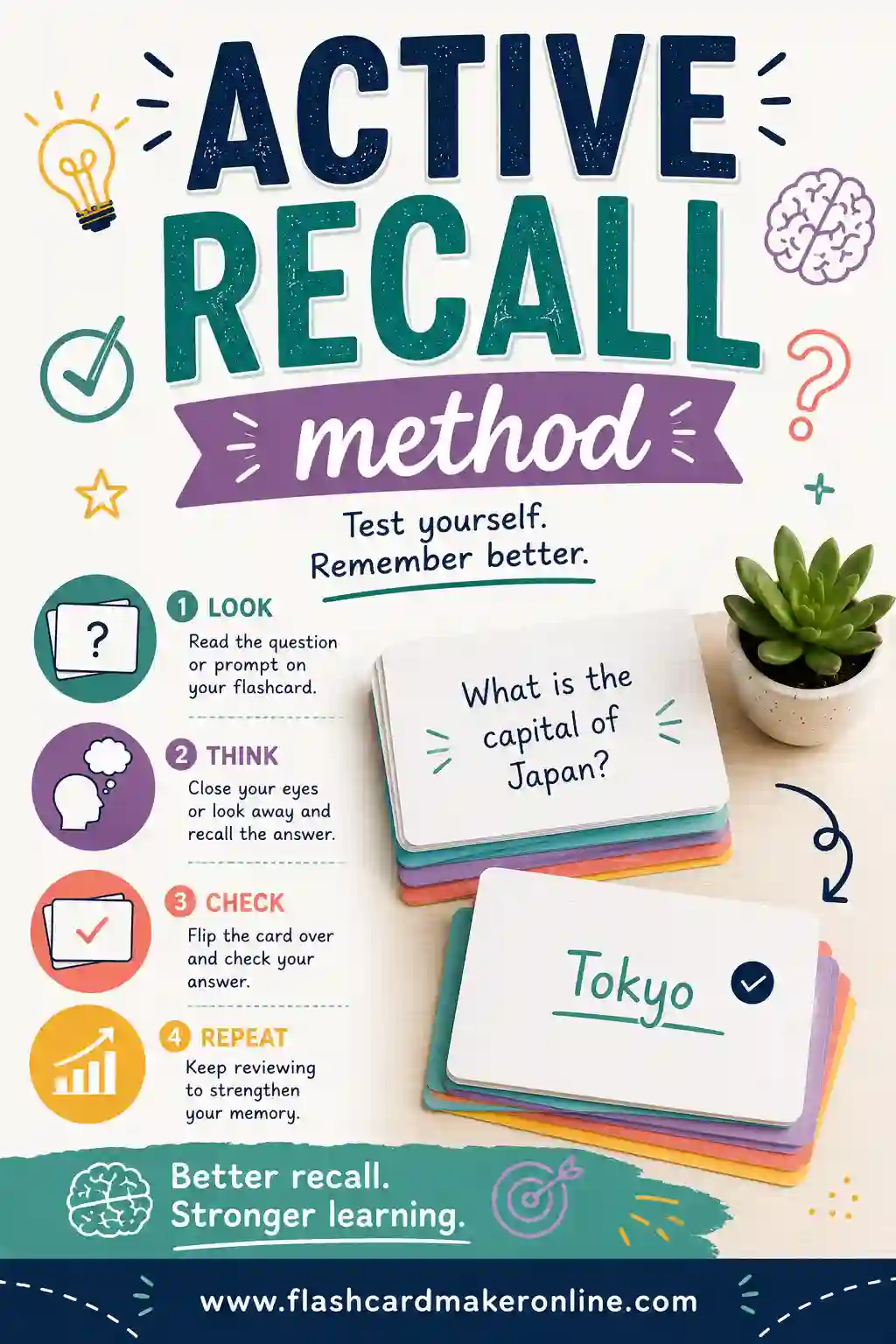
In a well-known 2006 study in Psychological Science, Henry Roediger and Jeffrey Karpicke had students read prose passages and then either restudy them or take recall tests on them. On a test five minutes later, restudying came out ahead. But on tests two days and one week later, the students who had practiced recall remembered substantially more, even though the restudy group felt more confident. That's the testing effect, and you can read more about it in our guide to the active recall method.
The kind of test matters too. Rowland's 2014 meta-analysis in Psychological Bulletin found that initial recall tests produced larger benefits than recognition tests such as multiple choice, and supported the idea that effortful retrieval contributes to the testing effect. A cloze card is a recall test: you have to produce the missing word, not just pick it from options.
They make you generate the answer
The generation effect is the finding that information you produce yourself is remembered better than information you simply read. A 2007 meta-analysis by Bertsch and colleagues in Memory & Cognition pooled 445 effect sizes from 86 studies and found an average effect of about 0.40 standard deviations in favor of generating over reading, with the size varying a lot depending on the conditions. Filling in a blank is a direct form of generation.
They keep the context
A plain question-and-answer card often strips a fact out of its sentence. A cloze card keeps the sentence around the answer, which can help you understand what the fact means and where it fits. That context is also a cue, which is a double-edged sword, as you'll see in the mistakes section.
They're fast to make
This is the practical reason they're so popular. You can turn a sentence from your notes into a card in seconds, which makes it easier to keep a deck up to date as you go.
Testing yourself is among the best-supported study strategies there is. In a 2013 review of ten learning techniques, John Dunlosky and colleagues rated practice testing as high utility, along with spaced practice. Cloze cards are simply one convenient format for practice testing.
How to Write Cloze Deletion Cards That Work
These rules come from the research above and from long experience with spaced-repetition decks. Follow them, and your cloze cards will test what you actually need to know.
Rule 1: Understand before you delete
Wozniak's first two rules are "Do not learn if you do not understand" and "Learn before you memorize." A cloze card made from a sentence you don't understand teaches you to recognize a pattern of words, not the idea. Read the section, make sure it makes sense, and then make cards.
Rule 2: Hide one key fact per card
Each blank should test one meaningful piece of information. That's the core of Wozniak's "minimum information principle": simple items are easier to recall and easier to review well over time. If a sentence has three important facts, make three cards from it, each hiding a different one.
Rule 3: Delete the important word, not the filler
Hide the word that carries the meaning you need to know: the name, number, term, cause or result. Hiding "the" or "is" tests grammar, not knowledge.
Rule 4: Make sure only one answer fits
Read your card as if you'd never seen it. Could several different words fill the blank and still be true? If so, add context or a hint until only one answer fits. "Water boils at [...] degrees" is ambiguous. "At sea level, pure water boils at [...] degrees Celsius" isn't.
Rule 5: Trim the sentence
Long sentences make cards slow to review and give away answers through extra context. Cut words that don't help you find the answer. You can rewrite the sentence in your own words, which also adds a little generation.
Rule 6: Don't let the sentence give the answer away
Watch for clues like "an [...]" (which tells you the answer starts with a vowel), plural verbs that reveal a plural answer, or a nearby word that repeats the answer. Rewrite to remove the giveaway.
Rule 7: Use hints only when they're needed
A short hint in parentheses can fix ambiguity: "[...] (year)" or "[...] (organ)." Use hints to narrow the type of answer, not to reveal the answer itself.
Rule 8: Break lists into overlapping cards
Wozniak recommends avoiding sets and long enumerations, and when you can't, using cloze deletions, ideally overlapping ones. Instead of one card asking for all seven items in a list, make several cards that each hide one or two items while showing the others.
Rule 9: Add a source and a reverse card when it helps
Noting where a fact came from ("Ch. 4 notes") makes it easier to check if something seems wrong. For key terms, pair a cloze card with a definition card asked the other way around, so you can both name the term and explain it.
Common Cloze Deletion Mistakes, With Fixes
The best way to learn good cloze writing is to see bad cards get fixed. These examples are illustrative.
| Problem | Weak card | Better card |
|---|---|---|
| Too many blanks | [...] wrote the [...] in [...]. | Thomas Jefferson was the main author of the [...] (1776 document). |
| Blank on a filler word | Photosynthesis [...] light energy into chemical energy. | Photosynthesis converts light energy into [...] energy. |
| More than one right answer | The capital of Australia is a [...] city. | The capital city of Australia is [...]. |
| Grammar gives it away | The largest planet is an [...]. | The largest planet in our solar system is [...]. |
| Sentence too long | A full paragraph about the causes of World War I with one name hidden | The 1914 assassination of Archduke [...] helped trigger World War I. |
| Whole list in one card | The noble gases are [...]. | Several overlapping cards, each hiding one or two of the noble gases |
| Copied without understanding | A textbook sentence with a term you can't explain | Rewrite the sentence in your own words first, then hide the key term |
The "pattern matching" trap
This one deserves extra attention. After you see the same cloze card a few times, you may start recognizing the shape of the sentence and recalling the answer from the surrounding words rather than from real knowledge. You "know" that "The powerhouse of the cell is the..." ends in "mitochondria," but you might not be able to explain what mitochondria do or answer a differently worded question.
Ways to avoid it:
- Make at least one non-cloze card for important ideas, such as "What does the mitochondrion do?"
- Occasionally reword your cloze sentences so you can't rely on memorized phrasing.
- Ask yourself "why?" after you get a card right. If you can't explain it, the card is testing recall of a sentence, not understanding.
- Hide the cause in one card and the effect in another, so you learn both directions.
Cloze Deletion vs. Question-and-Answer Cards
Cloze cards and classic Q&A cards both work. They're good at different things.
| Feature | Cloze deletion card | Question-and-answer card |
|---|---|---|
| Speed to make | Very fast; copy a sentence and hide a word | Slower; you write a question in your own words |
| Context | Keeps the sentence around the fact | Can strip context unless you add it |
| Risk of pattern matching | Higher; you may memorize the sentence shape | Lower if you write good questions |
| Best for | Definitions, key terms, dates, grammar, formulas, quotes, sequences | Explanations, "why" and "how" questions, comparisons, problem solving |
| Typical mistake | Hiding too much or too little | Asking vague or overly broad questions |
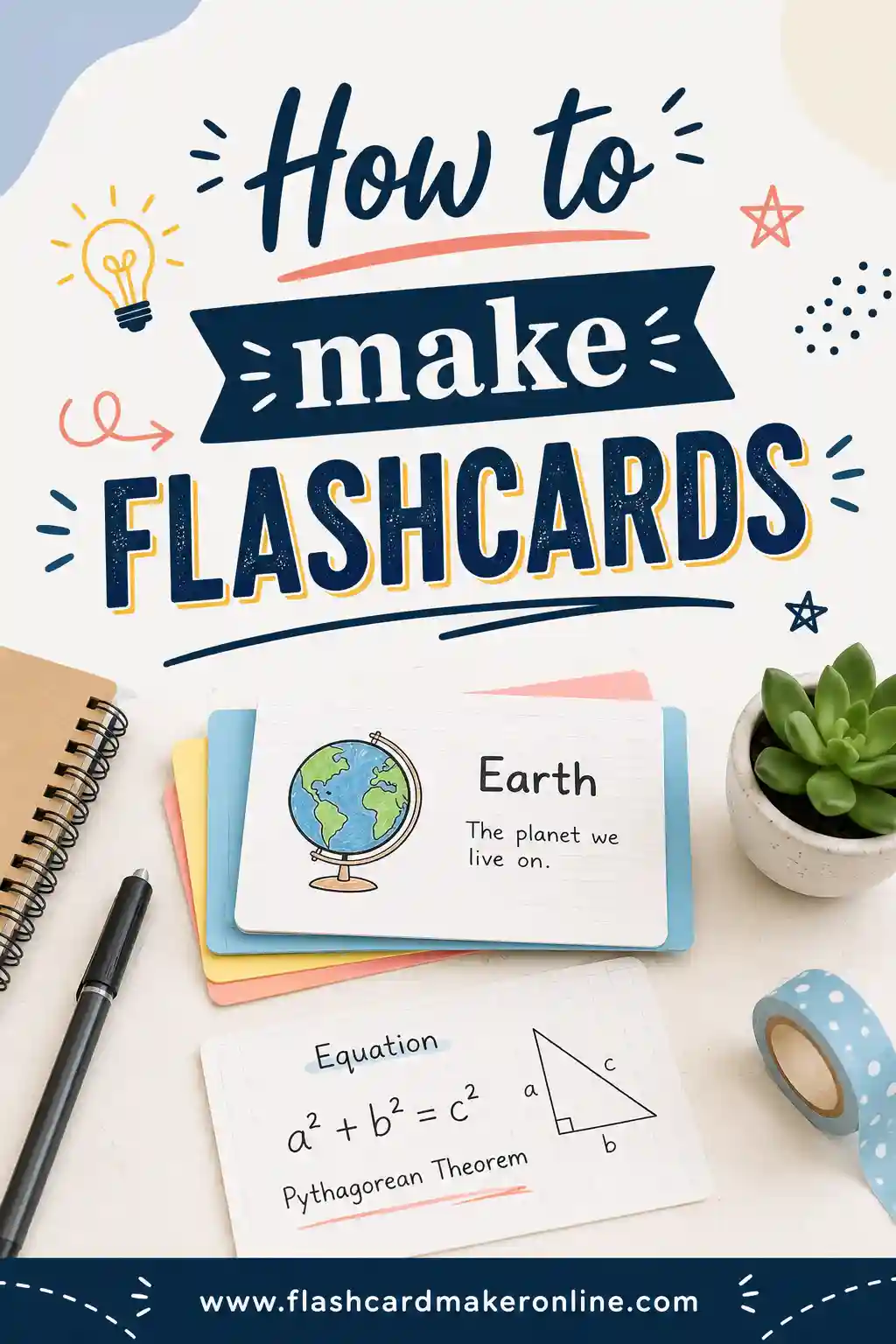
A balanced deck usually has both. Use cloze cards to lock in terms and facts quickly, and Q&A cards to test whether you understand them. For more on writing Q&A cards, see our guide on how to make flashcards.
Worked Examples by Subject
The cards below are illustrative examples you can adapt.
Foreign languages
Cloze cards are great for grammar and word choice because they show the word in a real sentence.
- Spanish verb choice: "Mi hermana [...] doctora." Back: es (from ser, used for professions).
- French gender: "J'ai acheté [...] voiture rouge." Back: une (voiture is feminine).
- German word order: "Ich weiß, dass er morgen [...]." (kommen) Back: kommt, with the verb at the end of the clause.
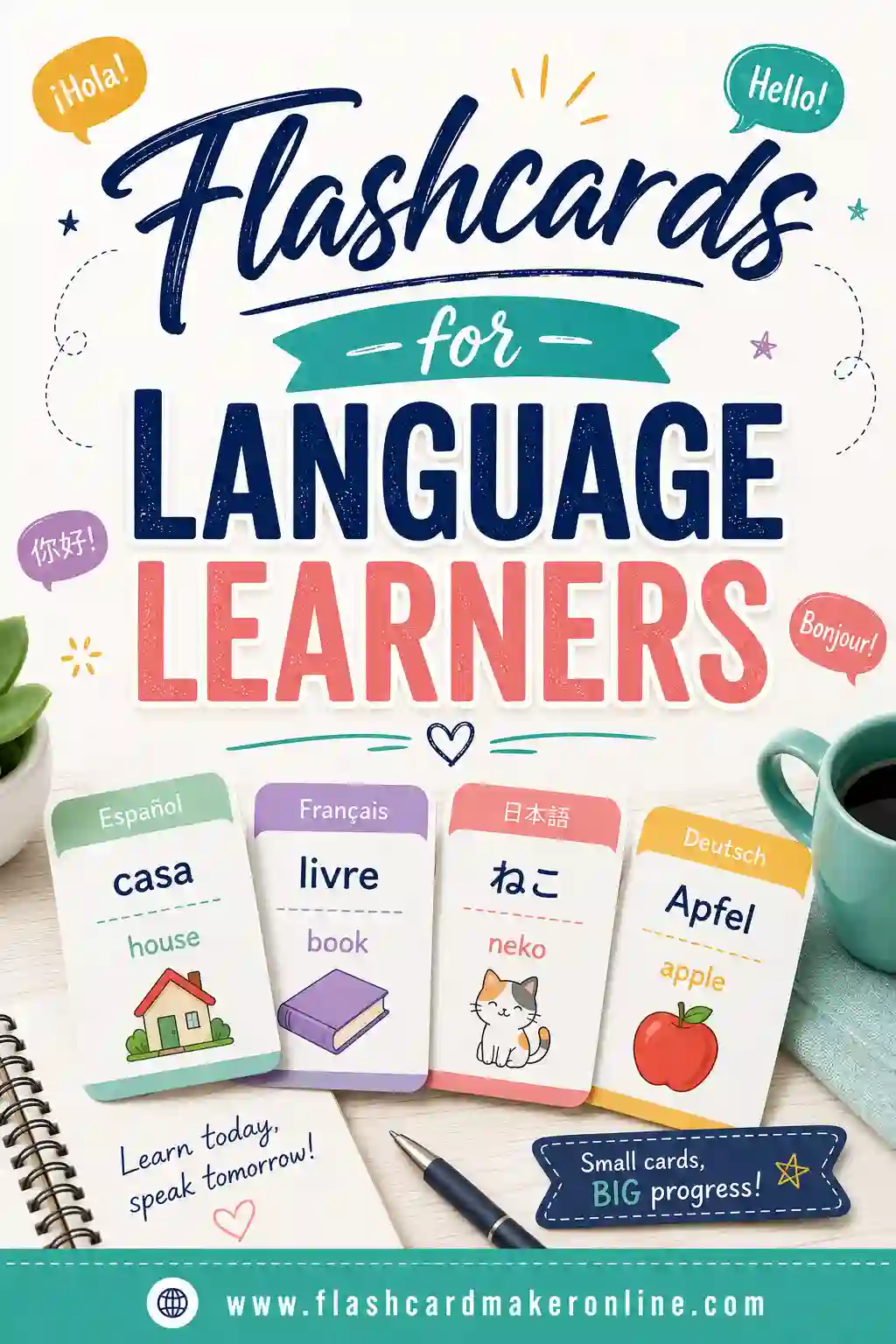
Notice how the hint in the German card tells you which verb to use, so the card tests word order and conjugation, not guessing the verb. For more language tips, see flashcards for language learners.
Biology
- "During photosynthesis, plants take in carbon dioxide and release [...]." Back: oxygen.
- "DNA bases pair as adenine with [...] and cytosine with guanine." Back: thymine.
- Paired card: "DNA bases pair as adenine with thymine and cytosine with [...]." Back: guanine.
The two DNA cards are a small example of overlapping cloze: same sentence, different blank. Our biology flashcards page has more subject-specific ideas.
U.S. history
- "The Constitutional Convention met in Philadelphia in [...] (year)." Back: 1787.
- "The first ten amendments to the U.S. Constitution are known as the [...]." Back: Bill of Rights.
- "The 19th Amendment, ratified in 1920, protected women's right to [...]." Back: vote.
Dates are a natural fit for cloze cards. For timeline strategies, see history dates flashcards.
Chemistry and math
- "The chemical formula for table salt is [...]." Back: NaCl.
- "The area of a circle equals pi times the [...] squared." Back: radius.
- "In the quadratic formula, the expression under the square root, b squared minus 4ac, is called the [...]." Back: discriminant.
For formulas, hide one piece at a time. A card that asks you to produce the entire formula from nothing is a different, harder card, and often worth having too once the parts are solid.
Medicine and nursing
- "The prefix 'brady-' means [...]." Back: slow.
- "Insulin is produced by the beta cells of the [...]." Back: pancreas.
Medical terminology is full of word parts, which makes it well suited to cloze cards that hide a prefix, root or suffix.
Literature and quotes
Cloze cards are a classic way to memorize lines for a speech or a performance. Hide one phrase at a time, working through the passage with overlapping cards, so each card tests a short piece while the rest gives you context.
Law and civics
- "The First Amendment protects freedom of religion, speech, the press, assembly and the right to [...] the government." Back: petition.
For a list like the five freedoms, make overlapping cards so each one hides a different freedom.
Overlapping Cloze: How to Handle Lists and Sequences
Lists are one of the hardest things to learn with flashcards. Wozniak calls unordered sets especially costly to retain and recommends turning them into ordered lists or breaking them into overlapping cloze cards when you can't avoid them.
Here's how to do it with the order of the planets from the Sun: Mercury, Venus, Earth, Mars, Jupiter, Saturn, Uranus, Neptune.
- Card 1: Mercury, [...], Earth (Back: Venus)
- Card 2: Venus, Earth, [...] (Back: Mars)
- Card 3: Earth, Mars, [...] (Back: Jupiter)
- Card 4: Mars, Jupiter, [...] (Back: Saturn)
- Card 5: Jupiter, Saturn, [...] (Back: Uranus)
- Card 6: Saturn, Uranus, [...] (Back: Neptune)
Each card shows a small window of the sequence and asks for the next item. Together they cover the whole list, but no single card overloads you. You can do the same with the steps of a process, the stages of mitosis, a list of amendments or the lines of a poem.
Graphic Deletion: Cloze Cards for Pictures
Wozniak's rule 8 is "Graphic deletion is as good as cloze deletion." It's the same idea applied to images: show a diagram with one label covered and ask for the missing name. This works well for anatomy, maps, the periodic table, circuit diagrams and parts of a plant or cell.
To make a graphic deletion card on paper, print or draw the diagram, cover one label with a sticky note or a box, and write the answer on the back. Make one card per label so each part gets tested on its own. If you're adding your own pictures to digital cards, use the same approach: one diagram, one hidden part per card.
A Step-by-Step Workflow: From Class Notes to a Cloze Deck
Knowing the rules is one thing. Building a deck week after week is another. Here's a simple routine that keeps your cards high quality without eating your whole evening.
Step 1: Review your notes the same day
Go over the day's notes while the lesson is still fresh. Fix anything that's confusing, look up terms you didn't catch, and mark the sentences that contain facts you'll be tested on. If you can't explain a sentence in your own words yet, put a question mark next to it and come back after you've cleared it up.
Step 2: Pick the "card-worthy" sentences
Not every sentence needs a card. Choose the ones that hold definitions, key terms, dates, names, formulas, causes and effects, or steps in a process. Skip background chatter and examples you already understand well. A good class session might produce ten to twenty cards, not fifty.
Step 3: Rewrite each sentence short and clear
Before you add a blank, trim the sentence to the essentials and put it in your own words. "In 1953, Wilson Taylor introduced the cloze procedure in an article about measuring readability in Journalism Quarterly" might become "Wilson Taylor introduced the cloze procedure in [...] (year)." Shorter sentences are faster to review and leave fewer accidental clues.
Step 4: Choose the blank
Ask, "What's the one thing in this sentence I'd be embarrassed not to know on the test?" That's your blank. If there are two or three equally important things, make two or three cards.
Step 5: Read each card cold
Cover the back and read the front as if you'd never seen it. Does exactly one answer fit? Is there a grammar clue? Could you answer it just from the sentence's wording without knowing the subject? Fix anything that fails.
Step 6: Add one deeper card per big idea
For each major concept in the lesson, add one question card that asks why, how or what would happen if. This guards against the pattern-matching trap and checks that your cloze cards are anchored to real understanding.
Step 7: Schedule the first review
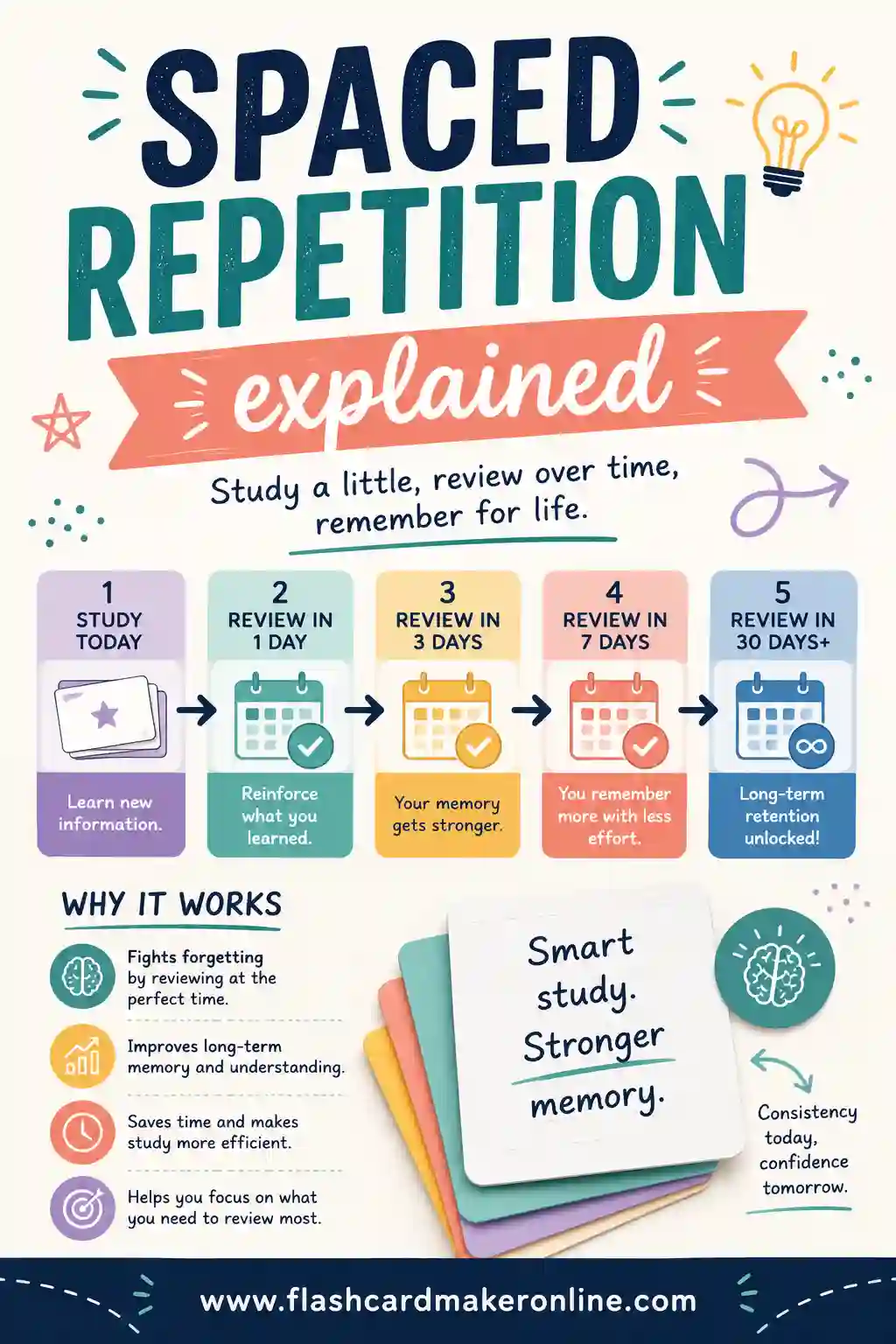
Review the new cards the next day, then again a few days later. If you're using paper cards, a simple box system works well; our guide to the Leitner system shows how to move cards between boxes based on whether you got them right.
When Not to Use Cloze Deletion
Cloze cards are flexible, but they're not the right tool for everything. Reach for a different card type when:
- The answer is an explanation. "Why did the Roman Republic become an empire?" can't fit in a blank. Use a question card and grade yourself on the key points.
- You need to solve problems. Math and physics problems are better practiced by working full problems, not by filling in a single number in a worked solution.
- You need to compare two things. "How is mitosis different from meiosis?" works better as a question card or a small table you recreate from memory.
- The fact is a simple pair. A vocabulary word and its translation, or a state and its capital, often works just as well as a basic front-and-back card with no sentence needed.
- The source sentence is badly written. If a textbook sentence is confusing, rewrite it first. A cloze card can only be as clear as the sentence it's built from.
A good habit is to ask what the test will actually ask you to do. If the test asks you to recall terms and facts, cloze cards are ideal. If it asks you to explain, apply or compare, use cloze cards as a foundation and add other card types on top.
Cloze Cards for Different Ages and Levels
The basic idea works from early elementary school through graduate school, but the design changes with the learner.
Young readers
For children who are still learning to read, keep sentences very short and use familiar words: "The cat sat on the [...]." with a picture of a mat. Read the sentence aloud together and let the child supply the word. At this level, cloze cards practice both reading and vocabulary. Avoid blanks that depend on spelling a hard word; let the child say the answer instead.
Middle and high school students
This is where cloze cards shine for science terms, history dates and grammar in a second language. Encourage students to write their own cards from their notes instead of using ready-made decks, since making the cards is part of the learning. Check a few of their cards together using the rules above: one blank, one right answer, no giveaways.
College and professional students
Advanced courses pack a lot of terminology into each lecture, which makes cloze cards very efficient. The risk is volume: it's easy to make hundreds of cards a week and fall behind on reviews. Be choosy, and pair cloze cards with practice questions that look like the real exam. Our page on how to make flashcards stick has more on keeping a big deck manageable.
Adult and self-directed learners
If you're learning for work or for fun, cloze cards built from articles, manuals or books you're reading are a quick way to keep what you read. Make a few cards right after each reading session while the context is fresh.
How to Study Your Cloze Cards
Making good cards is half the job. Here's how to review them for the best results.
- Say or write your answer before flipping. Don't just think "I know this." Commit to an answer so you get honest feedback.
- Grade yourself strictly. If you needed several seconds and a lucky guess, mark it as missed.
- Space your reviews. Review new cards again within a day or two, then at longer intervals. Our guide to spaced repetition explains the timing.
- Fix cards that keep failing. A card you miss over and over usually has a design problem: too much hidden, unclear wording or a fact you don't really understand. Rewrite it instead of just repeating it.
- Retire or rewrite cards you can answer by pattern. If you realize you're answering from the sentence shape, reword the card or add a Q&A version.
Try It Yourself: Turn a Paragraph Into Cloze Cards
Here's a short practice paragraph (written for this exercise):
The water cycle describes how water moves through the environment. Heat from the Sun causes water to evaporate from oceans and lakes. As water vapor rises and cools, it condenses into clouds. When the droplets grow heavy enough, they fall as precipitation, such as rain or snow. Water then collects in bodies of water or soaks into the ground, and the cycle continues.
Try making four to six cloze cards before you read on. Then compare with these:
- Heat from the Sun causes water to [...] from oceans and lakes. (evaporate)
- As water vapor rises and cools, it [...] into clouds. (condenses)
- Water that falls from clouds as rain or snow is called [...]. (precipitation)
- The water cycle's main energy source is [...]. (the Sun)
- Evaporation, then [...], then precipitation. (condensation)
Notice what these cards do: each hides one meaningful idea, the wording points to a single answer, and card 5 is a small overlapping-cloze sequence. Notice also what they don't do: none of them hides a filler word, and none tries to test the whole paragraph at once.
Start Making Your Own Cloze Deletion Cards
Cloze deletion turns a sentence into a recall test by hiding its key word or phrase. It started as Wilson Taylor's 1953 readability measure and became one of the most popular flashcard formats because it's fast and lines up with what research shows about retrieval and generation. The rules are simple: understand first, hide one key fact, make sure only one answer fits, trim the sentence, break lists into overlapping cards, and pair important cloze cards with "why" or "how" questions so you aren't just memorizing sentence shapes.
To make your own, try our free flashcard maker. You can add words and your own pictures, study with flip cards on screen, and print double-sided or as cut-out sheets. Put the sentence with the blank on the front, the complete sentence on the back, and you're ready to start practicing.
Cloze Tests, Cloze Cards and Other Card Types Compared
This table shows what a cloze test is, what a cloze card is, and which card type fits when cloze isn't the right tool.
| Situation or tool | How it works | Best choice |
|---|---|---|
| Cloze test | A teacher removes words at a regular interval to estimate reading ability | An assessment, not a study tool |
| Cloze flashcard | You choose the blank on purpose, so you practice recalling one key fact | Terms, facts, dates and definitions |
| The answer is an explanation | It can't fit in a blank | A question card, graded on the key points |
| You need to solve problems | One blank in a worked solution doesn't build the skill | Work full problems |
| You need to compare two things | A single blank can't show differences | A question card or a small table recreated from memory |
| The fact is a simple pair | No sentence is needed | A basic front-and-back card |
Frequently Asked Questions
What does cloze deletion mean?
Cloze deletion means taking a sentence, hiding one key word or phrase, and asking the learner to fill in the gap. On a flashcard, the front shows the sentence with a blank, often written as brackets or three dots, and the back shows the full sentence with the answer. For example, the front might read: Insulin is produced by the beta cells of the blank. The back would read pancreas. It is essentially a fill-in-the-blank question built from real text.
Why is it called cloze?
Wilson Taylor coined the word in a 1953 article in Journalism Quarterly about measuring readability. According to a 1974 historical review archived by ERIC, Taylor said the word is pronounced like close and comes from closure, a term from Gestalt psychology. Closure describes our tendency to mentally complete something unfinished, such as seeing a full circle when part of its outline is missing. Filling in a blank in a sentence is the language version of that same tendency.
Are cloze deletion cards effective?
They can be, because they are a form of practice testing, which a major 2013 review rated as one of the highest-utility study techniques. Cloze cards make you produce an answer from memory rather than recognize it, and a 2014 meta-analysis found that recall tests produce larger benefits than recognition tests. They also involve generating the answer yourself, which research links to better memory. Their main weakness is that you can learn to recognize the sentence pattern without understanding the idea.
How many blanks should a cloze card have?
Usually one. Each card should test one meaningful fact, following the minimum information principle that simple items are easier to remember and review. If a sentence contains three important facts, make three separate cards from the same sentence, each hiding a different part. Multiple blanks on one card make it hard to grade yourself fairly and tend to slow you down. The main exception is a short pair of words that always go together, like a first and last name.
What is the difference between cloze deletion and a regular flashcard?
A regular flashcard asks a question on the front and gives the answer on the back. A cloze card shows a sentence with a gap on the front and the complete sentence on the back. Cloze cards are faster to make and keep the fact in its original context. Question cards are better for explanations, comparisons and why questions. Many students use cloze cards for terms, dates and grammar, and question cards to check deeper understanding of the same topics.
What is an overlapping cloze?
An overlapping cloze is a set of cards made from the same list or passage, where each card hides a different small part while showing its neighbors. For the planets in order, one card might show Mercury, blank, Earth, and the next might show Venus, Earth, blank. Together the cards cover the whole sequence, but each one only asks for a single item. It is a practical way to learn lists, steps in a process, poems or speeches without overloading one card.
What are the most common cloze deletion mistakes?
The most common mistakes are hiding too many words at once, hiding filler words instead of key terms, writing sentences where several answers could fit, leaving grammar clues such as an before the blank, and copying long textbook sentences you don't understand. Another big one is relying only on cloze cards, which can lead to memorizing sentence shapes. Fix these by hiding one key fact per card, trimming sentences, adding short hints, and pairing important cloze cards with why or how questions.
Are cloze cards good for learning a language?
Yes, they work well for grammar and word choice because they show words in real sentences. You can hide a verb ending, an article that shows gender, a preposition or a word that commonly appears in a fixed phrase. Add a short hint, such as the base form of a verb, when you want to test conjugation rather than guessing which verb fits. For plain vocabulary, simple picture or translation cards are often quicker, so many learners use both types together.
Can I make cloze cards on paper?
Yes. Write the sentence with a blank line or brackets on the front of the card and the full sentence with the answer underlined on the back. For lists, write overlapping cards by hand, each with a different gap. For diagrams, cover one label with a box or sticky note and put the answer on the back, which is called graphic deletion. Paper cloze cards can be sorted into piles for spaced review, just like any other flashcards.
Sources
We checked every source below while writing this guide. Last reviewed October 30, 2026, by Joan Ramos.
- Historical Overview of the Cloze Procedure (Walter, 1974), ERIC document ED094337 (ERIC, Institute of Education Sciences, U.S. Department of Education)
- Effective Learning: Twenty Rules of Formulating Knowledge (Wozniak, 1999) (SuperMemo)
- Test-Enhanced Learning: Taking Memory Tests Improves Long-Term Retention (Roediger & Karpicke, 2006) (Psychological Science, via PubMed)
- The Effect of Testing Versus Restudy on Retention: A Meta-Analytic Review of the Testing Effect (Rowland, 2014) (Psychological Bulletin, via PubMed)
- The Generation Effect: A Meta-Analytic Review (Bertsch, Pesta, Wiscott & McDaniel, 2007) (Memory & Cognition, via PubMed)
- Improving Students' Learning With Effective Learning Techniques (Dunlosky et al., 2013) (Psychological Science in the Public Interest, via PubMed)