History Dates Flashcards: Free Printable & Study-Ready
History dates flashcards are two-sided cards with an event on one side and the year it happened on the other, so you can drill the timeline until it sticks. The fastest way to build a full set is to use a free flashcard maker that turns your list of events into flip-and-print cards you can review on screen or on paper. Below you'll find a ready-made timeline deck plus the study tricks that finally make dates stop slipping.
Want to skip the setup? Open the free flashcard maker, paste in the timeline from this page, and you'll have a study-ready deck in minutes. No sign-up, no fee, nothing to install.
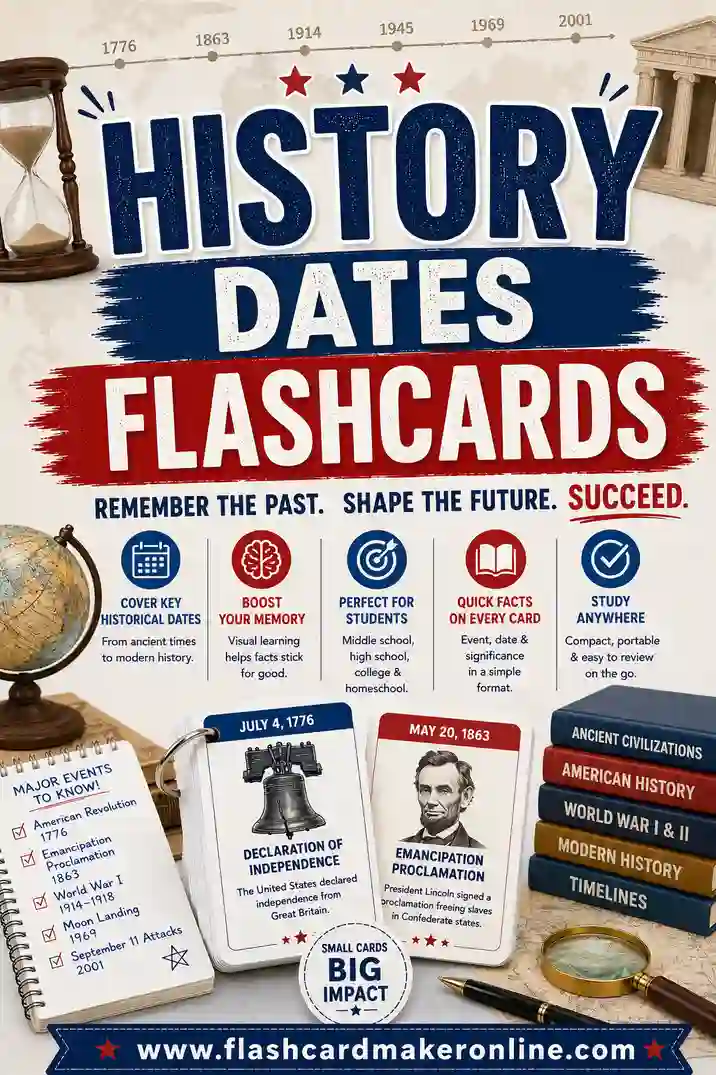
What Are History Dates Flashcards?
Picture a stack of cards, each one a single moment in history. The front names the event, "World War II ends." The back gives the year, "1945." You read the front, try to recall the date, then flip to check. That tight loop is exactly what makes dates stick.
The reason it works is active recall. When you reach for the year before flipping, you're retrieving the fact from memory instead of re-reading it. Study after study shows retrieval strengthens memory far more than passive review, and dates, which have no logic to fall back on, are precisely the kind of fact that needs it.
You can flip a date deck two directions:
- Event to year. See "Moon landing," recall "1969." The classic "when did it happen" question.
- Year to event. See "1969," recall "Moon landing." Trains you for timeline and ordering questions.
Why Make Your Own History Dates Deck
A printed pack works, but building your own beats it.
- It's free. A full printable timeline deck costs nothing when you make it yourself.
- You pick the era. Study only the unit your test covers, ancient, U.S., world wars, whatever's on the exam.
- You can flip and print. Review on screen, then print just the dates you keep missing. No wasted paper.
It's fast, too. From "the exam is Friday" to a printed deck takes most people under ten minutes.
Free History Timeline Flashcard Deck (Copy & Paste)
Here's a ready-to-use set of major world and U.S. events. The left column is the card front (the event); the right is the back (the year). Paste it into the flashcard maker and start flipping.
| Term (front) | Definition (back) |
|---|---|
| Fall of the Western Roman Empire | 476 |
| Norman Conquest of England | 1066 |
| Magna Carta signed | 1215 |
| Columbus reaches the Americas | 1492 |
| Protestant Reformation begins | 1517 |
| Jamestown founded | 1607 |
| Declaration of Independence | 1776 |
| French Revolution begins | 1789 |
| U.S. Constitution ratified | 1788 |
| Louisiana Purchase | 1803 |
| U.S. Civil War begins | 1861 |
| Emancipation Proclamation | 1863 |
| Abolition of slavery (13th Amendment) | 1865 |
| World War I begins | 1914 |
| Russian Revolution | 1917 |
| World War I ends | 1918 |
| Stock market crash, Great Depression | 1929 |
| World War II begins | 1939 |
| Pearl Harbor attacked | 1941 |
| World War II ends | 1945 |
| United Nations founded | 1945 |
| Indian independence | 1947 |
| Civil Rights Act | 1964 |
| Moon landing | 1969 |
| Fall of the Berlin Wall | 1989 |
| Soviet Union dissolves | 1991 |
Trim it to your unit, or add the events your class covers. Watch the close pairs, World War I ends in 1918, the Great Depression starts in 1929, World War II begins in 1939. Those near-misses are the cards worth flipping twice.
Other date decks to build
The same event-to-year setup works for any timeline:
- Single-era decks. Ancient history, the Middle Ages, the Renaissance, the 20th century, study one at a time.
- U.S. history. Colonial era through the present, broken into your textbook's chapters.
- Wars and treaties. Start and end dates, plus the treaty that closed each conflict.
- Inventions and discoveries. "Printing press → 1440," "telephone → 1876."
- Your country's history. Build a deck from your own national timeline.
A good rule: one deck per unit. A sprawling deck that jumps from ancient Rome to the Cold War is hard to review, because the dates have nothing to do with each other. A focused deck of just the events your current chapter covers is faster to learn and easier to finish.
A Focused 20th-Century Deck to Start With
The 20th century is where most date confusion lives, all those wars and crises crowded close together. If that's your trouble spot, build a tight deck for just that span first. Here's a starter set you can paste straight in.
| Term (front) | Definition (back) |
|---|---|
| World War I begins | 1914 |
| Russian Revolution | 1917 |
| World War I ends | 1918 |
| Women gain the vote in the U.S. (19th Amendment) | 1920 |
| Stock market crash | 1929 |
| World War II begins | 1939 |
| Pearl Harbor attacked | 1941 |
| D-Day | 1944 |
| World War II ends | 1945 |
| United Nations founded | 1945 |
| Korean War begins | 1950 |
| Cuban Missile Crisis | 1962 |
| Civil Rights Act | 1964 |
| Moon landing | 1969 |
| Fall of the Berlin Wall | 1989 |
| Soviet Union dissolves | 1991 |
Once these sit in order in your head, the rest of the century has anchors to attach to. A new date is easy to place when you already know it falls "right after the war ended" or "around the moon landing." That's the quiet power of learning a tight, ordered set first.
How to Make History Dates Flashcards in 4 Steps
No design skills required. Here's the whole process.
- Pick your events. Pull the dates your exam covers from your notes or textbook.
- Add your terms. Paste the list above into the flashcard maker, or type your own event-and-year pairs.
- Flip to study. Review on screen first. Tap a card, guess the year, then flip to check.
- Print your trouble cards. Print the full deck or just the dates you keep missing.
That's it. Print double-sided if you can, so the year lands on the back of each event.
Study Tips That Make Dates Stick
Dates are slippery because they're pure facts with no story to hang on. These tricks give them something to hang on.
| Tip | Why it works |
|---|---|
| Use spaced repetition | Review missed dates more often, easy ones less. Spacing beats cramming. |
| Build a timeline | Lay events in order so each date has neighbors. Order gives context. |
| Chunk by era | Learn one period at a time so the centuries don't blur. |
| Link to a story | Tie each date to what happened around it, not just the number. |
| Use number tricks | Rhymes and patterns ("in 1492, Columbus sailed the ocean blue") cement odd dates. |
| Flip both directions | Quiz event-to-year and year-to-event for full coverage. |
Spaced repetition in plain terms
Spaced repetition means spacing your reviews out and leaning harder on what you miss. Nail "1776" three times? Set it aside. Keep mixing up 1914 and 1918? Keep both in the daily pile. Your time flows to the dates that fight you, which is exactly where it should go.
Order beats isolated dates
A date alone is hard; a date in a line is easy. When you can see that the Civil War (1861) comes before WWI (1914) which comes before WWII (1939), each one anchors the next. Lay your cards out in order now and then, even once, and the timeline starts to feel like a single story instead of two dozen loose numbers.
Who History Dates Flashcards Are Great For
This deck flexes to almost any learner.
Students
From middle-school history quizzes to AP and college exams, a date deck turns a long timeline into quick, repeatable review. Print a set or study on screen.
Homeschool families
A printable timeline deck is a ready-made history spine. Younger kids learn a handful of big dates; older students fill in the detail.
Exam and standardized-test prep
History and social-studies sections love date and ordering questions. A focused deck makes that part reliable instead of a gamble.
Trivia and quiz-bowl fans
Fast recall of "what year did that happen" is a trivia staple. A few minutes of flipping a day keeps the timeline sharp.
Printing Tips for Sturdy, Reusable Cards
A few small choices make your deck last.
- Use cardstock if you can. It survives repeat shuffling far better than thin paper.
- Print double-sided. Line up front and back so the year lands on the flip side of the event.
- Cut with a paper cutter. Cleaner, faster edges than scissors for a full deck.
- Keep a "missed" pile. Set aside dates you flub so the next session targets them.
- Print in black and white. Saves ink, and the text reads clearly without color.
Loving the study-deck approach? Build the same kind of set for other subjects with our presidents flashcards, geography flashcards, and coding terms flashcards.
Frequently Asked Questions
How many history dates flashcards do I need?
As many as your exam covers, often 20 to 40 for a unit. The flashcard maker lets you build the full timeline or a smaller stack in one go, so you study exactly what's on the test.
What should go on the back of a history dates flashcard?
Put the year, and only the year, if the test asks for dates. If you also need context, add one short clause, but keep the date the headline so recall stays fast.
Are these history dates flashcards really free to print?
Yes. You build and print them yourself at no cost. There's no sign-up and no watermark, so a whole class can study from one free deck.
How do I memorize history dates fast?
Chunk them by era, lay them in a timeline so each date has neighbors, and use spaced repetition so the dates you miss come back around more often. Rhymes and number tricks help with the stubborn ones.
Can I make history dates flashcards for young kids?
Absolutely. Start with a handful of the biggest, roundest dates and keep each card to one event and one year. Bigger text and fewer cards per session work best for early learners.
Can I study the cards without printing them?
Yes. The flip-card maker lets you study right on screen, tap a card to reveal the year, then print only the dates you keep missing.
Ready to Build Your History Dates Flashcards?
Grab the timeline above, open the free flashcard maker, and you'll have a flip-and-print set of history dates flashcards in minutes. It's free, there's no sign-up, and you can study on screen or print a stack for the exam. Pick an era, start flipping, and watch the dates stick.