Presidents Flashcards: Free Printable & Study-Ready
Presidents flashcards are simple two-sided cards with a U.S. president's name or number on the front and the key facts you need to remember on the back, like the years they served and what they're known for. The fastest way to build a full set is to use a free flashcard maker that flips your terms into study-ready cards you can review on screen or print at home. Below you'll find a ready-made deck of all 46 presidencies plus the study tricks that actually make the names stick.
Want to skip the setup? Open the free flashcard maker, paste in the president list from this page, and you'll have a flip-and-print deck in under five minutes. No sign-up, no fee, nothing to install.
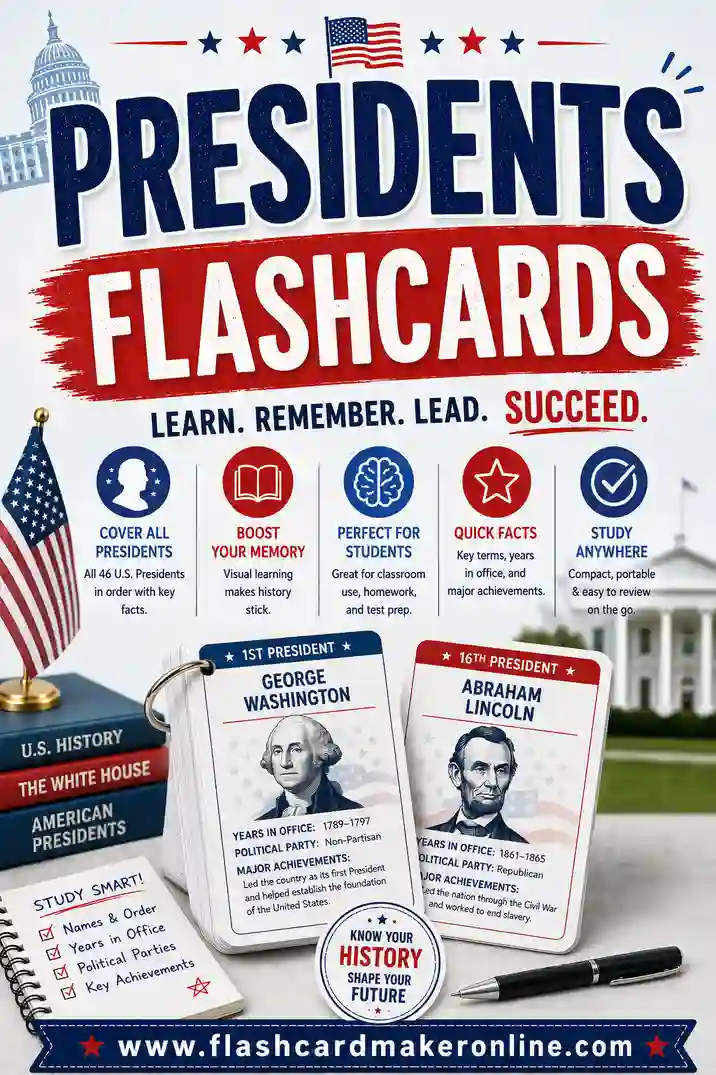
What Are Presidents Flashcards?
Think of a stack of cards, one per president. The front holds the prompt, usually the president's name or their number in the order of office. The back holds the answer you're trying to recall: the years they served, the party, and a quick fact or two that makes them memorable.
That two-sided setup is the whole point. When you look at the front and try to remember the back before you flip, you're using active recall. That's the act of pulling an answer out of your own memory instead of re-reading it. Decades of study research show active recall beats passive re-reading by a wide margin, and flashcards are the easiest way to do it.
You can study presidents flashcards two ways:
- Name to facts. See "Abraham Lincoln," recall "16th president, led the Union through the Civil War." Great for tests that ask about a specific person.
- Facts to name. See "16th president, Civil War" and recall "Abraham Lincoln." This trains you for trickier questions and matching sections.
Flip your deck both directions and the names lock in far faster.
Why Make Your Own Presidents Deck
You can buy a printed pack, but making your own beats it for a few reasons.
- It's free. A full printable deck costs nothing when you build it yourself.
- You control the facts. Add the exact dates, parties, or trivia your class or quiz cares about. Skip what you already know.
- You can flip and print. Study on screen first, then print the cards you keep missing. No wasted paper.
It's quick, too. Most people go from "I have a test Friday" to a finished, printed deck in well under ten minutes.
Free Presidents Flashcard Deck (Copy & Paste)
Here's a ready-to-use set covering every U.S. presidency in order. The left column is your card front; the right column is the back. Paste it straight into the flashcard maker and start flipping.
| Term (front) | Definition (back) |
|---|---|
| George Washington | 1st, 1789-1797, no party, set presidential traditions |
| John Adams | 2nd, 1797-1801, Federalist |
| Thomas Jefferson | 3rd, 1801-1809, wrote the Declaration, Louisiana Purchase |
| James Madison | 4th, 1809-1817, "Father of the Constitution," War of 1812 |
| James Monroe | 5th, 1817-1825, Monroe Doctrine |
| John Quincy Adams | 6th, 1825-1829, son of John Adams |
| Andrew Jackson | 7th, 1829-1837, founded the Democratic Party |
| Martin Van Buren | 8th, 1837-1841, Panic of 1837 |
| William Henry Harrison | 9th, 1841, shortest term, 31 days |
| John Tyler | 10th, 1841-1845, first VP to succeed a president |
| James K. Polk | 11th, 1845-1849, Mexican-American War |
| Zachary Taylor | 12th, 1849-1850, war hero "Old Rough and Ready" |
| Millard Fillmore | 13th, 1850-1853, Compromise of 1850 |
| Franklin Pierce | 14th, 1853-1857, Kansas-Nebraska Act |
| James Buchanan | 15th, 1857-1861, last president before the Civil War |
| Abraham Lincoln | 16th, 1861-1865, Civil War, Emancipation Proclamation |
| Andrew Johnson | 17th, 1865-1869, first president impeached |
| Ulysses S. Grant | 18th, 1869-1877, Union general, Reconstruction |
| Rutherford B. Hayes | 19th, 1877-1881, ended Reconstruction |
| James A. Garfield | 20th, 1881, assassinated months into office |
| Chester A. Arthur | 21st, 1881-1885, civil service reform |
| Grover Cleveland | 22nd & 24th, only president with two non-consecutive terms |
| Benjamin Harrison | 23rd, 1889-1893, grandson of William Henry Harrison |
| William McKinley | 25th, 1897-1901, Spanish-American War |
| Theodore Roosevelt | 26th, 1901-1909, national parks, Panama Canal |
| William Howard Taft | 27th, 1909-1913, later Chief Justice |
| Woodrow Wilson | 28th, 1913-1921, WWI, League of Nations |
| Warren G. Harding | 29th, 1921-1923, Teapot Dome scandal |
| Calvin Coolidge | 30th, 1923-1929, "Silent Cal," 1920s boom |
| Herbert Hoover | 31st, 1929-1933, start of the Great Depression |
| Franklin D. Roosevelt | 32nd, 1933-1945, New Deal, WWII, 4 terms |
| Harry S. Truman | 33rd, 1945-1953, ended WWII, Marshall Plan |
| Dwight D. Eisenhower | 34th, 1953-1961, WWII general, Interstate Highways |
| John F. Kennedy | 35th, 1961-1963, Cuban Missile Crisis, assassinated |
| Lyndon B. Johnson | 36th, 1963-1969, Civil Rights Act, Great Society |
| Richard Nixon | 37th, 1969-1974, China visit, Watergate, resigned |
| Gerald Ford | 38th, 1974-1977, only unelected president |
| Jimmy Carter | 39th, 1977-1981, Camp David Accords |
| Ronald Reagan | 40th, 1981-1989, end of the Cold War |
| George H. W. Bush | 41st, 1989-1993, Gulf War |
| Bill Clinton | 42nd, 1993-2001, economic boom, impeached |
| George W. Bush | 43rd, 2001-2009, 9/11, war on terror |
| Barack Obama | 44th, 2009-2017, first Black president, ACA |
| Donald Trump | 45th & 47th, businessman, non-consecutive terms |
| Joe Biden | 46th, 2021-2025 |
That's a full set you can trim to whatever your test covers. Grover Cleveland counts twice (22nd and 24th), which is why the count of presidencies runs higher than the count of people.
Smaller decks to start with
A 46-card deck is a lot to learn at once. Break it into smaller, theme-based stacks so each session feels doable:
- Founding era: Washington through Monroe
- Civil War & after: Lincoln through Hayes
- Modern presidents: FDR through today
- The hard-to-remember middles: the one-term presidents between Jackson and Lincoln
How to Make Presidents Flashcards in 4 Steps
You don't need any design skills. Here's the whole process.
- Pick your facts. Decide what each card's back should hold, just the name, or name plus years, party, and a fact. Match it to your test.
- Add your terms. Paste the list above into the flashcard maker, or type your own front-and-back pairs.
- Flip to study. Review on screen first. Tap each card, guess the back, then flip to check.
- Print what you keep missing. Print the full deck or just your trouble cards onto paper or cardstock.
That's it. Print double-sided if your printer supports it, so the answer lands on the back of each card.
Study Tips That Make the Names Stick
Presidents are easy to mix up, all those one-term names between Jackson and Lincoln blur together. These tricks help.
| Tip | Why it works |
|---|---|
| Use spaced repetition | Review missed cards more often and easy ones less. Spacing beats cramming for long-term memory. |
| Say it out loud | Speaking the answer adds a second memory channel beyond reading. |
| Group by era | Chunking 46 names into 4-5 eras makes each batch easier to hold. |
| Learn the numbers | Knowing Lincoln is the 16th gives you an anchor for the ones nearby. |
| Make a memory phrase | A silly sentence using first letters helps recall tricky runs of names. |
| Flip both directions | Quiz name-to-facts and facts-to-name so you're ready for any question format. |
Spaced repetition in plain terms
Spaced repetition just means you space your reviews out and lean harder on the cards you miss. Got "James K. Polk" right three times? Set it aside. Keep blanking on "Chester A. Arthur"? Keep him in the daily pile. The cards you struggle with get the most attention, which is exactly where your study time should go.
Who Presidents Flashcards Are Great For
This deck flexes to almost any learner.
Students
From elementary classes learning the order of presidents to AP U.S. History students nailing dates, flashcards turn a long list into bite-sized review. Print a class set or share a deck digitally.
Homeschool families
A printable presidents deck is a ready-made history unit. Younger kids can match names to numbers; older ones can add the facts and events.
Trivia and quiz-bowl fans
Quick recall of presidents, their order, and their big events is bread-and-butter trivia. Flip a deck for a few minutes a day and you'll never get caught on the basics.
Citizenship test prep
The U.S. naturalization civics test asks about several presidents and what they did. A focused flashcard deck makes that section painless.
Printing Tips for Sturdy, Reusable Cards
A few small choices make your deck last.
- Use cardstock if you can. It survives repeat shuffling and feels better in hand than thin paper.
- Print double-sided. Line up the front and back so the answer is literally on the flip side.
- Cut once with a paper cutter. Cleaner edges than scissors and far faster for a 46-card stack.
- Keep a "missed" pile. Set aside cards you flub so your next session targets them.
- Print in black and white. Saves ink, and the text reads clearly without color.
Loving the study-deck approach? You can build the same kind of set for other subjects with our geography flashcards, history dates flashcards, and coding terms flashcards.
Frequently Asked Questions
How many presidents flashcards do I need?
One card per presidency, so 46 cards covers everyone (Grover Cleveland counts twice). For a class test, you may only need the era you're studying. The flashcard maker lets you build the full set or a smaller stack in one go.
What should go on the back of a presidents flashcard?
Put the recall target your test cares about: the term years, the political party, and one memorable fact or event. Keep it short, two or three details per card is plenty so you're not overloaded.
Are these presidents flashcards really free to print?
Yes. You build and print them yourself at no cost. There's no sign-up and no watermark, so a whole classroom can study from one free deck.
How do I memorize the presidents in order?
Learn them in small era-based chunks, use the number on each card as an anchor, and review with spaced repetition so missed names come back around more often. A memory phrase from the first letters helps with tricky runs.
Can I make presidents flashcards for young kids?
Absolutely. Keep each card's back simple, just the name and number, or a name and one picture-friendly fact. Bigger text and fewer cards per session work best for early learners.
Can I study the cards without printing them?
Yes. The flip-card maker lets you study right on screen, tap to flip and reveal the answer, then print only the cards you keep missing.
Ready to Build Your Presidents Flashcards?
Grab the deck above, open the free flashcard maker, and you'll have a flip-and-print set of presidents flashcards in minutes. It's free, there's no sign-up, and you can study on screen or print a stack for class. Pick an era, start flipping, and watch the names stick.