Geography Flashcards: Free Printable & Study-Ready
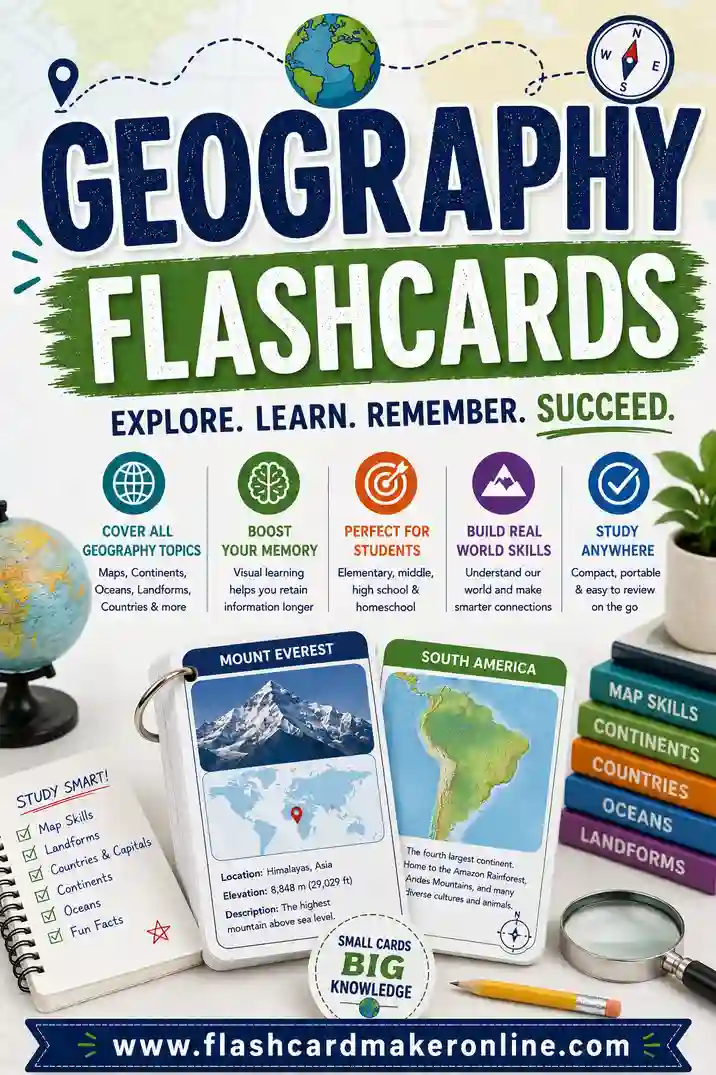
Geography flashcards are two-sided cards that put a place on the front, a country, capital, river, or landmark, and the fact you need to recall on the back. The quickest way to build a full set is to use a free flashcard maker that turns your list into flip-and-print cards you can review on screen or on paper. Below you'll find ready-made decks for capitals and continents, plus the study tricks that make maps actually stick.
Want to skip the setup? Open the free flashcard maker, paste in the capitals list from this page, and you'll have a study-ready deck in minutes. No sign-up, no fee, nothing to download.
What Are Geography Flashcards?
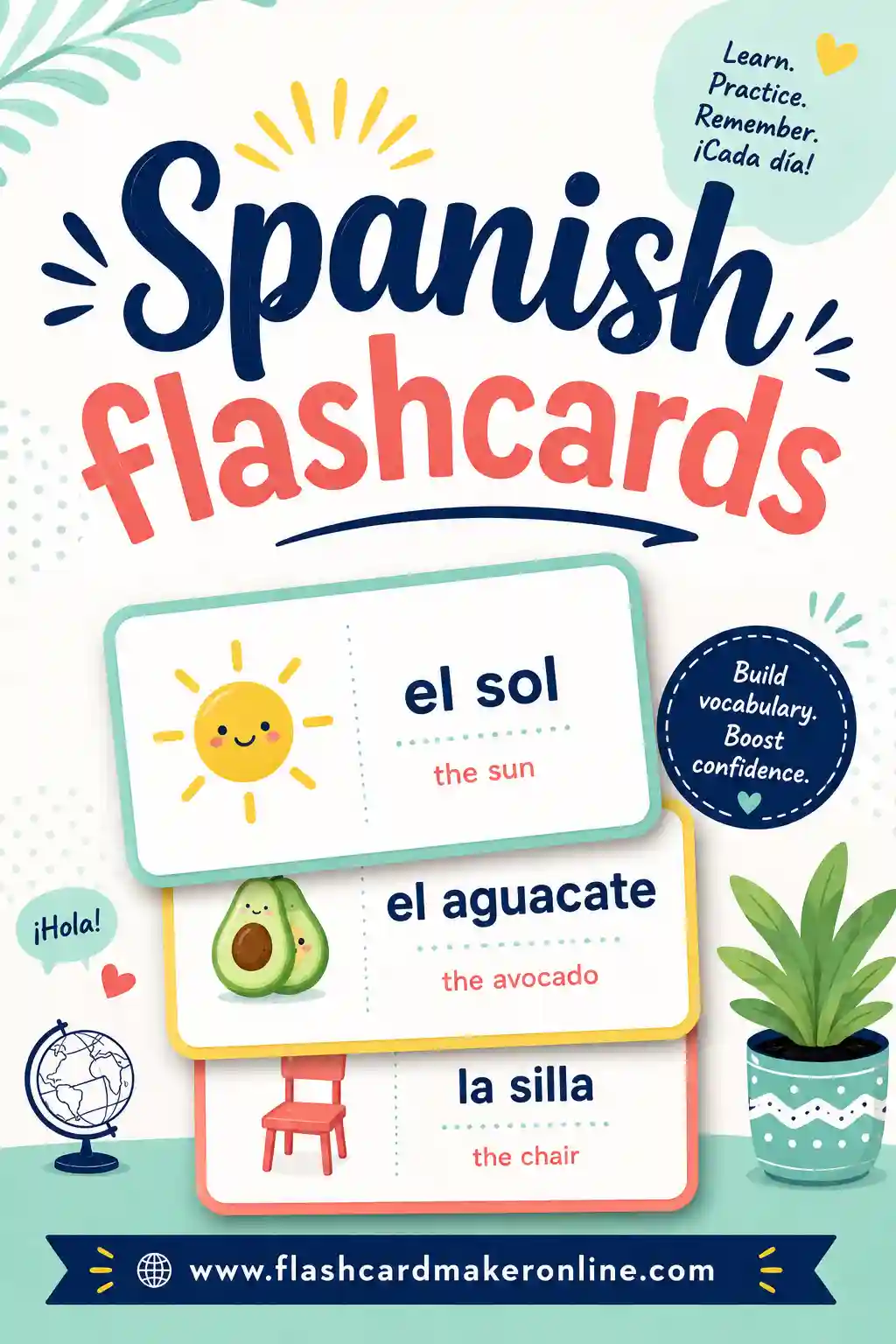
Picture a stack of cards, each one a quick geography quiz. The front shows a place, say "France." The back shows what you're trying to recall, "Paris." You look at the front, try to remember the answer, then flip to check. That simple loop is the whole game.
Why does it work so well? Because pulling the answer out of your own head, instead of just re-reading it, is active recall. Study research has shown again and again that retrieving a fact strengthens the memory far more than reading it over. Flashcards are the cleanest way to practice that, one card at a time.
Geography is a perfect fit because so much of it is pairs: a country and its capital, a country and its continent, a landmark and its location. Each pair becomes one card.
You can flip a deck two directions:
- Place to fact. See "Japan," recall "Tokyo." Good for "name the capital" questions.
- Fact to place. See "Tokyo," recall "Japan." Trains you for reverse and matching questions.
Why Make Your Own Geography Deck
Buying a printed pack works, but building your own beats it.
- It's free. A full printable deck costs nothing when you make it.
- You choose the scope. Study only the continent your unit covers, or only the capitals you keep forgetting.
- You can flip and print. Review on screen, then print just the cards you're still missing. No wasted paper.
It's fast, too. From "I have a map quiz tomorrow" to a printed deck takes most people under ten minutes.
Free World Capitals Flashcard Deck (Copy & Paste)
Here's a ready-to-use set of capitals from around the world. The left column is the card front (the country); the right is the back (the capital). Paste it into the flashcard maker and start flipping.
| Term (front) | Definition (back) |
|---|---|
| United States | Washington, D.C. |
| Canada | Ottawa |
| Mexico | Mexico City |
| Brazil | Brasilia |
| Argentina | Buenos Aires |
| United Kingdom | London |
| France | Paris |
| Germany | Berlin |
| Spain | Madrid |
| Italy | Rome |
| Portugal | Lisbon |
| Norway | Oslo |
| Sweden | Stockholm |
| Russia | Moscow |
| Greece | Athens |
| Egypt | Cairo |
| Nigeria | Abuja |
| Kenya | Nairobi |
| South Africa | Pretoria |
| Morocco | Rabat |
| China | Beijing |
| Japan | Tokyo |
| India | New Delhi |
| South Korea | Seoul |
| Thailand | Bangkok |
| Indonesia | Jakarta |
| Australia | Canberra |
| New Zealand | Wellington |
| Saudi Arabia | Riyadh |
| Turkey | Ankara |
Trim it to your quiz, or add the countries your unit covers. A few capitals trip people up, Australia's is Canberra (not Sydney), Brazil's is Brasilia (not Rio), and South Africa has three, with Pretoria as the executive one. Those are exactly the cards worth flipping twice.
Other geography decks to build
Capitals are just the start. The same flip-card setup works for any geography pair:
- Country to continent. "Egypt" → "Africa." Great for younger students learning the map.
- Landmark to location. "Eiffel Tower" → "Paris, France."
- Flag to country. Put a flag image on the front, the country on the back.
- River or mountain to country. "Nile" → "Egypt," "Mount Everest" → "Nepal/China border."
- U.S. states to capitals. A 50-card deck for state-capital quizzes.
Mixing card types in one deck is fine, but it's usually easier to keep each pairing in its own stack. A capitals deck and a continents deck pull on different parts of the map, and your brain holds each one better when it isn't switching between question types every card.
A Quick Continents Deck to Start With
If world capitals feel like too much at once, build a smaller continents deck first. It's only a handful of cards, and it gives every later capital a place to belong. Here's a starter set you can paste straight in.
| Term (front) | Definition (back) |
|---|---|
| Egypt | Africa |
| Nigeria | Africa |
| Kenya | Africa |
| China | Asia |
| India | Asia |
| Japan | Asia |
| France | Europe |
| Germany | Europe |
| Italy | Europe |
| Brazil | South America |
| Argentina | South America |
| Peru | South America |
| Canada | North America |
| Mexico | North America |
| Australia | Oceania |
| New Zealand | Oceania |
Once a student can sort any country onto the right continent, capitals come much faster, because they already know roughly where each country sits. Continents are the frame; capitals are the detail you hang on it.
How to Make Geography Flashcards in 4 Steps
No design skills needed. Here's the whole process.
- Pick your pairs. Decide what goes front and back, country to capital, landmark to place, whatever your quiz asks.
- Add your terms. Paste the list above into the flashcard maker, or type your own pairs.
- Flip to study. Review on screen first. Tap a card, guess the back, then flip to check.
- Print your trouble cards. Print the whole deck or just the ones you keep missing.
That's it. Print double-sided if you can, so the answer sits on the back of each card.
Study Tips That Make the Map Stick
Geography rewards a few smart habits. These help the names and places lock in.
| Tip | Why it works |
|---|---|
| Use spaced repetition | Review missed cards more often, easy ones less. Spacing beats one big cram. |
| Pair cards with a map | Locate each place on a real map after you flip it. Position cements the name. |
| Group by region | Learn one continent at a time so 30 capitals don't blur together. |
| Say it out loud | Speaking the answer adds a second memory channel beyond reading. |
| Flip both directions | Quiz country-to-capital and capital-to-country for full coverage. |
| Tackle the tricky ones first | Hit the capitals you always miss while your focus is fresh. |
Spaced repetition in plain terms
Spaced repetition just means spacing your reviews out and leaning harder on what you miss. Nail "France → Paris" three times? Set it aside. Keep blanking on "Australia → Canberra"? Keep it in the daily pile. Your study time flows to the cards that need it, which is the whole trick.
Pair every card with a real map
Flashcards teach the pair; a map teaches the place. After you flip "Kenya → Nairobi," point to Kenya on a world map. Linking the word to a spot on the globe gives your brain a second hook, and it makes the fact far harder to forget.
Who Geography Flashcards Are Great For
This deck flexes to almost any learner.
Students
From grade-school map quizzes to high-school world geography, flashcards turn a long list of countries into quick, repeatable review. Print a class set or study on screen.
Homeschool families
A printable capitals or continents deck is a ready-made geography unit. Younger kids match countries to continents; older ones add capitals and landmarks.
Travelers and trivia fans
Brushing up before a trip, or want to stop getting caught on capitals at quiz night? A few minutes of flipping a day keeps the world map fresh.
Test and exam prep
Geography sections on standardized tests and citizenship exams lean on capitals, borders, and major features. A focused deck makes that part painless.
Printing Tips for Sturdy, Reusable Cards
A few small choices make your deck last.
- Use cardstock if you can. It holds up to repeat shuffling far better than thin paper.
- Print double-sided. Line up front and back so the capital lands on the flip side of the country.
- Cut with a paper cutter. Cleaner, faster edges than scissors for a big deck.
- Keep a "missed" pile. Set aside cards you flub so the next session targets them.
- Add color sparingly. Black and white saves ink; a colored map on the back can help visual learners.
Loving the study-deck approach? Build the same kind of set for other subjects with our presidents flashcards, history dates flashcards, and music notes flashcards.
Frequently Asked Questions
How many geography flashcards do I need?
As many as your quiz covers. A world-capitals quiz might be 30 cards; a single-continent unit might be 10. The flashcard maker lets you build a full deck or a smaller stack in one go, so you only study what you need.
What should go on the back of a geography flashcard?
Put the single fact you're being tested on, the capital, the continent, or the location. Keep each card to one clear answer so you're not juggling several facts at once.
Are these geography flashcards really free to print?
Yes. You build and print them yourself at no cost. There's no sign-up and no watermark, so a whole class can study from one free deck.
How do I memorize world capitals fast?
Study one region at a time, pair each card with a real map, and use spaced repetition so the capitals you miss come back around more often. Flipping both directions, country-to-capital and capital-to-country, locks them in faster.
Can I make geography flashcards for young kids?
Absolutely. Keep each card to one simple pair, like country to continent, and use bigger text or a small map image. Fewer cards per session works best for early learners.
Can I study the cards without printing them?
Yes. The flip-card maker lets you study right on screen, tap a card to reveal the answer, then print only the cards you keep missing.
Ready to Build Your Geography Flashcards?
Grab the capitals deck above, open the free flashcard maker, and you'll have a flip-and-print set of geography flashcards in minutes. It's free, there's no sign-up, and you can study on screen or print a stack for class. Pick a region, start flipping, and watch the map stick.