Music Notes Flashcards: Free Printable & Study-Ready
Music notes flashcards are two-sided cards that show a note on the staff, a symbol, or a term on the front, and its name or meaning on the back, so you learn to read music by sight. The fastest way to build a set is to use a free flashcard maker that turns your list into flip-and-print cards you can drill on screen or on paper. Below you'll find ready-made decks for note names, rests, and symbols, plus the practice tricks that turn slow sight-reading into instant recognition.
Want to skip the setup? Open the free flashcard maker, paste in the note list from this page, and you'll have a study-ready deck in minutes. No sign-up, no fee, nothing to install.
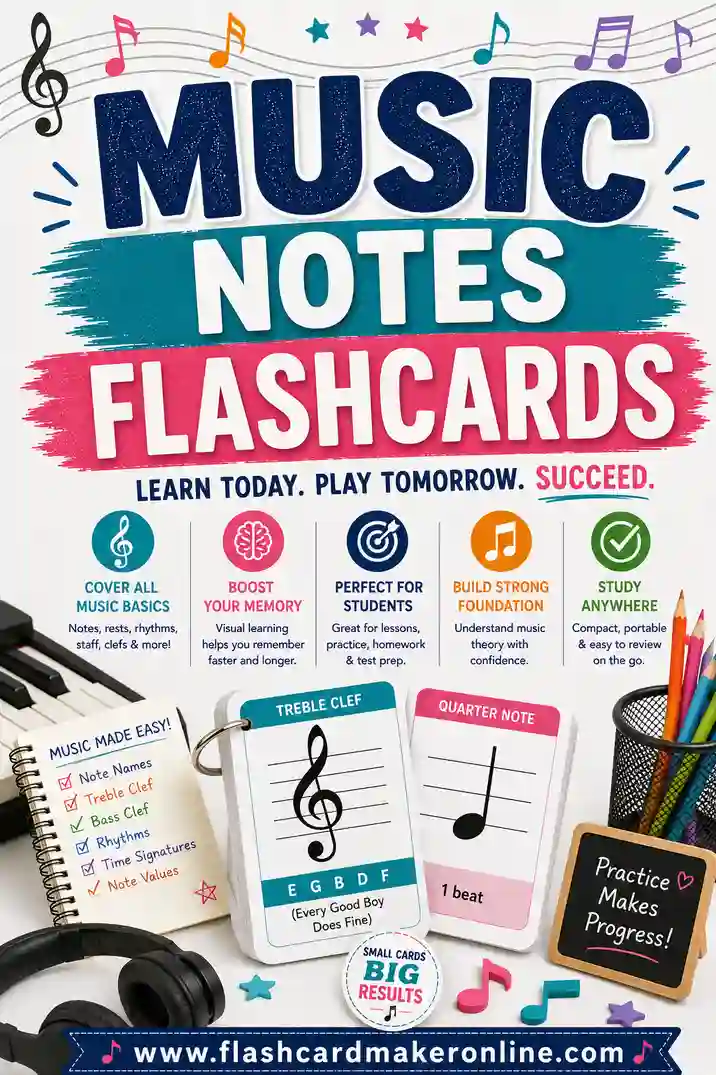
What Are Music Notes Flashcards?
Picture a stack of cards built for reading music. The front shows something you'd see on a page of sheet music, a note sitting on a line of the staff, a rest symbol, or a term like "forte." The back gives the answer: the note's letter name, how many beats it lasts, or what the term tells you to do. You look, you guess, you flip.
That loop is active recall, and for music it's gold. Sight-reading is really just instant recognition: see the note, know the name, no counting up from the bottom line. Counting works when you're starting out, but it's slow. Flashcards push you past counting into knowing, one quick flip at a time.
You can drill a music deck two ways:
- Symbol to name. See a note on the staff, recall "E." This is straight sight-reading practice.
- Name to symbol. See "E," picture where it sits on the staff. Helpful for writing music and theory work.
Why Make Your Own Music Notes Deck
Printed packs exist, but building your own beats them.
- It's free. A full printable deck costs nothing when you make it yourself.
- You match your level. Start with just the treble-clef line notes, then add spaces, ledger lines, the bass clef, and terms as you grow.
- You can flip and print. Drill on screen, then print the cards you keep missing. No wasted paper.
It's quick, too. From "I want to read music faster" to a printed deck takes most people under ten minutes.
Free Music Notes Flashcard Deck (Copy & Paste)
Here's a ready-to-use starter set covering staff notes, note values, rests, and common terms. The left column is the card front; the right is the back. Paste it into the flashcard maker and start flipping.
| Term (front) | Definition (back) |
|---|---|
| Treble clef, bottom line | E |
| Treble clef, 2nd line | G |
| Treble clef, middle line | B |
| Treble clef, 4th line | D |
| Treble clef, top line | F |
| Treble clef spaces (bottom up) | F A C E |
| Bass clef, bottom line | G |
| Bass clef, 2nd line | B |
| Bass clef, middle line | D |
| Bass clef, 4th line | F |
| Bass clef, top line | A |
| Middle C | the note between treble and bass staves |
| Whole note | 4 beats |
| Half note | 2 beats |
| Quarter note | 1 beat |
| Eighth note | half a beat |
| Sixteenth note | a quarter of a beat |
| Whole rest | 4 beats of silence |
| Quarter rest | 1 beat of silence |
| Sharp (#) | raise the note a half step |
| Flat (b) | lower the note a half step |
| Natural | cancel a sharp or flat |
| Forte (f) | play loud |
| Piano (p) | play soft |
| Crescendo | gradually get louder |
| Fermata | hold the note longer than written |
Trim it to your level or add the symbols your method book uses. The mnemonics are worth a card each: treble lines from the bottom are "Every Good Boy Does Fine" (E G B D F) and the spaces spell FACE. Those two unlock the whole treble staff.
Other music decks to build
The same flip-card setup works for anything in music theory:
- Bass clef mnemonics. Lines "Good Boys Do Fine Always" (G B D F A), spaces "All Cows Eat Grass" (A C E G).
- Key signatures. How many sharps or flats each key has.
- Intervals. "C to G" → "perfect fifth."
- Chords. "C major" → "C E G."
- Italian terms. Tempo and expression words like allegro, adagio, staccato, legato.
It's worth keeping each of these in its own small deck rather than dumping everything together. Note names, note values, and terms are three different kinds of knowledge, and your brain holds each one better when it isn't bouncing between them every card.
Match Your Deck to Your Level
Music reading builds in layers, and your flashcards should follow the same order. Trying to learn ledger lines before you know the basic staff just slows you down. Here's a sensible path from first day to confident reader.
| Level | What to put in the deck | Why now |
|---|---|---|
| Brand new | Treble line notes (E G B D F) and the FACE spaces | The single most-used staff, learned first. |
| Early | Note values: whole, half, quarter, eighth | You can name notes, now learn how long they last. |
| Building | Bass clef lines and spaces | Adds the left-hand or lower staff for piano and band. |
| Growing | Rests, sharps, flats, naturals | The symbols that change or pause what you read. |
| Confident | Dynamics and tempo terms (forte, piano, allegro) | The expression markings that shape how you play. |
Add a layer only once the one before it feels automatic. Each new batch sticks faster when it lands on a solid base, and you avoid the overwhelm that makes beginners quit.
How to Make Music Notes Flashcards in 4 Steps
No design skills needed. Here's the whole process.
- Pick your set. Start small, just the treble line notes, then layer in spaces, rests, and terms.
- Add your terms. Paste the list above into the flashcard maker, or type your own pairs.
- Flip to study. Review on screen first. See the front, name it fast, then flip to check.
- Print your trouble cards. Print the whole deck or just the notes you keep missing.
That's it. Print double-sided if you can, so the answer sits on the back of each card.
Practice Tips That Speed Up Sight-Reading
Reading music gets fast with the right habits. These help recognition become automatic.
| Tip | Why it works |
|---|---|
| Use spaced repetition | Review missed notes more often, easy ones less. Spacing beats one long cram. |
| Race the clock | Time yourself naming a stack. Speed forces recognition over counting. |
| Learn the mnemonics | "FACE" and "Every Good Boy Does Fine" give instant anchors for the staff. |
| Drill in short bursts | Five focused minutes a day beats one long weekly session. |
| Say the note out loud | Speaking the name adds a second memory channel beyond seeing it. |
| Mix clefs once solid | Shuffle treble and bass together so you read whatever lands in front of you. |
Spaced repetition in plain terms
Spaced repetition means spacing your reviews out and leaning harder on what you miss. The high F you nail every time? Set it aside. The ledger-line note you always have to count up to? Keep it in the daily pile. Your practice time flows to the notes that slow you down, which is the fastest way to get smooth.
Stop counting, start knowing
Beginners count up from a known note: "bottom line is E, so the next space is F, then G..." It works, but it's the thing standing between you and real sight-reading. Flashcards break the habit. Because each card demands an instant answer, you stop counting and start recognizing the note on sight, which is the whole goal.
Who Music Notes Flashcards Are Great For
This deck flexes to almost any learner.
Beginning music students
Whether it's piano, guitar, band, or choir, every new reader has to learn the staff. Flashcards make that first hurdle quick and even a little fun.
Music teachers
A printable deck is a ready-made drill for lessons or class. Print a set per student, or flash cards to the whole room as a warm-up.
Homeschool and self-taught players
Teaching yourself an instrument? A note-name deck gives you the structured review that a lesson would, on your own schedule.
Players coming back after a break
Picked the instrument back up after years away? A few minutes with a flashcard deck shakes the rust off your reading fast.
Printing Tips for Sturdy, Reusable Cards
A few small choices make your deck last.
- Use cardstock if you can. It survives repeat shuffling far better than thin paper.
- Print double-sided. Line up front and back so the note name lands on the flip side.
- Cut with a paper cutter. Cleaner, faster edges than scissors for a full deck.
- Keep a "missed" pile. Set aside notes you flub so the next session targets them.
- Print large and clear. Notes and symbols need to read at a glance, so don't shrink them too small.
Loving the study-deck approach? Build the same kind of set for other subjects with our presidents flashcards, geography flashcards, and coding terms flashcards.
Frequently Asked Questions
How many music notes flashcards do I need?
Start with the dozen or so notes on each staff, then grow the deck as you add rests, accidentals, and terms. The flashcard maker lets you build a small starter set or a full theory deck in one go.
What should go on the back of a music notes flashcard?
Put the single answer you're drilling, the letter name for a staff note, the beat count for a note value, or the meaning for a term. Keep each card to one clear answer so recognition stays fast.
Are these music notes flashcards really free to print?
Yes. You build and print them yourself at no cost. There's no sign-up and no watermark, so a whole class or studio can drill from one free deck.
How do I learn to read music faster?
Drill the staff with flashcards until you recognize notes on sight instead of counting, lean on mnemonics like FACE, and use spaced repetition so the notes you miss come back around more often. Short daily bursts beat one long session.
Can I make music notes flashcards for young kids?
Absolutely. Start with just the treble-clef line notes and the FACE spaces, keep each card to one note, and use bigger symbols. Fewer cards per session works best for early learners.
Can I study the cards without printing them?
Yes. The flip-card maker lets you drill right on screen, tap a card to reveal the name, then print only the notes you keep missing.
Ready to Build Your Music Notes Flashcards?
Grab the deck above, open the free flashcard maker, and you'll have a flip-and-print set of music notes flashcards in minutes. It's free, there's no sign-up, and you can drill on screen or print a stack for lessons. Start with the staff, keep flipping, and watch your sight-reading speed up.