The Memory Palace: How to Build One and Use It to Study
A memory palace is a place you know well, like your home or your walk to school, that you use as a mental filing system. You picture yourself moving through it along a fixed route and "leave" a vivid image of each thing you want to remember at a different spot. Later, you take the same walk in your mind and pick the images back up in order. The technique is also called the method of loci (Latin for "places"), and it goes back to ancient Greece and Rome.
It's also one of the few memory techniques with solid brain-imaging research behind it. World-class memory competitors rely on it, and studies show that ordinary people can learn it in a few weeks. This guide covers where the memory palace came from, what the science says, how to build your first one step by step, and how to combine it with flashcards so the memories stick for the long term.
What a memory palace is and how it works
The idea rests on something your brain already does well: remembering places. You can probably picture your kitchen, the order of rooms in your home, or the shops along a street you walk often, without any effort at all. Lists of facts, on the other hand, slip away easily.
A memory palace borrows the strength of your spatial memory to hold information that would otherwise be hard to keep. It has three parts:
- The palace: a real or imagined place you know very well.
- The loci (stations): specific spots along a route through the palace, such as the front door, the coat hook, the couch and the TV. Each spot holds one item. (The singular is "locus.")
- The images: vivid, often silly pictures that stand for the things you want to remember, placed at each spot.
When you need the information, you mentally walk the route. Each spot reminds you of the image you left there, and each image reminds you of the item. Because the route has a fixed order, the items come back in order too. That makes the memory palace especially good for lists, sequences, the points of a speech, and anything else where order matters.
Where the memory palace came from
The best-known origin story features the Greek poet Simonides of Ceos. The Roman teacher of public speaking Quintilian retells it in his Institutio Oratoria (Book 11, Chapter 2), a guide to training orators. In the story, Simonides was called away from a banquet just before the roof of the hall collapsed. The bodies were too badly crushed to recognize, but Simonides could identify them by remembering where each guest had been sitting.
Quintilian himself is a bit skeptical about the details. He notes that writers disagree on whose house it was, and he calls part of the tale "purely fictitious." But the lesson he draws from it is the core of the technique: memory is helped when things are tied to places that are clearly fixed in the mind.
How Roman speakers used it
Quintilian then describes the method as orators of his day practiced it. You choose a large, varied place, such as a spacious house, and memorize its rooms and features. You then attach a symbol to each idea you want to remember. His examples are an anchor, if you need to talk about something to do with the sea, or a weapon, for a point about warfare. You place the first symbol in the entrance hall, the next in the living room, and so on around the house. When you give the speech, you walk through the house in your mind and collect each symbol in turn. Quintilian adds that the places can be real or imagined.
Quintilian's warning
Here's a detail many modern articles leave out. Quintilian thought the method was useful for some things, such as remembering a list of names in order, but "of less service" for learning a full speech word for word. Abstract ideas and small words like conjunctions don't turn into pictures easily, he argued, and juggling symbols could interrupt the flow of a speech. His own advice for memorizing a speech was simpler: divide it into sections, learn it piece by piece, and practice. He named practice and hard work as the most important method of all.
That warning still holds up. As you'll see, the memory palace shines for lists and sequences and is a weaker fit for deep understanding.
What brain research says about the memory palace
For most of its history, the memory palace was backed only by tradition and the stories of people who used it. In the last two decades, brain-imaging studies have looked at it directly.
Superior memorizers aren't born different
In 2003, Eleanor Maguire and colleagues published "Routes to remembering: the brains behind superior memory" in Nature Neuroscience. They studied people with exceptional memory, including competitors in the World Memory Championships. Using memory tests and brain scans, they found that these people did not have unusually high general intelligence or unusual brain structure. What set them apart was strategy. They relied on a spatial learning method, the memory palace, and while memorizing they used brain regions involved in spatial memory, including the hippocampus.
That's encouraging. It suggests that outstanding memory is mostly a learned skill, not a gift you either have or don't.
Ordinary people can learn it in six weeks
Martin Dresler and colleagues tested that idea in a study published in Neuron in 2017. They first compared 23 memory athletes, all ranked in the top 50 of the memory sports world ranking list, with matched controls. On a task of memorizing 72 words, the athletes who were analyzed on that task recalled 70.8 words on average after 20 minutes, while the controls recalled 39.9.
Then came the key part. A group of 51 men with no mnemonic experience were split into three groups: one trained in the memory palace, one did a different memory-training task as an active control, and one got no training. The memory palace group practiced for six weeks, 40 sessions of 30 minutes each. Afterward, their recall improved significantly more than both control groups, and their brain networks shifted toward the pattern seen in the memory athletes. Those changes predicted memory performance up to four months later.
The gains lasted months
A follow-up analysis by Isabella Wagner and colleagues, published in Science Advances in 2021, looked at how durable those memories were. At a retest four months after training, the memory palace group recalled on average about 22.7 more words than they had before training, while the two control groups showed essentially no change (about minus 0.7 and minus 1.5 words). The authors concluded that the training made memories more durable, not just easier to hold for a few minutes.
| Study | Who took part | What they found |
|---|---|---|
| Maguire et al. (2003), Nature Neuroscience | Superior memorizers, including World Memory Championships competitors, and controls | No special intelligence or brain structure; they used a spatial strategy that engaged spatial-memory regions such as the hippocampus |
| Legge et al. (2012), Acta Psychologica | Students with no mnemonic experience | A briefly learned virtual environment worked as well as a familiar real place; both beat no instruction |
| Qureshi et al. (2014), Advances in Physiology Education | 78 second-year medical students | Students taught with memory palaces scored higher on a 10-question quiz (mean 9.31 vs 8.10) |
| Dresler et al. (2017), Neuron | 23 memory athletes; 51 untrained men | Six weeks (40 sessions of 30 minutes) improved recall and shifted brain networks toward the athletes' pattern |
| Wagner et al. (2021), Science Advances | Same training design, four-month follow-up | Memory palace group recalled about 22.7 more words than before training; controls didn't improve |
Do you need a real place? Virtual and imagined palaces
Classic advice says to use a place you know extremely well, like your childhood home. But what if you need several palaces, or you don't want to tie all your study material to the same house?
Legge and colleagues tested this in a 2012 study in Acta Psychologica titled "Building a memory palace in minutes." Participants memorized 10 lists of 11 unrelated words. One group used the traditional method with a highly familiar place. Another used a virtual environment they had only studied briefly. Both memory palace groups did better than an uninstructed control group, and the virtual palace worked just as well as the familiar one. The authors also noted that, for beginners, a highly detailed environment didn't clearly improve memory for word lists.
So you have options. Good palaces include:
- Your home, apartment or a relative's house
- Your school, from the front entrance to your classroom
- A walk or drive you take often
- A store you know well, aisle by aisle
- A place from a video game or a movie set you know thoroughly
- A building you sketch on paper and then study for a few minutes
Quintilian made the same point in ancient Rome when he said the places can be real or imagined. What matters is that you can walk the route in your mind reliably, in the same order, every time.
How to build a memory palace step by step
Here's a full method for building your first palace. Set aside about 30 minutes for the first one; later ones go much faster.
Step 1: Pick your place
Choose somewhere you can picture clearly without effort. For your first try, your own home is ideal.
Step 2: Plan a route
Decide on a walking path that never doubles back. For example: front door, entry table, coat closet, living room couch, TV, kitchen doorway, fridge, stove, sink, back door. Always walk it the same way. Many people go clockwise around each room.
Step 3: Choose distinct stations
Pick specific objects or spots, not whole rooms. They should look different from each other. Two identical chairs side by side are easy to confuse; a chair and a bookcase are not. Start with 10 stations.
Step 4: Practice the empty route
Before you store anything, walk the route in your mind a few times and name each station out loud. Then try it backward. If you can list all 10 stations forward and backward without hesitating, the palace is ready. Write the list down so you can check it.
Step 5: Turn each item into a vivid image
For each thing you need to remember, create a picture that stands for it. Abstract ideas need a concrete stand-in: "democracy" might become a giant ballot box; "photosynthesis" a sunflower eating sunlight with a knife and fork.
Step 6: Place each image at a station and make it interact
Don't just set the image down. Make it do something with the station. The ballot box is jammed in the front door so you have to squeeze past it. The sunflower is sitting on the couch, munching rays from the window. Interaction ties the image to the place.
Step 7: Walk through and review
Right after placing everything, walk the route and recall each item. Then do it again later that day, the next day and a few days after that. A memory palace is a way of storing information, not a guarantee you'll keep it forever. Review is still what makes it last, just as with spaced repetition.
How to make images you won't forget
The images are where most beginners struggle. These guidelines, drawn from the tradition Quintilian describes and from modern practice, make them stick.
- Make them concrete. Quintilian's anchor and weapon are good models: real objects that stand for an idea.
- Make them big, strange or funny. An ordinary apple on a table is forgettable. A giant apple crushing the table is not.
- Add motion and sound. A melting clock dripping onto the floor beats a clock sitting still.
- Involve your senses. Smell the burning toast, feel the cold of the ice sculpture.
- Use sound-alikes for hard words. "Mitosis" might become "my toes" being split in two. This is close to the keyword method, a related technique.
- Keep it clean and personal. The best images are ones that mean something to you. They don't need to make sense to anyone else.
Worked examples
The following examples are illustrative. They show how the method looks in practice.
Example 1: A shopping list
Suppose you need milk, eggs, bread, batteries and dish soap. Using the home route above:
- Front door: Milk is pouring out from under the door, flooding the porch.
- Entry table: A hen is sitting on the table, laying eggs that roll off and crack.
- Coat closet: Every coat has been replaced by a loaf of bread on a hanger.
- Couch: Giant batteries are sitting on the couch watching TV.
- TV: Bubbles are pouring out of the screen, filling the room with soap foam.
At the store, walk through your home in your mind. The silly scenes bring the items back in order.
Example 2: The stages of mitosis
A biology student needs to remember the stages of mitosis in order: prophase, metaphase, anaphase, telophase.
- Front door: A "pro" football player is blocking the door (prophase). Prophase is when chromosomes condense, so he's wrapped up tight in a coiled rope.
- Entry table: A "metal" rod lies across the middle of the table with chromosomes lined up on it (metaphase, when chromosomes line up at the middle).
- Coat closet: Two "ants" are pulling coats in opposite directions (anaphase, when the copies are pulled apart).
- Couch: A "telephone" rings at each end of the couch, and the couch splits into two (telophase, when two new nuclei form).
Notice how each image carries both the name and a hint about what happens in that stage. That's better than a name alone, because it ties the memory to understanding.
Example 3: The outline of a class presentation
A student has a five-minute talk with five main points. She puts one image for each point along her walk to school: the mailbox, the corner store, the crosswalk, the park bench and the school gate. During the talk she doesn't memorize the words, just the order of the points, exactly as Quintilian suggested for orators. She speaks naturally about each point once the image brings it to mind.
Using a memory palace with flashcards
The memory palace and flashcards are good partners, not rivals. The palace is great for getting a list or sequence into memory fast. Flashcards are great for testing yourself on it and spacing your reviews so you don't lose it.
Here's how to combine them:
- Front: the name of a station. "Kitchen palace, station 4: the fridge." Back: the image and the fact it stands for.
- Front: the fact. "What's the third stage of mitosis?" Back: the answer plus a note on your image ("ants pulling coats apart").
- Front: a picture of your actual station (a photo of your couch). Back: what's stored there.
- Front: "Walk the anatomy palace. List all stations in order." Back: the full list to check against.
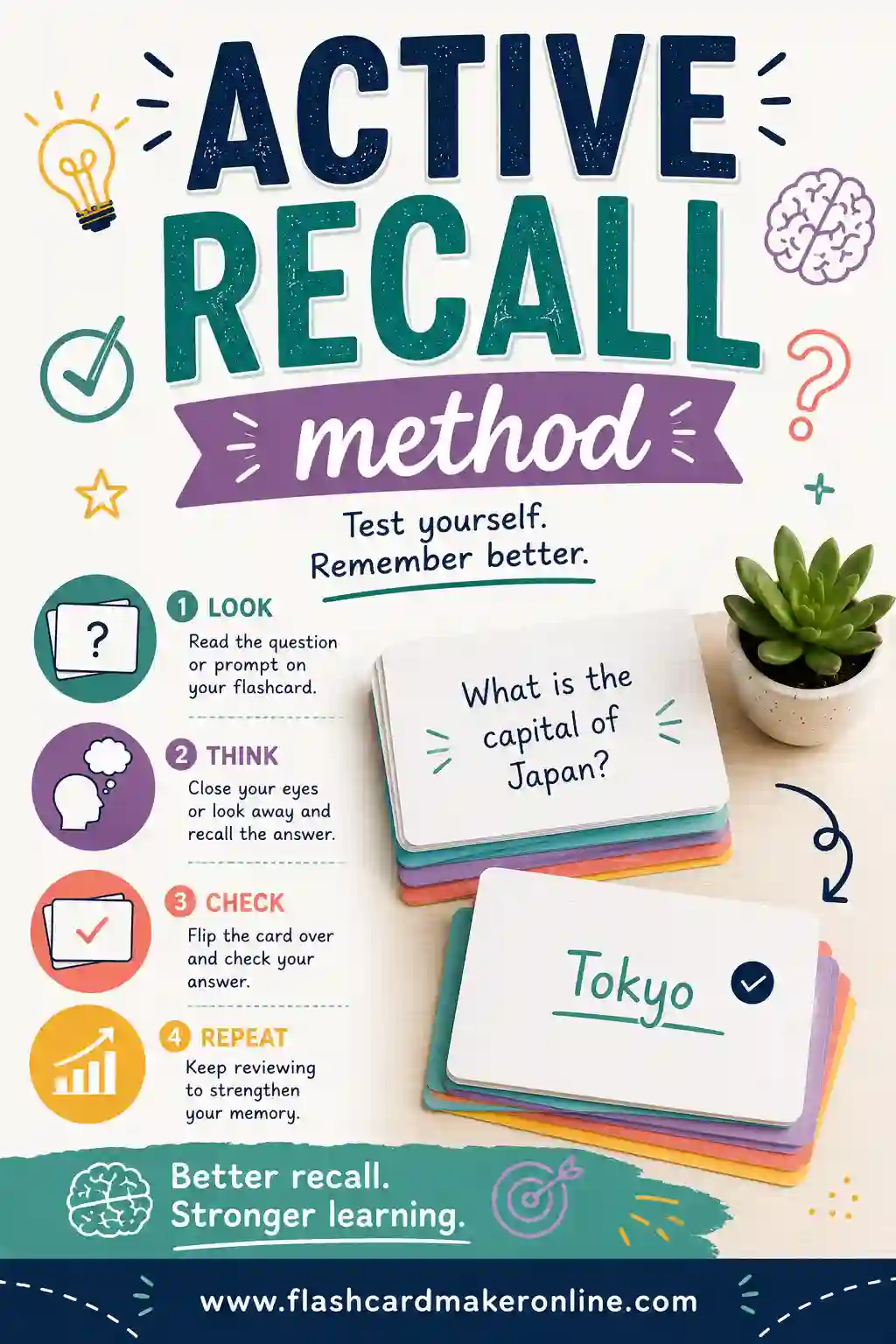
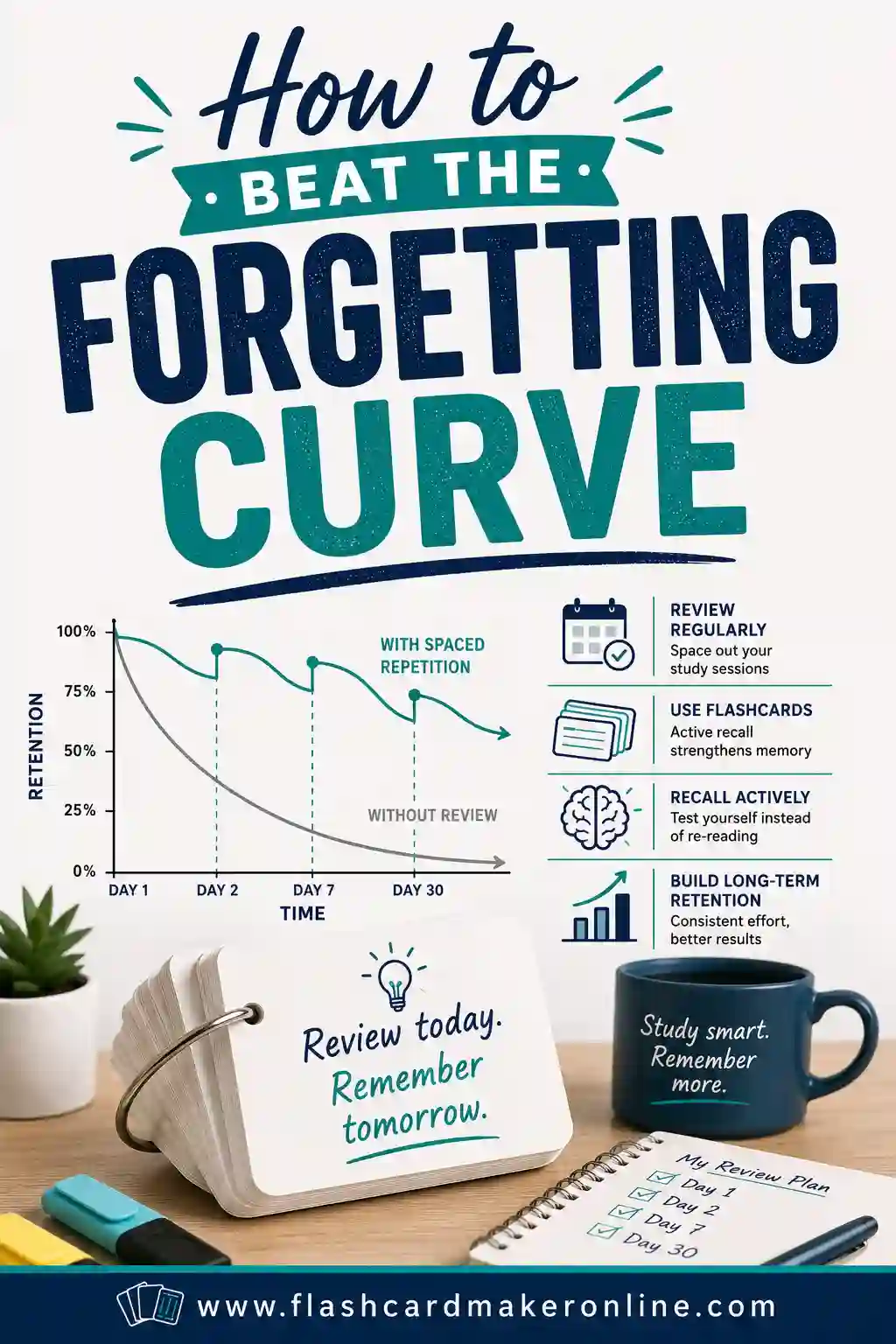
Testing yourself this way is a form of active recall, which strengthens memory more than just walking the palace while looking at a list. For tips on how often to review, see our guide on beating the forgetting curve.
| Type of material | Memory palace fit | Better partner |
|---|---|---|
| Ordered lists (stages, steps, sequences) | Excellent | Palace plus flashcards for review |
| Speech or presentation outline | Excellent for the order of points | Practice speaking out loud |
| Groups of names (bones, muscles, elements) | Good | Labeled-diagram flashcards |
| Foreign-language vocabulary | Fair; works best with sound-alike images | Spaced flashcards with pictures |
| Long numbers | Good when combined with a number-to-image code | A phonetic number code (covered in our article on the major system) |
| Deep concepts and cause-and-effect | Weak | Explaining it in your own words, practice problems |
| Word-for-word text | Weak, as Quintilian warned | Learning in short sections and reciting |
Does the memory palace work in real classes?
Lab studies use word lists. Real courses involve harder, connected material. What happens when students use memory palaces for actual coursework?
A small study by Qureshi and colleagues, published in Advances in Physiology Education in 2014, tried it in a medical school endocrinology unit. Of 78 second-year medical students, 28 were randomly chosen for sessions using memory palaces about insulin and diabetes, built around three campus locations. The others studied with self-directed worksheets. On a 10-question multiple-choice quiz, the memory palace group averaged 9.31 compared with 8.10 for the worksheet group. Every student who answered the questionnaire said the method was helpful.
The authors were honest about the limits. It was a pilot study, the quiz was multiple choice and mainly tested recall, and it couldn't show whether the learning lasted or transferred to harder problems. The palaces were also built by other students under teacher supervision, not by the participants themselves.
The big-picture caution
In a major 2013 review of study techniques in Psychological Science in the Public Interest, John Dunlosky and colleagues rated the keyword mnemonic and imagery use for text learning as "low utility" for students in general. They didn't rate the memory palace itself, and the keyword method is a different technique, but the reasoning is worth knowing: mnemonic tricks can take time to learn, work best for certain kinds of material, and don't automatically build understanding. The same review rated practice testing and spaced practice as "high utility."
The fair conclusion: the memory palace is a powerful tool for memorizing ordered information, with strong lab and brain-imaging evidence. It's not a replacement for understanding, testing yourself and spacing your reviews. Use it for what it's good at, and pair it with those other habits.
Memory palace ideas by subject
The same basic method adapts to almost any class. Here's how students in different subjects can use it. The examples are illustrative.
History and social studies
History is full of sequences: causes leading to a war, the steps of a reform movement, the order of events in a revolution. Put each event at a station in order. Make each image carry a clue to what happened, not just a name. For a unit on the causes of the American Revolution, the image at your front door might be a giant stamp sealing the door shut (the Stamp Act), and the next station might be a teapot pouring into a bathtub (the Boston Tea Party). Walking the route gives you the story in order, which also helps you write essays. For quick self-tests on names and events, pair the palace with presidents flashcards or your own history cards.
Science
Processes and cycles fit well: the steps of the scientific method, the stages of cell division, the parts of the digestive tract in order, or the layers of the atmosphere. A digestive-tract palace could follow the actual path of food, starting at your front door (the mouth) and moving through the house. When the order in the palace matches the order in nature, the palace becomes a map of the process itself.
Medicine and nursing
Medical students face long lists: drug classes, cranial nerves, symptoms of a condition. Many build a separate palace for each body system. The study by Qureshi and colleagues described above used campus locations for insulin and diabetes, which shows the idea in a real course. Because medical facts also need to be understood and applied, the palace should be a starting point, followed by case questions and spaced flashcards.
Languages
For vocabulary, the palace works best when combined with sound-alike images. To remember that the Spanish word "pato" means "duck," you might picture a duck patting your couch cushion at a living-room station. It's a fun way to get a group of words started, but for the hundreds of words a language requires, regular spaced flashcards are more efficient. Use the palace for tricky words that won't stick any other way.
Literature and speeches
For a poem or a speech, use the palace to hold the order of stanzas or main points, not every word. Quintilian's advice still applies: learn the actual wording in short sections by reciting, and let the palace keep you from losing your place.
Advanced memory palace techniques
Once the basic method feels comfortable, these refinements help you store more and keep it organized.
Build a library of palaces
Competitive memorizers often keep many palaces ready. You might use your home for biology, your school for history and a grandparent's house for vocabulary. Separating subjects this way reduces the chance that images from one list will interfere with another.
Mark every fifth station
Give every fifth station a special landmark in your mind, such as a golden hand at station 5 or a dime at station 10. This lets you jump straight to item 15 without walking the whole route, and it tells you right away if you've skipped one.
Store two or three images per station
Experienced users sometimes place a small cluster of images at each station, such as two objects interacting. This doubles a palace's capacity, but it's harder for beginners, so wait until single images feel easy.
Combine with a number code
Numbers are hard to picture. Many memorizers pair the memory palace with a phonetic code that turns digits into consonant sounds and then into words, so "32" can become a picture of the moon (m = 3, n = 2). We explain how that works in our article on the major system. Once numbers become images, they can go in a palace like anything else.
If you find it hard to picture things
Not everyone "sees" mental images vividly, and that's okay. Some people find the technique works better when they focus on other details: what the station feels like, the sound the image makes, or a short sentence describing the scene ("the batteries are hogging the couch"). Others draw a quick floor plan on paper and sketch tiny symbols at each station, then study the drawing. The memory benefit seems to come from linking items to an ordered set of places, so use whatever makes those links feel real to you. If it still doesn't click after a few honest tries, other methods, such as self-testing with flashcards, will serve you well.
Retire and reuse palaces
When you no longer need a list, you can reuse its palace. Leave it alone for a while first, so the old images fade, or build the new list with very different images. If old images keep popping up, choose a different palace for the new material.
Memory palace compared with other mnemonic methods
The memory palace is one of several classic memory aids. Here's how it compares with a few you may have heard of.
| Method | How it works | Best for | Main drawback |
|---|---|---|---|
| Memory palace (method of loci) | Images placed at stations along a familiar route | Ordered lists, outlines, sequences | Takes setup time; weak for concepts |
| Link or story method | Each image interacts with the next in a chain or story | Short lists without a place handy | One forgotten link can break the chain |
| Keyword method | A sound-alike word links a new term to its meaning | Foreign vocabulary, technical terms | Rated "low utility" overall in a 2013 review |
| Acronyms and acrostics | First letters form a word or sentence | Short fixed lists | Only gives first letters, not the content |
| Phonetic number code (major system) | Digits become consonant sounds, then words | Dates, numbers, formulas | Takes practice to learn the code |
None of these replaces understanding or self-testing. They're tools for getting hard-to-hold information into memory so you can then practice it.
Common mistakes and how to fix them
- Stations too similar. If you use five identical kitchen cabinets, images blur together. Pick stations that look clearly different.
- Images too bland. "A book on the table" won't stick. Make it strange, big or moving.
- Images that don't touch the station. An image floating near a station is easy to lose. Make it interact with the spot.
- Changing the route. Walk the same way every time. If you go left one day and right the next, the order falls apart.
- Overloading one palace. Storing new lists in the same palace too soon can cause old images to interfere with new ones. Build separate palaces for separate subjects, or wait until the old list is well learned.
- Never reviewing. A palace you never revisit fades like any other memory.
- Using it for everything. If you're trying to understand why something happens, a palace won't help much. Explain it, draw it or work problems instead.
Try it yourself: build a 10-station palace tonight
Here's a short exercise to test the technique on yourself. It takes about 20 minutes.
- Write a list of 10 random concrete words, or ask someone to write them for you. For example: rocket, pineapple, violin, umbrella, tiger, candle, bicycle, crown, snowman, telescope.
- Pick 10 stations in your home and practice the route until you can name them in order.
- Spend about a minute on each word, creating a vivid image that interacts with its station.
- Put the list away and do something else for 15 minutes.
- Write down the words in order by walking through your palace.
- Check your list. Try again tomorrow without looking first.
Many first-timers are surprised by how many words come back, in order, a day later. If some don't, look at those images. Usually they were too bland or didn't interact with the station.
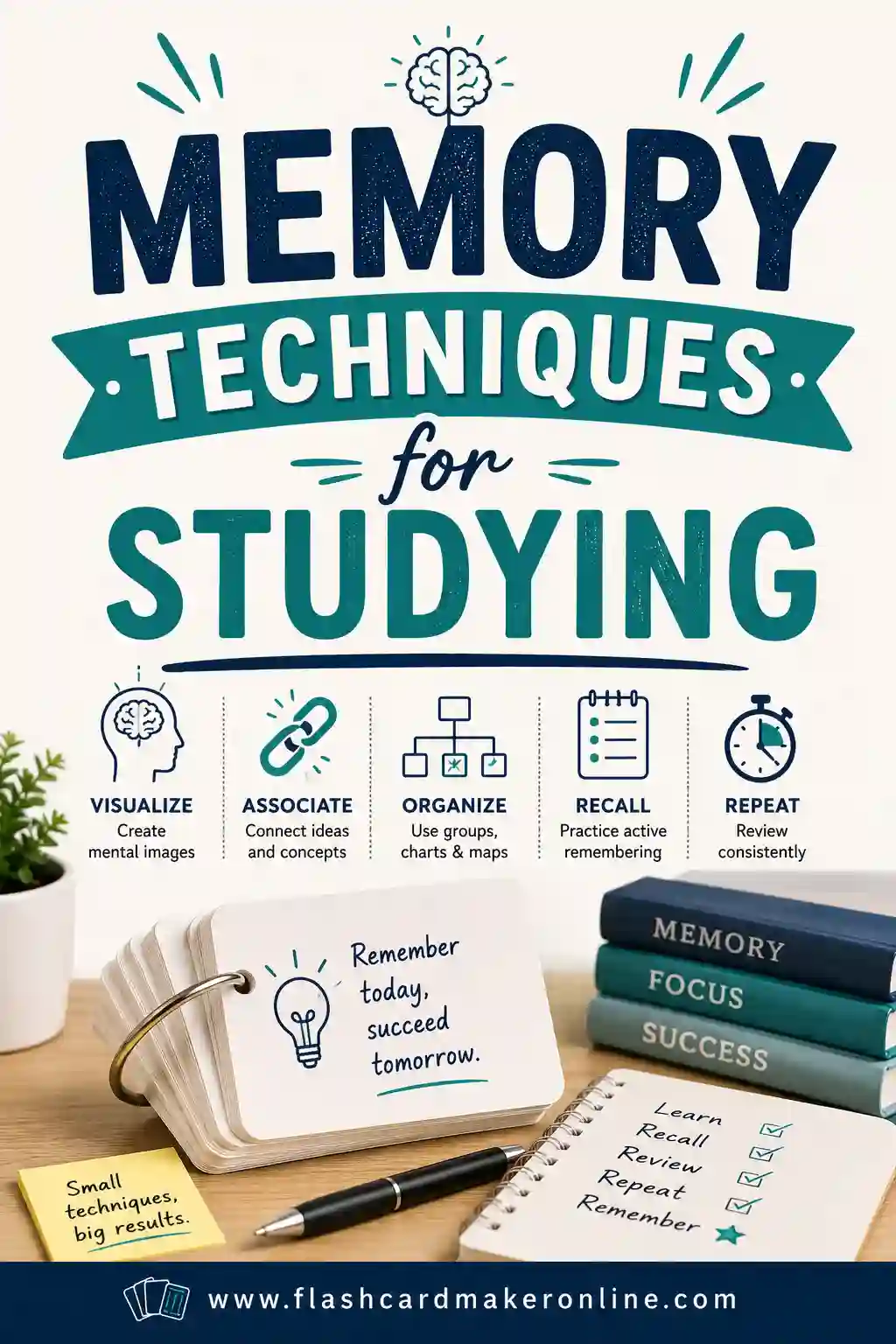
Once you're comfortable, try it with real study material: the steps of a process for your science class, the order of events in a history unit, or the bones of the hand for anatomy. For more techniques like this one, see our overview of memory techniques for studying.
Pair your memory palace with your own flashcards
The memory palace gets information into your head quickly and in order. Flashcards help you keep it there by testing yourself and coming back at the right times. Used together, they cover each other's weak spots.
Our free flashcard maker lets you add your own words and pictures, so you can put a photo of each station on the front and the fact it holds on the back. You can study with flip cards on screen and then print your deck double-sided or as cut-out sheets to carry with you as you walk your palace.
What a Memory Palace Fits and What It Doesn't
The method shines for some kinds of material and is a weaker fit for others. This table sums up the article's guidance, with an example for each.
| Kind of material | How well it fits | Why, or what to do |
|---|---|---|
| Lists and sequences, such as a shopping list | Shines | The route has a fixed order, so the items come back in order too |
| Ordered steps, such as the stages of mitosis | Good | Place one vivid image at each station along the route |
| Abstract ideas | Works with a stand-in | Use a concrete picture, such as a giant ballot box for "democracy" |
| A full speech, word for word | Of less service, according to Quintilian | Use it for the order of the main points instead |
| Deep understanding | Weaker fit | Pair it with other study methods |
Frequently Asked Questions
What is a memory palace?
A memory palace is a familiar place, such as your home or your route to school, that you use to store information in your mind. You choose a fixed path with specific stops, then picture a vivid image for each item you want to remember at each stop. To recall the items, you mentally walk the path again and pick up the images in order. The technique is also called the method of loci, from the Latin word for places, and it dates back to ancient Greece and Rome.
Is the memory palace the same as the method of loci?
Yes. Memory palace, mind palace, journey method and method of loci all describe the same basic technique: placing mental images at locations along a familiar route. Researchers usually say method of loci, while popular books and TV shows tend to say memory palace or mind palace. Some people use journey method when the route is a walk or a drive rather than a building. The steps are the same either way: pick a place, plan a route, store vivid images and walk it again to recall them.
Does the memory palace really work?
Yes, for the right kind of material. Brain-imaging research found that World Memory Championships competitors weren't more intelligent than others and didn't have unusual brain structure; they used this spatial strategy. A 2017 study in Neuron trained ordinary people for six weeks, in 40 sessions of 30 minutes, and their recall improved more than two control groups. A 2021 follow-up found the gains were still there four months later. It works best for lists and sequences, not for deep understanding.
How long does it take to learn the memory palace technique?
You can try a basic version in one evening. Building and using a 10-station palace usually takes about 20 to 30 minutes the first time. Getting fast and reliable takes longer. In the 2017 Neuron study, people with no experience practiced for 40 sessions of 30 minutes over six weeks and showed large gains. A 2012 study found that even a virtual environment learned in a few minutes worked as well as a familiar place for memorizing word lists, so you don't need years of practice to benefit.
How many items can one memory palace hold?
As many as you have distinct stations. A small apartment might give you 10 to 20 stations, and a large house or a long walk could give you far more. Beginners do best starting with 10. If you need to store a lot, it's usually better to build several smaller palaces for different subjects than to cram everything into one. Reusing the same palace for new material too soon can cause old images to get mixed up with new ones.
Can I use an imaginary place for a memory palace?
Yes. The Roman teacher Quintilian wrote that the places could be real or imagined, and a 2012 study in Acta Psychologica found that a virtual environment people had studied only briefly worked as well as a highly familiar real place. You can use a building from a game, a movie set you know well, or a floor plan you sketch and study. The important thing is that you can walk the route in your mind the same way every time without hesitating.
Is the memory palace good for studying for exams?
It helps with some exam material and not others. It's very good for ordered lists, steps in a process, stages, classifications and groups of names, such as bones or the order of events. It's weak for understanding why things happen or applying ideas to new problems. A large 2013 review rated practice testing and spaced practice as the most useful study methods overall. A good plan is to use the palace to get lists into memory, then use flashcards to test yourself and space your reviews.
What makes a good memory palace image?
Good images are concrete, vivid and active. Turn abstract ideas into objects, the way Quintilian suggested using an anchor for a point about the sea. Make the image big, strange or funny, give it motion or sound, and make it interact with the station, such as a giant pineapple stuck in the front door. For hard words, use a sound-alike picture. Bland images, like a small book lying on a table, are the most common reason beginners forget items.
How do memory palaces and flashcards work together?
The palace gets information into memory quickly and in order, while flashcards help you keep it. After storing a list in your palace, make cards that test it: put a station on the front and its item on the back, or ask for the next item in a sequence. Add a photo of each station if you like. Reviewing the cards on a spaced schedule turns the palace from a short-term trick into lasting knowledge.
Sources
We checked every source below while writing this guide. Last reviewed October 30, 2026, by Joan Ramos.
- Quintilian, Institutio Oratoria, Book 11, Chapter 2 (Loeb Classical Library translation, 1920) (LacusCurtius, University of Chicago)
- Routes to remembering: the brains behind superior memory (Maguire, Valentine, Wilding & Kapur, 2003), Nature Neuroscience 6(1), 90-95 (PubMed, U.S. National Library of Medicine)
- Mnemonic training reshapes brain networks to support superior memory (Dresler et al., 2017), Neuron 93(5), 1227-1235 (PubMed Central, U.S. National Library of Medicine)
- Durable memories and efficient neural coding through mnemonic training using the method of loci (Wagner et al., 2021), Science Advances 7(10) (PubMed Central, U.S. National Library of Medicine)
- Building a memory palace in minutes: equivalent memory performance using virtual versus conventional environments with the method of loci (Legge, Madan, Ng & Caplan, 2012), Acta Psychologica 141(3), 380-390 (PubMed, U.S. National Library of Medicine)
- The method of loci as a mnemonic device to facilitate learning in endocrinology (Qureshi et al., 2014), Advances in Physiology Education 38(2), 140-144 (PubMed Central, U.S. National Library of Medicine)
- Improving students' learning with effective learning techniques (Dunlosky et al., 2013), Psychological Science in the Public Interest 14(1), 4-58 (PubMed, U.S. National Library of Medicine)