The Major System: Turning Numbers Into Words You Can Remember
The major system is a memory technique that turns numbers into words. Each digit from 0 to 9 stands for one or more consonant sounds, and you fill in vowels to make a word you can picture. The number 32, for example, becomes m + n, which can be "moon." Major system memory works because a moon is easy to picture and remember, while "32" on its own is not. Once you know the code, any number, from a locker combination to the digits of pi, can become a short string of vivid images.
This guide gives you the full digit-to-sound table, simple tricks for learning it, the rules that trip people up, a short history of the system, worked examples, practice drills with answers, and a clear look at what the research does and doesn't show. By the end you'll be able to encode and decode numbers on your own.
How major system memory works
Numbers are hard to remember because they're abstract. "4,821" doesn't look like anything, and one string of digits looks a lot like another. Words for concrete things, on the other hand, are easy to picture and easy to link together.
The major system bridges that gap in three steps:
- Digits to sounds. Each digit has its own consonant sound or sounds. 3 is "m," 2 is "n," and so on.
- Sounds to words. You add any vowels you like (and the letters w, h and y, which don't count) to turn the consonants into a real word. M + n can be "moon," "man," "mine" or "money."
- Words to images. You picture the word as vividly as you can and connect it to whatever the number belongs to.
Decoding works in reverse. When you remember the image of a moon, you know the consonants are m and n, so the number is 32. Because every consonant sound maps to exactly one digit, a word always decodes to just one number. That one-way certainty is what makes the system reliable.
The system is sometimes called the phonetic system, the phonetic mnemonic or the number-consonant system. "Phonetic" is the key word: it's based on sounds, not spelling.
The major system table: digits and their sounds
Here is the standard modern table. Learn this first; everything else builds on it.
| Digit | Sounds | Common spellings | Example words |
|---|---|---|---|
| 0 | s, z | s, z, soft c (as in "city") | zoo, sea, ice |
| 1 | t, d, th | t, d, th (as in "thin" and "this") | tie, day, tea |
| 2 | n | n | knee, Noah, honey |
| 3 | m | m | ma, ham, home |
| 4 | r | r | rye, ray, hair |
| 5 | l | l | law, lie, eel |
| 6 | j, sh, ch, zh | j, sh, ch (as in "chair"), soft g (as in "gem"), the "s" in "measure" | shoe, jaw, chew |
| 7 | k, hard g | k, hard c (as in "cat"), q, hard g (as in "go"), ck | cow, key, egg |
| 8 | f, v | f, v, ph (as in "phone"), gh (as in "laugh") | ivy, foe, hive |
| 9 | p, b | p, b | pie, bee, boy |
| none | vowels, w, h, y | a, e, i, o, u, w, h, y, and silent letters | use them freely as filler |
Notice that the sounds in each row are related. T and d are made with the tongue in the same place; the only difference is whether your voice is on. The same is true of f and v, p and b, s and z, and k and hard g. That's why they share a digit. Once you notice it, the table feels less random.
Easy ways to remember each digit's sound
Memory teachers have used the shapes of letters to anchor the code for a long time. In his 1813 book The New Art of Memory, the early mnemonics teacher Gregor von Feinaigle wrote that the letters he assigned to figures were "not merely arbitrary," but chosen to match the shapes of the numerals where possible. These modern memory hooks follow the same idea:
- 0 = s, z: "z" is the first sound of "zero."
- 1 = t, d: a lowercase "t" has one downstroke.
- 2 = n: a lowercase "n" has two downstrokes.
- 3 = m: a lowercase "m" has three downstrokes.
- 4 = r: "four" ends with an r.
- 5 = l: L is the Roman numeral for 50, and if you hold up your left hand, the thumb and four fingers make an L shape with five digits.
- 6 = j, sh, ch: a capital "J" written backward looks a bit like a 6.
- 7 = k, hard g: a capital "K" can be drawn from two 7s, one right side up and one flipped, leaning against a line.
- 8 = f, v: a handwritten cursive "f" has two loops, like an 8.
- 9 = p, b: a "p" is a mirror image of 9, and a "b" is a 9 turned upside down.
Spend 10 minutes with these hooks and then quiz yourself in random order. Most people can learn the whole table in one sitting, and a few days of quick review makes it automatic. Flashcards are perfect for this: put the digit on the front and the sounds plus your memory hook on the back, then flip the deck around so you also practice sound-to-digit.
The rules that trip people up
The table is simple. The rules for applying it are where beginners stumble. They all follow from one principle: count the consonant sounds you hear, not the letters you see.
1. Sounds, not spelling
"Cello" starts with a "ch" sound, so it's 6 + 5 = 65, not 7 + 5. "City" starts with an s sound, so it's 0 + 1 = 01. "Phone" is f + n = 82. "Laugh" is l + f = 58, because the "gh" sounds like f.
2. Silent letters don't count
"Knife" is n + f = 28, because the k is silent. "Tomb" is t + m = 13, because the b is silent. "Lamb" is 53, not 539.
3. Double letters count once if you hear one sound
"Butter" has one t sound, so it's b + t + r = 914. "Muddy" is m + d = 31. But "midday" has two separate d sounds you can hear, so it's 311.
4. One letter can make two sounds
The letter x usually sounds like "ks," so "ax" is 70 (k + s). In "accept," the two c's make two different sounds, k and s, so the word is 7 + 0 + 9 + 1 = 7091.
5. Vowels, w, h and y are free
"Toe," "tie," "tea," "doe" and "dough" all equal 1. "Way," "hay" and "yo-yo" equal nothing at all. These free letters are what let you build real words from any string of consonants.
6. Watch the "ng" sound and your accent
The "ng" in "sing" is a single sound that's neither a clear n nor a clear g. Practitioners handle it differently. Some count it as 27 (n + g), some as 2, and some just avoid "ng" words. Pick one rule and stick with it. Accents matter too. If you don't pronounce the r in "car," you may hear it as just 7. Use your own pronunciation consistently, since you're the only one who needs to decode your words.
7. Th is always 1
Both the "th" in "thin" and the "th" in "this" count as 1. They're close cousins of t and d.
A quick decoding checklist
When you're unsure about a word, run through these four questions in order:
- Say it out loud. What consonant sounds do you actually hear?
- Cross out the free sounds. Remove every vowel sound and any w, h or y.
- Merge doubles. If two letters make one sound, count it once.
- Look up each remaining sound in the table. Write the digits in the same order as the sounds.
Take "hammock." Out loud it's h-a-m-o-k. Cross out h and the vowels: m, k. The double m makes one sound. M is 3 and k is 7, so "hammock" is 37. With a little practice, this checklist runs in your head in a second or two.
Where the major system came from
Number-to-letter codes have a long history, and the major system as we know it took shape step by step.
Feinaigle's consonant code
In The New Art of Memory (London, 1813 edition), Gregor von Feinaigle assigned consonants to digits and treated vowels only as connectors used to turn consonants into words, describing them as "but the ligaments." His code was close to today's, with some important differences, shown in the table below.
Aimé Paris and the modern form
Aimé Paris refined Feinaigle's code. In Phreno-Mnemotechny, or The Art of Memory, published in 1845, Francis Fauvel-Gouraud printed what he called the "Fundamental Basis of Paris." It's essentially the modern table: s and z for 0, t and d for 1, n for 2, m for 3, r for 4, l for 5, ch and j for 6, k and q for 7, f and v for 8, and p and b for 9. Fauvel-Gouraud credited Paris with "perfecting" the basis, including giving the ch and j sounds to 6, while noting that most of Paris's principles came from Feinaigle. For his own English version, Fauvel-Gouraud said that w, h and y are always "null," the same rule we use today.
| Digit | Feinaigle (1813 edition) | Paris's basis, as printed by Fauvel-Gouraud (1845) | Modern major system |
|---|---|---|---|
| 0 | s, x, z | s, z | s, z, soft c |
| 1 | t | t, d | t, d, th |
| 2 | n | n, gn | n |
| 3 | m | m | m |
| 4 | r | r | r |
| 5 | l | l, ll | l |
| 6 | d | ch, j | j, sh, ch, soft g |
| 7 | c, k, g, q | k, q | k, hard c, hard g, q |
| 8 | b, h, v, w | f, v | f, v, ph |
| 9 | p, f | p, b | p, b |
The biggest changes from Feinaigle to Paris were at 6, 8 and 9. Feinaigle used d for 6, put b with 8 and f with 9. Paris grouped the sounds by how they're made instead (d with t, f with v, b with p), which is a big part of why the modern system is easy to learn. The Feinaigle column is a reconstruction from a scanned 1813 text, so treat it as a guide to the general pattern.
The name "major system" is commonly used today, but its origin is uncertain, so we won't guess at it here.
Build your number pegs from 0 to 20
You can create a word on the fly for any number, but it's much faster to have a fixed word ready for each number you use often. These ready-made words are called pegs. Many people build pegs for 0 to 99, so any long number can be split into two-digit chunks.
Start with 0 to 20. Here's a common set. Each one follows the rules above, and you can swap in your own words as long as they decode correctly.
| Number | Sounds | Peg word | Number | Sounds | Peg word |
|---|---|---|---|---|---|
| 0 | z | zoo | 11 | t, t | tot |
| 1 | t | tie | 12 | t, n | tin |
| 2 | n | Noah | 13 | t, m | tomb |
| 3 | m | ma | 14 | t, r | tire |
| 4 | r | rye | 15 | t, l | towel |
| 5 | l | law | 16 | d, sh | dish |
| 6 | sh | shoe | 17 | t, k | tack |
| 7 | k | cow | 18 | d, v | dove |
| 8 | v | ivy | 19 | t, b | tub |
| 9 | b | bee | 20 | n, s | nose |
| 10 | t, s | toes |
Tips for choosing good pegs:
- Pick concrete nouns. "Tire" is easy to picture; "tear" (as in crying) is harder.
- Make each peg distinct. Avoid two pegs that are both small round objects, or you'll mix them up.
- Prefer pegs with only the needed consonants. "Toes" is cleaner for 10 than "tease," which also works but is less concrete.
- Write them down and review them. A deck of 100 peg flashcards, with the number on one side and your peg word and a picture on the other, is the fastest way to make them automatic.
Extending your pegs from 21 to 99
Once 0 to 20 feel automatic, extend your list. Two-digit pegs are the workhorses of the system, because any long number can be split into pairs. Here are pegs for 21 to 40 to get you started. Every word follows the sound rules.
- 21 net, 22 nun, 23 gnome (the g is silent), 24 Henry, 25 nail
- 26 notch, 27 neck, 28 knife, 29 knob, 30 mouse
- 31 mat, 32 moon, 33 mummy, 34 mower, 35 mule
- 36 match, 37 mug, 38 movie, 39 map, 40 rose
A few strategies make building the rest easier:
- Work one "decade" at a time. All the 40s start with r, all the 50s with l, and so on. Brainstorm words for one decade, choose the best, and review them for a few days before moving on.
- Group by theme if it helps. Some people make all the 70s (k/g sounds) into foods or all the 90s (p/b sounds) into animals. Themes make pegs easier to recall, though they can also make them more similar to each other, so test what works for you.
- Use a dictionary when you're stuck. Say the two consonant sounds and try every vowel between them: for 64 (sh + r), you get "share," "shore," "sheer" and "chair." Pick the most picturable.
- Retire weak pegs. If a peg keeps failing in practice, it's probably too abstract or too close to another. Swap it for a better one and update your flashcards.
- Keep a master list. Write all 100 pegs in one place. That list is your reference when you're encoding something important.
Building all 100 takes a while, but you don't need them all before you start using the system. Even 0 to 20 lets you encode many everyday numbers.
Major system ideas for school subjects
Here's how students in different classes can put the system to work. The examples are illustrative.
History
Dates are the classic use. Encode the year as one or two images and link them to an image of the event. Many people drop the leading "1" for years in the 1000s and 1900s if the century is obvious from context, which saves a word. Our guide to history dates flashcards shows how to build a deck around dates.
Chemistry
Atomic numbers become pegs you can attach to each element. If an element's atomic number is 8, link the element to your peg for 8, "ivy," with a memorable scene. For the full table, combine the pegs with periodic table flashcards so you practice both directions: element to number and number to element.
Math and physics
Constants like pi and e are natural targets, as the worked examples below show. Formulas with numbers in them, such as coefficients and exponents, can also be anchored with a peg. The system won't help you understand where a formula comes from, though, so pair it with practice problems.
Everyday life
Room numbers, bus routes, parking spots, appointment times and page numbers all work. Turn the number into a word, link the word to the place, and you'll often find you don't need to check your notes. For anything sensitive, like a PIN or password, follow your bank's or school's security rules first.
Worked examples: encoding real numbers
The examples below are illustrative. Locker combinations and PINs here are made up, and you should never write a real PIN in an easy-to-decode form where others could see it.
Example 1: The first digits of pi
Pi begins 3.14159. Split it into chunks: 3-1-4 and 1-5-9.
- 3, 1, 4 = m, t, r = meter
- 1, 5, 9 = t, l, p = tulip
Picture a meter stick with a tulip growing out of the end. "Meter tulip" decodes back to 314159. Add the decimal point after the first digit, and you have 3.14159.
Example 2: The number e
The math constant e begins 2.71828. Split it into 27, 18 and 28.
- 27 = n, k = neck
- 18 = d, v = dove
- 28 = n, f = knife (the k is silent)
Picture a dove perched on someone's neck, holding a butter knife. Neck, dove, knife decodes to 271828.
Example 3: A locker combination
Say your locker combination is 14-32-8. Using pegs: 14 = tire, 32 = moon, 8 = ivy. Picture a tire rolling across the moon, which is covered in ivy. When you stand at your locker, the scene gives you the numbers in order.
Example 4: A long number split into pegs
Suppose you need to remember a made-up ID number, 9512 7430. Split it into 95, 12, 74 and 30.
- 95 = p, l = pole
- 12 = t, n = tin
- 74 = k, r = car
- 30 = m, s = moose
Now make a short story: a tin can is stuck on top of a pole, a car crashes into the pole, and a moose climbs out of the car. Four images hold eight digits.
Example 5: Linking a number to its meaning
The major system becomes most useful when you tie the number to what it belongs to. To remember that an imaginary room number is 215, encode 215 as n, t, l = "needle" and picture a giant needle stuck in the door of that room. Now the image carries both the place and the number. For history dates, the same trick works: tie the image for the date to an image of the event.
Using the major system with a memory palace and flashcards
On its own, the major system turns numbers into words. To remember long numbers or many numbers, combine it with other tools.
With a memory palace
A memory palace is a familiar route where you leave images at stops in order. (We explain it fully in our article on the memory palace.) Once digits become images, they can go in a palace like anything else. Put "meter" at your front door, "tulip" at the coat hook, and the next pair of digits at the couch. Walk the route and the digits come back in order. This is how many memory competitors handle very long numbers.
With flashcards
Flashcards help in two ways. First, they help you learn the system itself: digits to sounds, sounds to digits, and your 100 peg words. Second, they help you keep the numbers you've encoded. Some card ideas:
- Front: "47." Back: "rock (r = 4, k = 7)."
- Front: a picture of a dove. Back: "18."
- Front: "What's the room number for the science lab?" Back: "215, needle in the door."
- Front: "Encode 85." Back: "file, foil, fly, veil (f/v = 8, l = 5)."
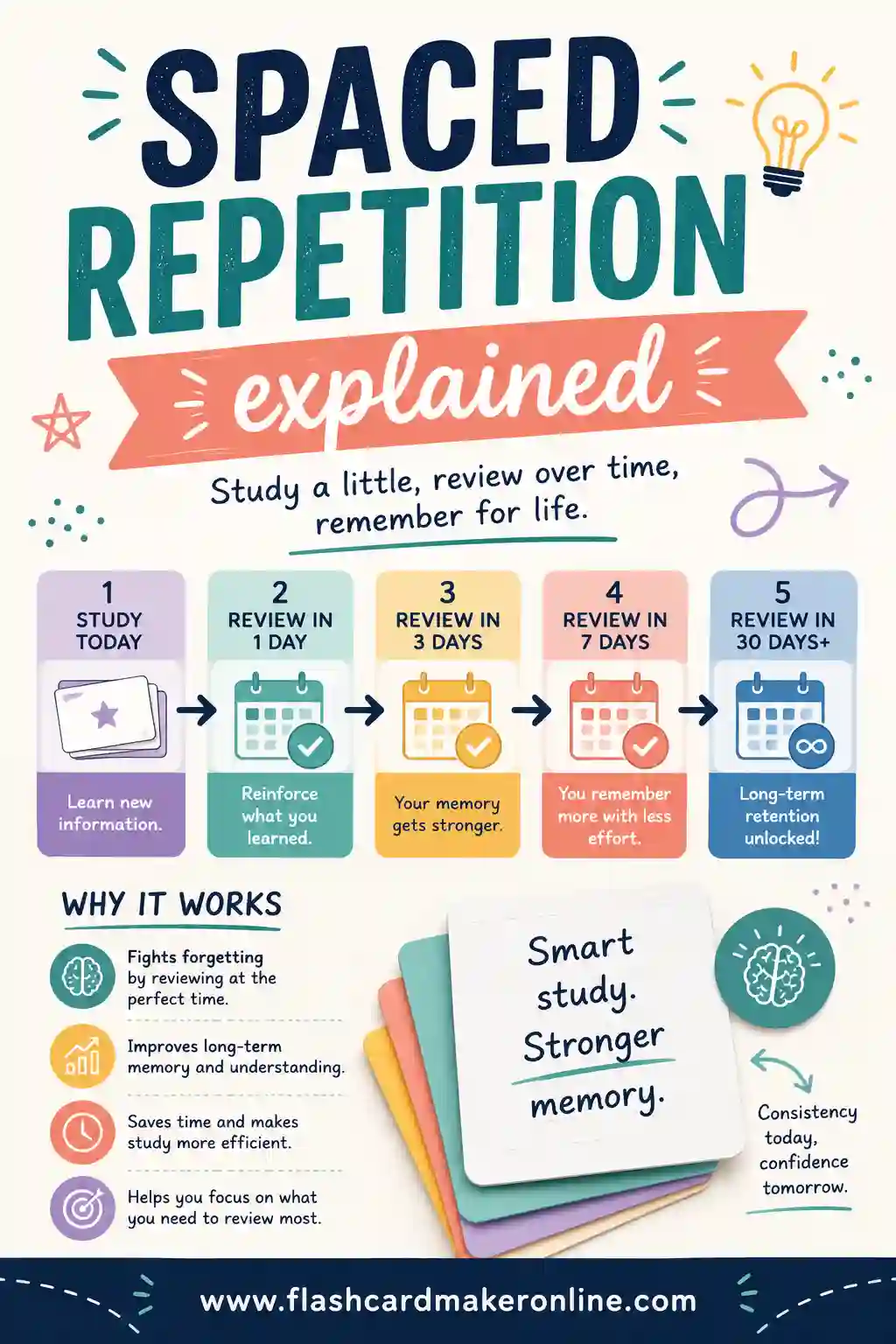
Answering before you flip is active recall, and coming back to the cards at growing intervals is spaced repetition. Both make the code automatic much faster than rereading the table.
What the research says about the major system
It's worth being honest here. Versions of the major system have been taught since at least Feinaigle's book in the 1810s, and it's a well-known tool among memory enthusiasts, but there's much less modern lab research on it than on techniques like the memory palace or retrieval practice. Here's what we can say with confidence.
Good mnemonics share certain properties
In an influential 1981 review in the Review of Educational Research, psychologist Francis Bellezza proposed a way to classify mnemonic devices and described four properties that the memory cues they create should have to work well: constructibility (you can build the cue reliably), discriminability (each cue is distinct from the others), associability (the cue links easily to the information) and invertibility (you can get from the cue back to the information). He also pointed out that methodological problems made much of the earlier research on mnemonic effectiveness inconclusive.
The major system scores well on these properties. It's constructible, because the rules always produce a word. It's invertible, because each consonant sound maps to one digit, so a word decodes to exactly one number. Discriminability and associability depend on you: choose distinct, vivid words and link them strongly to the context.
Superior memory is mostly strategy
Brain-imaging research supports the idea that outstanding memory for things like numbers comes from technique. In a 2003 study in Nature Neuroscience, Eleanor Maguire and colleagues studied people with superior memory, including World Memory Championships competitors. They found no unusual intelligence or brain structure. Instead, the memorizers used a spatial strategy, the memory palace, which engaged regions involved in spatial memory. A 2017 study in Neuron by Martin Dresler and colleagues found that six weeks of mnemonic training, 40 sessions of 30 minutes, improved memory in people with no prior experience and shifted their brain networks toward the pattern seen in top memory athletes. Those studies focused on the memory palace, not the major system specifically, but they show that memory skill can be trained.
Expertise takes practice
Psychologist Kenneth Higbee wrote a well-known guide to mnemonics, Your Memory: How It Works and How to Improve It (Prentice-Hall, 1977), and later studied how people go from novice to skilled user of the phonetic system in a 1997 paper titled "Novices, Apprentices, and Mnemonists: Acquiring Expertise with the Phonetic Mnemonic" in Applied Cognitive Psychology. The very framing of that research makes an important practical point: the phonetic system is a skill you build in stages, not a trick that works the first time you see the table.
Keep expectations realistic
A major 2013 review of study techniques in Psychological Science in the Public Interest, by John Dunlosky and colleagues, rated the keyword mnemonic (a different but related memory trick) as "low utility" for students in general. Practice testing and spaced practice earned the top "high utility" rating. The takeaway for the major system is similar: it's a specialized tool for numbers. It won't help you understand math, but it can make remembering specific numbers much easier.
Practice drills with answers
Try these drills to build speed. Cover the answers, work through each list, then check.
Drill 1: Decode these words into numbers
- moon
- cello
- knight
- action
- butter
- gem
- ghost
- photo
Answers: 1. moon = 32. 2. cello = 65 (it starts with a ch sound). 3. knight = 21 (k and gh are silent). 4. action = 762 (k, sh, n). 5. butter = 914 (one t sound). 6. gem = 63 (soft g). 7. ghost = 701 (g, s, t). 8. photo = 81 (ph sounds like f).
Drill 2: Encode these numbers as words
- 21
- 45
- 63
- 90
- 52
- 77
Possible answers: 1. 21 = net, nut, nod. 2. 45 = rail, roll, rule. 3. 63 = jam, chime, sham. 4. 90 = bus, piece, bass. 5. 52 = lion, lane, loan. 6. 77 = cake, cook, kick. Any word works if its consonant sounds decode correctly.
Drill 3: Speed rounds
Set a timer for one minute. Write the numbers 0 to 9 in random order and say the sound for each as fast as you can. Then do the reverse: have someone call out sounds ("sh," "v," "d") and say the digit. When you can do both in under 15 seconds with no mistakes, the table is automatic.
Drill 4: Real numbers from your life
Pick three numbers you actually need, such as a room number, a bus route or an important date, and encode each one. Make a flashcard for each with the number on the front and the image on the back. Review them for a week and see which stick.
Common mistakes with the major system
- Counting letters instead of sounds. This is the most common error. Say the word out loud and listen.
- Forgetting silent letters. "Knee" is 2, not 72. "Comb" is 73, not 739.
- Counting a double letter twice. "Happy" is 9, not 99, because you hear only one p.
- Picking abstract words. "Mine" for 32 is fine, but "moon" is easier to picture. Concrete beats abstract.
- Changing your rules. If you count "ng" as 27 one day and 2 the next, you'll decode wrongly. Decide once and write your choices down.
- Skipping the image. Saying "neck dove knife" isn't enough. Picture the scene vividly and link it to what the number is for.
- Trying to learn 100 pegs in one day. Learn 10 at a time and review them on a schedule.
- Using it where plain practice works better. For math facts like times tables, regular practice until answers are automatic is usually simpler than encoding each one.
Who the major system is good for
The major system is most useful for people who regularly need to remember specific numbers: students memorizing dates, constants or formulas; anyone who wants to remember phone numbers, addresses and appointment times without writing them down; people who enjoy memory games or competitions; and anyone who simply likes the challenge. It's less useful if you rarely need numbers, or if the numbers you need are already in your phone. For a broader set of strategies, see our overview of memory techniques for studying.
Give it a fair try. Most people find the first week slow and a little awkward, and then one day they realize they turned a number into a picture without thinking about it.
Practice the code with your own flashcards
The fastest way to learn the major system is to drill it: digits to sounds, sounds to digits, and then your peg words. Make a small deck for the table, another for pegs 0 to 20, and add more as you go. Review a few minutes a day and with steady practice you'll start encoding numbers on sight.
Our free flashcard maker lets you add your own words and pictures, so you can put a number on the front and your peg word with a picture on the back. Study with flip cards on screen, then print the deck double-sided or as cut-out sheets to practice anywhere.
Spelling Rules for Decoding Words, With Examples
Beginners usually stumble on how to apply the table, not on the table itself. This table shows each rule next to a word from the article and the number it gives.
| Rule | Example word | How it decodes | Number |
|---|---|---|---|
| Count sounds, not spelling | phone | f + n | 82 |
| Silent letters don't count | knife | The k is silent, so n + f | 28 |
| One heard sound counts once | butter | b + t + r, with a single t sound | 914 |
| Two heard sounds both count | midday | m + d + d, with two separate d sounds | 311 |
| One letter can make two sounds | ax | The x sounds like k + s | 70 |
| Vowels, w, h and y are free | toe, tie, tea | Only the t counts | 1 |
Frequently Asked Questions
What is the major system for memory?
The major system is a memory technique that turns numbers into words. Each digit stands for one or more consonant sounds: 0 is s or z, 1 is t or d, 2 is n, 3 is m, 4 is r, 5 is l, 6 is j, sh or ch, 7 is k or hard g, 8 is f or v, and 9 is p or b. You add vowels to make a word you can picture, so 32 becomes moon. Because images are easier to remember than digits, the words help you hold on to the numbers.
What is the major system table?
The standard table is: 0 = s, z and soft c; 1 = t, d and th; 2 = n; 3 = m; 4 = r; 5 = l; 6 = j, sh, ch, soft g and the zh sound in measure; 7 = k, hard c, hard g and q; 8 = f, v and ph; 9 = p and b. Vowels and the letters w, h and y have no value, so you can use them freely to build words. Always go by the sound you hear, not the letter you see.
How do you remember the major system digits?
Most people use shape and sound hooks. Zero starts with z. A lowercase t has one downstroke, n has two and m has three. Four ends in r. L is the Roman numeral for 50. A backward J looks like 6. A capital K can be drawn from two 7s. A cursive f has two loops like an 8. And p is a mirror image of 9. With these hooks and a few days of flashcard review, most people can learn the table quickly.
Does the major system use spelling or sound?
Sound. The system counts the consonant sounds you hear when you say a word. Cello starts with a ch sound, so it's 65. Knife has a silent k, so it's 28. City starts with an s sound, so it's 01. Butter has one t sound, so it's 914, not 9114. Laugh ends with an f sound, so it's 58. Saying each word out loud is the easiest way to avoid mistakes when you encode or decode.
Who invented the major system?
It developed over time. Gregor von Feinaigle's book The New Art of Memory, in its 1813 London edition, assigned consonants to digits and used vowels only as connectors, though several of his assignments differ from today's. Aimé Paris refined the code into what is essentially the modern version, which Francis Fauvel-Gouraud printed in 1845 as the Fundamental Basis of Paris, crediting Paris with perfecting it. Fauvel-Gouraud also said w, h and y count as nothing, as they do today.
How long does it take to learn the major system?
Learning the 10-digit table usually takes one sitting plus a few days of quick review. Building fluency, where you can turn numbers into words without thinking hard, takes longer. Many people build a set of 100 peg words for 00 to 99, and learning those works best in batches of about 10 at a time with regular flashcard review. Research on the phonetic mnemonic frames it as a skill people develop in stages, from novice to expert, so expect the first week to feel slow.
What is the difference between the major system and the peg system?
A peg system gives you a fixed word for each number, which you then link to items you need to remember. The major system is one way to make those pegs: it creates peg words from consonant sounds, so 1 is tie, 2 is Noah and 10 is toes. Other peg systems use rhymes, such as one-bun and two-shoe, but rhyming pegs are hard to extend past 10 or 20. The major system can create a peg for any number.
Does the major system actually work?
It works well for its narrow purpose: remembering specific numbers. Its code is reliable because each consonant sound maps to one digit, so a word decodes to exactly one number. Brain research shows that superior memory performers rely on learned strategies rather than special brains, and that mnemonic training can be learned. But there's less modern lab research on the major system than on the memory palace, and it won't help you understand math. Use it for numbers and use practice testing for everything else.
Can kids learn the major system?
Older kids who read fluently and can hear individual sounds in words can usually learn it, and many enjoy it as a game. Start with just the 10 digit sounds and a few fun peg words, like tie, Noah and ma. Have them say words out loud to hear the consonants, and make a set of picture flashcards. Younger children who are still learning phonics may find it confusing, since it uses sounds rather than spelling. For them, plain number practice is a better fit.
Sources
We checked every source below while writing this guide. Last reviewed October 30, 2026, by Joan Ramos.
- The New Art of Memory, Gregor von Feinaigle (London: Sherwood, Neely and Jones, 1813), digitized from the University of California Libraries (Internet Archive)
- The New Art of Memory, Gregor von Feinaigle (1813), full text (Internet Archive)
- Phreno-Mnemotechny, or The Art of Memory, Francis Fauvel-Gouraud (1845), full text (Internet Archive)
- Mnemonic Devices: Classification, Characteristics, and Criteria (Bellezza, 1981), Review of Educational Research 51(2), 247-275 (American Educational Research Association)
- Your Memory: How It Works and How to Improve It, Kenneth L. Higbee (Prentice-Hall, 1977) (Internet Archive)
- Novices, Apprentices, and Mnemonists: Acquiring Expertise with the Phonetic Mnemonic (Higbee, 1997), Applied Cognitive Psychology 11(2), 147-161 (Wiley)
- Routes to remembering: the brains behind superior memory (Maguire, Valentine, Wilding & Kapur, 2003), Nature Neuroscience 6(1), 90-95 (PubMed, U.S. National Library of Medicine)
- Mnemonic training reshapes brain networks to support superior memory (Dresler et al., 2017), Neuron 93(5), 1227-1235 (PubMed Central, U.S. National Library of Medicine)
- Improving students' learning with effective learning techniques (Dunlosky et al., 2013), Psychological Science in the Public Interest 14(1), 4-58 (PubMed, U.S. National Library of Medicine)