Flashcards for Teachers: Make, Print & Use in Class
Flashcards for teachers are quick, two-sided cards that turn any lesson — vocabulary, math facts, key terms, dates, definitions — into an active recall activity students can do solo, in pairs, or as a whole class. They work because they get students producing answers instead of passively listening, and they fill those awkward gaps in a school day with five minutes of real learning. The fastest way to get a set that fits your exact curriculum is to build your own with a free flashcard maker and print a class set.
Short on prep time? Open the free flashcard maker, type your terms and definitions, and print a clean classroom set in minutes. No sign-up, no software, no budget required.
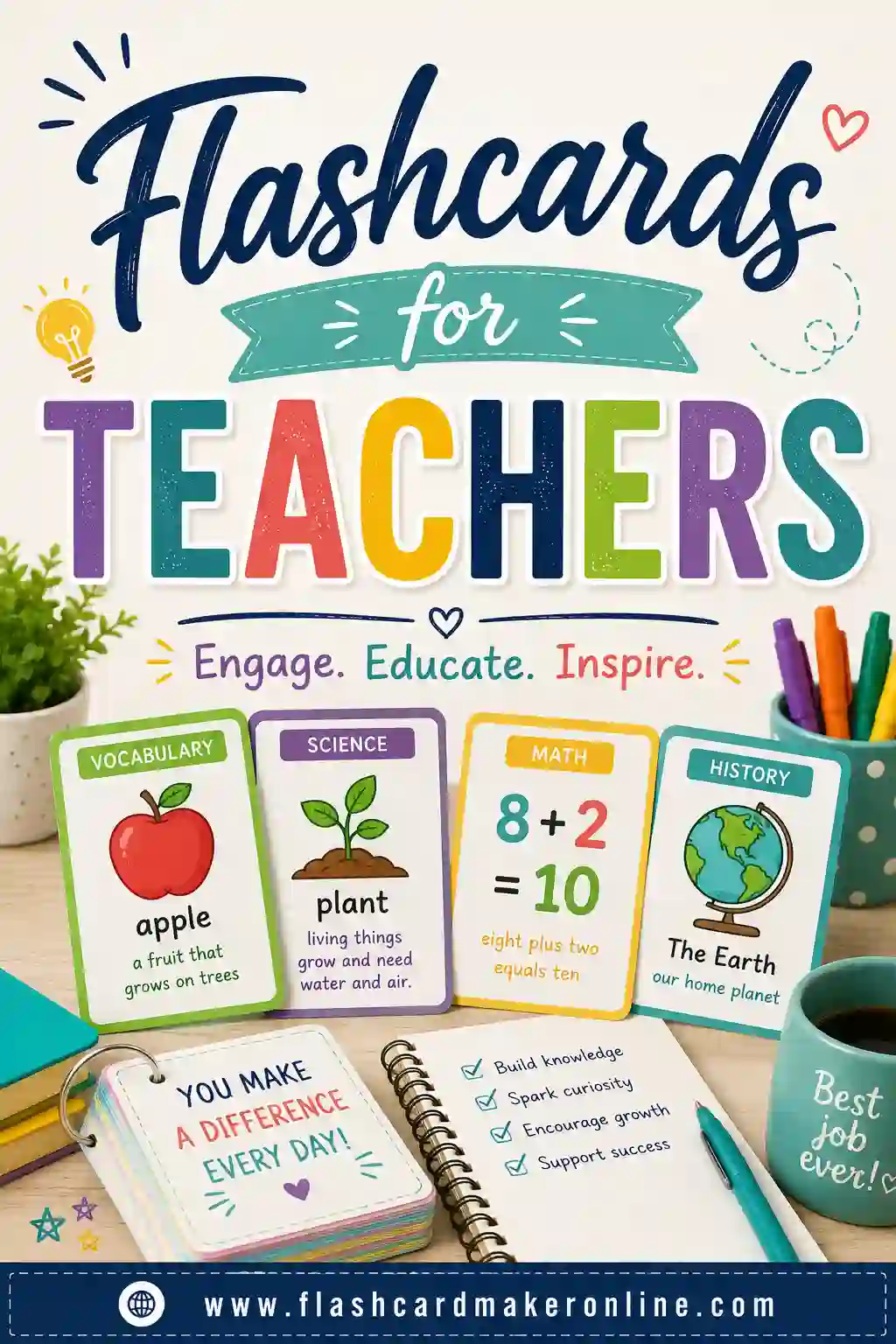
Why Flashcards Belong in Every Classroom
Teachers have a constant challenge: helping every student remember what matters, with limited time and a wide range of levels. Flashcards are one of the cheapest, most flexible tools for the job.
Here's why they earn their place:
- They demand active recall. When a student tries to produce an answer, they learn far more than from rereading notes. Flashcards make that retrieval practice the whole point.
- They fit any gap. The five minutes before lunch, a sub day, a fast-finisher activity — cards turn dead time into review time.
- They flex to any level. The same deck can be a partner quiz for strong students and a teacher-led review for those who need support.
- They're nearly free. A printed set costs a few sheets of cardstock and lasts for years.
Best of all, they shift the work to the students. Once a deck exists, they do the quizzing while you circulate and support.
What Makes a Strong Classroom Flashcard
A good teaching card is clear, focused, and aligned to exactly what you'll assess.
- One concept per card. Test a single term, fact, or step — not a whole topic.
- Front = prompt, back = answer. Put the question or term on the front and the cleanest possible answer on the back.
- Match your standards. Card the things you actually test, so review time pays off directly.
- Keep language at their level. A definition a student can't read isn't a definition that helps.
- Add a picture for visual learners. Especially powerful for younger grades and ESL students.
A Sample Classroom Flashcard Deck (Copy & Adapt)
Here's a cross-subject starter set you can adapt to any grade. Drop these into the flashcard maker and swap in your own terms. The front is the prompt; the back is the answer.
| Term (Front) | Definition (Back) |
|---|---|
| Noun | A person, place, or thing |
| Verb | An action word |
| Adjective | A word that describes a noun |
| Simile | A comparison using "like" or "as" |
| Synonym | A word with a similar meaning |
| Photosynthesis | How plants make food from sunlight |
| Habitat | Where an animal lives |
| Igneous rock | Forms from cooled magma |
| Water cycle | Evaporation, condensation, precipitation |
| 7 x 8 | 56 |
| 9 x 6 | 54 |
| Sum | The result of addition |
| Difference | The result of subtraction |
| Perimeter | Distance around a shape |
| Capital of France | Paris |
| Capital of Japan | Tokyo |
| Continent count | Seven |
| Branches of government | Legislative, executive, judicial |
| Primary colors | Red, blue, yellow |
| Fraction | Part of a whole |
That's 20 cards across subjects. The real value comes when you build a deck for your current unit so review lines up exactly with the test.
Classroom Games and Activities Using Flashcards
Flashcards aren't just for solo drilling. They power dozens of engaging activities:
- Around the world. One student stands behind a seated peer; you flip a card; first to answer advances. Fast, high-energy review.
- Partner quiz. Students pair up and quiz each other, sorting cards into "got it" and "review" piles.
- Bell-ringer review. Flash five cards at the start of class to wake brains up and recap yesterday.
- Exit ticket. Hand each student a card on the way out; they answer it to leave.
- Sorting and matching. Print terms and definitions separately and have students match them.
- Team relay. Split into teams; each member answers a card before passing to the next. Great for energy and review.
Match the activity to your goal
| Goal | Best activity |
|---|---|
| Quick recap | Bell-ringer flash review |
| Peer practice | Partner quiz |
| Whole-class energy | Around the world / team relay |
| Check understanding | Exit ticket |
| Deeper processing | Term-definition matching |
Differentiating Flashcards for Mixed-Ability Classes
Every class has a range of levels, and the same deck can serve all of them with a few tweaks. Flashcards are unusually easy to differentiate, which is part of why teachers love them.
For students who need support, add picture cues to your cards and pair them with a stronger partner who can coach. Shrink the deck to the most essential terms so they get repeated wins instead of feeling buried. A smaller stack mastered fully beats a big stack half-learned.
For on-level students, the standard term-and-definition deck works well. Have them quiz a partner and sort cards into "got it" and "review" piles so they self-direct their practice.
For students who need a challenge, flip the task. Instead of recalling the definition from the term, have them produce the term from the definition, or use each card's word in an original sentence, or explain why the answer is correct. Same deck, deeper thinking.
This flexibility means you build one set and reach the whole room. It also frees you up to circulate and spend time exactly where it's needed while students stay actively engaged.
Using Flashcards for Assessment and Feedback
Flashcards aren't only a study tool — they're a quick, low-stress way to check what students actually know. A two-minute card round at the start of class tells you instantly which concepts landed and which need another pass before the test.
Try a quick "thumbs" check: flash a card, have students answer in their heads, then show a thumb up, sideways, or down to signal their confidence. You'll get a real-time read on the whole class without a single quiz. Exit-ticket cards work the same way — collect them on the way out and you've got a stack of evidence about who's ready to move on.
Because the stakes are low, students stay relaxed and you get an honest picture. Use what you see to decide your next move: reteach a fuzzy concept, regroup students for targeted practice, or confidently move forward. That fast feedback loop is one of the most underrated benefits of keeping flashcards in your daily rotation.
Digital vs. Printed Flashcards for Teachers
Both have a clear role in a classroom, and most teachers use a blend.
Printed cards are perfect for hands-on stations, partner work, and game days. They need no devices, never run out of battery, and work even when the Wi-Fi doesn't.
Digital cards are great for projecting to the whole class, for students to review on their own devices, and for quick edits when a typo sneaks in. With a free flashcard maker you build the deck once and use it both ways — project it on the board, then print a set for stations.
Printing tips for classroom sets
- Print on cardstock so cards survive a year of student handling.
- Laminate high-use decks for repeated reuse.
- Print 4–6 cards per page, then cut, to save paper and time.
- Make a few full sets so groups can work in parallel.
- Store each deck in a labeled zip bag or envelope by unit.
How to Build a Class Deck Fast
When prep time is tight, here's the quickest path from "I need a review deck" to a printed stack.
- Pull your key terms. Grab the vocabulary or facts straight from your current unit or standards.
- Write a clean answer for each. One idea, at your students' reading level.
- Add them to the flashcard maker. Term on the front, definition on the back.
- Print a few sets. One per small group keeps everyone active.
- Reuse all year. Save the deck and reprint whenever you revisit the unit.
Most teachers can build a 20-card review deck in well under fifteen minutes — and reuse it for years.
Common Mistakes Teachers Make With Flashcards
A few tweaks keep flashcard time effective instead of just busy.
- Overloaded cards. Cramming a whole concept onto one card muddies what students actually missed. One idea per card.
- Passive flipping. If students just flip and read, they're not recalling. Have them answer out loud or in writing first.
- Using them only before tests. Spaced review all unit long beats a single cram session the day before.
- One difficulty for everyone. Differentiate — give strong students harder decks and provide picture support where needed.
- Skipping the why. Cards reinforce facts; pair them with the explanation so students understand, not just memorize.
Frequently Asked Questions
Are flashcards an effective teaching tool?
Yes. Flashcards drive active recall and retrieval practice, two of the most research-supported ways to build durable memory. They're also flexible and cheap, working for solo study, partner quizzing, whole-class games, and quick review — which is why they remain a classroom staple across every grade and subject.
How do I make flashcards for my class quickly?
Pull the key terms from your current unit, write a short answer for each, and enter them into a free flashcard maker with the term on the front and the definition on the back. Print a few sets on cardstock. Most teachers can build and print a full review deck in under fifteen minutes.
What's the best way to use flashcards with a whole class?
Project a digital deck for bell-ringers and recaps, and run group games like "around the world" or team relays with printed sets. For independent practice, hand out partner sets so students quiz each other. Matching games with separate term and definition cards work well for deeper processing.
Can I reuse flashcards from year to year?
Absolutely. Save your digital deck and reprint it whenever you teach the unit again. Print on cardstock and laminate your high-use sets so the physical cards hold up through years of student handling.
Do flashcards work for older students, not just young kids?
Yes. Flashcards work at every level — from sight words in kindergarten to vocabulary, formulas, dates, and key terms in high school and beyond. The format scales simply by changing the content; the active-recall benefit stays the same.
Ready to Build Your Classroom Flashcards?
You've got activity ideas, a cross-subject starter deck, and a fast workflow. Now open the free flashcard maker, turn your current unit into a review deck, and print a class set today. It's free, there's no sign-up, and you can project it on the board or print for stations. Want more ideas? See our guides on flashcards for kids, flashcards for ESL, and flashcards for language learners. Happy teaching — your students will thank you at test time.