The Learning Styles Myth: What the Research Actually Shows
Here's the short answer: the learning styles myth is the popular belief that each person is a "visual," "auditory," or "kinesthetic" learner and will learn more when teaching matches that style. People really do have preferences. But when researchers set up fair tests, matching lessons to a person's style doesn't make them learn more. The big reviews say the same thing again and again, and they point to better uses of your study time.
That might sting a little if you've taken a learning styles quiz, been told you're a visual learner, or built your study habits around it. You're in good company. Surveys find that nearly all teachers believe some version of the idea, and plenty of college courses still teach it. This guide walks through what the claim actually is, how scientists tested it, why it feels so true, and what to do instead. The "instead" part is the useful bit, because the methods that do hold up in research are simple and work for everyone.
What "learning styles" means
A learning style is supposed to be a stable trait, a bit like being left-handed, that describes the way you take in information best. There are many versions. The most common one in schools sorts people into three or four groups:
- Visual: learns best from pictures, charts, diagrams and color.
- Auditory: learns best from listening, such as lectures, discussions and podcasts.
- Kinesthetic: learns best by doing, moving and handling things.
- Reading/writing: added in the VARK version, for people who prefer words on a page.
The three-group version is often called VAK, and the four-group version is VARK. Other models use different labels altogether, such as "concrete" versus "abstract" or "active" versus "reflective." A news release from the Association for Psychological Science about the major 2008 review noted that at least 71 different learning-style models have been proposed. That number alone is a clue. If learning styles were a clear, measurable feature of the brain, you'd expect researchers to agree on what the styles are.
Most of these models come with a questionnaire. You answer questions like "When you assemble furniture, do you read the instructions, look at the pictures, or just start building?" Then you get a label. The questionnaire part isn't the problem. It's what people do with the label afterward.
The claim that has to be tested: the meshing hypothesis
Researchers break the learning styles idea into separate claims, and it helps to do the same. The first claim is that people differ in how they like to receive information. That's true, and nobody disputes it. The second claim is the important one, and it has a name: the meshing hypothesis. It says that people learn more when instruction "meshes" with, or matches, their preferred style.
In 2008, four well-known memory researchers, Harold Pashler, Mark McDaniel, Doug Rohrer and Robert Bjork, published a long review in Psychological Science in the Public Interest. They laid out exactly what evidence you'd need to support the meshing hypothesis. According to the PubMed record of Pashler and colleagues' review, "Learning Styles: Concepts and Evidence", a fair test has three parts:
- Sort learners into groups by their style, for example visual and auditory.
- Randomly assign people in each group to different teaching methods, for example a visual lesson or an auditory lesson.
- Give everyone the same test afterward.
For the meshing hypothesis to be true, the results have to show a crossover interaction. That's a technical term with a simple meaning: the visual learners should do best with the visual lesson, and the auditory learners should do best with the auditory lesson. Each group wins with its own method. Here's what that would look like next to the pattern researchers actually tend to find.
| Group | What meshing predicts | What studies usually find |
|---|---|---|
| "Visual" learners, visual lesson | High score | Same as with the other lesson |
| "Visual" learners, auditory lesson | Lower score | Same as with the other lesson |
| "Auditory" learners, auditory lesson | High score | Same as with the other lesson |
| "Auditory" learners, visual lesson | Lower score | Same as with the other lesson |
| Overall pattern | Each group wins with its own method (a crossover) | One method may beat another for everyone, or there's no difference |
Notice the bottom row. Sometimes one teaching method really is better than another. A good diagram of the heart beats a spoken description of the heart. But it beats it for everybody, including people who call themselves auditory learners. That's not a learning style effect. That's just a better lesson.
The Pashler review found that very few studies had used this kind of design at all. Of those that did, several contradicted the meshing hypothesis. The authors concluded there was "no adequate evidence base to justify incorporating learning-styles assessments into general educational practice." They were also careful to say that many versions of learning styles had simply never been tested properly, so they couldn't rule out every possible version forever. What they could say is that the popular versions schools were using had no solid support.
What the research found when people ran fair tests
After 2008, a few research teams took the Pashler checklist and ran the experiment it described. These studies are worth knowing, because they're the closest thing we have to a direct answer.
Adults listening versus reading
Beth Rogowsky, Barbara Calhoun and Paula Tallal ran the first study that followed the Pashler design. They measured adults' preferences for visual or auditory learning, then had them learn from either an audiobook or the same text on screen. They tested comprehension and, later on, how much people had retained. When the same team looked back on that study, they summarized the result simply: there was no link between learning style, teaching method and performance. People who said they preferred listening did not learn more from the audiobook, and people who preferred reading did not learn more from the e-text.
Fifth graders, same design
Because a common objection is "kids are different," the same team repeated the design with children. In their 2020 paper in Frontiers in Psychology, "Providing Instruction Based on Students' Learning Style Preferences Does Not Improve Learning", Rogowsky and colleagues tested fifth graders at a rural Pennsylvania school. A total of 125 students took part across three days. Students took a learning-style inventory, then completed both reading and listening comprehension tests.
The results lined up with the adult study:
- A student's visual-style score didn't predict their reading comprehension.
- The gap between a student's visual and auditory scores didn't predict the gap between their reading and listening results.
- There was no crossover pattern. The students labeled "visual" actually did better than the students labeled "auditory" on both the reading and the listening tests.
- About 68% of students didn't have a clear style preference at all.
That last point surprises a lot of people. Most of the kids didn't fit neatly into a box in the first place. The authors' bottom line was blunt: "Teachers and schools should not devote time and resources to learning styles-based instruction."
College anatomy students using VARK
A third line of evidence comes from real classes rather than lab tasks. Polly Husmann and Valerie Dean O'Loughlin at Indiana University School of Medicine followed 426 undergraduate anatomy students across two fall semesters. Their paper's title asks "Another Nail in the Coffin for Learning Styles?" Students took the VARK questionnaire and reported how they actually studied.
Three findings stand out:
- Most students didn't study in ways that matched their own VARK results. Knowing their "style" didn't change their habits much.
- Scores in the VARK categories weren't related to how well students did in anatomy.
- Students whose study methods matched their VARK type didn't get better outcomes. What did matter was the specific strategy. Some study methods were linked to higher grades no matter what a student's style was.
Put those studies together and you get a consistent picture. Preferences are real but loose, many people don't have a strong one, and matching instruction to the preference doesn't add learning.
Why the learning styles myth is so hard to shake
If the evidence is this thin, why does almost everyone still believe it? The numbers on belief are striking.
In a 2012 study in Frontiers in Psychology, Sanne Dekker and colleagues surveyed 242 teachers in the United Kingdom and the Netherlands about common "neuromyths," meaning popular beliefs about the brain that research doesn't support. One statement was "Individuals learn better when they receive information in their preferred learning style (e.g., auditory, visual, kinesthetic)." According to the paper, 93% of UK teachers and 96% of Dutch teachers agreed with it. These were practicing teachers, people who spend their days watching students learn, and nearly all of them accepted the idea. That tells you the myth isn't about carelessness. It's about how convincing the idea sounds.
The research world isn't immune either. Philip Newton looked at recent papers on learning styles in higher education. His 2015 analysis, "The Learning Styles Myth is Thriving in Higher Education", found that 89% of the 109 papers he reviewed endorsed learning styles in some way. Only one of them actually tested the matching idea, and it found no effect. Most of the papers in the PubMed portion of his sample studied students in the health professions, which means future doctors and nurses were often being taught to think in terms of styles.
So the myth survives for a few understandable reasons:
- It feels true. You probably do enjoy some formats more than others. Enjoyment is easy to mistake for learning.
- It's kind. It tells every student they're smart in their own way and that a struggling student just needs the right format. That's a generous message, and teachers want to believe it.
- It's easy to "confirm." When a visual lesson goes well for a self-described visual learner, it feels like proof. You don't see the comparison case where the same student would have done just as well another way.
- It sells. The APS release noted that the idea supports a large market of tests and teaching guides.
- It mixes up two true things. People differ, and varied teaching is good. Both are true. Neither one means you should label students and match lessons to labels.
Preferences, abilities and styles: what's real and what isn't
A big reason the debate gets muddled is that people use "learning style" to mean very different things. Untangling them clears up most arguments. Here's a quick guide.
| Idea | Is it real? | What it means for studying |
|---|---|---|
| People prefer some formats over others | Yes | Preferences can affect motivation, so they're worth noticing, but they don't decide what you learn. |
| People differ in specific abilities, such as spatial skill or reading speed | Yes | A fast reader may finish a chapter sooner. That's an ability difference, not a style. |
| Some content is naturally visual or auditory | Yes | Teach maps with maps, music with sound and dance with movement. Match the method to the material. |
| Words plus pictures often beat words alone | Often yes | This tends to help most learners, not just "visual" ones. |
| Matching lessons to a student's style makes them learn more | No good evidence | Don't spend study time trying to find your style or limit yourself to one format. |
| You can't learn well outside your style | No | Saying "I'm not an auditory learner" can talk you out of useful methods like explaining out loud. |
The third and fourth rows are the ones people often confuse with learning styles. If you're learning where the countries of Africa are, a map is the right tool for everyone. If you're learning to pronounce French, you need to hear French, whatever your quiz said. The format should come from what you're learning, not from a label on who you are.
Why the label can actually hurt
The biggest practical cost isn't wasted quizzes. It's the way a label can close doors. A student who believes "I'm a kinesthetic learner, so lectures don't work for me" may tune out in class or skip reading. A student who believes "I'm visual" may spend hours making color-coded notes and very little time testing themselves. Husmann and O'Loughlin made the same point when they argued that students and teachers should reject the belief. The fifth graders study found something similar: when a student had a preference, getting lessons in that style didn't help, so building a study plan around the preference just limits options.
What actually works instead
Here's the good news. While learning styles were failing their tests, other study methods were passing theirs, over and over, with all kinds of learners.
In 2013, John Dunlosky and four colleagues published a major review of ten popular study techniques in Psychological Science in the Public Interest, the same journal that ran the Pashler review. They rated each technique by how well the evidence supported it across different learners, materials and situations. Their review, "Improving Students' Learning With Effective Learning Techniques", sorted the techniques like this:
| Rating | Techniques | Plain-English meaning |
|---|---|---|
| High utility | Practice testing; distributed practice | Quizzing yourself; spreading study sessions out over time |
| Moderate utility | Elaborative interrogation; self-explanation; interleaved practice | Asking "why is this true?"; explaining steps to yourself; mixing different problem types together |
| Low utility | Summarization; highlighting; keyword mnemonic; imagery for text; rereading | Methods that feel productive but helped less, or only in narrow cases |
Notice what's missing: there's no row for "study in your learning style." The top two techniques work regardless of style. You don't need to know whether you're visual or auditory to quiz yourself. You just need a question and the discipline to answer it before peeking.
Practice testing, also called retrieval practice
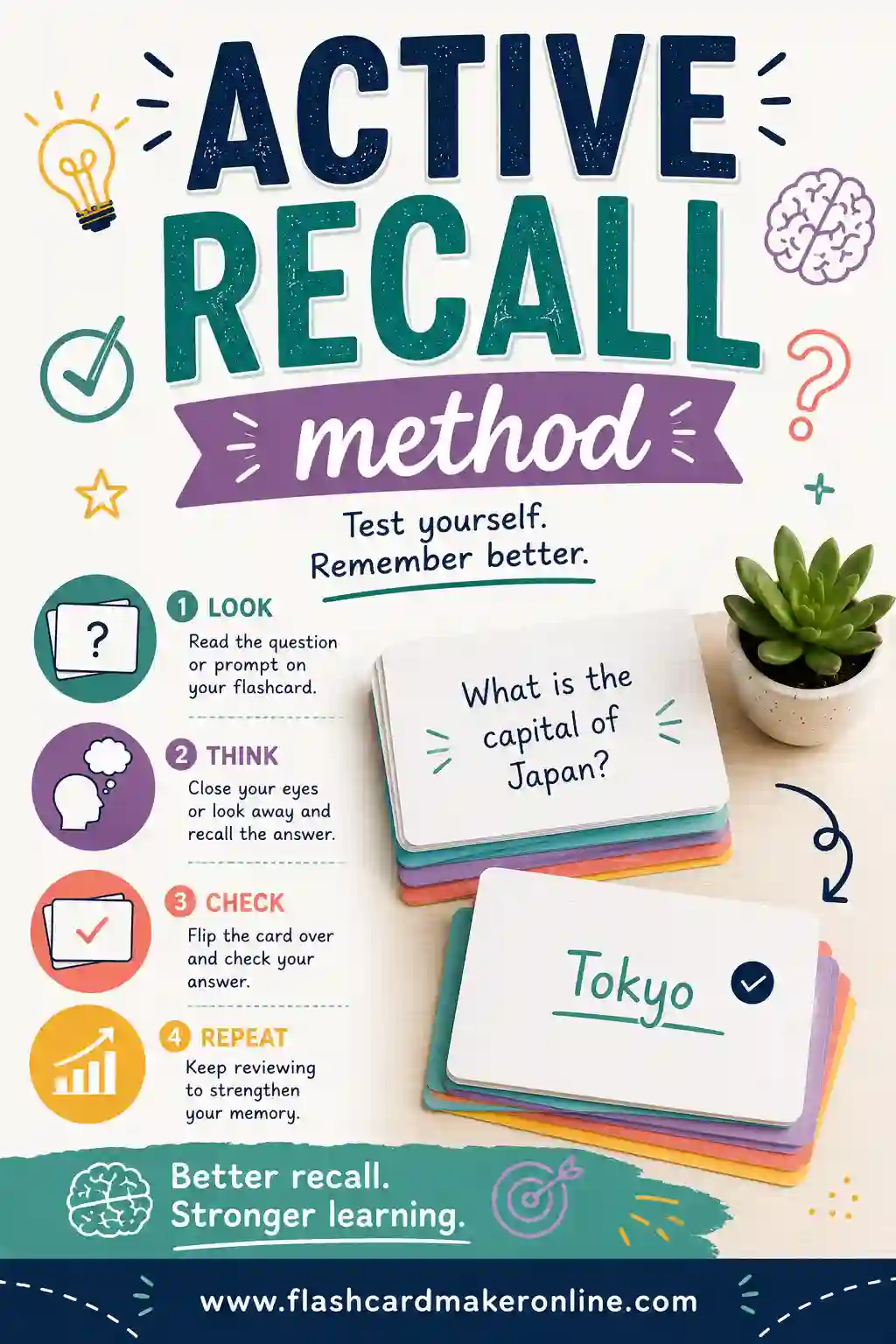
Pulling information out of your memory strengthens it more than looking at it again. That's the core of the active recall method. Flashcards are a natural fit: the front asks, you answer in your head or out loud, and then you flip to check. It doesn't matter if the card shows a word, a picture or a sound clip. What matters is the act of recalling.
Distributed practice, also called spacing
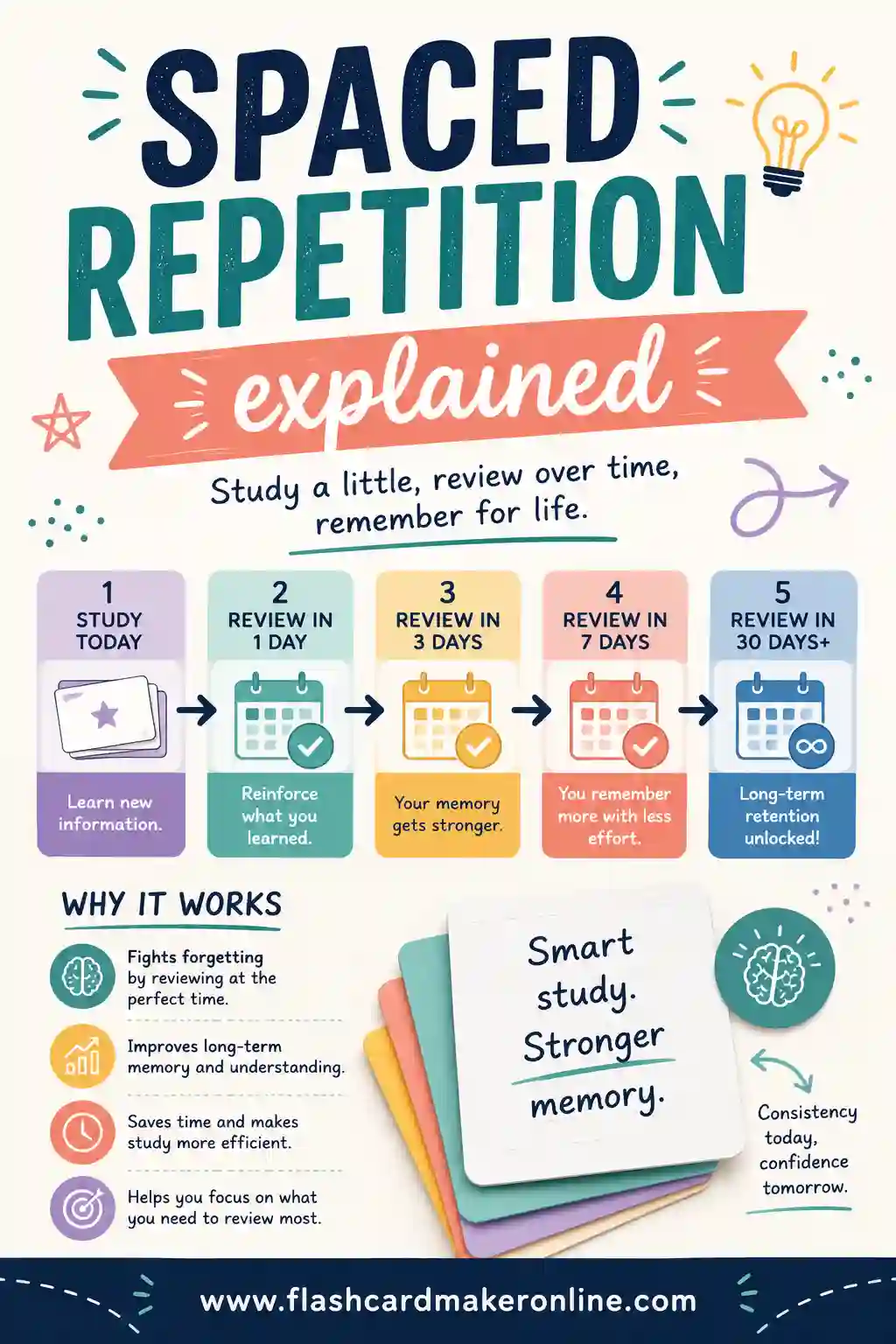
Spreading the same amount of study over several days beats cramming it into one sitting. If you want the details on scheduling, our guide to spaced repetition walks through it. Again, this is style-free. A visual learner and an auditory learner both forget on roughly the same kind of curve, and both benefit from coming back before the memory fades.
Combining words and pictures
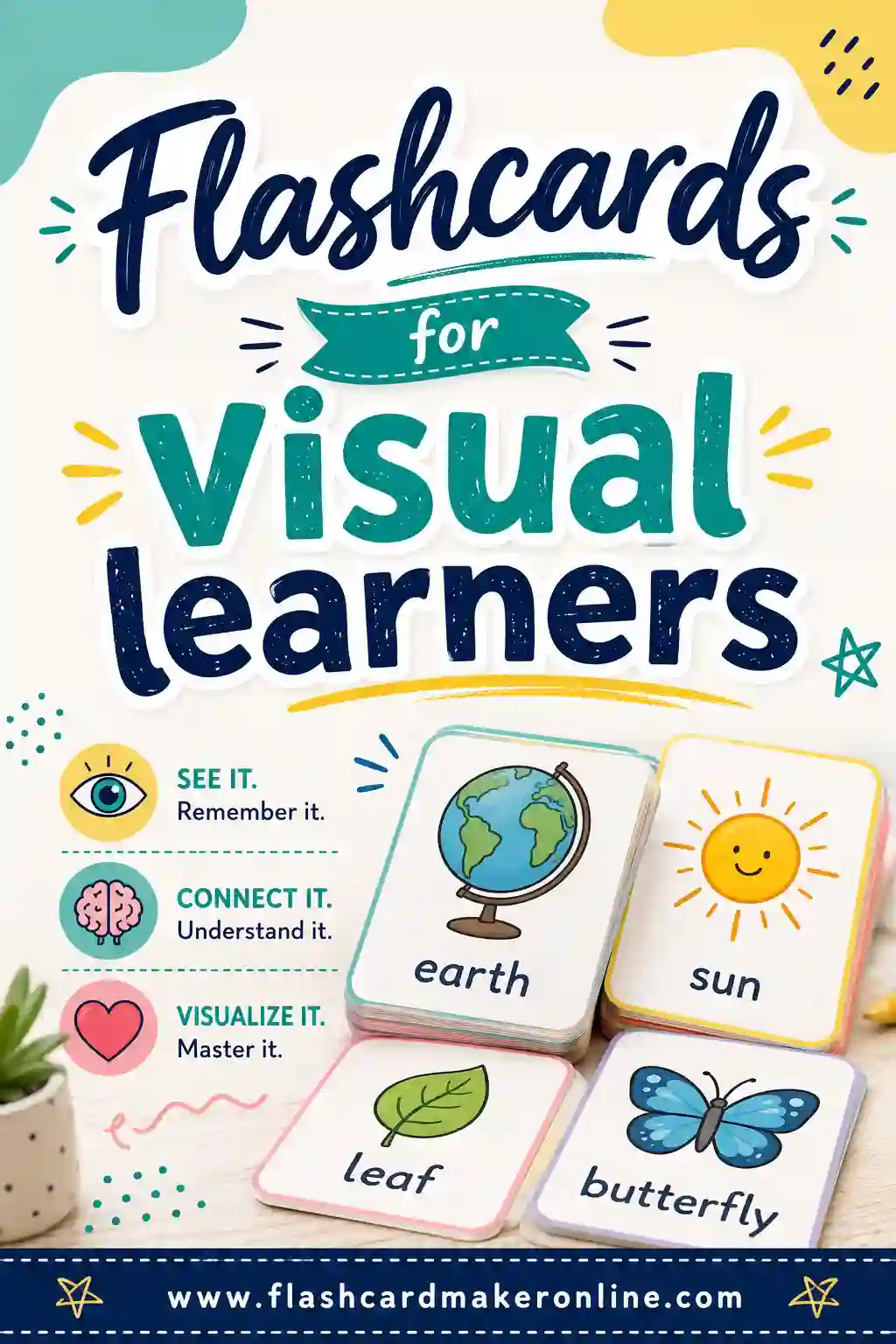
There's one more research idea that sounds like learning styles but isn't. Pairing words with relevant pictures often helps people remember, and it tends to help most learners. That's why a vocabulary card with a clear picture can beat a word on its own. If you've read our page on flashcards for visual learners, think of those tips as "flashcards with visuals," useful for anyone, rather than a rule for one type of person.
Match the method to the material, not the student
If you take one practical rule away from the learning styles research, make it this one: choose the format that fits the content. Here are some examples of how that works in real subjects.
- Geography: Use maps. A card that shows an outline of a country and asks "Which country is this?" beats a written description for everyone.
- Anatomy: Use labeled diagrams, then blank ones. Cover the labels and test yourself.
- Language pronunciation: Use audio. Listen, repeat out loud, and record yourself to compare.
- Math procedures: Work problems by hand. Reading a worked example helps at first, but you have to solve problems yourself to learn.
- History: Use timelines for order and stories for causes. Then quiz yourself on both.
- Sports, music and lab skills: Practice the movement itself. No amount of reading teaches your hands to tie a surgical knot.
See the pattern? Every subject uses whatever channel carries its information best. A self-described auditory learner still needs a map for geography, and a self-described visual learner still needs to hear Spanish to pronounce it.
Using flashcards without worrying about your "style"
Flashcards are a good test case, because they can hold words, pictures or both, and you can use them silently, out loud or with a partner. Here's a style-free way to use them that leans on the high-utility techniques. For a fuller walkthrough of the basics, see how to study with flashcards.
- Write a clear question on the front. One fact or idea per card. "What does the mitral valve separate?" is better than "Heart valves."
- Add a picture when the content is visual. A diagram of the heart for anatomy, a flag for geography, a photo of the object for vocabulary. Skip pictures that are just decoration.
- Answer before you flip. Say it out loud or write it down. Saying it out loud doesn't make you an auditory learner. It just makes you commit to an answer, which is the whole point.
- Sort the cards. Put the ones you got right in one pile and the misses in another. Review the misses again soon and the hits later.
- Come back on later days. Short sessions spread over a week beat one long session.
- Mix the topics. Once you know the basics, shuffle cards from different chapters together so you have to figure out what kind of question each one is.
A worked example
Here's an illustrative example with a made-up student. Maya is studying for a biology quiz on the parts of a cell. She took a learning styles quiz in middle school that said she's a kinesthetic learner, so she's been building a clay model of a cell and hoping the details stick.
Building a model isn't bad. It can be fun, and it forces her to think about where each part goes. But it takes hours and tests her memory very little. Here's how she could rework her study week with the research in mind:
- Day 1: She makes 20 flashcards. Each front has a labeled cell diagram with one part circled. Each back names the part and its job in one line.
- Day 1, later: She goes through the cards once, answering out loud before flipping. She gets 8 right and sorts the 12 misses into a "again" pile.
- Day 2: She reviews only the "again" pile, then the whole deck once. Now she gets 15 of 20.
- Day 4: She shuffles in 10 cards from last week's chapter on cell division, so her review mixes topics.
- Day 6: She does a final pass, covering the diagram labels and drawing the cell from memory. She checks her drawing against the textbook.
Nothing in that plan depends on her being kinesthetic. Drawing the cell on Day 6 involves her hands, but its value comes from recall, not from movement. A classmate who calls himself "visual" could follow the exact same plan and expect the same kind of benefit.
Common mix-ups about learning styles
These are the arguments that come up most often when someone hears that learning styles are a myth. Each one has a reasonable core, so it's worth taking them seriously.
"But I know I learn better from videos."
You may well prefer videos, and you may pay attention longer when you enjoy something. That matters. But preference and learning are different things to measure. In the fair tests described above, people's beliefs about their best format didn't predict where they actually learned most. A useful check is to test yourself a few days later. Your memory after a delay is a better guide than how a session felt.
"Isn't variety good for students?"
Yes. Using several formats keeps lessons interesting and helps teachers reach students who missed something the first time. Varied, rich teaching is great. The myth is the idea that each student should get their format and that other formats won't work for them.
"What about students with dyslexia or hearing loss?"
Disabilities and real differences in ability aren't learning styles. A student who is deaf needs visual access to spoken information, and a student with dyslexia may need structured reading support or audio versions of texts. Those are accommodations based on a specific, identified need. They're important, and nothing in the learning styles research argues against them. If you're supporting a learner with a diagnosed difference, our page on flashcards for special education has practical ideas.
"Multiple intelligences proves learning styles."
The theory of multiple intelligences is a separate idea about different kinds of ability. It isn't the same thing as the VAK model, and it doesn't make the meshing hypothesis true. Even if people differ in many abilities, the question of whether to match lessons to a label still needs the kind of test Pashler and colleagues described.
"The research just hasn't found the right styles yet."
That's technically possible, and the 2008 review said as much. Many models have never been tested properly. But the popular models schools actually use have been tested, and they haven't held up. Meanwhile, techniques like self-testing and spacing already have strong support. It makes sense to spend your limited study hours on what's known to work.
How to judge a new learning styles claim
New versions of the idea pop up all the time, often with fresh names and brain-themed graphics. You don't need a psychology degree to size them up. Ask these five questions, in this order, and most claims sort themselves out quickly.
- What exactly is being promised? "People have preferences" is a harmless statement. "Your child will learn more if lessons match their type" is a testable promise. Make the claim specific before you judge it.
- Were people randomly assigned to teaching methods? If a study only asked students about their style and their grades, it can't tell you whether matching helps. Random assignment is what lets researchers compare like with like.
- Did everyone take the same final test? If the "visual" group was tested with pictures and the "auditory" group was tested out loud, the results can't be compared fairly.
- Is there a crossover? Look for the pattern from the table earlier in this article, where each group wins with its own method. If one method wins for everyone, that's a good lesson, not a learning style.
- Was memory measured after a delay? How much someone recalls minutes after a lesson can differ from what they keep days later. Learning that lasts is what students actually need.
If a claim doesn't pass the first four questions, it hasn't tested the meshing hypothesis at all, no matter how many charts or brain scans it shows. That's exactly the gap Pashler and colleagues found in most of the older literature.
Red flags in learning styles products
- A quiz that gives you a permanent label, especially one sold to schools.
- Promises that "every child is gifted in their own style," with no data on test scores.
- References to brain hemispheres, such as "left-brain" and "right-brain" learners.
- Testimonials instead of experiments.
- Advice that tells you to avoid a whole format, such as "auditory learners shouldn't take notes."
None of this means the people selling these materials are acting in bad faith. The APS release on the 2008 review described the intentions behind the idea as generally good. Good intentions just aren't the same as evidence.
For teachers and parents: what to do with the learning styles myth
If you teach or homeschool, you might be wondering what to change. The answer is less than you'd think, because many good habits overlap with learning styles practices. Here's a quick checklist.
- Keep: Rich lessons that use pictures, demonstrations, stories, discussion and hands-on work. Use each one when it fits the content.
- Keep: Paying attention to what students enjoy. Interest helps attention and effort.
- Drop: Labeling students by style, sorting them into style groups, or telling them they can't learn a certain way.
- Drop: Spending class time on style questionnaires.
- Add: Low-stakes quizzes, short reviews of older material and mixed practice sets. These build long-term memory for everyone.
- Add: Teaching students how to study, especially self-testing, so they don't rely on rereading.
If you're building review materials for a class, flashcards fit nicely into this approach. Our guide to flashcards for teachers has classroom routines that work with mixed groups.
Try it yourself: a two-week experiment
You don't have to take anyone's word for this. You can run a small, honest test on yourself. It won't be a scientific study, but it will tell you more than a style quiz.
- Pick two similar sets of material. For example, two lists of 20 vocabulary words or two short chapters of equal difficulty.
- Study set A in your "preferred" style. If you think you're visual, make colorful notes and diagrams and review them.
- Study set B with self-testing and spacing. Make flashcards, answer before flipping, and review on three different days.
- Spend the same total time on each. Use a timer so neither set gets an unfair advantage.
- Wait a week, then test both. Write down everything you can remember from each set without looking.
- Compare your scores, not your feelings. Ask yourself which set felt easier while studying, and which one you actually remembered better.
Many people find that the self-testing set felt harder at the time and stuck better later. That gap between how studying feels and what it produces is one of the most useful lessons in learning science. It's also why the learning styles myth feels convincing: the comfortable format feels like it's working.
The bottom line on the learning styles myth
People have real preferences, real differences in ability, and real reasons to enjoy some formats more than others. What the research doesn't support is the promise at the heart of learning styles: that discovering your style and matching your study to it will make you learn more. Fair tests with adults, children and college students haven't found that effect, and leading reviews recommend spending time on better-supported methods.
Those methods are easy to start. Quiz yourself, space your reviews, mix topics once you know the basics, and use pictures, sound or hands-on practice when the content calls for them. If you want more background on why self-testing works so well, our article on whether flashcards are effective goes deeper into the research, and memory techniques for studying covers more tools you can add.
When you're ready to put this into practice, the free flashcard maker on our homepage lets you add words and your own pictures, study with flip cards on screen, and print your cards double-sided or as cut-out sheets. Make a small deck tonight, quiz yourself tomorrow, and let your results, not a label, tell you what works.
Learning Styles Research Compared, Study by Study
After the 2008 review, research teams ran the kind of experiment it described. This table lines up the review and three of them and what each one found.
| Study | Who took part | What they did | What they found |
|---|---|---|---|
| Pashler, McDaniel, Rohrer and Bjork (2008) | A long review of existing studies | Checked which studies used the sort, assign and test design | Very few used it, and several contradicted the meshing hypothesis |
| Rogowsky, Calhoun and Tallal (adults) | Adults with measured preferences for visual or auditory learning | Learned from an audiobook or the same text on screen | No link between learning style, teaching method and performance |
| Rogowsky and colleagues (2020) | 125 fifth graders at a rural Pennsylvania school | Took a learning-style inventory, then reading and listening comprehension tests | No crossover pattern, and about 68% had no clear style preference |
| Husmann and O'Loughlin | 426 undergraduate anatomy students over two fall semesters | Took the VARK questionnaire and reported how they studied | Matching study methods to VARK type didn't improve outcomes; the specific strategy mattered |
Frequently Asked Questions
Are learning styles real or a myth?
Part of the idea is real and part is a myth. People really do prefer some formats, like videos or reading, and they differ in specific abilities. The myth is the claim that you'll learn more when lessons match your preferred style. Fair tests that sort people by style and randomly assign them to matching or mismatched lessons haven't found that effect. Major reviews conclude there isn't enough evidence to use learning-style assessments in everyday teaching, so your study time is better spent on methods with strong support.
What is the meshing hypothesis?
The meshing hypothesis is the specific claim at the center of learning styles. It says people learn more when teaching meshes with, or matches, their preferred style, so a visual learner should learn more from visual lessons and an auditory learner more from listening. To support it, a study has to show a crossover pattern where each group does best with its own method. Researchers who reviewed the evidence found very few studies with that design, and several of those contradicted the hypothesis.
Who debunked learning styles?
No single person did, but a 2008 review by Harold Pashler, Mark McDaniel, Doug Rohrer and Robert Bjork in Psychological Science in the Public Interest is the most cited turning point. It explained what a fair test would require and found little evidence that met the standard. Later experiments, including studies with adults and fifth graders by Beth Rogowsky and colleagues and a study of 426 anatomy students by Husmann and O'Loughlin, also found that matching instruction to style didn't improve learning.
Is VARK a valid test?
VARK can describe what kinds of materials you say you like, and that can be interesting to think about. The problem is using the result to decide how you should study. In a study of 426 undergraduate anatomy students, VARK scores weren't related to course performance, most students didn't study in ways that matched their own results, and students whose methods matched their VARK type didn't get better outcomes. Specific strategies mattered more than the label, so treat the questionnaire as a curiosity rather than a study plan.
Why do so many teachers believe in learning styles?
The idea feels true, it sounds kind, and it's easy to confirm by accident. When a lesson goes well for a student who prefers that format, it looks like proof, even though the same student might have done just as well another way. A survey of 242 teachers in the UK and the Netherlands found that 93% and 96% agreed with the learning styles statement. Many teacher training programs and college papers have presented the idea as fact, which helps it spread.
What should I do instead of studying to my learning style?
Use the techniques that research rates most highly for all kinds of learners. Quiz yourself instead of rereading, which is called practice testing or retrieval practice. Spread your study over several days instead of cramming. Once you know the basics, mix different topics or problem types together. Ask yourself why facts are true and explain steps in your own words. Use pictures, sound or hands-on practice when the material itself calls for it, such as maps for geography or audio for pronunciation.
Do pictures help visual learners more than other people?
Pairing words with relevant pictures often helps people remember, but that benefit isn't limited to self-described visual learners. A clear diagram of the heart beats a spoken description for nearly everyone, because the content itself is visual. That's different from the learning styles claim, which says each type of learner needs their own format. In fair tests, students labeled visual didn't get a special boost from visual lessons. Use pictures when they carry real information, not because of a label.
Can believing in learning styles hurt my grades?
It can if it changes how you study. A student who thinks they're visual may spend hours making colorful notes and very little time testing themselves. A student who thinks lectures don't suit them may tune out in class. Those choices push you away from methods like self-testing and spacing that research supports. The belief also limits your options, because you might skip a format that's actually best for the material, such as listening to native speakers when learning a language.
Are learning disabilities the same as learning styles?
No. A learning disability such as dyslexia, or a sensory difference such as hearing loss, is a specific, identified need. Students with these needs may require accommodations like audio texts, captions or structured reading instruction, and those supports are important. Learning styles are a different idea: a claim that ordinary differences in preference should decide how everyone is taught. The research against learning styles doesn't argue against accommodations, so talk with the school team about any identified need.
Sources
We checked every source below while writing this guide. Last reviewed October 30, 2026, by Joan Ramos.
- Learning Styles: Concepts and Evidence (Pashler, McDaniel, Rohrer & Bjork, 2008) (Psychological Science in the Public Interest, via PubMed)
- Learning Styles Debunked: There is No Evidence Supporting Auditory and Visual Learning, Psychologists Say (Association for Psychological Science)
- Providing Instruction Based on Students' Learning Style Preferences Does Not Improve Learning (Rogowsky, Calhoun & Tallal, 2020) (Frontiers in Psychology)
- Another Nail in the Coffin for Learning Styles? (Husmann & O'Loughlin, 2019) (Anatomical Sciences Education, via PubMed)
- Neuromyths in Education: Prevalence and Predictors of Misconceptions among Teachers (Dekker et al., 2012) (Frontiers in Psychology)
- The Learning Styles Myth is Thriving in Higher Education (Newton, 2015) (Frontiers in Psychology)
- Improving Students' Learning With Effective Learning Techniques (Dunlosky et al., 2013) (Psychological Science in the Public Interest, via PubMed)