Interleaved Practice: Why Mixing Topics Beats Studying in Blocks
Interleaved practice means mixing different types of problems or topics within one study session, instead of finishing all of one kind before moving to the next. If you're studying three kinds of math problems, A, B and C, blocked practice looks like AAA BBB CCC. Interleaved practice looks more like ABC BCA CAB. It feels slower and messier while you're doing it, and that's exactly the point. In study after study, students who mix their practice score better on later tests, especially when the topics are easy to confuse with each other.
This guide explains what interleaving is, why it works, what the research really shows (including where it doesn't help), and how to use it with a deck of flashcards, a stack of math problems or a list of vocabulary words. You'll find worked examples, a sample weekly plan, the common mistakes people make, and honest answers to the questions students ask most.
What Interleaved Practice Is, in Plain Terms
Think about the way most textbooks are built. Chapter 5 teaches a new skill, and the practice set at the end of Chapter 5 has twenty problems that all use that one skill. Chapter 6 teaches the next skill, and its practice set uses only that skill. That's blocked practice: each block of practice matches one lesson.
Interleaved practice reshuffles the same work. After you've learned several skills, each practice set includes a mix of them. One problem might need the Chapter 5 method, the next needs the Chapter 3 method, and the one after that needs Chapter 6. You can't just repeat the last thing you did. You have to look at each problem and decide what kind it is before you solve it.
Here are a few terms you'll see in this article:
- Blocked practice: practicing one type of item over and over before switching (AAA BBB CCC).
- Interleaved practice: mixing types so that items of the same kind don't sit next to each other (ABC BCA CAB).
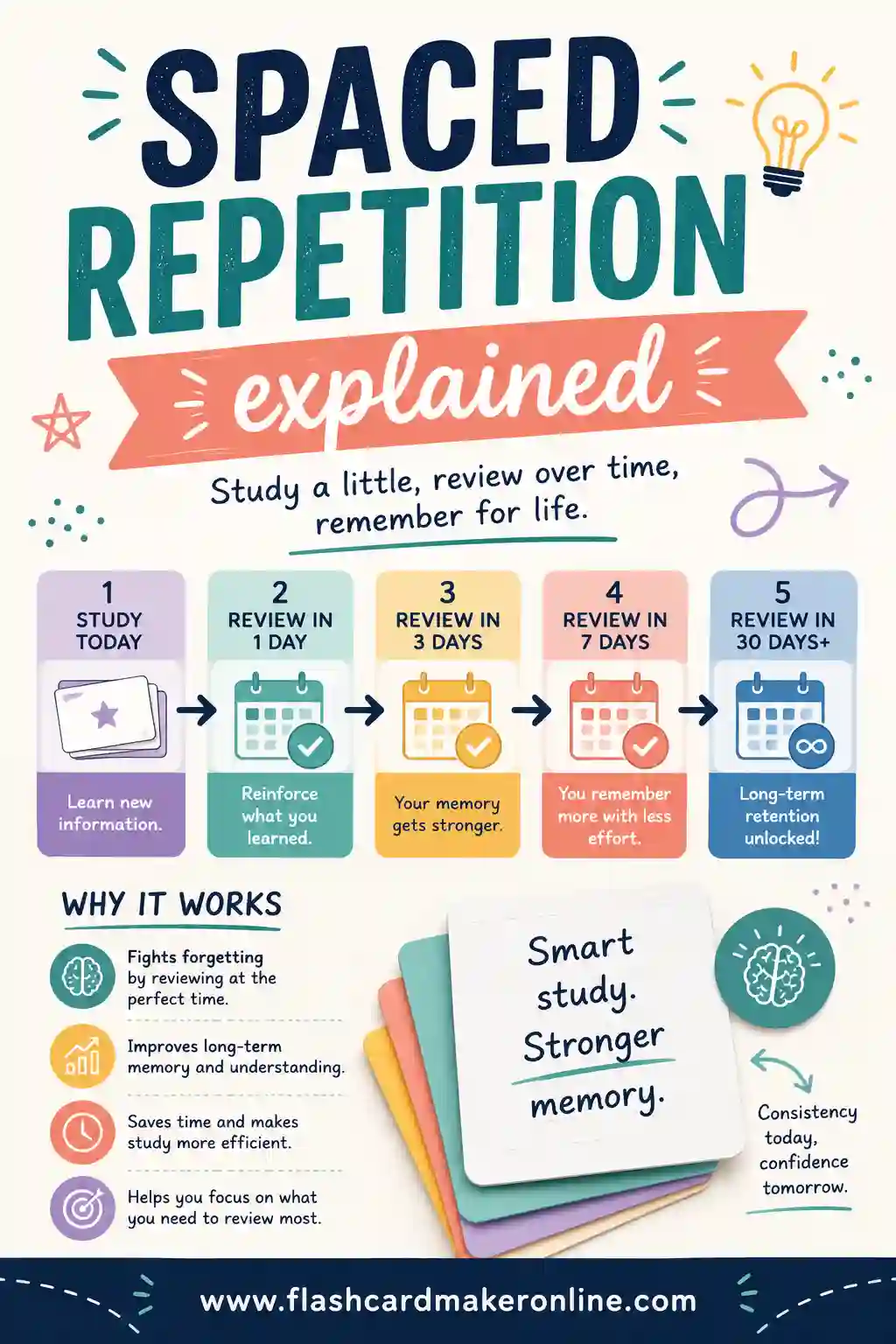
- Spacing: spreading study of the same item over time, with gaps in between. Interleaving creates some spacing automatically, which is why researchers had to work hard to separate the two.
- Inductive learning: learning a category or rule by seeing examples, such as learning to recognize an artist's style by looking at many of their paintings.
- Discrimination: telling similar things apart. This turns out to be the heart of why interleaving works.
Interleaving isn't about cramming more into a session. You do the same problems, the same number of times. Only the order changes.
Blocked vs. Interleaved Practice Side by Side
The easiest way to see the difference is to lay the two approaches next to each other. Picture a student practicing four kinds of geometry problems over one session.
| Feature | Blocked practice | Interleaved practice |
|---|---|---|
| Order of problems | All of type A, then all of B, then C, then D | A, C, B, D, B, A, D, C (mixed) |
| How it feels | Smooth and fast; you get into a rhythm | Choppy and slower; you pause before each item |
| Accuracy during practice | Usually higher | Usually lower at first |
| What you practice | Carrying out a method you already know you need | Choosing the right method, then carrying it out |
| Performance on a later, mixed test | Usually lower | Usually higher, especially for similar-looking problems |
| Best moment to use it | Right after first learning a brand-new skill | Once you know the basics of two or more related skills |
The trade-off in that table is the whole story in miniature. Blocked practice makes you look good today. Interleaved practice makes you better later.
Why Interleaving Works: Learning to Tell Things Apart
When every problem on a worksheet is the same type, you never have to ask, "What kind of problem is this?" The worksheet has already answered that question for you. You read the chapter title, you know the method, and you plug in numbers. That's fine for building basic fluency, but it skips one of the hardest parts of a real test: figuring out which method a problem needs in the first place.
Real tests, real jobs and real life don't come labeled. A final exam mixes everything together. A nurse sees a patient, not a chapter heading. A driver sees a road sign without a hint about which section of the manual it came from. Interleaving forces you to practice the "which one is this?" step every single time.
Researchers describe a few reasons why this helps:
- It trains discrimination. When similar items sit side by side, your brain notices how they differ. In a study by Kelli Taylor and Doug Rohrer at the University of South Florida, an error analysis of children practicing four types of math problems suggested that interleaving helped students match each problem with the right procedure. The mistakes the blocked group made were more often about choosing the wrong method, not about doing the arithmetic.
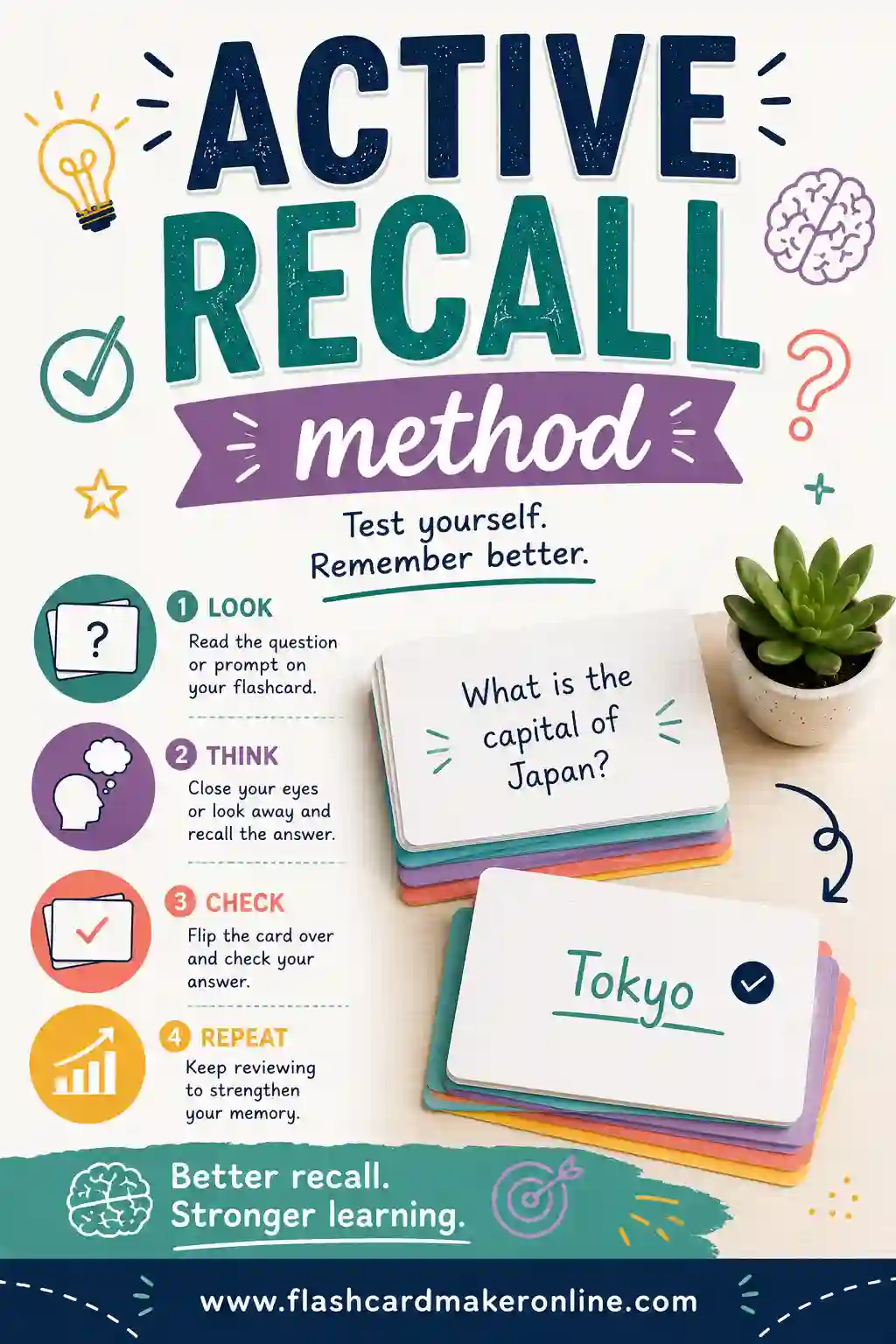
- It builds in retrieval. Each time you switch topics, you have to pull the right method out of memory instead of keeping it "warm" from the last problem. Pulling something from memory is a strong way to learn it (that's the idea behind the active recall method).
- It spaces things out. In an interleaved set, two problems of the same type are separated by other work, so you get a small dose of spacing for free. The spacing effect is one of the best-supported findings in learning science, and it helps explain part of the benefit.
- It stops you from coasting. In a blocked set, the fifth problem is often solved by copying the steps from the fourth. That feels productive but involves little thinking. Mixing takes that shortcut away.
Here's a quick example. A student learning to find the volume of different solids might see a formula for a wedge, a spheroid, a spherical cone and a half cone. In a blocked set, they use the wedge formula ten times in a row. In a mixed set, they must first recognize the shape, recall which formula belongs to it, and only then do the math. That extra recognition step is what the later test demands, so it's the step worth practicing.
What the Research on Interleaved Practice Shows
Interleaving has been studied in classrooms, labs and sports gyms. The headline is positive, but the details matter, so let's go through the key studies one at a time. Numbers below come straight from the published papers or official summaries linked in each paragraph.
Math problems: Rohrer and Taylor (2007)
Doug Rohrer and Kelli Taylor compared the two most common ways math textbooks arrange homework. Most books fill each practice set with problems from the lesson just taught. A few "shuffle" practice so each set mixes problems from earlier lessons. In their paper "The Shuffling of Mathematics Practice Problems Boosts Learning" in Instructional Science, college students learned several types of problems and practiced them either grouped by type or randomly mixed. On a test one week later, the students who had mixed their practice did far better. A separate experiment in the same paper found that spreading practice across sessions beat doing it all at once, so both features of the shuffled format helped.
Separating mixing from spacing: Taylor and Rohrer (2010)
A fair criticism of early interleaving studies was that mixing also spaces things out. Maybe spacing, not mixing, was doing the work. Taylor and Rohrer tackled this in "The Effect of Interleaving Practice" in Applied Cognitive Psychology. Children practiced four kinds of math problems in either a blocked or an interleaved order, with the amount of spacing held equal between the groups. Interleaving lowered scores during practice, but it doubled scores on a test given one day later. That's one of the clearest demonstrations of the core trade-off: worse while practicing, better when it counts.
A real classroom trial: Rohrer and colleagues (2020)
Lab studies are useful, but teachers want to know whether something works in an ordinary school with ordinary homework. Rohrer, Dedrick, Hartwig and Cheung ran a randomized trial in seventh-grade math classes, published in the Journal of Educational Psychology. The U.S. Department of Education's What Works Clearinghouse reviewed the study and reported that it involved 787 seventh graders in Florida middle schools. Both groups got the same problems on four topics (expressions, inequalities, graphs and circles) across eight worksheets. The only difference was order: one group's problems were interleaved, the other's were grouped by type. Teachers got no special training.
On the delayed test, the interleaved group's mean score was about 62 compared with about 38 for the blocked group (62.17 vs. 37.60 on the clearinghouse's summary). The clearinghouse rated the study as meeting its design standards without reservations. That's an unusually strong result for a change that costs nothing but reshuffling homework. It's still one study in one subject and one grade, so treat it as strong evidence for middle-school math, not proof that every subject will see the same gap.
Paintings and categories: Kornell and Bjork (2008)
Interleaving isn't only for math. Nate Kornell and Robert Bjork at UCLA asked people to learn the styles of several painters by viewing examples of each artist's work. Some participants saw each artist's paintings back to back. Others saw paintings from different artists mixed together. Their paper in Psychological Science, "Learning Concepts and Categories: Is Spacing the 'Enemy of Induction'?", found that the mixed group was better at identifying which artist painted new paintings they hadn't seen before.
The most surprising part was what learners believed. Participants rated the blocked approach as more effective, even after their own test results showed the opposite. That gap between what feels effective and what is effective shows up again and again in learning research, and it's the main reason students don't interleave on their own.
The big picture: a meta-analysis (2019)
A meta-analysis pools the results of many studies to find the average effect and what makes it bigger or smaller. Monika Brunmair and Tobias Richter at the University of Würzburg did exactly this in "Similarity Matters: A Meta-Analysis of Interleaved Learning and Its Moderators" in Psychological Bulletin. They gathered 59 studies with 238 effect sizes.
To read their numbers, you need one quick definition. An effect size (here, Hedges' g) tells you how big a difference is in standard-deviation units. Roughly, 0.2 is usually called small, 0.5 medium and 0.8 large. Here's what they found:
| Type of material | Average effect of interleaving (Hedges' g) | What it means in plain terms |
|---|---|---|
| All materials combined | 0.42 | A moderate benefit for interleaving overall |
| Paintings (art styles) | 0.67 | The strongest benefit in the analysis |
| Math tasks | 0.34 | A small but real benefit |
| Expository texts (informational reading passages) | No significant effect | Results were mixed and unclear |
| Words (such as vocabulary lists) | -0.39 | Blocked study actually came out ahead |
The authors also found that interleaving helped most when the categories were similar to each other but the examples inside each category varied, and when the material was more complex. That pattern makes sense if interleaving works by highlighting differences. If two categories are already obviously different, there's little to gain from putting them side by side.
That word result deserves attention because it matters for flashcard users. Mixing doesn't automatically help with every kind of list. We'll come back to what that means for vocabulary decks in a later section.
Sports and motor skills: the contextual interference effect
Coaches have their own name for this idea: contextual interference. Practicing several skills in a random order (high interference) instead of one at a time (low interference) tends to make practice look worse but retention and transfer look better. This line of research in motor learning goes back to a 1979 study by Shea and Morgan.
A 2024 systematic review and meta-analysis in Frontiers in Psychology by Czyż, Wójcik and Solarská looked specifically at how random practice affects transfer to new motor tasks. Across 34 studies, random practice came out ahead with a medium pooled effect (0.55), which shrank to a small effect (0.40) after unusual results were removed. The effect was medium and significant in lab studies but small and not statistically significant in applied settings, and it was negligible for young participants. The authors also flagged high variation between studies and few high-quality trials. So for sports, the honest summary is "promising, but the real-world effect is smaller and less certain than the lab effect."
How experts rate it
In a widely cited 2013 review in Psychological Science in the Public Interest, John Dunlosky and colleagues rated ten common study techniques. Practice testing and spaced practice earned "high utility." Interleaved practice earned "moderate utility," along with elaborative interrogation and self-explanation. The authors noted that the benefits of interleaving had only begun to be explored systematically. Since then, the classroom trial and meta-analysis above have added a lot, but the moderate rating is still a fair, cautious summary: very useful for some kinds of learning, less clear for others.
When Interleaving Helps Most, and When It Doesn't
Putting the research together, you can predict pretty well when mixing will pay off.
Interleave when:
- Problems look alike but need different methods. Think of different types of algebra word problems, similar-looking chemistry reactions, or verb tenses that are easy to confuse.
- You'll face a mixed test. Final exams, standardized tests and licensing exams all mix topics without labels.
- You're learning categories from examples. Art styles, bird species, types of rock, heart rhythms on an ECG strip, or kinds of logical fallacies.
- You already know the basics of each topic. Mixing is about choosing and comparing. You need something to choose between.
Be careful or block first when:
- A skill is completely new. A short block of practice right after a lesson can help you get the basic steps down before you start mixing.
- Items are simple, unrelated facts. The meta-analysis found blocked study came out ahead for word lists. If two cards have nothing in common, mixing them doesn't create a useful comparison.
- The material is a long reading passage. Results for expository texts were unclear, so don't expect a guaranteed gain from chopping chapters together.
- The categories are wildly different. Mixing "Spanish vocabulary" with "photosynthesis" mostly just interrupts you. Interleave within a subject, among related topics.
A good rule of thumb: if a test question could plausibly belong to more than one topic, interleave those topics during practice.
How to Use Interleaved Practice With Flashcards
Flashcards are a natural fit for interleaving because each card is a separate unit you can shuffle. The trick is to shuffle with a purpose instead of just randomly.
Step 1: Learn each topic on its own first
When you first make a set of cards for a new topic, it's okay to review them as a single block for a session or two. Your goal at this stage is basic understanding. If you've never seen a concept, mixing it with others will just confuse you.
Step 2: Group your decks by "confusable families"
Sort your cards into families of topics that are easy to mix up. For a biology course, mitosis and meiosis belong together. For Spanish, ser and estar belong together. For geometry, area and perimeter formulas belong together. These families are where interleaving pays off most. Our guide on how to organize flashcards covers practical ways to label and store groups like these.
Step 3: Shuffle within each family
Combine the cards from one family and shuffle them. Now each card makes you decide "which concept is this?" before you answer. If you use a Leitner box, you can put a whole family into the same box so that cards from related topics come up together.
Step 4: Write cards that force a choice
Some cards are better at training discrimination than others. Instead of a front that says "Mitosis: how many daughter cells?", try a front that describes a situation without naming the process: "A division produces four genetically different cells with half the chromosome number. Which process is this?" Now the card trains the exact skill a mixed test will need.
Step 5: Add comparison cards
Write a few cards that ask about differences directly: "What's one key difference between a simile and a metaphor?" or "When do you use the quadratic formula instead of factoring?" These cards make the contrast explicit, which helps the shuffled cards do their job.
Step 6: Keep reviewing over days, not just within a session
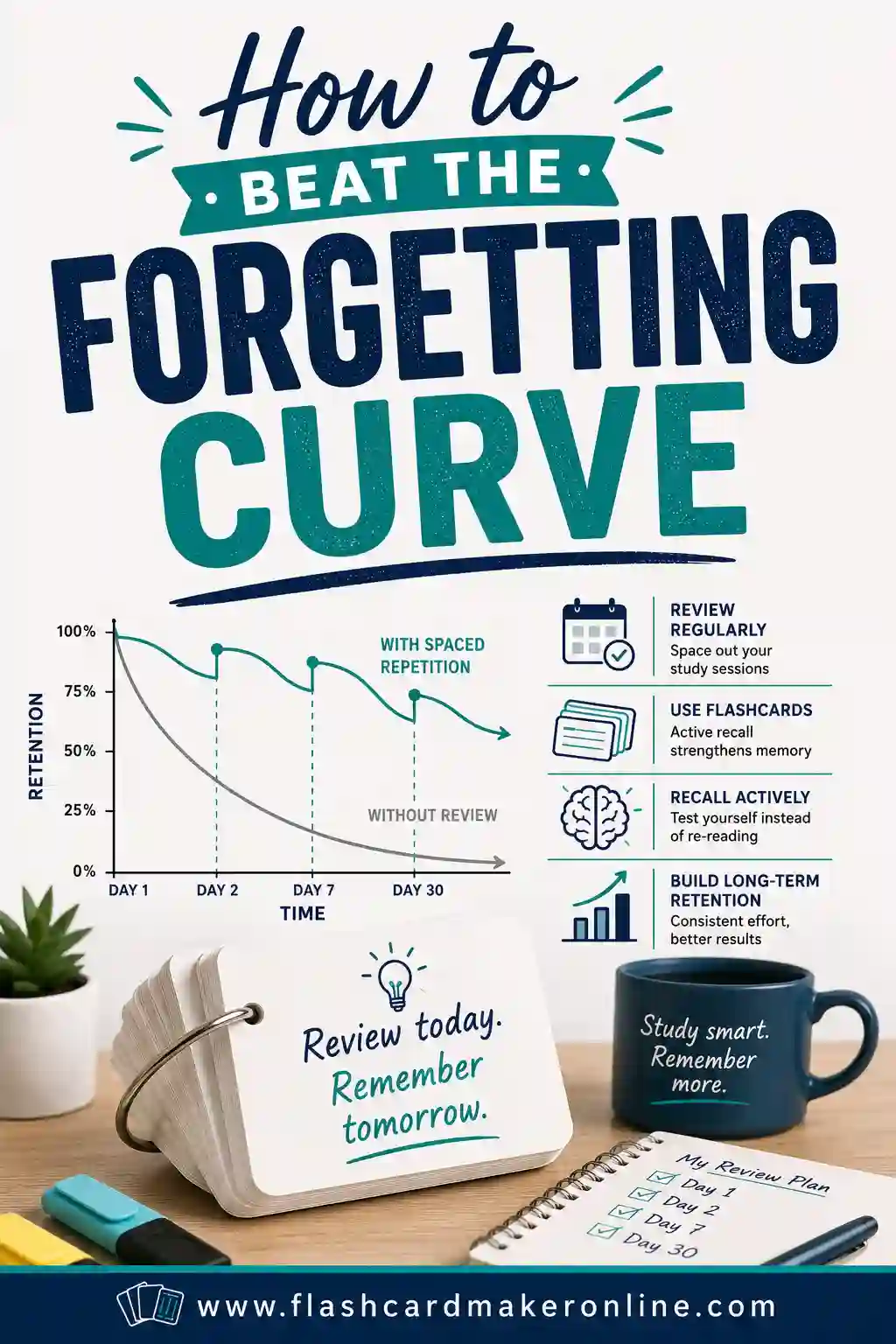
Interleaving works alongside spacing, not instead of it. Shuffled practice inside one session is good. Shuffled practice spread across several days is better. If you want to plan the days, our article on how to beat the forgetting curve shows how review timing affects memory.
Worked Examples by Subject
The examples below are illustrative. The students are made up, but the card designs are the kind you can copy straight into your own deck.
Example 1: Middle-school math
Maya (an illustrative seventh grader) has learned four skills this month: solving one-step equations, solving inequalities, finding slope from a graph, and finding the area of a circle. Her textbook gives her twenty problems on each, grouped by chapter.
Instead of doing them in chapter order, she writes each problem on its own card, shuffles all eighty, and works through twenty per evening. On the first night, she's slower and gets more wrong than she would have with the chapter sets. By the fourth night, she's quicker at spotting which skill a problem needs, and the mistakes she does make are about arithmetic rather than choosing the wrong method. That's the shift the classroom research describes.
Example 2: High school chemistry
Jordan (illustrative) keeps confusing four reaction types: synthesis, decomposition, single replacement and double replacement. He makes cards with a balanced equation on the front and the reaction type on the back. In a blocked deck, all the synthesis cards come first, so he can answer "synthesis" without even reading. In a shuffled deck, he has to look at each equation and notice the pattern. He adds four comparison cards, such as "How can you tell single replacement from double replacement at a glance?"
Example 3: Learning a language
Priya (illustrative) is learning Spanish and struggles with por versus para. Instead of reviewing a block of por sentences and then a block of para sentences, she mixes them: each card shows a sentence with a blank, and she has to pick the right word. She keeps her simple vocabulary cards (like "dog" and "window") in a separate, unshuffled-by-topic deck, since the research suggests mixing unrelated words doesn't add much. For more on language decks, see flashcards for language learners.
Example 4: Art history
Sam (illustrative) needs to recognize works by Monet, Renoir, Pissarro and Sisley for an exam. Following the design of the painting studies, Sam puts images of each artist's work on separate cards (with the artist's name on the back), mixes all four artists together, and practices naming the artist for each image. This is the kind of material where the meta-analysis found the strongest benefit.
Example 5: Nursing or medical school
Alex (illustrative) is learning heart rhythm strips that look similar at first glance. Each card shows a description of a strip's features on the front and the rhythm name on the back. Alex mixes the confusable rhythms together and adds cards asking "What feature separates rhythm X from rhythm Y?" The point isn't to memorize one rhythm at a time but to learn to tell them apart under test conditions.
A Sample Interleaved Study Plan for One Week
Here's a simple plan for a student with three related math topics (call them A, B and C) and one week before a unit test. Adjust the topics to your own subject.
| Day | What to do | Why |
|---|---|---|
| Monday | Short blocked practice on topic C (the newest), then a mixed set of A and B | Get the basics of the new skill before mixing it in |
| Tuesday | Mixed set of A, B and C (about equal numbers of each) | Start practicing the "which method?" decision |
| Wednesday | Mixed set plus a few comparison cards ("When do I use A instead of B?") | Make the differences explicit |
| Thursday | Rest from this subject, or a light review of missed cards only | Let spacing work; avoid burnout |
| Friday | Mixed set, timed, with no notes | Practice under test-like conditions |
| Saturday | Review only the cards you missed on Friday, still mixed | Target weak spots without blocking them |
| Sunday | One final mixed set, then stop | Confirm you can switch topics smoothly |
Notice that the plan never asks you to do more problems than a blocked plan would. It just changes the order and spreads things out. If you want help deciding how many cards to review each day, see how many flashcards per day.
Common Mistakes With Interleaving
Mistake 1: Quitting because it feels worse
This is the big one. Interleaved practice almost always feels harder and produces more mistakes in the moment. Students in the painting study rated blocking as better even after it lost. If you judge your study method by how smooth it feels, you'll keep choosing the less effective one. Judge it by how you do on a mixed quiz a few days later.
Mistake 2: Mixing unrelated subjects
Shuffling your history cards in with your chemistry cards isn't really interleaving in the useful sense. The benefit comes from comparing things that could be confused. Mix within a subject, and especially within families of similar ideas.
Mistake 3: Mixing before you understand anything
If you've never solved a single problem of a given type, mixing it in will just leave you stuck. A little blocked practice first is reasonable. Then switch to mixing as soon as you can solve a problem of each type on your own.
Mistake 4: Cards that give away the category
If every card's front says "Photosynthesis question:" or is color-coded by topic, you've removed the decision step. Strip labels off the fronts so you have to figure out the category from the content.
Mistake 5: Treating it as a replacement for spacing and testing
Interleaving is one tool in the kit. Testing yourself and spacing your reviews have even stronger research support. The best approach combines all three: shuffled flashcards (testing), reviewed over several days (spacing), with related topics mixed (interleaving).
Mistake 6: Expecting it to fix vocabulary memorization
For simple word lists, the evidence doesn't favor mixing. If you're learning the names of thirty unrelated objects in a new language, the order probably matters less than how often you test yourself and how well you space reviews. Save interleaving for the parts of language learning where words or rules compete, like similar verbs, genders or tenses.
Interleaving for Teachers and Parents
If you teach or help a child with homework, interleaving is one of the easiest research-backed changes you can make. You don't need new materials. You just need to rearrange what you already have.
- Add review problems to every assignment. Instead of twenty problems from today's lesson, try a smaller set from today plus a handful from earlier lessons, mixed together.
- Warn students it will feel harder. Kids who expect the struggle are less likely to decide they're "bad at math" when they make more mistakes during practice.
- Grade the delayed test, not the practice. If practice scores drop when you switch to mixed assignments, that's expected. Look at quiz scores a week or more later.
- Use mixed flashcard games. Many classroom games work with a shuffled deck. Quick review games like "sort the card into the right pile" or "first to name the method" work well with a mixed set.
- Keep comparisons in view. A short class discussion like "How did you know this was an inequality problem and not an equation?" reinforces the discrimination skill.
The classroom trial described above used ordinary teachers with no special training. That's encouraging. It suggests the benefit comes from the order of practice itself, not from a special teaching style.
Try It Yourself: A 20-Minute Interleaving Test
You don't have to take the research's word for it. Here's a small experiment you can run on yourself this week.
- Pick two or three related topics you're currently studying, with at least eight practice items for each.
- Split the items into two equal halves for each topic.
- Practice half A in blocked order (all of topic 1, then all of topic 2, then topic 3). Note how many you get right and how it feels.
- On a different day, practice half B in a shuffled order. Note how many you get right and how it feels.
- About a week later, take a short mixed quiz with new items from all topics, without notes.
- Compare. Did the topic you practiced mixed go better on the quiz? Which method felt better while you were doing it?
This isn't a controlled study, and one try won't prove anything. But many students find the result eye-opening: the method that felt worse often does better a week later.
How Interleaving Fits With Other Study Methods
Interleaving doesn't stand alone. It works best as part of a wider routine built on the strongest study techniques.
- Retrieval practice: Answer from memory before you check. Flashcards do this by design. Interleaving makes each retrieval a little harder and more useful.
- Spaced repetition: Spread reviews over days and weeks. A shuffled deck reviewed across a week combines both techniques.
- Elaboration: Ask "why does this method fit this problem?" Comparison cards are a quick way to add this.
- Concrete examples: Vary your examples within each category. The meta-analysis found that interleaving helps more when examples within a category differ, so don't make every card about the same example.
For a fuller picture of how these pieces fit together, see our guide to the science behind flashcards. The related ideas of desirable difficulties and the illusion of competence are good next reads once they're available on the site.
Make Your Own Interleaved Flashcards
Interleaved practice comes down to one simple change: mix related topics so every item makes you decide what kind of problem it is before you solve it. It feels harder while you're doing it, and that difficulty is part of what makes the learning last. The research is strongest for math problems and visual categories, more mixed for long readings, and doesn't favor mixing simple word lists. So use it where things are easy to confuse, and pair it with self-testing and spaced review.
Ready to try it? Our free flashcard maker lets you add words and your own pictures, study with flip cards on screen, and print your cards double-sided or as cut-out sheets. Make one card per problem or concept, shuffle related topics together, and start practicing the way the research suggests.
Four Interleaving Studies Compared
This table lines up the main studies described above, so you can see who practiced what and how mixing compared with grouping.
| Study | Who and what they learned | What mixing did |
|---|---|---|
| Rohrer and Taylor (2007) | College students learning several types of math problems | Students who mixed their practice did far better on a test one week later |
| Taylor and Rohrer (2010) | Children practicing four kinds of math problems, with spacing held equal | Lower scores during practice, but doubled scores on a test one day later |
| Rohrer and colleagues (2020) | 787 seventh graders in Florida, four topics across eight worksheets | Mean delayed score of about 62 for mixed practice vs. about 38 for grouped practice |
| Kornell and Bjork (2008) | People learning painters' styles from examples | Mixed group was better at naming the artist of new paintings, yet rated grouped study as more effective |
Frequently Asked Questions
What is interleaved practice in simple words?
Interleaved practice means mixing different but related topics or problem types in one study session instead of finishing one type before starting the next. If blocked practice looks like AAA BBB CCC, interleaved practice looks like ABC BCA CAB. You do the same amount of work, but the order forces you to figure out what kind of problem each item is before you solve it. That decision step is what most tests require, so practicing it tends to improve scores on later, mixed tests.
Is interleaving better than blocked practice?
For many kinds of learning, yes, but not all. A 2019 meta-analysis of 59 studies found a moderate overall benefit for interleaving, with the strongest effect for learning painting styles and a smaller benefit for math. However, blocked study came out ahead for word lists, and results for long reading passages were unclear. Interleaving helps most when topics are similar enough to be confused. For brand-new skills, a short block of practice first is often sensible before you start mixing.
Why does interleaved practice feel harder?
It feels harder because you can't rely on momentum. In a blocked set, you already know which method to use, so you just repeat the steps. In a mixed set, you have to stop, identify the problem type and recall the right method every time. That slows you down and causes more mistakes during practice. Researchers have found that this extra effort is part of why the learning lasts longer. Studies have also shown that learners often rate blocked study as more effective, even when their test scores say the opposite.
What is the difference between interleaving and spaced repetition?
Spaced repetition is about timing: you review the same material several times with gaps between sessions. Interleaving is about order: you mix different topics together within a session. They overlap, because mixing naturally puts gaps between items of the same type. Researchers have tested them separately, and a 2010 study by Taylor and Rohrer held spacing equal and still found that interleaving doubled scores on a test the next day. The best routine uses both, with mixed decks reviewed across several days.
Does interleaving work for learning vocabulary?
For simple, unrelated vocabulary words, the evidence doesn't favor it. The 2019 meta-analysis by Brunmair and Richter found that blocked study actually did better than interleaving for word materials. Where mixing can help in language learning is with items that compete with each other, such as similar verbs, confusing prepositions, verb tenses or noun genders. For basic word lists, focus on testing yourself and spacing your reviews, and save interleaving for the parts of the language you tend to mix up.
How do I interleave my flashcards?
First, learn each topic on its own until you understand the basics. Next, group your cards into families of ideas that are easy to confuse, such as mitosis and meiosis or area and perimeter. Shuffle the cards within each family so related items come up in a mixed order. Remove topic labels from the fronts so you must figure out the category yourself. Add a few comparison cards that ask how two ideas differ. Then review the shuffled family across several days rather than all at once.
Should beginners use interleaved practice?
Beginners can use it, but timing matters. When a skill is completely new, a short session of blocked practice helps you learn the basic steps. Once you can solve at least one example of each type on your own, start mixing those types together. The research on interleaving mostly involves learners who had already been introduced to each kind of problem. Mixing is about learning to choose between methods, and that only helps when you know the methods you're choosing between.
Does interleaving work for sports and music?
Coaches call it contextual interference, and it has been studied since a 1979 motor-learning experiment by Shea and Morgan. A 2024 meta-analysis found that random practice improved transfer to new motor tasks with a medium effect overall. The effect was clearer in lab studies than in applied settings, where it was small and not statistically significant, and it was negligible for young participants. So mixing skills during practice is promising for athletes and musicians, but the real-world benefit is smaller and less certain than in the lab.
How do I know if interleaving is working for me?
Don't judge it by how practice feels or by your score during the session, since both usually look worse at first. Instead, take a short mixed quiz a few days to a week later, without notes, using new questions from all the topics you studied. Compare it with topics you studied in blocks. If you're getting better at recognizing which method each problem needs, and your mistakes shift from choosing the wrong approach to small slips, the mixing is doing its job.
Sources
We checked every source below while writing this guide. Last reviewed October 30, 2026, by Joan Ramos.
- Improving Students' Learning With Effective Learning Techniques: Promising Directions From Cognitive and Educational Psychology (Dunlosky et al., 2013) (Psychological Science in the Public Interest, via PubMed)
- Learning Concepts and Categories: Is Spacing the "Enemy of Induction"? (Kornell & Bjork, 2008) (Psychological Science, via PubMed)
- The Shuffling of Mathematics Practice Problems Boosts Learning (Rohrer & Taylor, 2007) (Instructional Science, via University of South Florida Digital Commons)
- The Effect of Interleaving Practice (Taylor & Rohrer, 2010) (Applied Cognitive Psychology, via University of South Florida Digital Commons)
- Study review: A Randomized Controlled Trial of Interleaved Mathematics Practice (Rohrer, Dedrick, Hartwig & Cheung, 2020) (What Works Clearinghouse, Institute of Education Sciences, U.S. Department of Education)
- Similarity Matters: A Meta-Analysis of Interleaved Learning and Its Moderators (Brunmair & Richter, 2019) (Psychological Bulletin, via PubMed)
- The Effect of Contextual Interference on Transfer in Motor Learning: A Systematic Review and Meta-Analysis (Czyż, Wójcik & Solarská, 2024) (Frontiers in Psychology, via PubMed Central)