Printable Math Flash Cards: Free Decks for Every Operation
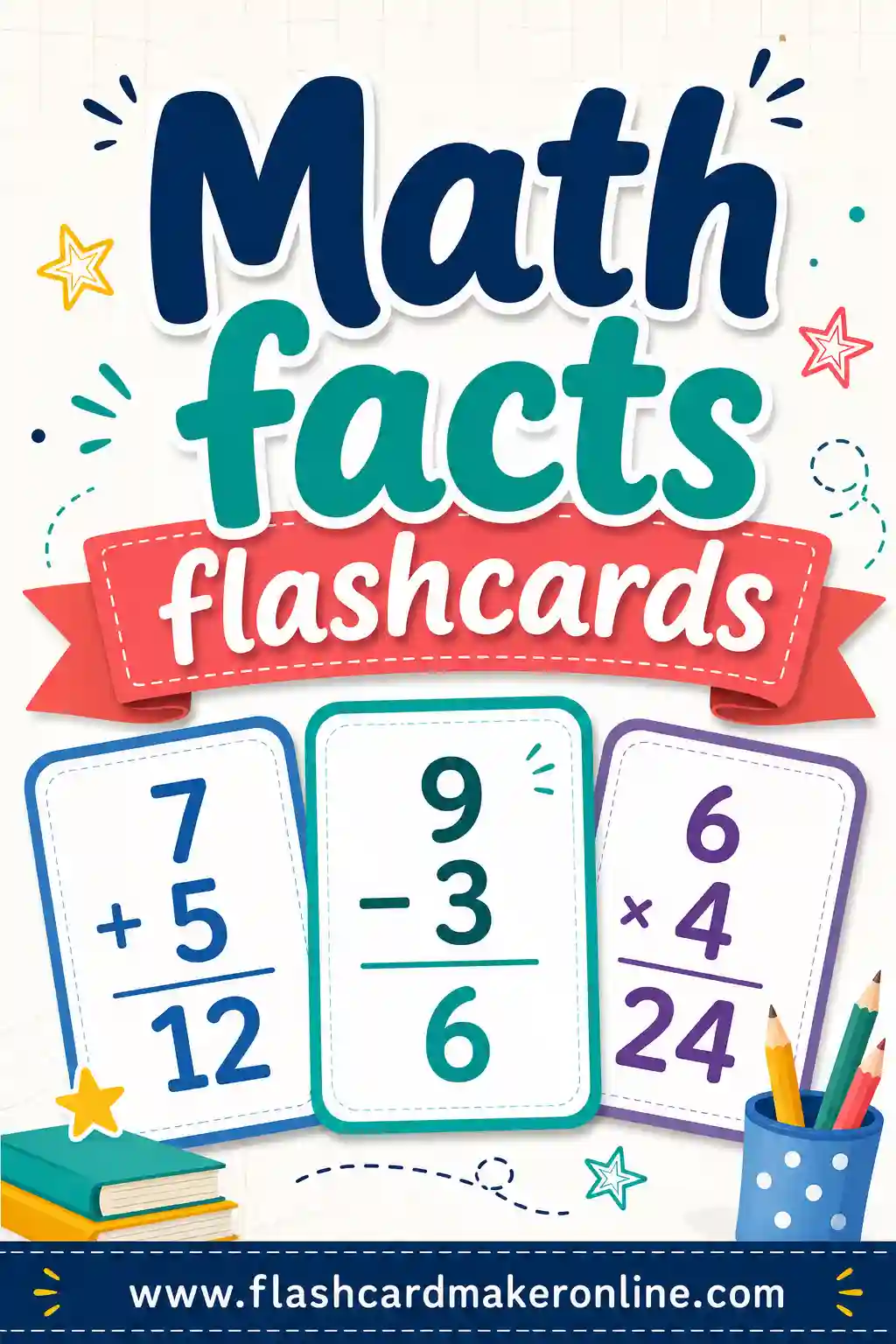
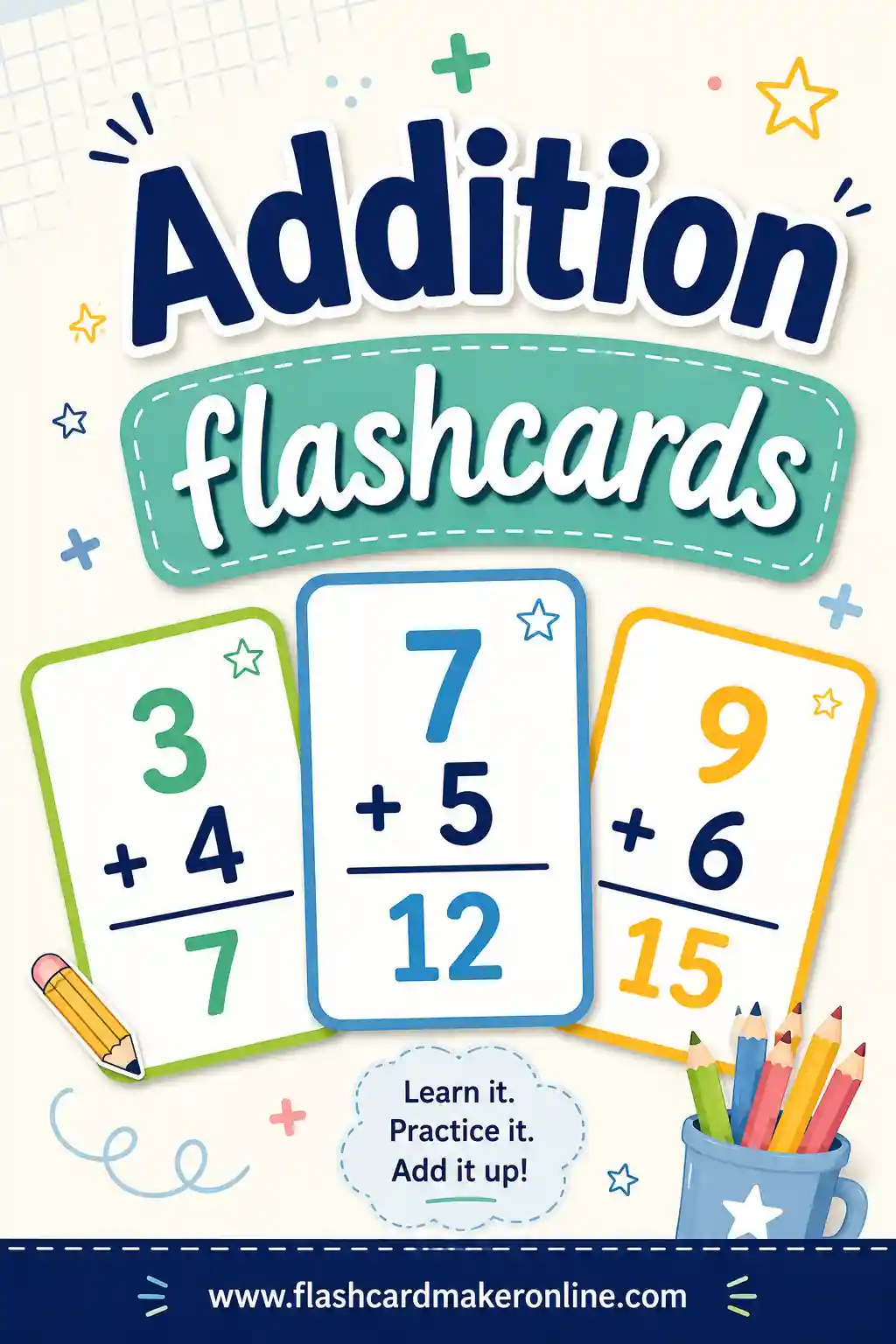
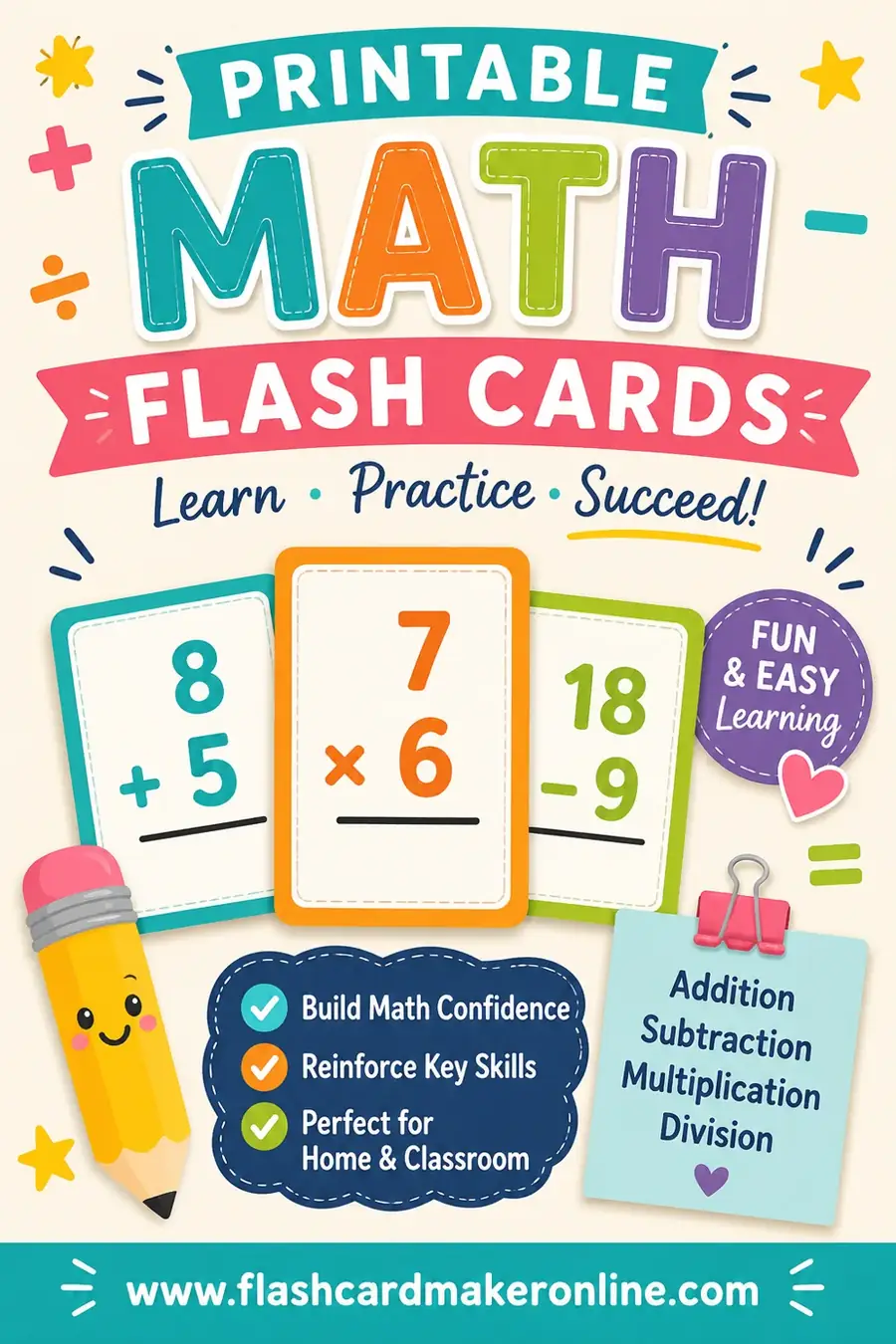
Printable math flash cards are paper cards with a problem on the front — 8 + 5, 14 − 6, 7 × 6, 42 ÷ 7 — and the answer on the back. Your child reads the problem, says the answer, and flips to check. The fastest way to print a deck for whatever your child is learning right now is a free flashcard maker that lets you type or paste the exact facts you need and prints them as big, bold cards.
Want a deck tonight? Open the free maker, copy one of the starter lists below, pick a card size, and print. No sign-up, no fee, and no PDF pack that drills two hundred facts when your child struggles with nine.
What Are Printable Math Flash Cards?
A math flash card is one fact on one card: problem on the front, answer on the back. The printable version is the classic kitchen-table format — a real stack your child can hold, answer out loud, and sort into "got it" and "not yet" piles.
The reason flash cards remain the gold standard for math facts is active recall. When a child has to produce "13" from "8 + 5" before flipping, the brain does the work that turns a calculation into an instant memory. Worksheets let kids count on fingers in private; a flash card session makes recall the whole game.
That instant recall — fluency — is the quiet superpower of elementary math. A child who knows 7 × 6 cold has full attention left for the actual problem, whether that's long division or a word problem about pizza slices.
Why One Custom Deck Beats Four Store-Bought Boxes
Math facts span four operations and several years of school. Buying (or downloading) a box per operation gets expensive and cluttered. Making your own printable math flash cards fixes that.
- Print only the facts in play. Your second-grader needs sums to 20, not the 12 times table. A custom deck matches this month's math, not a curriculum's worth.
- Skip the mastered facts. Every child has a personal list of stubborn facts. Print those, drill those, and stop wasting reps on 2 + 2.
- Mix operations when it matters. Real tests mix addition and subtraction. A custom deck can too — something fixed PDF packs rarely allow.
- Reprint on demand. Facts change as school advances. The deck lives in your browser; next month's version is an edit and a print away.
Starter Decks for Each Operation (Copy & Paste)
Copy the rows your child needs into the flashcard maker. This sampler covers the facts kids most often stumble on in each operation.
| Problem | Answer |
|---|---|
| 8 + 5 | 13 |
| 9 + 7 | 16 |
| 7 + 6 | 13 |
| 8 + 7 | 15 |
| 9 + 6 | 15 |
| 13 − 5 | 8 |
| 14 − 6 | 8 |
| 15 − 7 | 8 |
| 16 − 9 | 7 |
| 12 − 8 | 4 |
| 6 × 7 | 42 |
| 7 × 8 | 56 |
| 8 × 6 | 48 |
| 9 × 7 | 63 |
| 8 × 8 | 64 |
| 42 ÷ 6 | 7 |
| 56 ÷ 8 | 7 |
| 48 ÷ 6 | 8 |
| 63 ÷ 9 | 7 |
| 64 ÷ 8 | 8 |
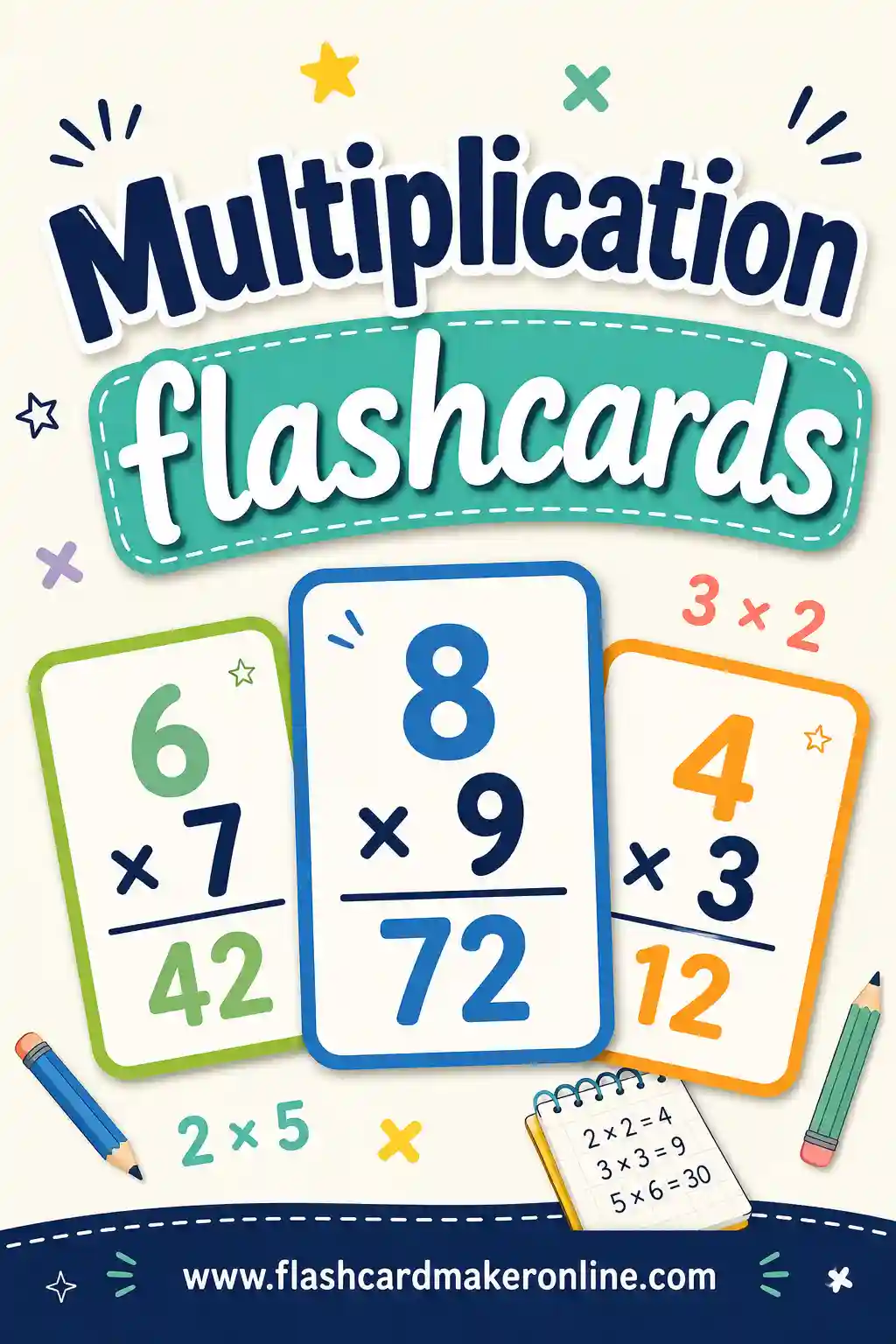
There's also a ready-made multiplication preset in the tool if you'd rather start from a full table and trim.
Drill fact families, not lone facts
Notice how the sampler repeats number trios? That's deliberate. A fact family is the set of related facts built from the same three numbers: 8 + 5 = 13, 5 + 8 = 13, 13 − 5 = 8, 13 − 8 = 5 — and later 6 × 7 = 42, 7 × 6 = 42, 42 ÷ 7 = 6, 42 ÷ 6 = 7. Print cards for the whole family and your child learns the relationship, which means subtraction comes almost free with addition, and division comes almost free with multiplication.
How to Make Printable Math Flash Cards in 4 Steps
- Open the tool. Go to the free flashcard maker — nothing to install.
- Add the facts. Type problem and answer, or paste a whole list. Include both orders (7 × 6 and 6 × 7) and the related facts in each family.
- Flip through on screen. One pass to proofread — and to spot which facts will need the most work.
- Pick a size and print. Big (4 per page) suits most school-age kids. Print on cardstock, cut along the borders, band the deck.
Your deck saves in the browser automatically, so updating it for next unit takes a minute, not an evening.
Smart Ways to Run Math Fact Practice
Five minutes, every day
Math facts are built by frequency, not duration. A short daily flip after dinner beats a Saturday marathon every time. Consistency is the entire trick.
Sort into three piles
As your child answers, sort each card by speed:
| Pile | What's in it | Drill |
|---|---|---|
| Daily | Missed or slow facts | Every day |
| Every few days | Correct but hesitant | 2–3 times a week |
| Weekly | Instant answers | Once a week |
Right twice in a row moves a card up; a miss drops it back to daily. The hard facts automatically get the most attention.
Answer out loud
Saying "eight plus five is thirteen" keeps kids honest and adds a sound memory on top of the visual one. Silent nodding hides shaky facts.
Shuffle every session
Same order twice and the brain memorizes the sequence, not the math. Shuffle like it's a card game — because at its best, it is.
Which Facts at Which Age?
Match the deck to the school year, roughly:
- Kindergarten–Grade 1: sums and differences within 10, then within 20. Keep decks at 10–15 cards.
- Grade 2: addition and subtraction fluency to 20, fact families, early skip counting. 15–20 cards.
- Grade 3: multiplication tables, starting with 2s, 5s, 10s and ending with 7s, 8s, 9s. 15–25 cards.
- Grade 4: division facts via fact families, mixed-operation review decks. 20–25 cards.
- Grade 5+: stubborn stragglers only, plus fractions and decimals equivalents.
Whatever the grade, small focused decks beat comprehensive ones. Print 20 cards, master them, print the next 20.
Printing Tips: Sizes, Paper, and Layout
- Pick the size for the kid. Jumbo (2 per page) for the youngest learners and group drills, Big (4 per page) — the kid-friendly default with bold print — for most elementary ages, Standard (8 per page) for older kids with bigger decks.
- Cardstock, always. 65 lb cardstock survives daily sorting; paper is done in a week.
- Double-sided with a test page. Print one sheet first and flip it to confirm the answers line up behind the right problems.
- Cut-out grid if duplex is fussy. Fronts and backs print side by side; fold each cell for an instant two-sided card.
- Save a PDF copy. Choose "Save as PDF" in the print dialog to keep the deck for reprints at school or the library.
Drilling a single operation? Go deeper with our addition flashcards, multiplication flashcards, and math facts flashcards guides.
Common Mistakes to Avoid
- Printing every fact at once. A 150-card brick teaches overwhelm. Print the current unit plus the personal trouble list — nothing more.
- Drilling only one direction. 6 × 7 known and 7 × 6 frozen is a real (and common) test-day problem. Print both orders.
- Ignoring fact families. Teaching subtraction from scratch when addition is solid wastes months. Family cards transfer the knowledge.
- Letting easy cards eat the session. Retire instant facts to the weekly pile fast. Reps belong on the strugglers.
- Practicing under pressure. Timers can be a fun game, but anxiety slows recall. Keep it light, short, and ended on a win.
Frequently Asked Questions
Are these printable math flash cards free?
Yes. You build and print them yourself at no cost — no sign-up, no watermark, unlimited decks and reprints across every operation.
Can I get them as a PDF?
Yes. Click print in the maker and choose "Save as PDF" as the destination. You'll get a clean file at your chosen card size to store or print anywhere.
What order should kids learn the operations?
Addition, then subtraction through fact families, then multiplication, then division through fact families. Each pair shares its facts, so sequence them and half the work is already done.
How many cards per practice session?
Ten to twenty. Small enough to finish, big enough to matter. As facts become instant, retire them and feed in new ones so the deck stays challenging but never discouraging.
My child counts on fingers — will flash cards fix that?
Yes, gradually. Finger counting means the fact isn't automatic yet. Short daily card sessions with a small deck give the repetitions that move a fact from "figured out" to "just known." Expect weeks, not days, and celebrate the shift.
What card size is best for math facts?
Big (4 per page) for most kids — bold print that's easy to read mid-drill. Jumbo (2 per page) for early learners, Standard (8 per page) for big review decks in older grades.
Ready to Print Your Math Deck?
Copy the facts your child needs, open the free flashcard maker, pick a card size, and print. Five minutes a day with a small stack of bold printed cards — that's the entire recipe for math-fact fluency, and the whole thing costs you a few sheets of cardstock.