Flashcards vs Notes: Which Helps You Learn More?
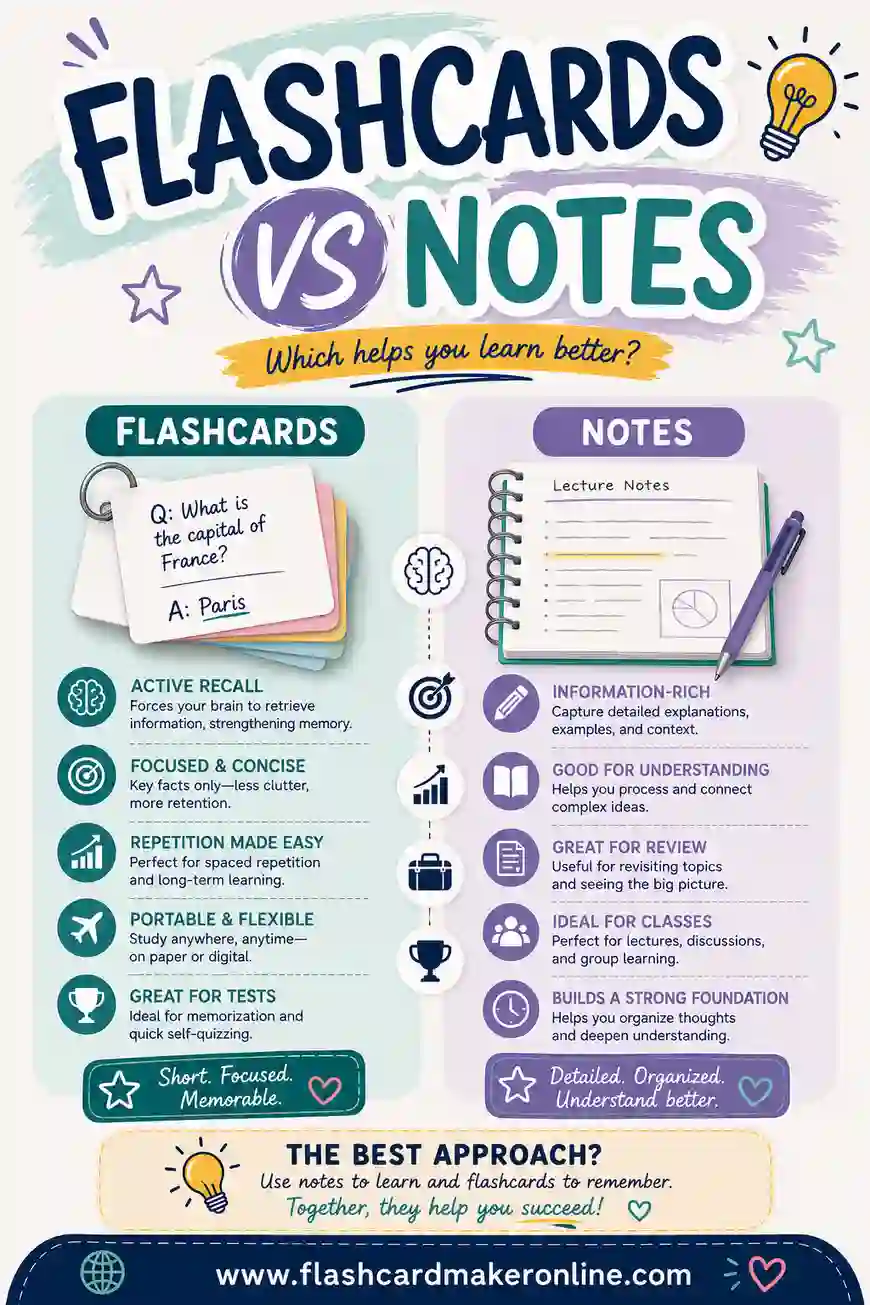
Flashcards usually beat plain notes for memorizing facts, terms, and definitions, because flashcards force active recall — you have to pull the answer from memory before you flip the card. Notes are better for understanding big ideas, seeing how concepts connect, and capturing a lecture in real time. The smartest approach uses both: take notes to understand, then turn the key facts into flashcards to remember. The fastest way to make that second step painless is a free flashcard maker that flips your notes into a study-ready deck.
If you've ever reread your notes five times and still blanked on the test, you're not lazy — you're using the wrong tool for the job. Let's break down exactly when each one wins, and how to get the best of both.
The Short Answer
If your goal is to remember specific things — vocabulary, dates, formulas, definitions, anatomy — flashcards win, and it's not close. They make you retrieve the answer, and retrieval is what burns information into memory.
If your goal is to understand something — how a process works, why an event happened, how three ideas fit together — notes win. Writing things out in your own words helps you make sense of them in a way that a single flashcard can't.
Most subjects need both. You understand first, then you memorize. That's the whole game.
Why Flashcards Are So Effective
Flashcards aren't magic. They just happen to force the two study habits researchers consistently find most powerful.
Active recall
When you look at the front of a card and try to answer before flipping, you're practicing retrieval — the act of pulling information out of your brain. Every time you do it, that memory gets stronger and easier to find later. Rereading notes doesn't do this. You see the answer, your brain nods, and nothing sticks.
Spaced repetition
Good flashcard study spreads reviews out over time instead of cramming them into one session. You see a card today, again in two days, again in a week. Each well-timed review tells your brain "this matters, keep it." Cards make this easy because you can shuffle them, set aside the ones you know, and focus on the ones you don't.
Built-in honesty
A flashcard catches you when you're guessing. You either knew it or you didn't — flip and find out. Notes let you feel like you know the material because the words are right there in front of you. That feeling is called the fluency illusion, and it's why people are shocked by test grades after "studying for hours."
Where Notes Still Win
Notes get a bad rap in study-tips articles, but they're essential — just for different work.
- Understanding new material. When a concept is brand new, writing it out in full sentences helps you process it. You can't make a good flashcard about something you don't understand yet.
- Seeing connections. Notes show the big picture: timelines, cause and effect, how chapter three builds on chapter one. A single card can't capture a web of ideas.
- Capturing a lecture live. You can't make flashcards while a professor is talking. Notes are how you grab the raw material to turn into cards later.
- Essay and discussion prep. For subjects where you argue and explain rather than recall facts, organized notes beat a stack of cards.
The takeaway: don't throw out your notes. Mine them for facts, then convert those facts into cards.
Flashcards vs Notes: Side-by-Side
Here's the comparison at a glance.
| Factor | Flashcards | Notes |
|---|---|---|
| Best for | Memorizing facts, terms, definitions | Understanding ideas and connections |
| Learning style | Active recall (you retrieve) | Passive review (you reread) |
| Self-testing | Built in — flip to check | None unless you cover answers |
| Spaced repetition | Easy — shuffle and sort | Hard to do with paragraphs |
| Capturing a lecture | Poor — too slow live | Excellent |
| Big-picture thinking | Weak | Strong |
| Portability | Very high — quiz anywhere | Moderate |
| Setup time | A few minutes to build | Created as you learn |
Neither column is "the loser." They're different tools. The mistake is using notes to do a flashcard's job.
The Winning Combo: Notes First, Then Cards
The best students don't pick a side. They run a two-step routine.
- Take notes to understand. In class or while reading, capture ideas in your own words. Focus on getting the concept, not on making it pretty.
- Highlight the testable facts. After class, scan your notes for the things you'll actually be quizzed on: definitions, dates, formulas, names, steps.
- Turn those facts into flashcards. One clear question per card, one clear answer. This step alone forces you to review your notes once more.
- Study the cards with active recall. Flip, guess, check, repeat. Set aside the ones you've nailed and spend your time on the hard ones.
- Go back to your notes when a card confuses you. If a card keeps tripping you up, the understanding wasn't solid. Reread that section, then try the card again.
This loop uses notes for what they're good at and flashcards for what they're good at. The free flashcard maker handles step three in seconds — paste your terms, and you've got a deck.
How to Turn a Page of Notes Into Cards
This is the step most people skip, and it's the one that does the heavy lifting. Here's how to do it without it feeling like a chore.
Hunt for the question hiding in each line
Good notes are full of facts that quietly answer a question. "The mitochondria is the powerhouse of the cell" is really the answer to "What does the mitochondria do?" Once you start reading your notes this way, the cards write themselves. Front: the question. Back: the fact.
Break big facts into small ones
If a note crams three things into one sentence, split it into three cards. A card with one clean fact is easy to recall. A card with a wall of text is just a tiny page of notes — and you already know how well rereading works.
Keep the answer short
The back of a card should be the shortest correct answer, not a paragraph. If you find yourself writing two sentences, that's a sign the idea belongs in your notes, not on a card. Card it down to the part you actually need to remember.
Skip the stuff you already know
You don't need a card for "Paris is the capital of France" if you've known it since you were eight. Card the things that trip you up. A lean deck of genuinely hard facts beats a fat deck you'll never finish reviewing.
A quick example. Say your notes read: "The French Revolution began in 1789; key causes were financial crisis, food shortages, and inequality between the estates." That one line becomes four cards: "When did the French Revolution begin?" plus one card for each cause. Four small retrievals beat one big reread every time.
A Sample Deck: Study Concepts You Can Actually Use
Want to see what good study flashcards look like? Here's a ready-made set on learning and memory itself. Copy it, study it, or use it as a model for your own subject.
| Term | Definition |
|---|---|
| Active recall | Retrieving an answer from memory instead of rereading |
| Spaced repetition | Reviewing at increasing intervals over time |
| Passive review | Rereading or rewatching without self-testing |
| Fluency illusion | Mistaking familiar material for material you know |
| Testing effect | Learning more from quizzing than from restudying |
| Retrieval practice | Deliberately pulling answers from memory |
| Interleaving | Mixing different topics in one study session |
| Cramming | Massing all study into one session before a test |
| Distributed practice | Spreading study across multiple sessions |
| Leitner system | Sorting cards into boxes by how well you know them |
| Encoding | Getting information into memory in the first place |
| Cue | A prompt that triggers a memory |
| Elaboration | Explaining an idea in your own words to understand it |
| Chunking | Grouping items so they're easier to remember |
| Metacognition | Thinking about how well you actually know something |
| Forgetting curve | How memory fades over time without review |
| Mnemonic | A memory aid like an acronym or rhyme |
| Recognition | Spotting the right answer when you see it |
| Recall | Producing the answer with no options given |
| Consolidation | The brain stabilizing a memory, often during sleep |
| Dual coding | Pairing words with images to lock in a memory |
| Self-explanation | Asking "why is this true?" to deepen understanding |
| Overlearning | Studying past the point of first getting it right |
| Generation effect | Remembering more when you produce the answer yourself |
| Desirable difficulty | A struggle that makes learning stick better |
That's 25 cards you can study right now. Notice how each one is a clean question-and-answer — that's the format flashcards are built for, and notes simply aren't.
When to Lean Harder on Each
A quick guide to choosing on the fly:
| Situation | Reach for |
|---|---|
| Vocabulary or a foreign language | Flashcards |
| Anatomy, terminology, formulas | Flashcards |
| A complex process you need to understand | Notes first |
| An essay or open-ended exam | Notes |
| Memorizing dates and names | Flashcards |
| Making sense of a dense chapter | Notes, then cards |
| Quick review on the bus | Flashcards |
Match the tool to the task and your study time pays off far more.
Mistakes That Make Notes Lose to Flashcards
Notes aren't the problem. How most people use them is. Sidestep these traps and your notes pull their weight again.
- Treating rereading as studying. Running your eyes over a page feels like work, but your brain isn't doing anything. If you're not covering the answer and testing yourself, you're just visiting the material, not learning it.
- Copying the textbook word for word. Notes only help when you put ideas in your own words. A transcript of the book teaches you nothing you didn't already have.
- Never converting notes into cards. Notes that sit in a binder until the night before the exam are wasted potential. Mine them while the lecture's still fresh.
- Carding everything. The flip side: don't turn every line into a flashcard. You'll drown in a deck you can't finish. Card the facts you'll be tested on, leave the context in your notes.
Print Your Cards for Screen-Free Study
Flashcards win over notes partly because they're so easy to quiz with anywhere — and printed cards take that one step further. Notes are awkward to study from on the go; a stack of cards fits in a pocket.
Once you've built a deck, hit print and you've got a physical set you can run through on the bus, at the kitchen table, or in the ten minutes before class. Print on cardstock so the cards survive a backpack, and cut them apart with the answer on the reverse. A study buddy can hold the stack and quiz you, which adds the social pressure that keeps you honest. No screen, no notifications, no temptation to "just check one thing" mid-session. For a lot of learners, that quiet, paper-only focus is exactly what a wall of notes can't offer.
Frequently Asked Questions
Are flashcards better than notes for studying?
For memorizing facts, terms, and definitions, yes — flashcards force active recall, which beats rereading notes. For understanding concepts and seeing how ideas connect, notes are better. Most people get the best results by taking notes first, then turning the key facts into flashcards.
Why do flashcards work better than rereading?
Rereading feels productive but it's passive — you see the answer and your brain assumes it knows it. Flashcards make you retrieve the answer from memory before checking, and that retrieval practice is what actually strengthens memory. It's called the testing effect.
Should I take notes or make flashcards in class?
Take notes in class — you can't make good flashcards while a lecture is moving, and you need to understand material before you can card it. After class, mine your notes for testable facts and turn those into flashcards. A free flashcard maker makes that conversion quick.
Can I just turn my notes into flashcards?
Yes, and you should. Pull out the definitions, dates, and key terms from your notes and put each on a card as a question-and-answer pair. This forces one extra review of your notes and gives you a tool you can actually self-test with.
Do flashcards work for every subject?
They're strongest for fact-heavy, memorization subjects like vocabulary, science terminology, and history dates. For subjects built on argument and analysis, notes do more of the heavy lifting — though cards still help with the key terms and definitions inside those subjects.
How many flashcards should I make from a chapter?
Focus on quality, not quantity. Pull the 15–40 most testable facts from a chapter rather than carding every sentence. Too many cards waters down your review time; too few and you miss key material.
Is it worth keeping my notes after I make flashcards?
Yes — don't toss them. Your notes are where the understanding lives, and you'll go back to them whenever a card confuses you or a question asks you to explain rather than recall. Think of the cards as the quiz and the notes as the textbook behind it.
Are handwritten or typed notes better for making flashcards?
Either works for the carding step, since you're pulling out facts no matter the format. Handwriting tends to help you understand as you write, while typed notes are faster to search and copy into a flashcard maker. Use whichever keeps you actually taking notes, then convert the key facts the same way.
Ready to Turn Your Notes Into a Deck?
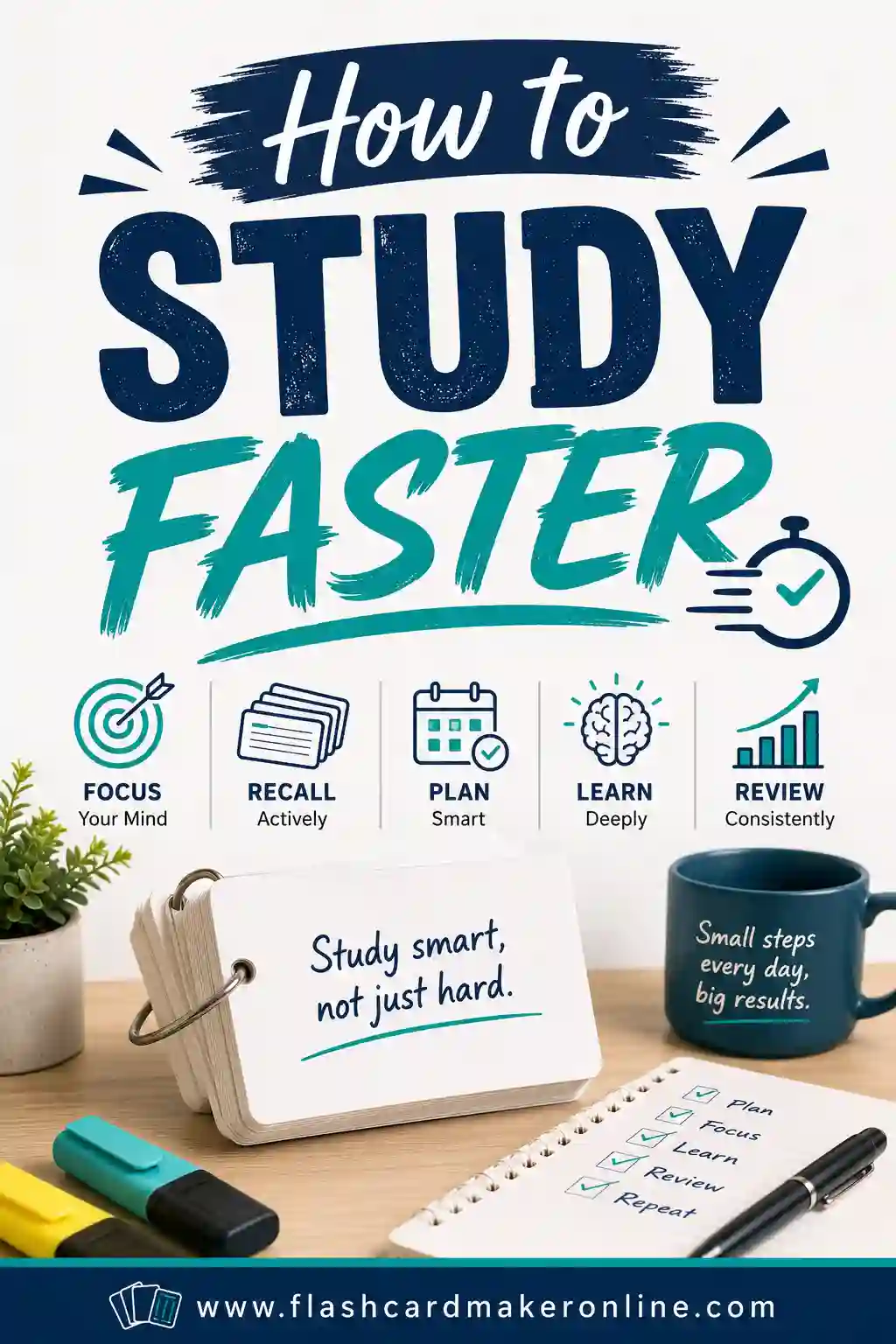
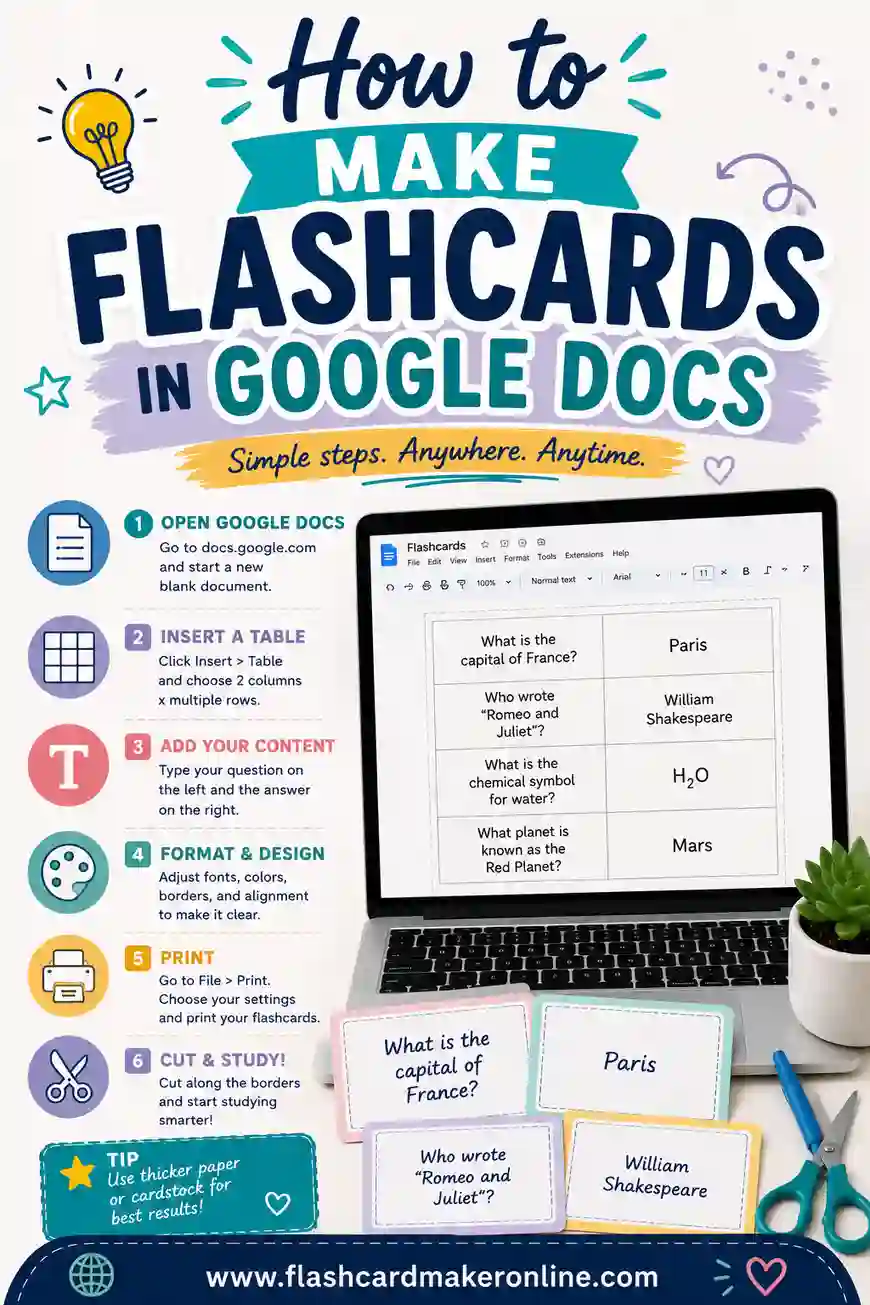
You don't have to choose between flashcards and notes — use notes to understand, then flashcards to remember. When you're ready for that second step, open the free flashcard maker, paste in the facts from your notes, and start flipping. It's free and there's no sign-up. From here, dig into the science behind flashcards, pick up tricks to study faster, or learn how to make flashcards in Google Docs. Your future self, the one walking into the exam calm, will thank you.