How to Make Medical Flashcards That Actually Stick
To make medical flashcards that stick, put one clean fact on each card, write the front as a specific question (not just a term), add a memory hook or mnemonic where you can, and review the deck with spaced repetition. Keep cards atomic — one drug, one mechanism, one lab value per card — so each one tests a single idea. The fastest way to build and study a deck like this is a free flashcard maker that lets you flip, shuffle, and print clean double-sided cards.
Med school, nursing, the MCAT, the boards — they all bury you in facts. Flashcards are how thousands of students survive that volume, because they turn an impossible reading list into bite-sized, testable pieces. Here's how to build a deck that actually holds up on exam day.
Why Flashcards Rule Medical Studying
Medicine isn't really about understanding one hard idea — it's about holding an enormous number of discrete facts in your head and recalling the right one under pressure. Drug doses, lab values, nerve pathways, bug-drug combos. That's exactly the kind of memorization flashcards are built for.
Two reasons they dominate med study:
- Active recall. When you read "First-line treatment for anaphylaxis?" and answer "Epinephrine" before flipping, you're practicing the exact skill the exam tests — producing the answer from memory.
- Spaced repetition. With thousands of facts, you can't review everything every day. Cards let you drill the ones you keep missing and rest the ones you've mastered.
If you want the full evidence, see the science behind why flashcards work. For now, just know this method is the backbone of how most successful med and nursing students study.
The Golden Rule: One Fact Per Card
The biggest mistake students make is cramming a whole topic onto one card. Don't write "Tell me everything about heart failure" on the front. That card tests nothing cleanly and is impossible to grade yourself on.
Instead, break it apart:
- "What are the two main types of heart failure?"
- "What's the hallmark symptom of left-sided heart failure?"
- "Which class of drugs is first-line for HFrEF?"
Each card now tests one fact you either know or don't. This is called making cards atomic, and it's the single most important habit for medical flashcards. Atomic cards are faster to review, easier to self-grade, and far better for spaced repetition.
Card Formats That Work for Medicine
Different facts call for different card shapes. Here are the formats that carry the load.
Basic term-to-definition
The classic. Front: a term or sign. Back: its meaning. Great for vocabulary, signs, and symptoms.
Front: Dyspnea Back: Difficult or labored breathing
Question-to-answer
Better than a bare term because it mirrors how you'll be tested. Front: a specific clinical question. Back: the answer.
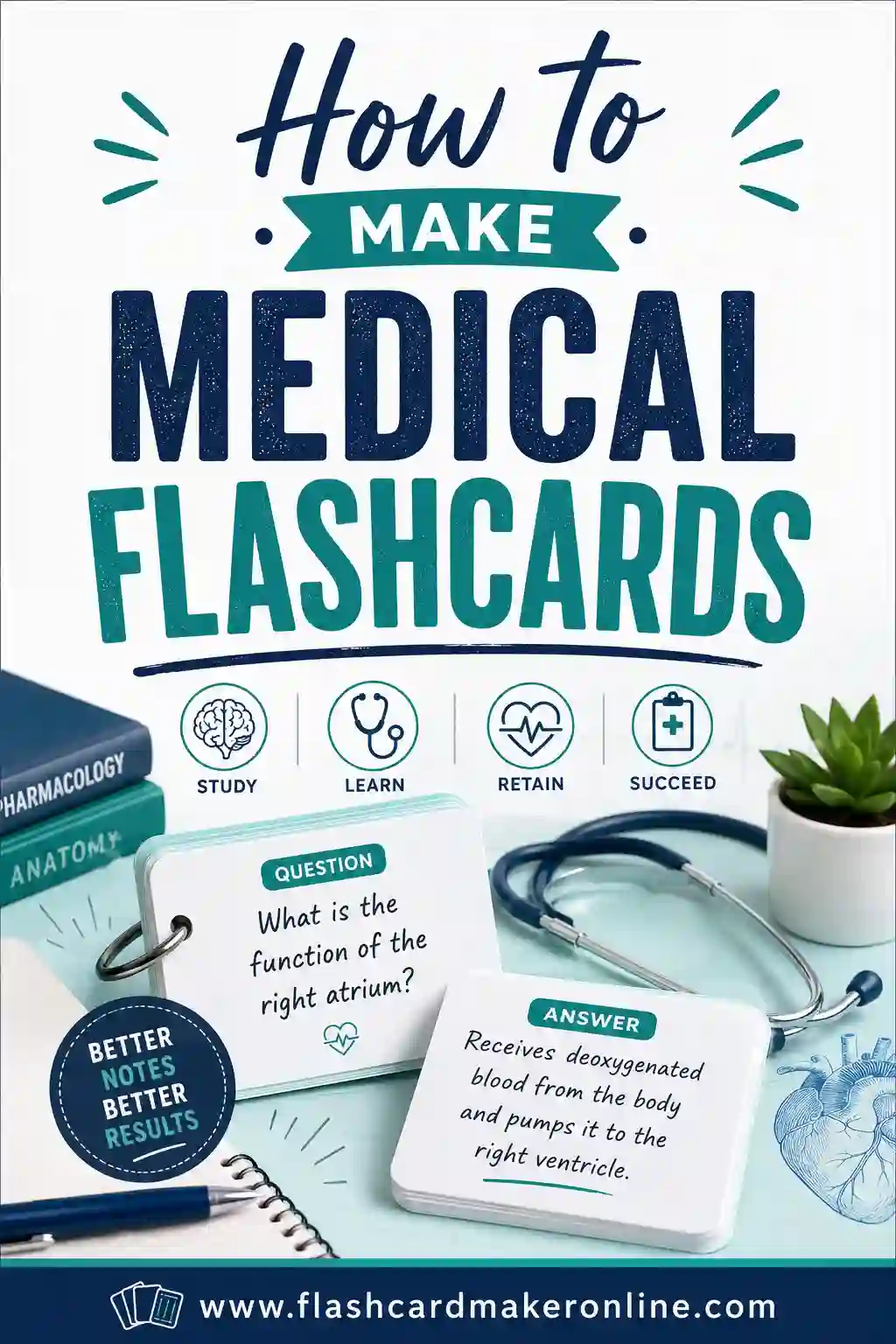
Front: First-line treatment for anaphylaxis? Back: Intramuscular epinephrine
Cloze deletion (fill in the blank)
Hide one key word in a sentence. Forces recall in context. Especially good for mechanisms and criteria.
Front: ACE inhibitors block the conversion of angiotensin I to angiotensin ___. Back: II
Image and pathway cards
For anatomy, ECGs, histology slides, and pathways, put the image on the front and label or identify on the back. (Add a descriptive note so you can study even without printing.)
Mnemonic cards
When a list won't stick, build a card around a memory hook. Front: the thing you need to recall. Back: the mnemonic plus the expansion.
Front: Causes of clubbing (mnemonic)? Back: "CLUBBING" — Cyanotic heart disease, Lung disease, Ulcerative colitis, Biliary cirrhosis, etc.
Mix formats freely. A strong deck uses whichever shape fits each fact.
A Sample Medical Flashcard Deck
Here's a ready-to-study set of common clinical terms and values to show you the right format. Copy it into the flashcard maker or use it as a model for your own subject.
| Term | Definition |
|---|---|
| Tachycardia | Heart rate over 100 beats per minute |
| Bradycardia | Heart rate under 60 beats per minute |
| Hypertension | Persistently elevated blood pressure |
| Hypotension | Abnormally low blood pressure |
| Dyspnea | Difficult or labored breathing |
| Tachypnea | Abnormally rapid breathing rate |
| Hyperkalemia | High potassium level in the blood |
| Hypokalemia | Low potassium level in the blood |
| Hyperglycemia | High blood glucose level |
| Hypoglycemia | Low blood glucose level |
| Anemia | Low red blood cell count or hemoglobin |
| Leukocytosis | Elevated white blood cell count |
| Thrombocytopenia | Low platelet count |
| Hypoxia | Inadequate oxygen reaching the tissues |
| Edema | Swelling from fluid buildup in tissues |
| Jaundice | Yellowing of skin and eyes from high bilirubin |
| Syncope | Temporary loss of consciousness (fainting) |
| Ischemia | Reduced blood flow to a tissue or organ |
| Necrosis | Death of body tissue |
| Sepsis | Life-threatening organ dysfunction from infection |
Twenty clean cards, one fact each. Notice none of them try to teach a whole topic — that's the model to copy.
Building Decks by Subject
Medicine is huge, so organize. A few high-yield buckets students card heavily:
- Pharmacology — drug, class, mechanism, side effects, and contraindications (often one card each).
- Microbiology — organism, gram stain, disease, and treatment (bug-drug pairs are perfect cards).
- Anatomy — structures, innervation, blood supply, using image cards.
- Pathology — disease, hallmark findings, and key labs.
- Lab values — normal ranges and what high/low means.
- Signs and symptoms — clinical sign to underlying cause.
Tag or color-code by subject so you can drill one system at a time, then mix them for a tougher review session. Mixing topics (interleaving) actually strengthens recall once you've got the basics down.
How to Study Your Medical Deck (So It Sticks)
Building the cards is half the battle. Here's how to study them.
| Step | What to do | Why it matters |
|---|---|---|
| Answer first | Say or write your answer before flipping | Triggers active recall, the whole point |
| Be honest | Only count it "known" if you nailed it cold | Recognizing isn't the same as recalling |
| Sort by mastery | Hard cards up front, easy ones aside | Focuses time where you're weak |
| Space reviews | Today, +2 days, +1 week, +1 month | Beats the forgetting curve |
| Shuffle | Randomize order every session | Stops you cueing off card position |
| Review missed cards same day | Loop the ones you flunked | Catches them before sleep |
A practical schedule: make new cards the day you learn material, review them that evening, then let a spaced schedule carry them forward. The free flashcard maker shuffles and lets you set aside known cards so you can run this routine without paper boxes.
Mistakes That Sink Medical Decks
Avoid these and your deck stays useful all year.
- Cards that are too dense. A paragraph on the back tests nothing. Split it up.
- Carding everything. You can't make a card for every sentence in First Aid or a 900-page text. Card the high-yield, testable facts.
- Front that's too vague. "Heart failure?" could mean anything. Ask a specific question.
- Never shuffling. Reviewing in the same order means you memorize position, not content.
- Cramming all reviews. Without spacing, most of it evaporates by the exam.
- Making cards instead of studying them. Building feels productive, but the learning happens when you test yourself. Don't spend all night formatting.
Print or Study on Screen?
Both work — the science is in the method, not the medium.
- On screen is great for spaced repetition, shuffling, and reviewing on your phone between rotations or classes.
- Printed cards suit the Leitner box system, group quizzing, and screen-free study during long shifts.
The nice thing about a free online maker is you don't have to pick — build the deck once, flip it on screen, and print a clean double-sided set when you want paper. Print on cardstock so cards survive a white-coat pocket.
Frequently Asked Questions
How do I make medical flashcards that actually stick?
Keep each card atomic — one fact per card — write the front as a specific question, add a mnemonic where a list won't stick, and review with spaced repetition. The combination of clean cards and active recall is what makes facts hold up under exam pressure.
Should medical flashcards have one fact or a whole topic?
One fact per card, always. A card that asks you to recall an entire topic tests nothing cleanly and is impossible to self-grade. Break big topics into many small, specific cards — it's faster to review and far better for spaced repetition.
What's the best format for pharmacology flashcards?
Make separate atomic cards for each drug: one for its class, one for its mechanism, one for major side effects, and one for contraindications. Cloze-deletion cards work well for mechanisms, and question-style fronts ("First-line for X?") mirror how you'll be tested.
How many medical flashcards should I make per day?
Quality over quantity — card the high-yield, testable facts rather than every line of your textbook. A focused 20–60 new cards a day is sustainable for most students; making hundreds you never review just creates a backlog.
Are digital or paper flashcards better for med school?
Both work since the benefit comes from active recall and spacing, not the medium. Digital cards make shuffling, spacing, and phone review easy; paper cards suit the Leitner box system and screen-free study. A free maker lets you do both from one deck.
How do I use spaced repetition with my medical deck?
Review new cards the day you make them, then again after two days, a week, and a month, pulling forward any you miss. Set aside cards you know cold so you spend your limited time on the ones you keep flunking. Shuffle each session to avoid memorizing order.
Ready to Build Your Medical Deck?
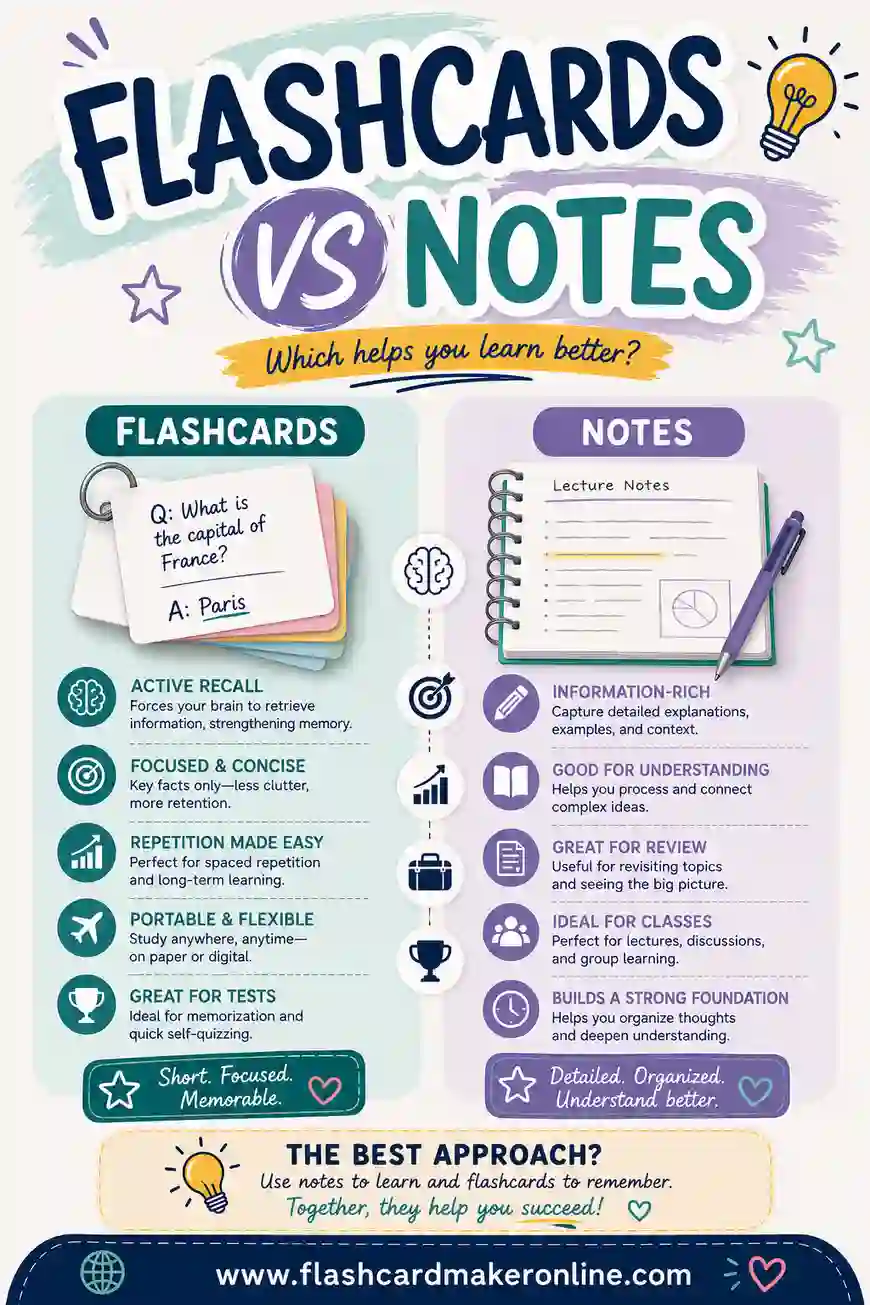
You've got the formula: one fact per card, specific questions, mnemonics where they help, and spaced, shuffled review. Now make it real — open the free flashcard maker, paste in your terms, and start testing yourself. It's free, with no sign-up, and you can print a clean set for your coat pocket. Keep going with the science behind flashcards, tricks to study faster, and flashcards vs notes for the bigger study picture. You've got this.