Flashcards for Homeschool: A Practical Guide for Parents
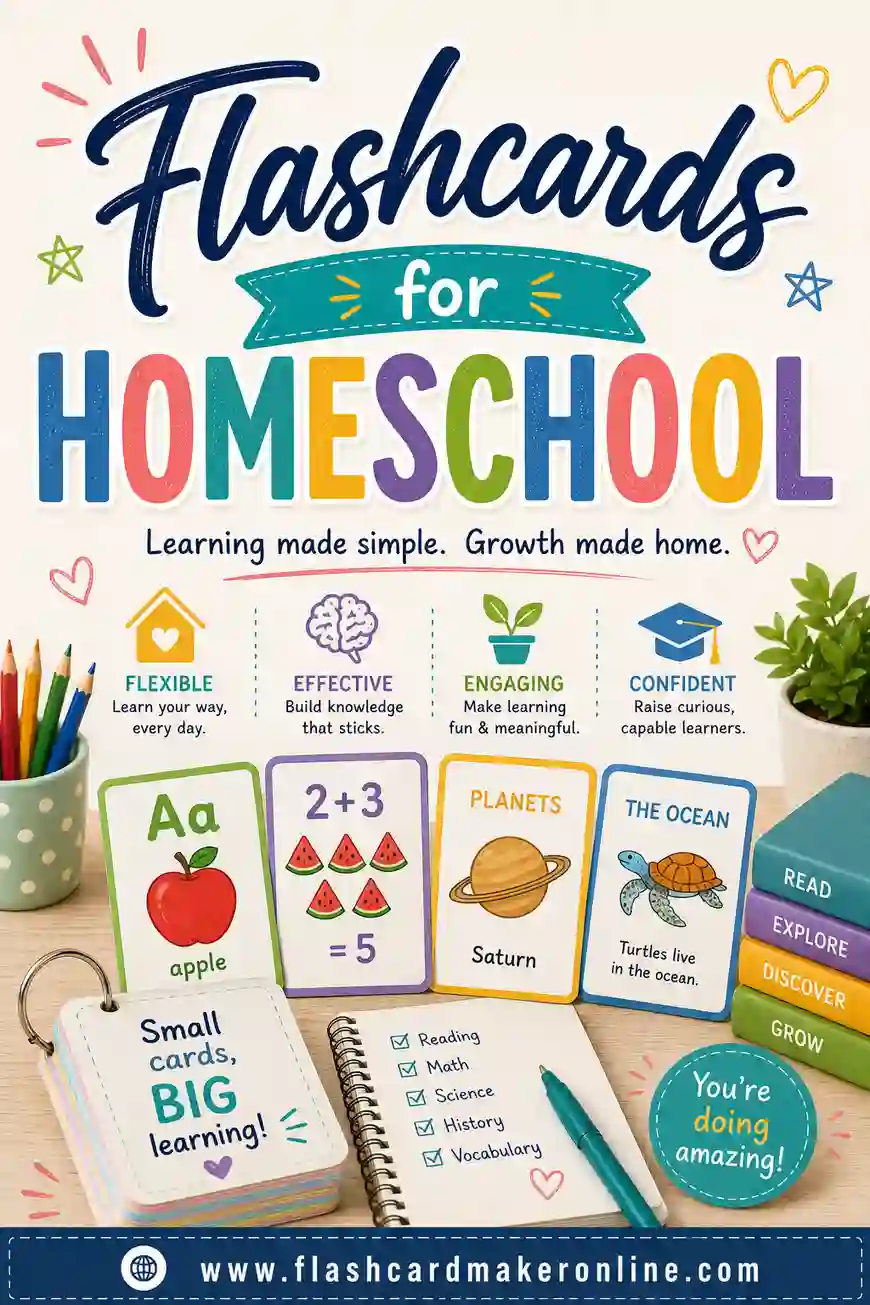
Flashcards for homeschool are simple two-sided cards (a question or term on the front, the answer on the back) that let your kids practice math facts, spelling, vocabulary, history dates, and almost anything else through quick, repeatable review. The fastest way to build a set tailored to your curriculum is to use a free flashcard maker where you type your own terms, flip them on screen, and print a clean deck for the kitchen table.
Want to start right now? Open the free flashcard maker, type in the terms your kids are working on this week (there's a ready-made sample deck below), and print or study them on any device. No sign-up, no app to install, no cost.
Why Flashcards Work So Well in a Homeschool
Homeschooling gives you something a classroom can't: you know exactly what your child has mastered and what's still shaky. Flashcards turn that knowledge into a tool you can aim with precision.
Two ideas make them powerful. The first is active recall — pulling an answer out of your head is far stronger than rereading it. When your child sees "7 x 8" and has to produce "56," their brain works harder and remembers longer. The second is spaced repetition — reviewing a card again right before you'd forget it. Cards your child nails get spaced out; the tricky ones come back often.
You don't need fancy software to use these ideas. A small stack of cards and a few minutes a day does the job. Flashcards also fit the rhythm of home learning: a quick round at breakfast, a few cards in the car, a fast review before a quiz.
What Subjects Work Best With Flashcards
Almost anything that involves a term and a matching answer is a good fit. Here are the subjects homeschool families lean on most.
- Math facts. Addition, subtraction, times tables, and division. Speed and confidence come from repetition, and that's exactly what cards deliver.
- Spelling and vocabulary. Word on one side, definition or correct spelling on the other.
- Reading sight words. For early readers, a card per high-frequency word builds instant recognition.
- Foreign language. The classic flashcard use: a word in the target language, the meaning on the back.
- History and geography. Dates, capitals, key figures, and "what happened in 1776."
- Science. Vocabulary, body parts, the states of matter, the planets in order.
If you can phrase it as a short question with a short answer, it can be a card.
A Ready-Made Sample Homeschool Deck
Here's a starter deck that spans a few common subjects. Type these into the flashcard maker to see how it works, then swap in your own curriculum's terms.
| Term (Front) | Definition (Back) |
|---|---|
| 6 x 7 | 42 |
| 8 x 9 | 72 |
| 12 ÷ 4 | 3 |
| Capital of France | Paris |
| Capital of Japan | Tokyo |
| Noun | A person, place, or thing |
| Verb | An action word |
| Synonym for big | Large |
| H2O | Water |
| Photosynthesis | How plants make food from sunlight |
| The 3 states of matter | Solid, liquid, gas |
| 1776 | The U.S. Declaration of Independence |
| Continent we live on | (Your continent) |
| A group of wolves | A pack |
| Spell: necessary | n-e-c-e-s-s-a-r-y |
| Antonym of hot | Cold |
| 9 x 9 | 81 |
| Sun, Earth, Moon order | Sun, then Earth, then Moon orbits Earth |
| Author of a book | The person who wrote it |
| Half of 50 | 25 |
Twenty cards is a comfortable size for one study session. You can always split a big subject into smaller decks so your child isn't overwhelmed.
Make the cards match your curriculum
The biggest advantage of building your own deck is control. If your reading program uses a specific spelling list, type those exact words. If your math curriculum is on the seven-times-table this week, make a deck of just sevens. Store-bought card packs can't follow your lesson plan — yours can, line for line.
How to Make Homeschool Flashcards in 4 Steps
You don't need to be techy. The whole thing takes a few minutes.
- List your terms. Pull this week's spelling words, math facts, or vocabulary straight from your lesson plan.
- Type them into the maker. Put the prompt on the front, the answer on the back. The flashcard maker keeps each pair together.
- Study or print. Flip the cards on screen for a quick session, or print a stack for hands-on practice.
- Reuse and reshuffle. Keep decks by subject. Pull out the ones your child is working on and shuffle so they can't memorize the order instead of the answers.
If you print on cardstock and slip the cards into sleeves, they survive being handled by little hands all year.
Study Routines That Actually Stick
A deck is only as good as how you use it. These simple routines keep review short and effective.
| Routine | How it works | Best for |
|---|---|---|
| The 3-pile sort | Sort into "knew it," "almost," and "missed." Review the missed pile twice as often. | Any subject |
| Five-a-day | Add five new cards a day, mixed with old ones. | Vocabulary, spelling |
| Two-minute drill | A fast-paced timed round of math facts. | Times tables, addition |
| Buddy quiz | A sibling or parent holds the cards and quizzes. | Making it social and fun |
| Last-card-wins | Loop the deck until every card is answered right once. | Test review |
The key is short and frequent. Five minutes a day beats an hour once a week, every time. Mix subjects so review doesn't feel like a slog.
Keep it light for younger kids
For little ones, turn it into a game. Race a timer, do a silly voice for right answers, or let them "teach" a stuffed animal using the cards. Learning that feels like play sticks better and keeps mornings happy.
Printable vs. Digital: Which Is Better for Homeschool
You don't have to choose — most families use both. Here's how they compare so you can pick the right one for the moment.
- Printable cards are great for hands-on learners, screen-free time, and group sorting games. Kids can shuffle, sort piles, and physically separate the cards they've mastered.
- Digital flip cards are perfect for travel, the car, waiting rooms, and quick solo review. Nothing to lose, nothing to print, and you can study on a phone or tablet.
A common rhythm: build the deck once in the flashcard maker, study digitally during the week, and print a paper set for a sorting game or a relaxed review day. One deck, two ways to use it.
Organizing Decks for the Whole Year
A little organization saves a lot of hunting later. Try these habits.
- One deck per topic. Keep "times tables," "states and capitals," and "Latin roots" separate so you can grab exactly what you need.
- Label by date or unit. Note which curriculum week a deck belongs to so review stays aligned with lessons.
- Keep a "tricky cards" deck. Pull the words and facts your child keeps missing into a single deck and review it more often.
- Retire mastered decks. Once a topic is solid, set it aside but don't toss it — a quick refresher every few weeks keeps it fresh.
If you have more than one child, build a shared deck for overlapping topics and a personal "tricky cards" deck for each. That way everyone reviews what they actually need.
Common Mistakes to Avoid
A few small fixes make flashcards far more effective.
- Too many cards at once. A 40-card pile overwhelms a young child. Break it into smaller decks of 10 to 20.
- Always studying in the same order. Kids memorize the sequence, not the content. Shuffle every session.
- Only reading, never recalling. Make your child say the answer before flipping. Recall is where the learning happens.
- Cramming once a week. Short daily reviews beat one long session. Spread it out.
- Wordy answers. Keep the back short and clear so the answer is unmistakable.
Frequently Asked Questions
What age can kids start using flashcards?
As young as two or three for picture-and-word cards, and around five or six for reading and math facts. Keep decks tiny for little ones and make it playful. For very young children, our guide to flashcards for toddlers has age-appropriate ideas.
How many flashcards should a homeschool deck have?
For one study session, 10 to 20 cards is comfortable. You can build bigger subject decks and pull a smaller batch to review each day. Smaller, focused decks keep kids from feeling swamped.
Are these homeschool flashcards free to make and print?
Yes. The flashcard maker is free to use. You type your own terms, study them on screen, and print as many as you like with no sign-up and no cost.
How do flashcards help with memorization?
They use active recall and spaced repetition — two methods proven to move facts into long-term memory. For a deeper look at the technique, see our guide to flashcards for memorization.
Can I make flashcards for any subject?
Just about. If you can phrase it as a short prompt with a short answer — a math fact, a spelling word, a date, a definition — it works as a flashcard. That covers most of a homeschool curriculum.
How often should my child review their flashcards?
A few minutes most days is ideal. Short, frequent review beats long, occasional cramming. Loop the tricky cards more often and space out the ones your child already knows.
Ready to Build Your Homeschool Flashcards?
Grab the sample deck above, open the free flashcard maker, and you'll have a custom set matched to your curriculum in minutes. It's free, there's no sign-up, and you can flip the cards on screen or print a stack for the table. Whether you're drilling times tables or learning state capitals, a good deck makes home learning faster and a lot more fun. Happy homeschooling.