Fractions Flashcards: Free Printable & Customizable
Fractions flashcards are two-sided cards that drill the facts kids need to master fractions, like equivalents ("1/2 = ?" → "2/4"), decimals ("1/4 as a decimal" → "0.25"), and simplifying ("4/8 simplified" → "1/2"). A child reads the front, recalls the answer, then flips to check. The fastest way to get a full set is to use a free flashcard maker that turns your list into printable cards you can study on screen or on paper.
Want to skip ahead? Open the free flashcard maker, type in your fraction facts (there's a ready-made list below), and print a stack in minutes. No sign-up, no fee, nothing to install.
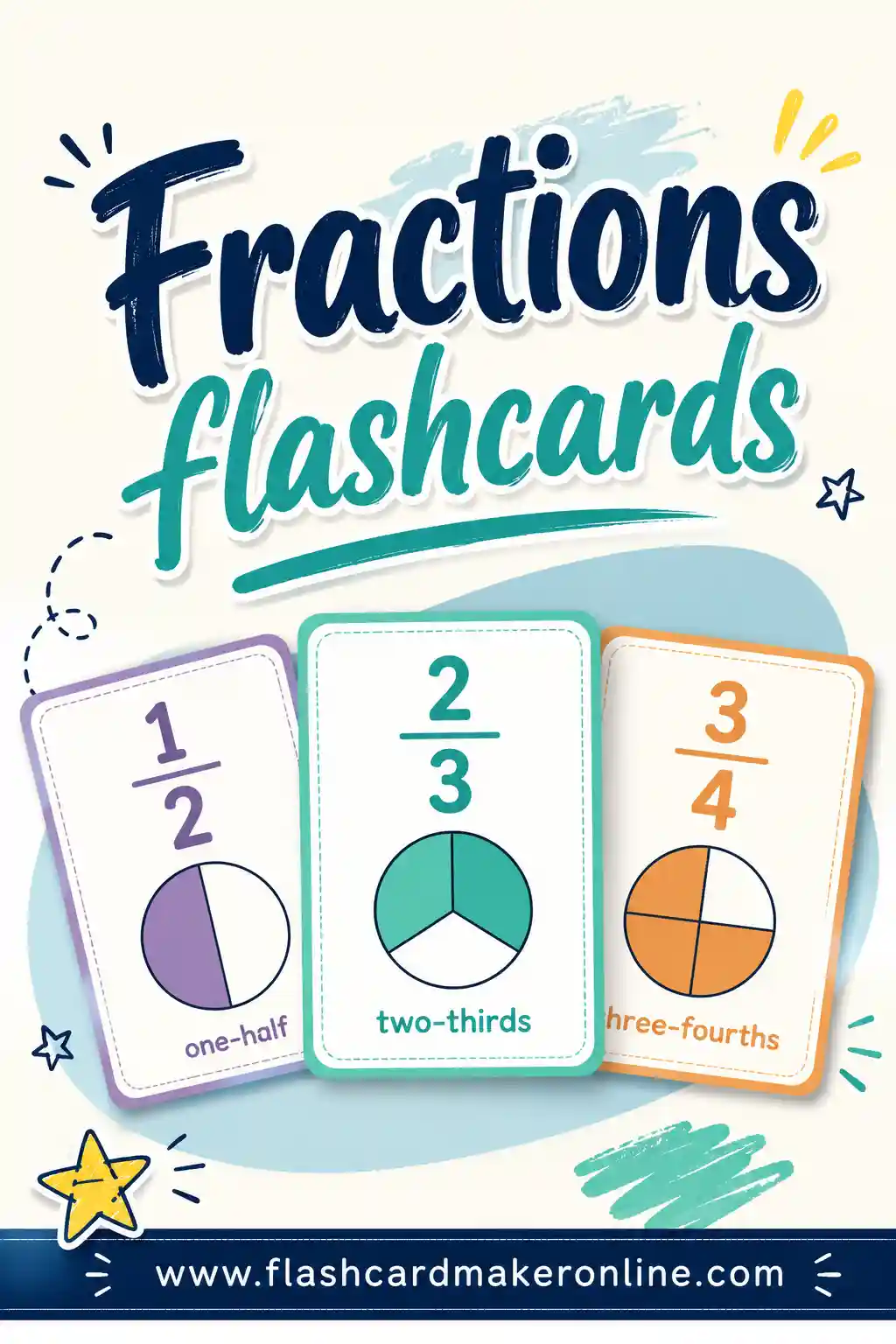
What Are Fractions Flashcards?
Fractions flashcards are a study tool for the facts that make fractions click. Each card holds one fact. The front asks a question, the back gives the answer, and that quick flip-and-check builds the kind of fast recall that turns fractions from scary into easy.
Fractions trip up more kids than almost any other math topic. The reason is that there's a lot to hold in your head: what a fraction means, which fractions are equal, how to simplify, and how fractions connect to decimals and percents. Flashcards break that mountain into bite-sized facts you can drill one at a time.
The real benefit is active recall. When a child sees "3/4 as a decimal" and tries to answer before flipping, that mental effort is what locks the fact in. Kids usually meet fractions in third grade and keep building through middle school, so a good deck pays off for years.
What to Put on Fractions Flashcards
"Fractions" covers a lot of ground, so it helps to know which facts are worth drilling. The best cards target the things kids need to recall instantly.
- Common equivalents. 1/2 = 2/4 = 3/6, and so on. Knowing these by heart speeds up everything else.
- Fraction-to-decimal conversions. 1/4 = 0.25, 3/4 = 0.75, 1/5 = 0.2. These show up constantly.
- Fraction-to-percent conversions. 1/2 = 50%, 1/4 = 25%, 3/4 = 75%.
- Simplifying. 4/8 = 1/2, 6/9 = 2/3. Spotting the simplest form fast saves real time.
- Comparing. Which is bigger, 2/3 or 3/4? Quick comparisons build number sense.
Pick one type per session at first. Drilling all of them mixed together too early just muddles things.
Free Fractions Flashcards: Sample Deck (Copy & Paste)
Here's a ready-to-use deck of the fraction facts kids most need to know cold. Paste these into the flashcard maker and you'll have a printable set in seconds. This mix covers decimals, percents, and equivalents.
| Front (problem) | Back (answer) |
|---|---|
| 1/2 as a decimal | 0.5 |
| 1/4 as a decimal | 0.25 |
| 3/4 as a decimal | 0.75 |
| 1/5 as a decimal | 0.2 |
| 1/10 as a decimal | 0.1 |
| 1/3 as a decimal | 0.333... |
| 1/2 as a percent | 50% |
| 1/4 as a percent | 25% |
| 3/4 as a percent | 75% |
| 1/5 as a percent | 20% |
| 1/2 equals | 2/4 |
| 1/3 equals | 2/6 |
| 2/4 simplified | 1/2 |
| 4/8 simplified | 1/2 |
| 6/9 simplified | 2/3 |
| 3/6 simplified | 1/2 |
| 1/4 + 1/4 | 1/2 |
| 1/2 + 1/4 | 3/4 |
| Which is bigger: 1/2 or 1/3? | 1/2 |
| Which is bigger: 2/3 or 3/4? | 3/4 |
That's 20 cards covering the must-know fraction facts. Add more conversions (eighths, sixths) as your child is ready.
Group cards by skill
Don't drill everything mixed at first. Cluster by type, master each, then shuffle:
- Decimal conversions (1/2 = 0.5, the everyday ones)
- Percent conversions (great for real-life money and grades)
- Equivalents (which fractions are secretly equal)
- Simplifying (spotting the simplest form fast)
- Comparing (which fraction is bigger)
How to Make Fractions Flashcards in 4 Steps
No design skills needed. Here's the whole thing.
- Pick your facts. Start with one skill type, or paste the full sample deck above.
- Type them in. Question on the front, answer on the back. The flashcard maker keeps each pair together.
- Choose study or print. Flip through on screen, or print a stack to cut out.
- Practice a little daily. Short, frequent sessions beat one long grind.
Print on cardstock if you can. Fraction decks get a lot of shuffling, and plain paper wears out fast.
Smart Ways to Study Fractions Flashcards
Plain flipping helps, but these tweaks make practice far more effective.
Use the three-pile method
As you flip, build three piles: know it cold, almost, and needs work. Spend most of your time on "needs work," check "almost" sometimes, and run "know it" once in a while. You'll target the facts that need attention.
Space your reviews out
Don't grind the same cards for twenty minutes straight. Review a fact today, again tomorrow, then a few days later. Each successful recall makes it stick longer. This is spaced repetition, the most powerful study habit there is, and it's free.
Picture the fraction
Fractions are easier when kids can see them. Tie a card to a real image: 1/2 is half a pizza, 1/4 is one slice of four. Once the picture is solid, the recall comes faster.
Say it out loud
Speaking the answer beats thinking it silently. It uses more of the brain and makes the fact stickier. It also lets you catch guessing.
Connect cards to real life
Fractions live everywhere once you start looking. Half a sandwich, a quarter of an hour, 50% off at the store, a recipe that needs 3/4 of a cup. When a card matches something your child already knows, it stops being abstract. Point out fractions during the day, then let the flashcards drill the formal version. The two reinforce each other.
Tackle one denominator at a time
Halves, then fourths, then eighths. Building up through related denominators helps kids see how the pieces nest inside each other: two fourths make a half, two eighths make a fourth. Jumping straight to messy numbers like sevenths or ninths before the friendly ones are solid just creates confusion. Walk up the ladder one rung at a time.
Fractions Flashcards by Grade Level
The right facts depend on where your child is. Here's a rough guide.
| Grade | Focus | Good card range |
|---|---|---|
| 3rd grade | What fractions mean, simple equivalents | 1/2 = 2/4 |
| 4th grade | Equivalents, comparing, simplifying | 6/9 = 2/3 |
| 5th grade | Decimals and percents, adding | 3/4 = 0.75 |
| 6th grade+ | Mixed review, harder conversions | Timed mixed deck |
Treat these as a guide, not a rulebook. Some kids race ahead, others need more time. Drill the facts they're missing, not the ones a chart assigns.
Printing Tips for Sturdy, Reusable Cards
A few small choices make your deck last.
- Use cardstock. It survives shuffling and rough handling far better than printer paper.
- Print double-sided. Question on the front, answer on the back, like store-bought sets.
- Laminate or sleeve them. Then they shrug off spills and last for years.
- Run a test page. Check your margins before printing the whole stack.
- Keep the print big. Fractions have small numbers, so larger type really helps young eyes.
No printer? Flip through the deck right on screen in the flashcard maker, perfect for a tablet on the go.
Making Practice Fun
Fractions have a scary reputation, so a little play helps a lot.
- Beat the clock. Race through the deck and try to beat yesterday's run.
- Match-up game. Spread cards face up and match each fraction to its decimal twin.
- Pizza props. Use a paper pizza or measuring cups so kids can see the fraction they just answered.
- Sticker streak. A sticker per session, building toward a small treat.
Keep rewards small and the mood light. The goal is to make a feared topic feel friendly.
Common Mistakes to Avoid
A few easy missteps can make fractions harder than they need to be. Watch for these.
- Mixing every skill at once. Decimals, percents, equivalents, and simplifying all at the same time is overwhelming. Drill one type, master it, then combine.
- Skipping the picture. Numbers alone feel abstract. Tie each card to something visual, like slices of a pizza, so the meaning sticks.
- Ignoring multiplication and division. Simplifying and finding equivalents lean on those facts. Shaky times tables make fractions feel impossible.
- A stack that's too big. Eight to twelve cards beats fifty. Grow the deck slowly.
- Cramming once a week. Short daily sessions beat one long grind. Spread it out.
None of these are dealbreakers. They're the small fixes that make a feared topic feel friendly.
Once fractions click, round out your math practice with our division flashcards, times tables flashcards, and addition flashcards.
Frequently Asked Questions
When should kids start fractions flashcards?
Usually third grade, once they understand what a fraction means (parts of a whole). Start with simple equivalents like 1/2 = 2/4, then move to decimals and percents in fourth and fifth grade as they're ready.
How many fractions flashcards at once?
Keep it to 8 to 12 cards per session for young kids, and stick to one skill type at first (say, just decimal conversions). Master that batch, then add the next. Mixing everything too early just confuses things.
Are these fractions flashcards really free to print?
Yes. You make and print them yourself at no cost. There's no sign-up and no watermark, so you can build a full set for one child or a whole class on a single free deck.
Why do kids struggle so much with fractions?
There's a lot to hold at once: meaning, equivalents, simplifying, and the links to decimals and percents. The fix is to break it into one fact type at a time, tie each card to a picture (half a pizza), and drill with spaced repetition so the facts stick.
What's the best way to study flashcards effectively?
Use active recall (answer before flipping), sort cards into know-it and needs-work piles, and space practice across several days. Short daily sessions beat one long cram. Those three habits do most of the work.
Can I study without printing?
Yes. The flashcard maker lets you flip through the deck right on screen, on a phone, tablet, or computer. Great for practice on the go.
Ready to Build Your Fractions Flashcards?
Grab the sample deck above, open the free flashcard maker, and you'll have a stack of printable fractions flashcards in minutes. It's free, there's no sign-up, and you can study on screen or on paper. Take one skill at a time, tie each card to a picture, and watch fractions go from feared to easy.