GRE Flashcards: Free, Printable & Easy to Study
GRE flashcards put a word, math fact, or concept on the front and the meaning or answer on the back, like "garrulous" → "talkative" or "area of a circle" → "πr²." You flip the card, recall the answer, and review what you miss. The fastest way to build a full set is a free flashcard maker that turns your study list into clean, printable flip cards you can quiz from on your phone or on paper.
Want to start studying right now? Open the free flashcard maker, paste in a word or formula list (there's a ready-made one below), and you'll have a deck of flip-style cards in under a minute. No sign-up, no app to install, and you can print the whole deck for offline review before test day.
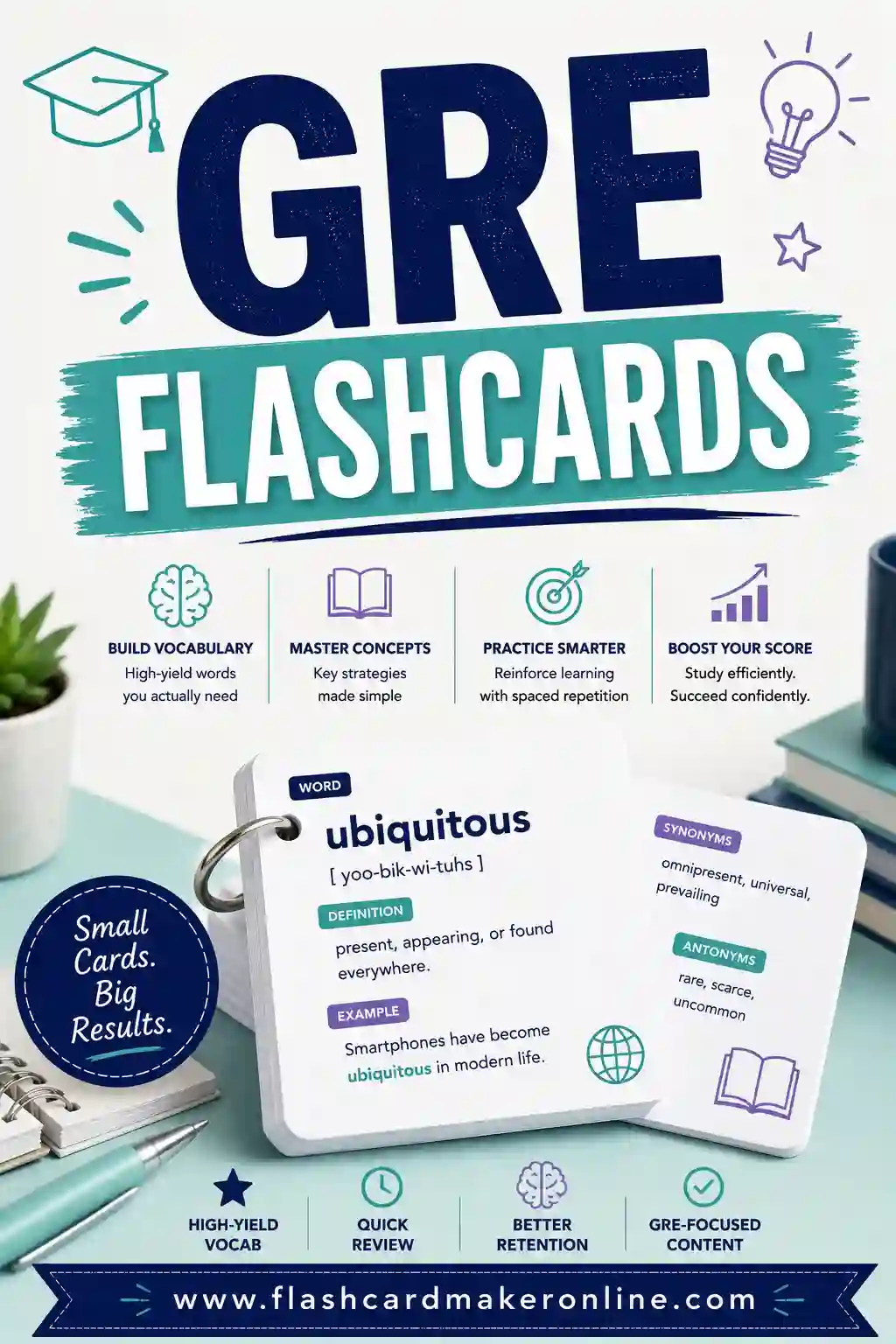
What Are GRE Flashcards?
The GRE is the exam many programs use for graduate admissions. It tests verbal reasoning, quantitative reasoning, and analytical writing. The verbal section leans heavily on advanced vocabulary, and the quant section rewards knowing core formulas cold. Both are perfect for flashcards.
A GRE flashcard puts a prompt on the front and a focused answer on the back. For verbal, that's a word and its meaning. For quant, that's a concept or formula and its definition. When you try to answer before you flip, you're using active recall, the most reliable way to make information stick.
You'll study cards two ways:
- Prompt to answer. See "ephemeral," recall "lasting a short time." See "area of a circle," recall "πr²."
- Answer to prompt. See a definition, recall the word. This deeper link helps you spot the right answer fast on test day.
Why Flashcards Are Ideal for the GRE
GRE prep is mostly memorization layered on top of practice. Flashcards handle the memorization part better than any other method.
- Active recall. Producing an answer from memory is exactly what the test demands. Practice it now.
- Spaced repetition. Sorting cards into "got it" and "missed it" piles drills your weak spots more often, which is how memory works best.
- Two subjects, one method. The same deck format handles GRE vocab and quant formulas, so your system stays simple.
- Daily reps. A few minutes a day over weeks beats a giant cram session. Flashcards make daily reps easy.
Keep each card short. One word, one meaning. One formula, one clean statement. Long cards slow you down and get skipped.
Free GRE Word & Formula List (Copy & Paste)
Here's a ready-to-use mix of common GRE vocabulary and core quant facts. Put the prompt on the front and the answer on the back. Copy any rows into the flashcard maker and it builds the flip cards for you.
| Prompt (front) | Answer (back) |
|---|---|
| Garrulous | Talkative; chatty |
| Laconic | Using few words; brief |
| Ephemeral | Lasting a very short time |
| Ubiquitous | Found everywhere; very common |
| Pragmatic | Practical; focused on results |
| Ambivalent | Having mixed feelings |
| Capricious | Changing suddenly; unpredictable |
| Pedantic | Overly concerned with small details or rules |
| Esoteric | Understood by only a few; obscure |
| Mitigate | To make less severe |
| Prosaic | Dull; ordinary |
| Sycophant | A person who flatters to gain favor |
| Tacit | Understood without being said |
| Verbose | Using too many words |
| Zealous | Full of energy and enthusiasm |
| Area of a circle | Pi times radius squared (πr²) |
| Area of a triangle | One half base times height |
| Pythagorean theorem | a² + b² = c² for right triangles |
| Prime number | A number divisible only by 1 and itself |
| Slope formula | Change in y over change in x |
| Average (mean) | Sum of values divided by the count |
| Percent change | (New − old) ÷ old, times 100 |
That's 22 cards to start, mixing verbal and quant. Build separate decks, one for vocab and one for formulas, so you can drill each on its own schedule.
Keep vocab and quant in separate decks
It's tempting to throw everything in one pile, but verbal and quant use different parts of your brain. Separate decks let you study words on the bus and formulas at your desk, and they make your "missed" piles easier to manage. Two focused decks beat one messy stack.
How to Make GRE Flashcards in 4 Steps
No special software needed. Here's the whole process.
- Split by subject. One deck for vocabulary, one for math facts. Around 20–25 cards each.
- Add your cards. Prompt on the front, answer on the back. Paste your list and the maker splits it into cards.
- Study and sort. Flip through and split into "know it" and "missing it" piles.
- Print or study online. Flip cards on screen, or print the deck for screen-free review.
That's it. Your first deck takes about ten minutes.
What to Focus On for Each Section
The GRE has two main content areas worth building decks around.
- Verbal reasoning. Advanced vocabulary is the highest-yield target. Words like "laconic," "esoteric," and "mitigate" show up in text completion and sentence equivalence questions.
- Quantitative reasoning. Core formulas and number properties. Know your geometry formulas, percent change, and prime numbers cold so you don't waste time deriving them.
- Word roots. Learning roots like "loqu/locu" (speak) helps you decode unfamiliar words, which is gold on the verbal section.
You don't need to memorize thousands of obscure words. A few hundred high-frequency GRE words, drilled well, cover most of what you'll see.
Study Tips That Actually Work for the GRE
A few habits make a long prep stretch far more effective.
| Tip | Why it helps |
|---|---|
| Study in short bursts | 15–20 minutes a day beats rare cram sessions |
| Shuffle the deck | Stops you memorizing the order, not the content |
| Use vocab in a sentence | Active use locks meaning in better than reading |
| Drill your missed pile | Spaced repetition focuses time on weak cards |
| Learn roots and prefixes | One root unlocks a family of words |
| Mix in practice questions | Flashcards build recall; practice builds test stamina |
The biggest gains come from the missed pile. Set aside every card you can't answer, then review just that smaller stack again. Pair this with full practice questions and you'll cover both memory and timing.
Who GRE Flashcards Help
GRE prep looks different for different people, and flashcards fit them all.
Prospective grad students
If you're applying to master's or PhD programs, flashcards build vocabulary and formula recall steadily over the months before your test. Daily reps add up without overwhelming your schedule.
Career changers returning to school
If it's been years since you took a standardized test, flashcards rebuild the math facts and academic vocabulary fast. Start with the formula deck to knock the rust off.
Students who already took the SAT
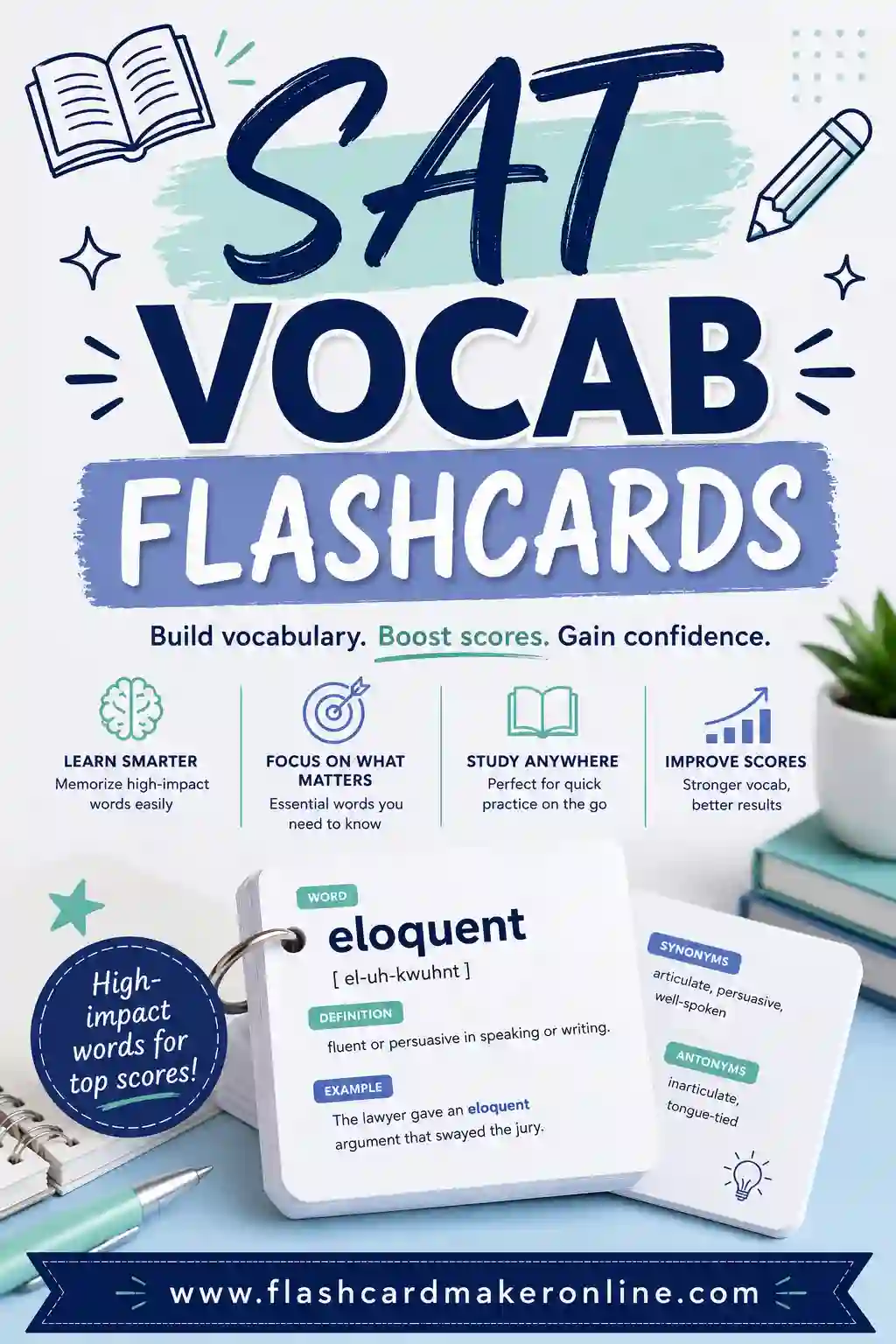
If you prepped for the SAT, you've got a head start. The methods carry over. Build on what worked with our SAT vocab flashcards and level up the difficulty.
Busy professionals studying part-time
If you're prepping around a job, short flashcard sessions fit into the gaps in your day. Ten cards at lunch is real progress.
A Sample GRE Study Plan With Flashcards
A deck is only as good as the schedule you run it on. The test-takers who score well usually aren't the ones who crammed the hardest, they're the ones who studied a little every day for weeks. Flashcards make that steady pace easy to keep.
Here's a simple rhythm that works for a lot of people:
| Phase | Focus | Daily flashcard work |
|---|---|---|
| Weeks 1–4 | Build vocab and formula decks | 20–25 new cards |
| Weeks 5–8 | Mix new with heavy review | 10 new + 25 review |
| Final 2 weeks | Review only, drill weak spots | Missed pile + 30 review |
Notice that new cards taper off as the test nears. In the last stretch you shouldn't be meeting fresh words, you should be tightening up what you already know and clearing your missed pile. Adding brand-new material in the final days just crowds out the recall you've worked to build.
A few habits keep this plan working. Study at the same time each day so review becomes automatic instead of a decision you have to make. Keep your vocab deck on your phone for spare moments and your formula deck at your desk for focused sessions. And track your missed pile week over week, because when it shrinks, you have real proof you're getting ready, which calms test-day nerves.
The other half of GRE prep is timed practice. Flashcards build the raw recall of words and formulas, but only full practice sections build the pacing the test demands. Do one or two timed sections a week alongside your daily cards. The flashcards make those sections feel easier, because you're not burning clock time trying to remember what "laconic" means or how to find the area of a circle.
Above all, measure progress by what you can answer cold, not by how many cards you've flipped. A deck you can run front to back without hesitation is worth far more than three decks you've only skimmed.
Printing and Reusing Your Cards
If you like studying on paper, a few choices help the deck last through weeks of prep.
- Use cardstock. It holds up to daily shuffling far better than copy paper.
- Print double-sided so each answer lands behind its prompt.
- Punch a corner and add a ring so the deck stays together in your bag.
- Color-code by subject with a highlighter dot to grab the vocab or formula deck fast.
- Print a test page first to check that fronts and backs line up.
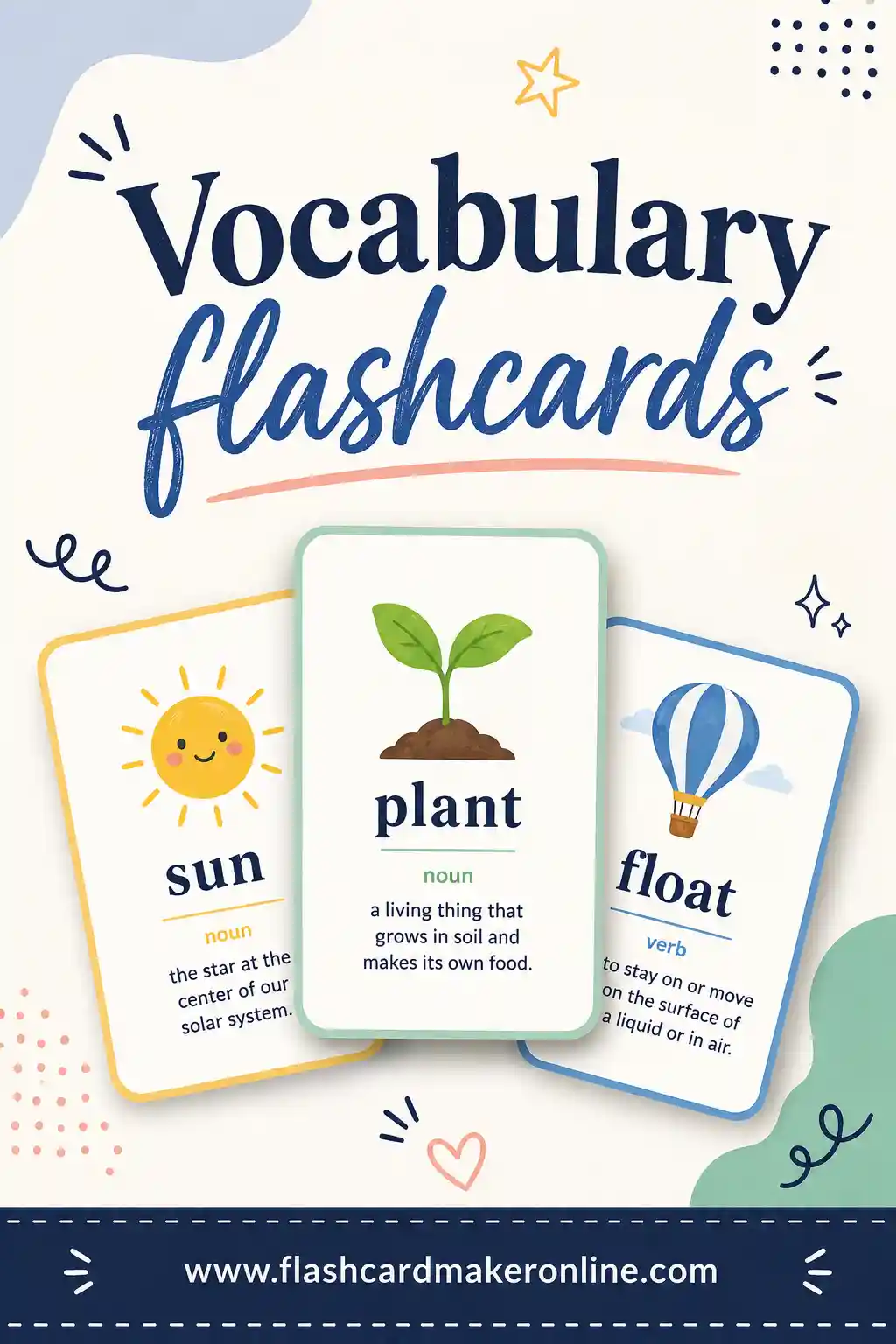
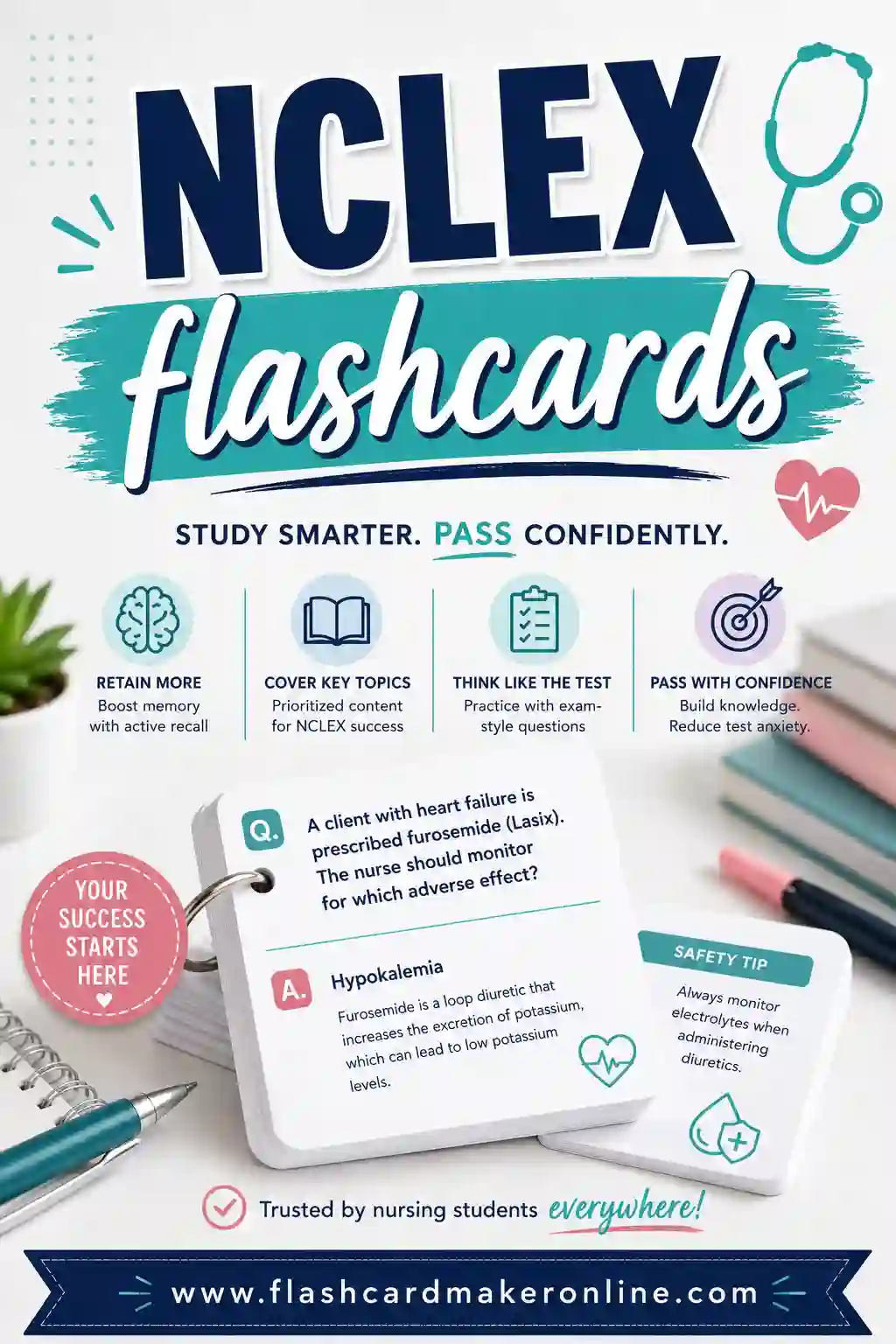
Want a broader study system? The same flip-card method works for any subject. See our general vocabulary flashcards approach, and if you're heading into a health program, our NCLEX flashcards use the same method.
Frequently Asked Questions
How many GRE flashcards do I need?
Enough to cover your high-frequency words and core formulas, split into small decks. A deck of 20–25 cards is easy to study in one sitting. Make as many decks as you need with the free flashcard maker.
What should go on a GRE flashcard?
For vocab, put the word on the front and a short meaning (plus an example) on the back. For quant, put the concept on the front and the formula or rule on the back. Keep each back short enough to read in a few seconds.
Are these GRE flashcards free to print?
Yes. You make and print them yourself at no cost. There's no sign-up and no watermark, so you can build a full vocab and formula system for free.
How many vocabulary words should I learn for the GRE?
A few hundred high-frequency GRE words covers most of what you'll see. You don't need thousands of obscure terms. Focus on common words, drill them well, and learn roots to decode the rest.
Can I study GRE flashcards on my phone?
Yes. The flip cards work in your browser, so you can review on your phone any time. You can also print the deck for screen-free study before the test.
Should I use flashcards or practice tests?
Use both. Flashcards build the recall of words and formulas. Practice tests build timing and stamina. Flashcards make the practice questions easier because you're not stuck recalling basics.
Ready to Build Your GRE Flashcards?
Grab the word and formula list above, open the free flashcard maker, and you'll have a deck of flip-style GRE cards in minutes. It's free, there's no sign-up, and you can print the whole set or quiz yourself on your phone. Build your vocab deck and your formula deck today, drill your missed pile, and walk into the GRE ready.