NCLEX Flashcards: Free, Printable & Easy to Study
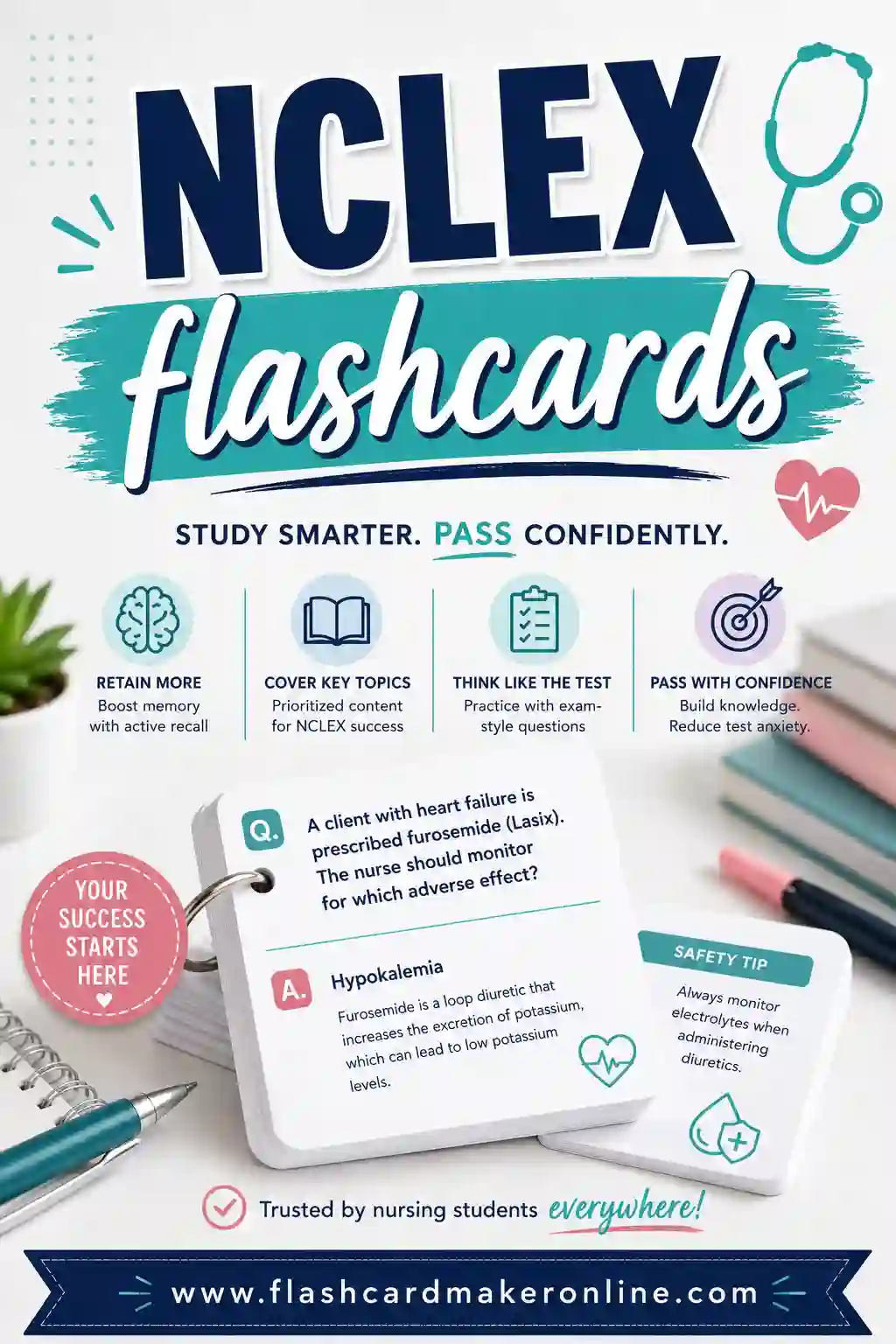
NCLEX flashcards put a nursing concept, lab value, or priority question on the front and the answer you need to recall on the back, like a normal range, a safety step, or which patient to see first. You flip the card, answer out loud, and review the ones you miss. The quickest way to build a full review deck is a free flashcard maker that turns your study list into clean, printable flip cards you can quiz from anywhere.
Want to start studying right now? Open the free flashcard maker, paste in a review list (there's a ready-made one below), and you'll have a deck of flip-style NCLEX cards in under a minute. No sign-up, no app, and you can print the whole deck for offline review before boards.
What Are NCLEX Flashcards?
The NCLEX is the licensing exam that decides whether you become a registered or practical nurse. It covers a huge range of material: lab values, medications, safety, priority setting, and the kind of "who do I see first?" judgment that nursing is built on. That's a lot to hold in your head.
NCLEX flashcards break it into small, testable pieces. The front asks a question or names a concept. The back gives the answer you need to recall fast on test day. When you try to answer before you flip, you're using active recall, which builds memory far better than re-reading your review book.
You'll study cards two ways:
- Fact recall. See a lab name, recall the normal range. Quick, high-yield, and easy to make.
- Judgment prompts. See a short scenario, pick the priority or first action. This trains the thinking the NCLEX really tests.
Why Flashcards Are Perfect for NCLEX Prep
The NCLEX rewards two things: knowing your facts cold and thinking through priorities. Flashcards train both.
- Active recall. Pulling an answer from memory is what you'll do on test day. Practice it now, not the night before.
- Spaced repetition. Sorting cards into "got it" and "missed it" means you review weak spots more often, which is exactly how memory works.
- Bite-sized prep. You can run 15 cards on a break. NCLEX prep is a marathon, and small daily reps beat rare cram sessions.
- Built-in priority practice. A card that asks "who do you see first?" forces the same judgment the exam demands.
Keep each card short. One question, one clean answer. If a card needs a paragraph, it's really two cards.
Free NCLEX Review List (Copy & Paste)
Here's a ready-to-use mix of high-yield facts and priority prompts. Use the question as the front and the answer as the back. Copy any rows into the flashcard maker and it builds the flip cards for you.
| Question (front) | Answer (back) |
|---|---|
| Normal potassium level? | 3.5 to 5.0 mEq/L |
| Normal sodium level? | 135 to 145 mEq/L |
| Normal blood glucose (fasting)? | 70 to 100 mg/dL |
| Normal adult heart rate? | 60 to 100 beats per minute |
| Normal adult respiratory rate? | 12 to 20 breaths per minute |
| Signs of hypoglycemia? | Shaky, sweaty, confused — give fast sugar |
| Signs of hyperkalemia? | Peaked T waves, muscle weakness, watch the heart |
| First step in any emergency? | Assess airway, breathing, circulation (ABCs) |
| Maslow priority order? | Physiologic needs come before safety or psychosocial |
| Who do you see first? | The least stable / most physiologic-risk patient |
| Normal oxygen saturation? | 95% or higher on room air |
| INR therapeutic range (warfarin)? | About 2.0 to 3.0 for most patients |
| Antidote for warfarin? | Vitamin K |
| Antidote for heparin? | Protamine sulfate |
| Antidote for opioids? | Naloxone |
| Safe needle disposal? | Sharps container, never recap |
| Standard precautions apply to? | Every patient, every time |
| Best way to prevent infection spread? | Hand hygiene |
| Position for shock? | Flat with legs raised (unless contraindicated) |
| Position to ease breathing? | Upright / high Fowler's |
| Normal urine output (adult)? | About 30 mL/hour or more |
| Delegation rule? | Don't delegate assessment, teaching, or unstable patients |
That's 22 high-yield cards to start. Build a few decks like this, one per topic such as lab values, safety, or priority setting, and you'll cover the exam without burning out.
Mix fact cards and scenario cards
Pure fact cards (lab values, antidotes) are fast wins. But the NCLEX leans on judgment, so add cards that make you choose: which patient first, what action first, what to delegate. Practicing that decision under low pressure now makes it feel familiar on test day.
How to Make NCLEX Flashcards in 4 Steps
No special tools needed. Here's the whole process.
- Pick a topic. Lab values, meds, safety, or priority — one focus per deck.
- Add your cards. Question on the front, the answer on the back. Paste your list and the maker splits it into cards.
- Study and sort. Flip through and split into "know it" and "missing it" piles.
- Print or review online. Flip cards on screen, or print the deck for study away from a screen.
That's it. The first deck takes ten minutes; after that you'll fly.
High-Yield Topics to Build Decks Around
If you're not sure where to start, these topics show up again and again on the NCLEX.
- Lab values. Memorize the common normal ranges and the danger signs when they swing.
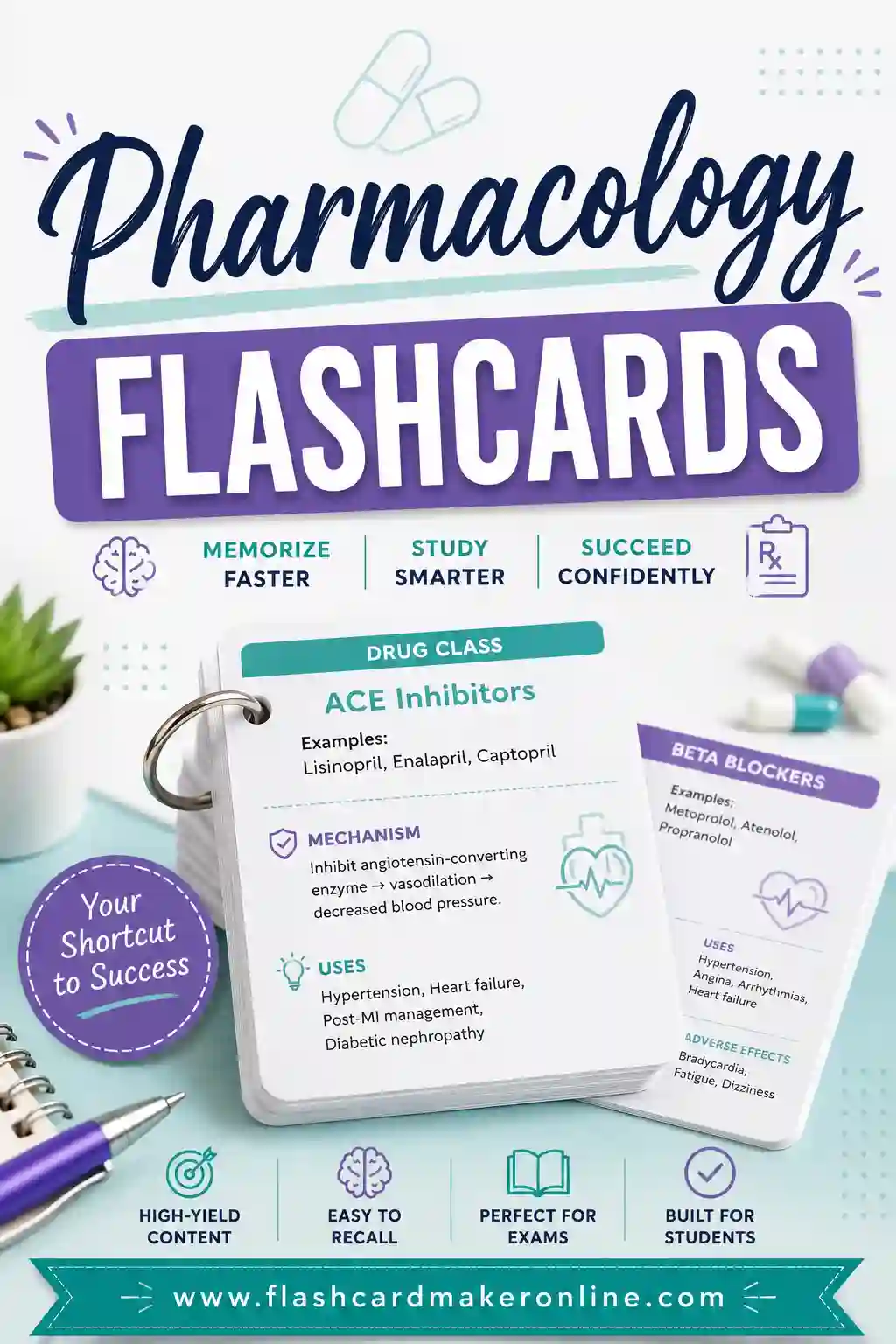
- Medications. Classes, side effects, and antidotes. Pair this with our pharmacology flashcards for a deeper drug deck.
- Safety and infection control. Standard precautions, hand hygiene, fall risk, and delegation.
- Priority setting. ABCs, Maslow, and "who do you see first?" scenarios.
- Maternal and newborn care. Normal findings, warning signs, and key teaching points.
A handful of focused decks beats one giant pile. You'll review faster and feel less buried.
Study Tips That Actually Work for NCLEX Prep
A few habits make a real difference over a long study stretch.
| Tip | Why it helps |
|---|---|
| Study in short bursts | 15–20 minutes a day beats rare cram sessions |
| Answer out loud | Speaking adds a second memory pathway |
| Shuffle the deck | Stops you memorizing the order, not the content |
| Keep a "missed" pile | Spaced repetition locks in your weak spots |
| Add rationale to backs | Knowing why beats memorizing what |
| Mix old and new cards | Keeps earlier topics from fading |
The most useful habit is the missed pile. Every card you can't answer goes to a smaller stack you review again at the end. Those cards are exactly where your study time pays off most.
Who NCLEX Flashcards Help
These cards fit anyone heading toward the licensing exam.
Nursing students prepping for boards
If you're in your final term or studying full-time for the NCLEX, flashcards give you structured daily reps. Sort your weak topics into their own decks and hit them more often.
New grads who delayed the exam
If life got in the way and your boards are months out from graduation, flashcards rebuild the facts fast. Start with lab values and meds, then layer in priority scenarios.
Repeat test-takers
If you're retaking the exam, decks let you target exactly what tripped you up last time. Build a deck of your missed topics and drill it daily.
Educators and tutors
Instructors can hand students a shared list and have everyone build the same deck. It's a simple, free way to standardize a study set.
Building a Study Schedule Around Your Cards
A deck only helps if you actually run it on a schedule. The students who pass on the first try usually aren't the ones who studied the hardest in one stretch, they're the ones who studied a little every day for weeks. Flashcards make that kind of steady pace easy.
A simple rhythm that works for a lot of test-takers:
| Phase | Focus | Cards per day |
|---|---|---|
| Early (weeks out) | Build decks, learn facts | 20–30 new |
| Middle | Mix new with review | 15 new + 20 review |
| Final week | Review only, drill weak spots | Missed pile + 30 review |
The key is that new cards taper off as the test nears, and review ramps up. In the last week you shouldn't be meeting fresh material, you should be tightening up what you already know and clearing your missed pile.
Two more things keep a schedule honest. First, study at the same time each day if you can, since a fixed slot turns review into a habit instead of a decision. Second, track your missed pile over time. When that pile shrinks week over week, you've got real proof you're ready, which does wonders for test-day nerves.
Pair this card routine with full-length practice questions once or twice a week. Flashcards build the recall; practice questions build the stamina and timing the NCLEX demands. Together they cover both halves of the exam.
Printing and Reusing Your Cards
If you prefer paper, a few choices make the deck last through months of prep.
- Use cardstock. It holds up to daily shuffling far better than copy paper.
- Print double-sided so each answer lands behind its question.
- Punch a corner and add a ring so the deck stays together in your bag.
- Color-code by topic with a highlighter dot, so you can grab the lab-values deck fast.
- Print a test page first to confirm fronts and backs line up.
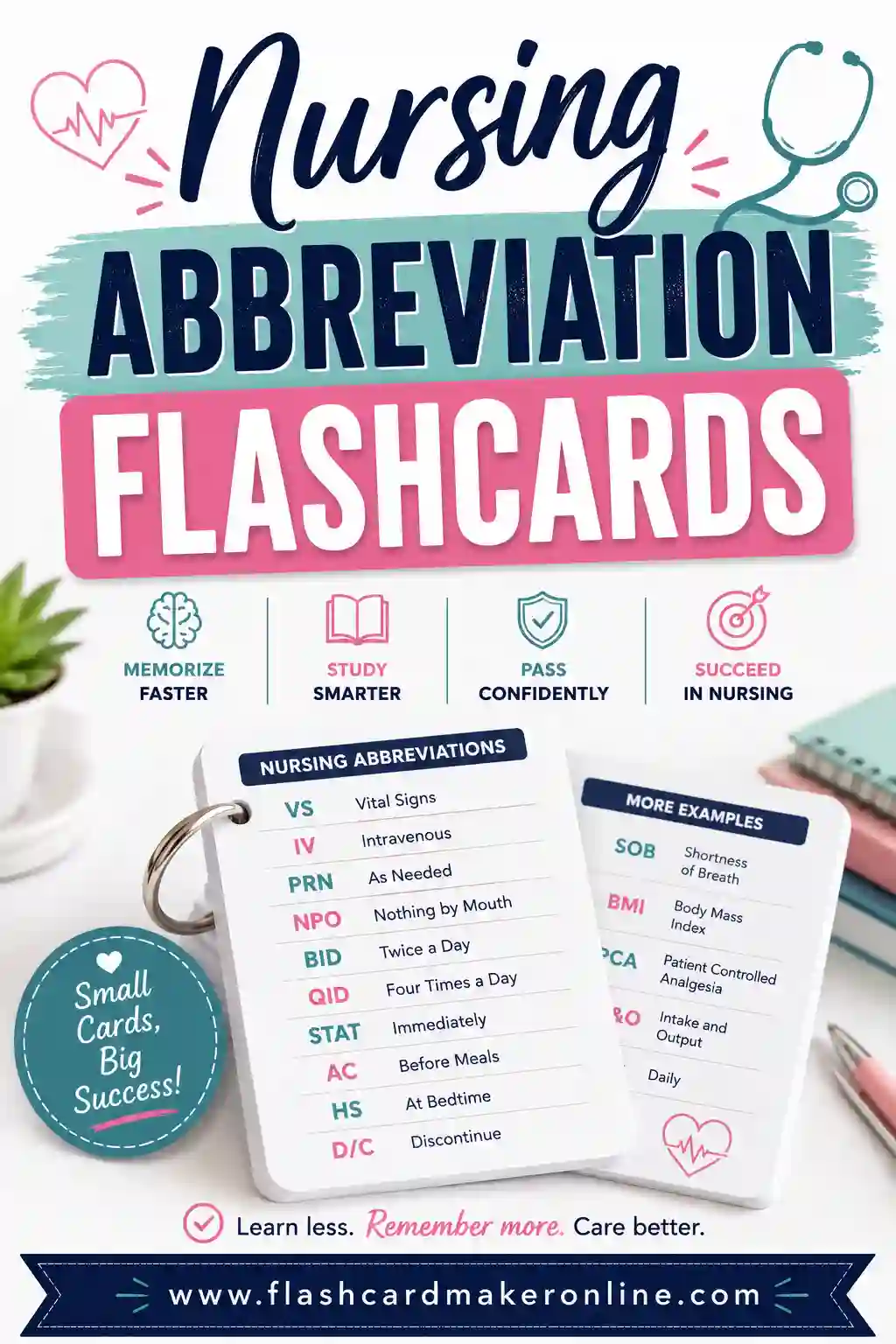
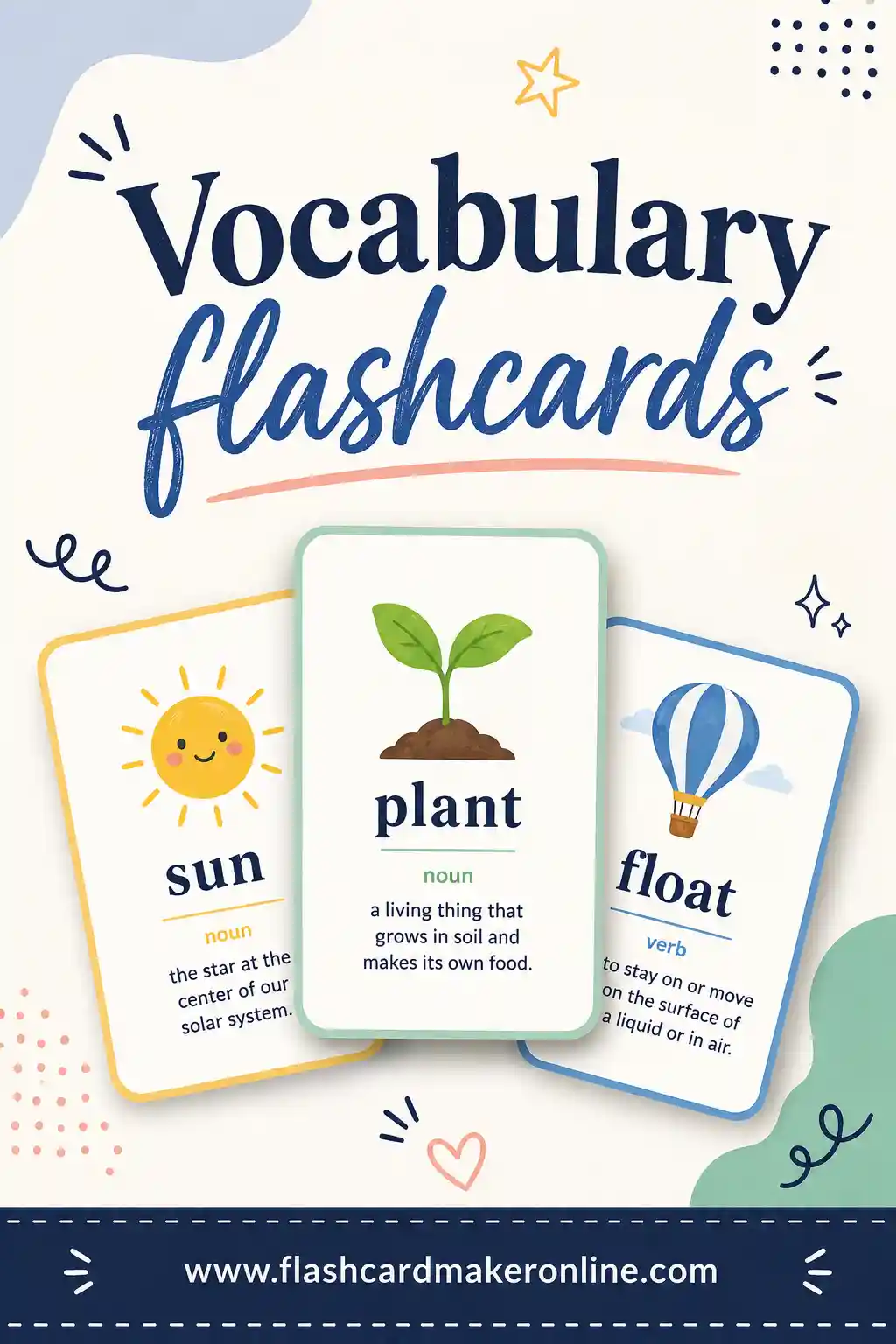
Want to expand your study system? The same flip-card method works for any subject. See how we approach it with our vocabulary flashcards and nursing abbreviation flashcards.
Frequently Asked Questions
How many NCLEX flashcards do I need?
Enough to cover your weak topics, split into small decks. A deck of 20–30 cards per topic is easier to study than one giant stack. Make as many decks as you need with the free flashcard maker.
What should go on an NCLEX flashcard?
Put a question or concept on the front and the answer on the back. For judgment topics, write a short scenario on the front and the priority action on the back. Add a one-line rationale when it helps you remember why.
Are these NCLEX flashcards free to print?
Yes. You make and print them yourself at no cost. There's no sign-up and no watermark, so you can build a full review system for boards for free.
What topics should I focus on for the NCLEX?
Start with lab values, medications, safety and infection control, and priority setting. These show up constantly. Build a separate deck for each so you can drill your weakest area more often.
Can I study NCLEX flashcards on my phone?
Yes. The flip cards work in your browser, so you can review on your phone during any spare minute. You can also print the deck for screen-free study.
Should I make my own cards or buy a set?
Make your own. Writing the card is a study step itself, and you can tailor each one to your course and the topics you keep missing. The maker just turns your list into flip cards fast.
Ready to Build Your NCLEX Flashcards?
Grab the review list above, open the free flashcard maker, and you'll have a deck of flip-style NCLEX cards in minutes. It's free, there's no sign-up, and you can print the whole set or quiz yourself on your phone. Pick one topic today, sort your missed cards, and build the confidence to pass on the first try.