SAT Vocab Flashcards: Free, Printable & Easy to Study
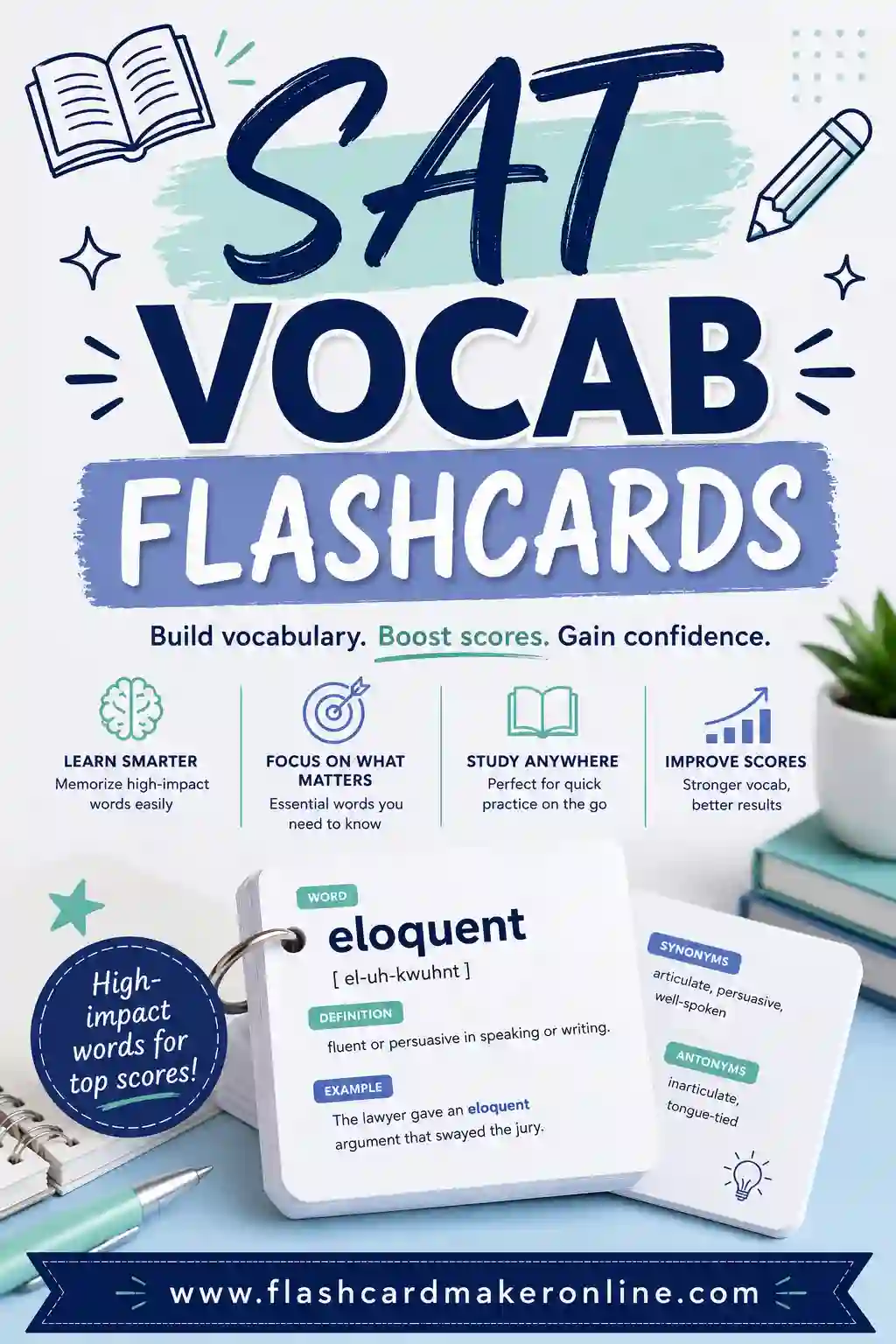
SAT vocab flashcards put a word on the front, like "ameliorate," and its meaning on the back, like "to make something better." You flip the card, recall the meaning, and review the words you miss. The fastest way to build a full study set is a free flashcard maker that turns your word list into clean, printable flip cards you can quiz from on your phone or on paper.
Want to start studying right now? Open the free flashcard maker, paste in a word list (there's a ready-made one below), and you'll have a deck of flip-style cards in under a minute. No sign-up, no app to install, and you can print the whole deck for quick review between classes.
What Are SAT Vocab Flashcards?
The SAT doesn't ask for dictionary definitions the way older tests did, but vocabulary still matters. The reading and writing sections lean on knowing what words mean in context, and a strong vocabulary helps you move faster and guess smarter on tough passages.
SAT vocab flashcards make learning words manageable. The front shows a word. The back shows a plain-English meaning, and ideally a quick example. When you try to recall the meaning before you flip, you're using active recall, which beats reading a vocabulary list over and over.
You can study these two ways:
- Word to meaning. See "frugal," recall "careful with money." This is the core skill the SAT tests.
- Meaning to word. See a definition, recall the word. This builds the deeper link that helps you use the word, not just recognize it.
Why Flashcards Beat a Vocabulary List
Most students try to learn SAT words by reading a long printed list. It feels like studying, but it's one of the weakest methods. Flashcards work far better.
- Active recall. A card makes you produce the meaning. A list just lets your eyes drift past it.
- Spaced repetition. Sorting cards into "know it" and "missed it" piles means you review the hard words more often.
- Context sticks. Add a short example sentence to each back and the word lands in a real situation, not in a vacuum.
- Portable practice. A deck of 20 words fits in a pocket. You can review on the bus or before practice.
Keep each card simple: one word, a short meaning, and one example. That's all you need.
Free SAT Vocab Word List (Copy & Paste)
Here's a ready-to-use set of common SAT-level words with plain meanings. Put the word on the front and the meaning on the back. Copy any rows into the flashcard maker and it builds the flip cards for you.
| Word (front) | Meaning (back) |
|---|---|
| Ameliorate | To make something better; improve |
| Candid | Honest and direct |
| Frugal | Careful with money; thrifty |
| Pragmatic | Practical; focused on what works |
| Verbose | Using too many words |
| Tenacious | Holding on firmly; persistent |
| Benevolent | Kind and generous |
| Cryptic | Mysterious; hard to understand |
| Diligent | Hardworking and careful |
| Eloquent | Speaking clearly and persuasively |
| Gregarious | Sociable; enjoys being with people |
| Hinder | To slow down or block progress |
| Indifferent | Not caring either way |
| Lucid | Clear and easy to understand |
| Meticulous | Very careful about details |
| Novel | New and original |
| Obscure | Not well known; hard to see |
| Prudent | Wise and cautious |
| Resilient | Able to recover quickly |
| Scrutinize | To examine closely |
| Superfluous | More than is needed; extra |
| Trivial | Of little importance |
| Vindicate | To clear of blame; prove right |
| Wary | Cautious; on guard |
| Zealous | Full of energy and enthusiasm |
That's 25 words to start. Build a few decks like this, maybe 20–25 words each, and you can grow your vocabulary steadily without cramming a thousand words the night before.
Add an example sentence to each card
A definition alone fades fast. A word inside a sentence sticks. On the back of each card, add a short example, like "She was frugal, so she packed lunch instead of eating out." Context turns a word you recognize into a word you can actually use.
How to Make SAT Vocab Flashcards in 4 Steps
No special tools needed. Here's the whole process.
- Pick a word set. Group words by theme or difficulty, around 20–25 per deck.
- Add your cards. Word on the front, meaning (and an example) on the back. Paste your list and the maker splits it into cards.
- Study and sort. Flip through and split into "know it" and "missing it" piles.
- Print or study online. Flip cards on screen, or print the deck for screen-free review.
That's it. Your first deck takes about ten minutes.
Smart Ways to Group Your Words
Random word lists are hard to remember. Grouped lists are easier, because related words reinforce each other. Try decks like these:
- By feeling. Positive words (benevolent, eloquent) versus negative words (verbose, indifferent).
- By root. Words sharing a root, like "bene-" (good) in benevolent and benefactor, teach you to guess unknown words.
- By passage type. Words common in science passages versus literature passages.
- By difficulty. A "tricky" deck of the words you keep missing, drilled more often.
Roots are especially powerful. Learn that "bene" means good and "mal" means bad, and you can decode dozens of words you've never seen before, which is exactly the skill the SAT rewards.
Study Tips That Actually Work for SAT Vocab
A few habits make vocabulary stick much faster.
| Tip | Why it helps |
|---|---|
| Study in short bursts | 15 minutes a day beats one long cram session |
| Shuffle the deck | Stops you memorizing the order instead of the words |
| Use each word in a sentence | Active use locks meaning in far better than reading |
| Drill your missed pile | Spaced repetition focuses time on weak words |
| Learn roots and prefixes | One root unlocks a whole family of words |
| Quiz a friend | Teaching a word proves you really know it |
The biggest gains come from the missed pile. Set aside every word you can't define, then review just that smaller stack again. Those are the words worth your time.
Who SAT Vocab Flashcards Help
A strong vocabulary helps more students than you'd think.
High schoolers prepping for the SAT
If your test is a few months out, daily flashcard reps build vocabulary steadily without overwhelm. Start with 20 words a week and keep your missed pile growing.
Students who also face the ACT
The ACT rewards strong vocabulary too. The same decks work for both tests, so your study time does double duty.
English language learners
If English isn't your first language, vocab flashcards build the academic words that show up in test passages. Adding an example sentence to each card helps even more.
Anyone aiming for a stronger essay
A richer vocabulary makes your writing sharper, on the SAT and beyond. The words you learn here show up in your essays for years.
How Many Words to Study Each Week
One of the most common questions is how fast to go. The honest answer: slower than you think, but more consistently. Trying to learn 100 words in a weekend almost always backfires, because nothing has time to move into long-term memory before the next wave buries it.
A pace that actually works for most students looks like this:
| Weeks until test | Words per week | Daily review |
|---|---|---|
| 8+ weeks | 20–25 new words | 10–15 minutes |
| 4–8 weeks | 25–30 new words | 15–20 minutes |
| Under 4 weeks | 30–40 new words | 20–25 minutes |
Notice that even the crunch plan keeps daily review short. That's on purpose. Vocabulary sticks through frequent, brief contact, not through marathon sessions. Fifteen focused minutes every day beats two hours once a week, every time.
The other half of the plan is review, not just new words. Each day, mix a handful of older cards into your new ones. Without that, the words you learned in week one quietly fade while you chase week four. Your "missed" pile is your friend here: any word you can't define goes back in, and you keep cycling it until it sticks for good.
Finally, don't measure progress by how many cards you've seen. Measure it by how many you can answer without flipping. A deck you can run cold, front to back, is worth more than three decks you've merely looked at.
Printing and Reusing Your Cards
If you like studying on paper, a few choices help the deck last.
- Use cardstock. It holds up to daily shuffling far better than copy paper.
- Print double-sided so each meaning lands behind its word.
- Punch a corner and add a ring so the deck stays together in your bag.
- Keep cards small so they're easy to flip between classes.
- Print a test page first to check that fronts and backs line up.
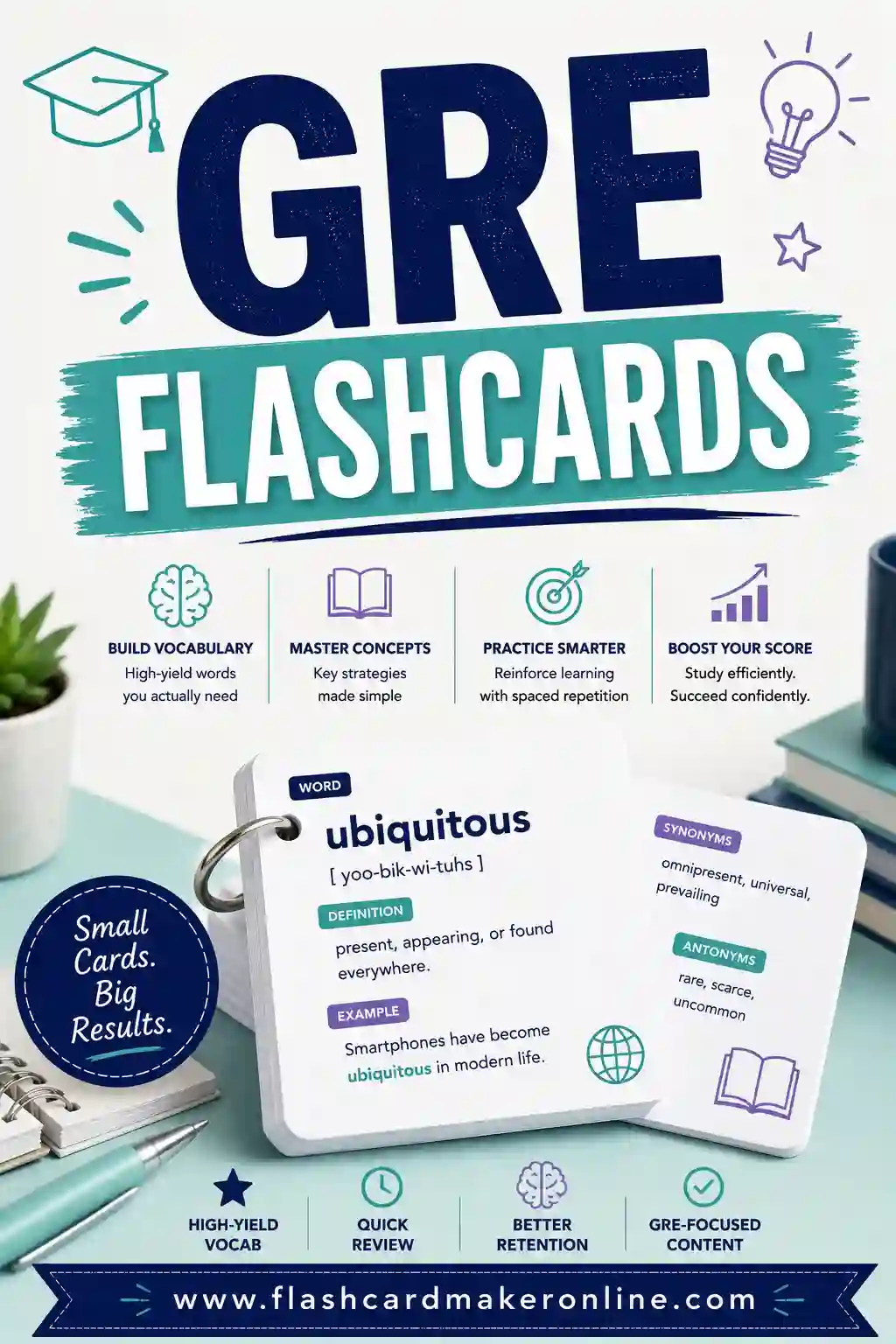
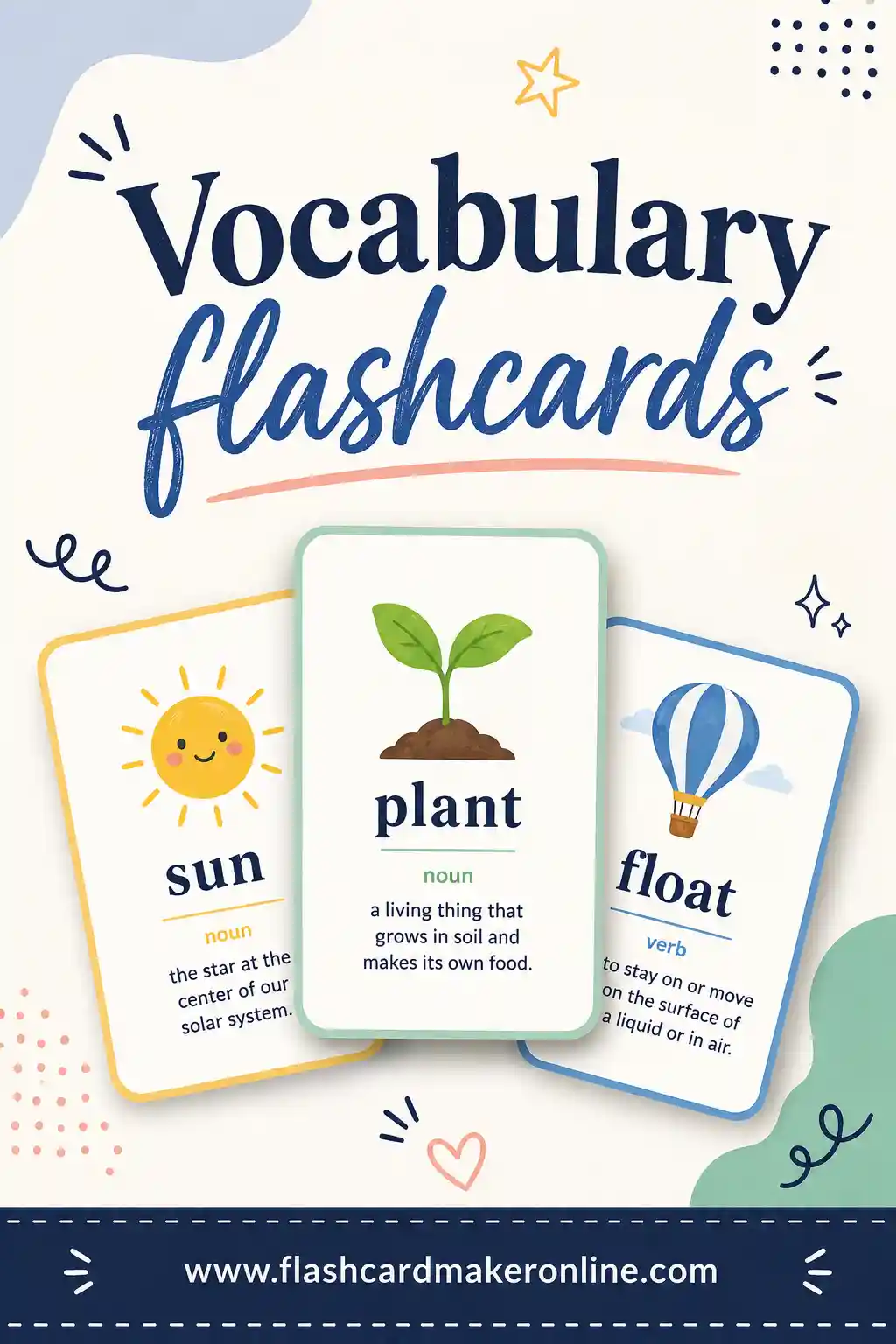
Heading toward more tests after high school? The same method scales up. See our GRE flashcards for grad-school prep and our general vocabulary flashcards approach for any subject.
Frequently Asked Questions
How many SAT vocab flashcards do I need?
Enough to grow your vocabulary steadily, split into small decks. A deck of 20–25 words is easy to study in one sitting. Make as many decks as you need with the free flashcard maker.
What should go on an SAT vocab flashcard?
Put the word on the front. On the back, write a short plain-English meaning and a quick example sentence. The example is what turns a word you recognize into a word you can actually use.
Are these SAT vocab flashcards free to print?
Yes. You make and print them yourself at no cost. There's no sign-up and no watermark, so you can build a full vocabulary system for free.
Does vocabulary still matter on the new SAT?
Yes. The current SAT tests words in context rather than asking for raw definitions, but knowing what words mean still helps you read faster and answer reading and writing questions correctly.
Can I study SAT vocab flashcards on my phone?
Yes. The flip cards work in your browser, so you can review on your phone any time. You can also print the deck for screen-free study before the test.
How far ahead should I start studying vocabulary?
The earlier the better, since vocabulary grows best with daily reps over weeks. Even 15 minutes a day for a couple of months beats cramming hundreds of words right before the test.
Ready to Build Your SAT Vocab Flashcards?
Grab the word list above, open the free flashcard maker, and you'll have a deck of flip-style SAT vocab cards in minutes. It's free, there's no sign-up, and you can print the whole set or quiz yourself on your phone. Start with 20 words today, drill your missed pile, and watch your vocabulary, and your score, climb.