How to Make Flashcards for Languages (Vocab That Sticks)
To make language flashcards, put a word or short phrase in the language you're learning on the front, and its meaning (plus a hint or example) on the back, keeping each card to a single word or idea. Study them with active recall, answering before you flip, and review across several days so the vocabulary moves into long-term memory. The fastest way to build a set is a free flashcard maker where you type your pairs, flip to study, and print the deck whenever you like.
Ready to start? Open the free flashcard maker, add your vocab (there's a ready-made sample deck below to copy), and study a small batch today. No sign-up, no app to install.
Why Flashcards Are Perfect for Language Learning
Vocabulary is mostly a memory game, and flashcards are the best memory tool we have. To speak a language you need a big stock of words ready to recall in an instant, and that's exactly what flipping cards trains. Every card is a tiny test: see the word, recall the meaning, check.
This matters because recognizing a word in a book is not the same as producing it when you need it. Flashcards build the second skill, fast recall, in a way that rereading a vocab list never will. Pulling "thank you" out of your memory when you see gracias is the muscle you're building.
Languages also reward daily, bite-sized practice, and flashcards fit that perfectly. A few minutes of flipping each day beats a long weekly session, because spacing the reviews is what locks words into long-term memory.
What to Put on a Language Flashcard
The basic format is simple: target language on the front, meaning on the back. But a few smart choices make your cards far more useful.
- Front: the foreign word or phrase. Just the word you're learning, nothing else.
- Back: the meaning, plus a small hint. The translation, and optionally a short example sentence or a memory hook.
- One word per card. Don't cram three vocab words onto one card. One word, one card.
A short example sentence on the back does a lot of work. It shows the word in context, which helps you remember not just what it means but how it's actually used. For a tricky word, a memory hook helps too, anything that links the sound or spelling to the meaning.
Should you also make reverse cards?
Yes, often. There are two directions to study a word:
- Recognition: see gato, recall "cat." Easier, and good for reading.
- Production: see "cat," recall gato. Harder, and what you need for speaking.
Making cards in both directions trains both skills. Start with recognition, then add the production cards once the words feel familiar. A digital flashcard maker makes it easy to flip the direction or duplicate a deck.
How to Make Language Flashcards in 6 Steps
Here's the whole process, start to finish.
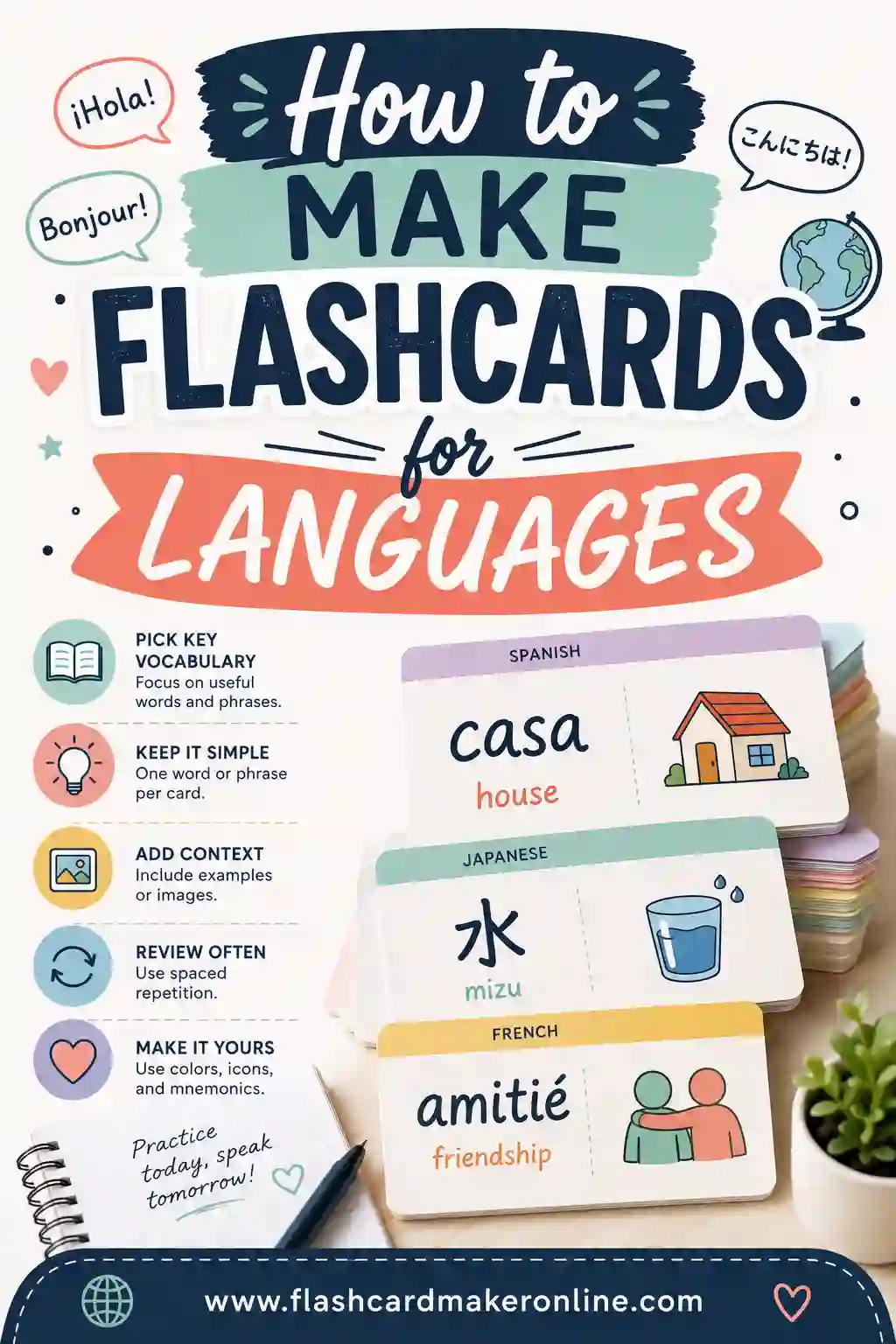
1. Pick a focused word set
Don't try to learn the whole dictionary at once. Choose a themed batch: food words, travel phrases, the 50 most common verbs, or the vocab from one textbook chapter. Themed sets are easier to remember because the words connect.
2. Put the target word on the front
Write the foreign word by itself on the front. Keep it clean. If pronunciation is tricky, you can add a phonetic hint, but keep the front mostly to the word itself.
3. Put the meaning and a hint on the back
Add the translation, and where it helps, a short example sentence or a memory hook. For biblioteca (library), you might add "think: biblio = books." Small cues turn a hard word into an easy one.
4. Add gender or key grammar where it matters
In many languages, nouns have a gender. Bake it into the card, write el perro or la casa, not just perro or casa, so you learn the article along with the word. The same goes for irregular verb forms.
5. Type your pairs into a flashcard maker
Open a free flashcard maker and enter each front and back. Typing is fast, and you can edit or reorder anytime. When you want a paper set for offline practice, print the whole deck in one click.
6. Study with active recall, daily
Read the front, say the meaning out loud before you flip, then check. Saying it aloud also drills pronunciation. Do a short session every day and let spaced repetition carry the words into long-term memory.
Sample Language Flashcard Deck (Copy & Paste)
Here's a ready-to-use beginner deck mixing Spanish and French so you can see the format. The left column is the front (the foreign word) and the right is the back (the meaning). Copy any rows into the flashcard maker to start.
| Front (word) | Back (meaning) |
|---|---|
| hola | hello (Spanish) |
| gracias | thank you (Spanish) |
| por favor | please (Spanish) |
| agua | water (Spanish) |
| casa | house (Spanish) |
| el perro | the dog (Spanish) |
| el gato | the cat (Spanish) |
| rojo | red (Spanish) |
| libro | book (Spanish) |
| comer | to eat (Spanish) |
| bonjour | hello (French) |
| merci | thank you (French) |
| s'il vous plaît | please (French) |
| eau | water (French) |
| maison | house (French) |
| le chien | the dog (French) |
| rouge | red (French) |
| livre | book (French) |
| manger | to eat (French) |
| ami | friend (French) |
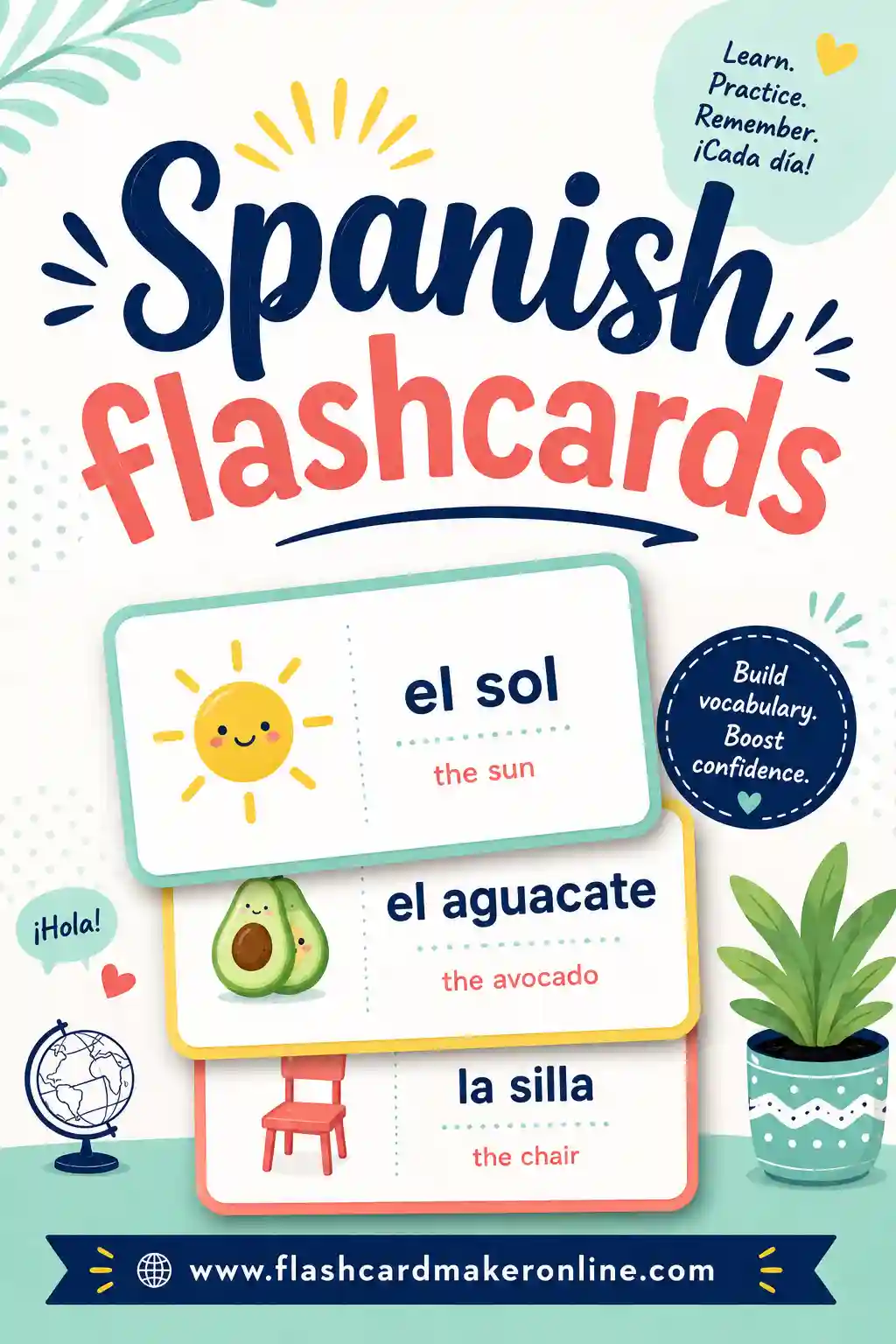
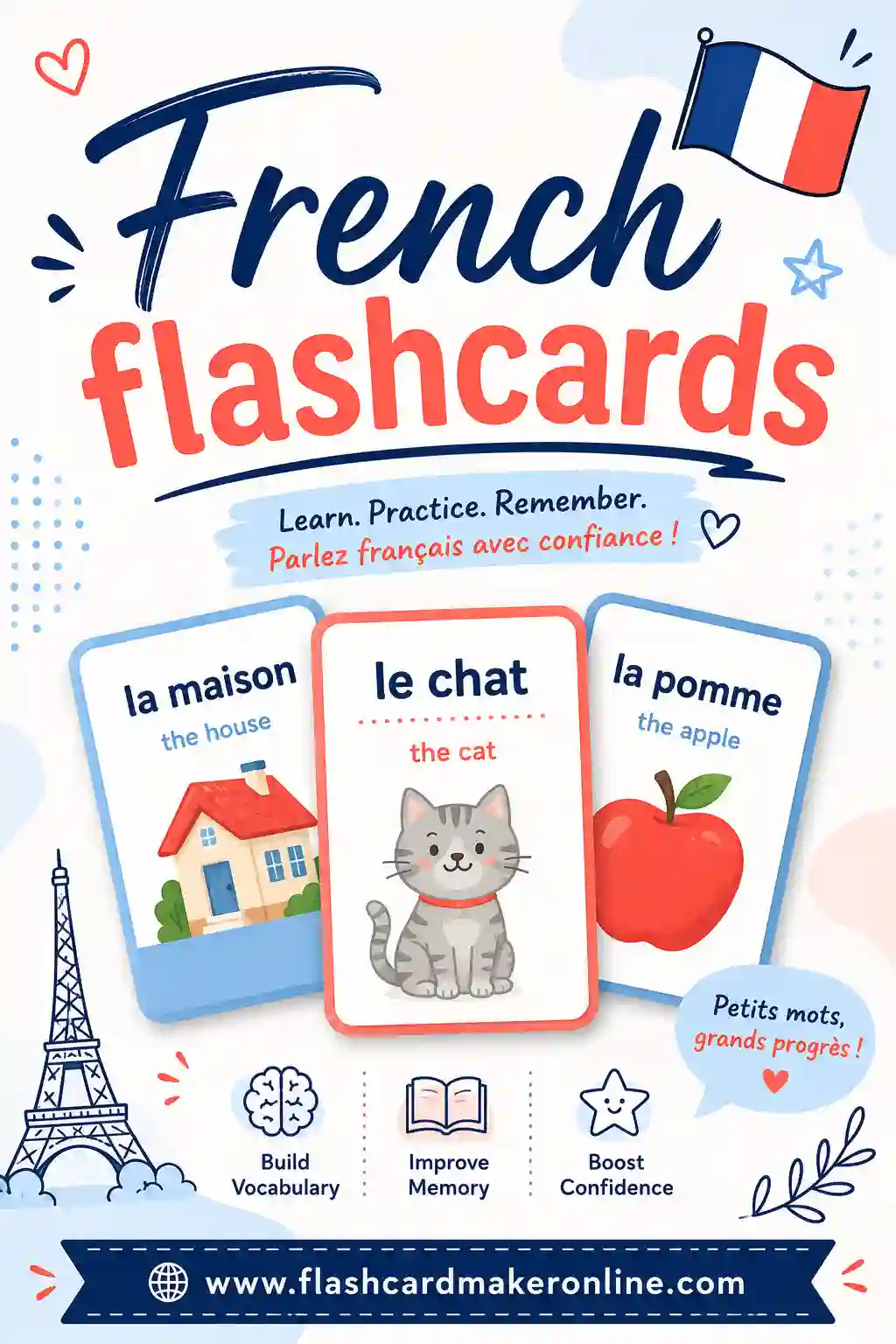
Notice how the nouns carry their article (el perro, le chien). That small habit saves you from relearning gender later. Building a bigger set? Start with our ready-made Spanish flashcards or French flashcards.
Want to grow the deck? A few more rows
Once the starter set feels easy, mix in these. They keep the same one-word-per-card format, and the verbs and connectors are the ones you'll reach for in almost any sentence.
| Front (word) | Back (meaning) |
|---|---|
| pero | but (Spanish) |
| porque | because (Spanish) |
| siempre | always (Spanish) |
| hablar | to speak (Spanish) |
| querer | to want (Spanish) |
| la calle | the street (Spanish) |
| mais | but (French) |
| parce que | because (French) |
| toujours | always (French) |
| parler | to speak (French) |
| vouloir | to want (French) |
| la rue | the street (French) |
Add five or six new rows at a time, not the whole list at once. A small batch you actually master beats a giant deck you skim.
Make Cards for the Words You Keep Forgetting
Here's a trick that doubles the value of any deck: feed it with your own mistakes. Every time you blank on a word in conversation, hit a wall while reading, or guess wrong on a quiz, jot it down. Those are your real weak spots, and they're far more useful than a generic top-100 list.
Keep a running "leak list" on your phone. At the end of the day, turn each word into a card. Because you already failed on it once, the word comes with a built-in story, and that emotional tag makes it stick faster.
Cognates and false friends
Some words are gifts. Hotel, animal, and idea mean roughly the same thing in Spanish, French, and English, so you barely need a card. Lean on these cognates early to build confidence fast.
But watch the false friends, words that look familiar and mean something else. Spanish embarazada means "pregnant," not "embarrassed." French librairie is a bookshop, not a library. Make a special card for each false friend with a bold warning on the back, because these are the words that trip up learners for years.
How Many New Cards Per Day?
It's tempting to make a hundred cards and try to learn them all by Friday. Don't. Your brain can only move so many new words into long-term memory at once, and overloading just means you forget most of them.
A steady pace works far better. Here's a rough guide by level.
| Level | New words per day | Why |
|---|---|---|
| Total beginner | 5–10 | Build the habit, avoid burnout |
| Comfortable beginner | 10–15 | You can handle more without cramming |
| Intermediate | 15–25 | Reviews are faster, so there's room for more |
| Heavy study (immersion) | 25–40 | Only if you can review every day |
Notice the new-word count grows as your reviews get faster, not just because you feel motivated. The real limit isn't learning new cards; it's keeping up with the old ones. Add new words only as fast as you can review what you've already got.
Tips for Language Flashcards That Stick
Good vocab cards are a skill. These habits make the biggest difference.
- Say it out loud. Speaking the word as you recall it drills pronunciation and strengthens memory. Don't just think it.
- Learn words in context. A short example sentence on the back beats a bare translation, because you learn how the word is used.
- Group by theme. Food words together, travel words together. Connected words are easier to recall.
- Add gender and key forms. Bake grammar into the card so you learn it from the start.
- Use both directions. Recognition first, then production, so you can both understand and speak.
- Picture the word. A quick mental image or a printed picture anchors the meaning, especially for concrete nouns.
Common mistakes to avoid
| Mistake | Better approach |
|---|---|
| Cramming several words on one card | One word per card |
| Bare translation, no context | Add a short example sentence |
| Skipping noun gender | Include the article (el/la, le/la) |
| Only studying recognition | Add production cards too |
| Never saying words aloud | Speak each answer as you flip |
| Reviewing in the same order | Shuffle every session |
Avoiding these turns a frustrating deck into one that actually builds your vocabulary.
How to Study Your Language Deck
Making the deck is half the job. Here's how to use it well.
- Read the front and answer aloud before flipping. This is active recall, plus pronunciation practice in one.
- Flip and check. Right? Set it aside. Wrong? Keep it in the rotation for another pass.
- Sort by difficulty. Words you nail go to a "review later" stack. Words you miss come back soon.
- Study daily, in short bursts. Ten minutes a day beats an hour once a week. Spacing is what makes vocab stick.
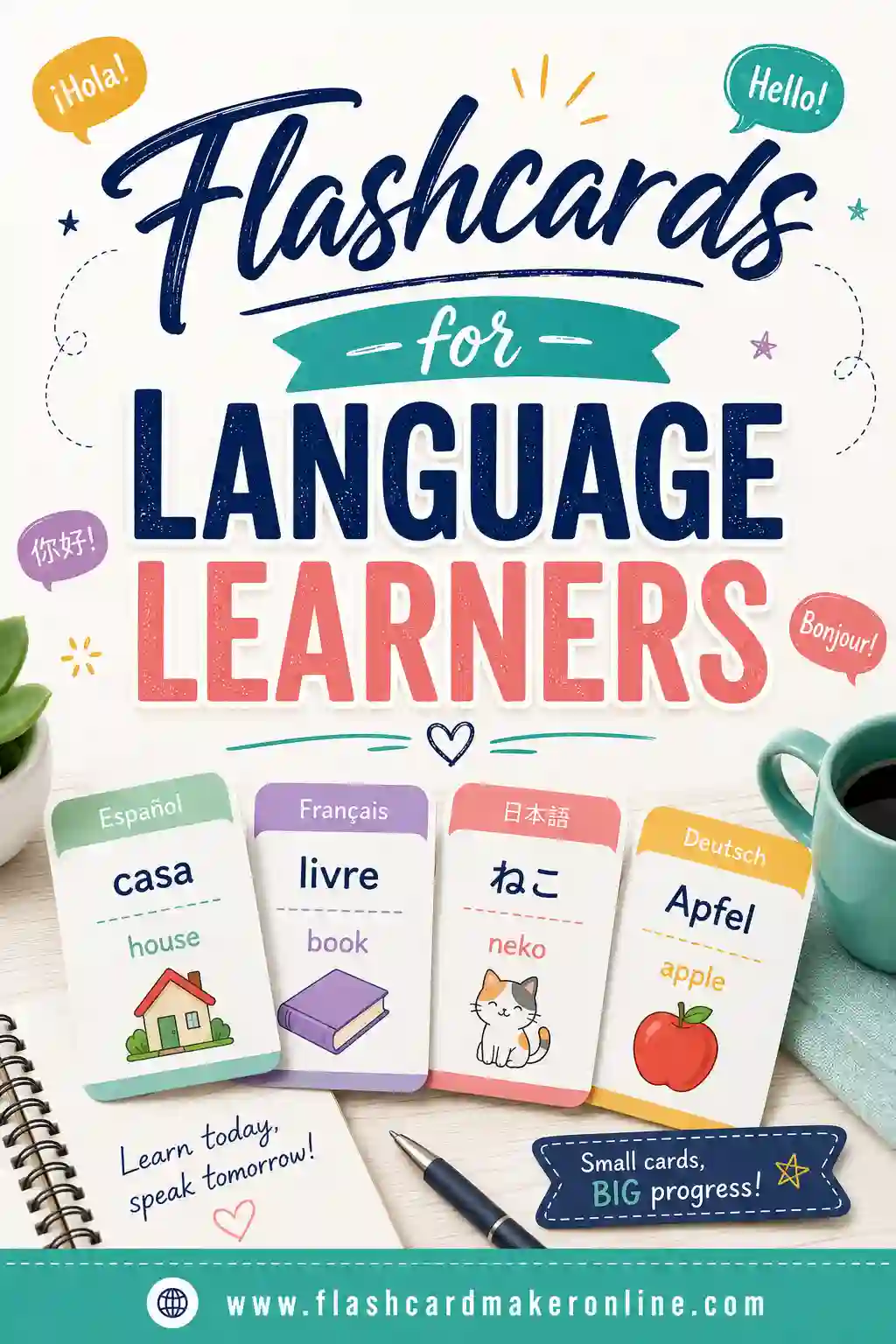
A few focused sessions across the week move far more words into long-term memory than a single cram. For more on technique, see our full flashcard study tips, and our guide for flashcards for language learners goes deeper on building vocabulary fast.
Frequently Asked Questions
How do I make flashcards for learning a language?
Put the target-language word on the front and its meaning on the back, with a short example sentence or hint when it helps. Keep one word per card, include noun gender, and study with active recall daily. A free flashcard maker lets you type the pairs, flip to study, and print the deck.
Should the foreign word go on the front or the back?
For recognition practice, put the foreign word on the front and the meaning on the back. For speaking practice, make reverse cards with your own language on the front. Studying both directions trains you to both understand and produce the word.
How many language flashcards should I study a day?
Most learners do well with 10 to 30 new words a day plus their due reviews. Beginners should start lower and build up. Daily, bite-sized practice beats long weekly sessions because spacing is what locks vocabulary in.
Should I add example sentences to language flashcards?
Yes, when they help. A short example sentence shows the word in context, so you learn how it's actually used, not just its translation. Keep the sentence short so the card still tests one idea.
Do I need to learn noun gender on my flashcards?
In languages that use grammatical gender, yes. Write the noun with its article (like el perro or la maison) so you learn the gender along with the word. Relearning gender later is far harder than picking it up from the start.
Can I print my language flashcards?
Yes. Build the deck in the flashcard maker, then print the whole set in one click. A printed deck is handy for practicing on the go or studying away from a screen, and you can reprint it any time for free.
Should I make a flashcard for every new word I meet?
No. Cards take time to study, so reserve them for words that actually matter: ones you'll use often, ones you keep forgetting, and the false friends that trip you up. Rare words you'll meet once aren't worth a card. Quality beats quantity, and a focused deck is one you'll actually finish.
Are pictures better than translations on language cards?
For concrete nouns, often yes. A picture of a dog on the back of perro skips English entirely and links the foreign word straight to the thing, which is how fluent speakers think. For abstract words, grammar, and phrases, a short translation plus an example sentence is clearer. Many learners mix both.
Ready to Build Your Language Flashcards?
Grab the sample deck above, open the free flashcard maker, and start drilling vocab today. Say each word out loud, answer before you flip, and study a little every day so spaced repetition can do its work. It's free, there's no sign-up, and you can make as many decks as you need, in any language. Start with one themed batch of words today, and watch your vocabulary grow faster than you'd expect.