How to Memorize the Cranial Nerves (Clean Mnemonics and Flashcards)
The easiest way to memorize the cranial nerves is in two passes: first the 12 names in order with a mnemonic, then whether each one is sensory, motor or both with a second mnemonic. Here's a clean pair you can learn in an evening. For the names: "Our Old Orange Truck Takes A Few Very Grumpy Village Animals Home." For sensory or motor: "Silly Sam Makes Muffins, But Mom Bakes Super Big Banana Muffins Mostly." Then lock it all in with flashcards that show the number on the front (CN VII) and the name, type and main job on the back.
Try a few cards. Look at the number, say the name, type and function out loud, then tap to check:
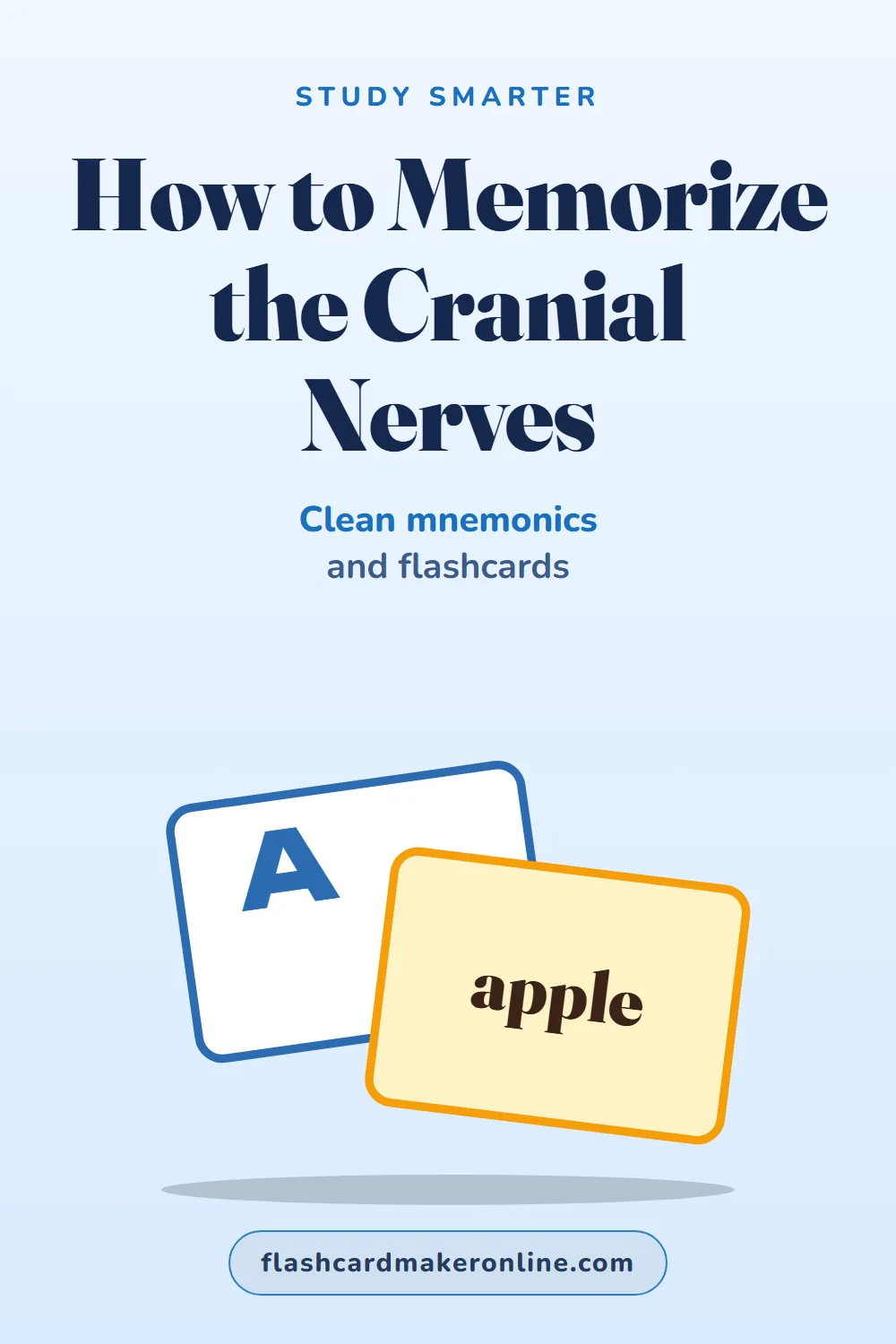
🃏 Quiz yourself: 12 cards from this page
Read the front, say your answer, then tap the card to check.
Make, study & print this deck → Opens the free flashcard maker with all 12 cards ready to edit or print.The 12 cranial nerves list (with what each one does)
Cranial nerves are the 12 pairs of nerves that come straight from the brain and brainstem instead of the spinal cord. They're numbered with Roman numerals, roughly front to back in the order they leave the brain.
| Number | Name | Type | Main job |
|---|---|---|---|
| CN I | Olfactory | Sensory | Smell |
| CN II | Optic | Sensory | Vision |
| CN III | Oculomotor | Motor | Moves most eye muscles, lifts the eyelid, narrows the pupil |
| CN IV | Trochlear | Motor | Superior oblique muscle (helps move the eye down and in) |
| CN V | Trigeminal | Both | Feeling in the face; chewing muscles |
| CN VI | Abducens | Motor | Lateral rectus muscle (moves the eye outward) |
| CN VII | Facial | Both | Facial expressions; taste on the front two-thirds of the tongue; tears and saliva |
| CN VIII | Vestibulocochlear | Sensory | Hearing and balance |
| CN IX | Glossopharyngeal | Both | Taste on the back third of the tongue; throat sensation; swallowing; parotid saliva |
| CN X | Vagus | Both | Voice box and swallowing; slows the heart; helps digestion |
| CN XI | Accessory | Motor | Shrugging the shoulders and turning the head |
| CN XII | Hypoglossal | Motor | Moves the tongue |
A clean cranial nerves mnemonic for the names
Honestly, the most famous cranial nerve mnemonics aren't ones you'd say out loud in class. So here's a fresh one. Picture an old orange pickup truck bouncing down a country road, loaded with grumpy goats and chickens on their way home.
| Word | Letter | Nerve |
|---|---|---|
| Our | O | I Olfactory |
| Old | O | II Optic |
| Orange | O | III Oculomotor |
| Truck | T | IV Trochlear |
| Takes | T | V Trigeminal |
| A | A | VI Abducens |
| Few | F | VII Facial |
| Very | V | VIII Vestibulocochlear |
| Grumpy | G | IX Glossopharyngeal |
| Village | V | X Vagus |
| Animals | A | XI Accessory |
| Home | H | XII Hypoglossal |
The three O's and two T's are where most people mix things up. Here's how to keep them straight:
- Olfactory, Optic, Oculomotor: smell comes first because the olfactory nerve is the most forward. Then sight (optic), then moving the eyes (oculomotor). Nose, eyes, eye muscles.
- Trochlear before Trigeminal: "truck" is the small word and trochlear is the small nerve (it's the thinnest cranial nerve). "Takes" comes next, and trigeminal is the big one.
- Vestibulocochlear is sometimes called the auditory or acoustic nerve in older books, so you may see an "A" in older mnemonics for nerve VIII.
Sensory, motor or both: the second mnemonic
Once the names are solid, learn the type of each nerve with a sentence where S means sensory, M means motor and B means both:
"Silly Sam Makes Muffins, But Mom Bakes Super Big Banana Muffins Mostly."
| Nerve | Word | Type |
|---|---|---|
| I | Silly | Sensory |
| II | Sam | Sensory |
| III | Makes | Motor |
| IV | Muffins | Motor |
| V | But | Both |
| VI | Mom | Motor |
| VII | Bakes | Both |
| VIII | Super | Sensory |
| IX | Big | Both |
| X | Banana | Both |
| XI | Muffins | Motor |
| XII | Mostly | Motor |
A quick check: there are 3 pure sensory nerves (I, II, VIII), 5 pure motor nerves (III, IV, VI, XI, XII) and 4 that are both (V, VII, IX, X). If your count comes out different, one word slipped.
More memory tricks for the cranial nerves
LR6 SO4: the eye muscles
Three nerves move the eyes, and this little formula tells you which does what: LR6 SO4, the rest 3. The lateral rectus is CN VI, the superior oblique is CN IV, and all the other eye-moving muscles are CN III. "Abducens" even sounds like "abduct," which means moving away from the middle, and that's exactly what the lateral rectus does to the eye.
The 2-2-4-4 rule: where they come from
A handy rule of thumb for where each nerve leaves the brain: 2 from above the brainstem (I and II), 2 from the midbrain (III and IV), 4 from the pons (V to VIII) and 4 from the medulla (IX to XII). It's a simplification. CN XI, for example, gets most of its fibers from the upper spinal cord. But it's close enough to help you picture the order.
1973: the parasympathetic nerves
Only four cranial nerves carry parasympathetic ("rest and digest") fibers: III, VII, IX and X. Remember them as the year 1973, where the 1 stands for 10: that's X, IX, VII and III. They control the pupil (III), tears and saliva (VII and IX) and heart rate and digestion (X).
Put them in a memory palace
If mnemonics slide out of your head, try placing all 12 nerves along a walk through your home. A nose on the front door for olfactory, a pair of glasses on the doormat for optic, and so on. Our guide to the memory palace shows how to set one up in about 15 minutes.
How to test each cranial nerve (a quick bedside version)
Nursing and pre-med students often need to know a simple exam for each nerve. Here's a basic version that works well on the back of a flashcard:
| Nerve | Quick test |
|---|---|
| I Olfactory | With eyes closed, identify a familiar smell, one nostril at a time. |
| II Optic | Read an eye chart; check side vision. |
| III, IV, VI | Follow a finger in an "H" pattern; check the pupils' response to light. |
| V Trigeminal | Feel a light touch on the forehead, cheek and jaw; clench the teeth. |
| VII Facial | Raise the eyebrows, close the eyes tight, smile and puff out the cheeks. |
| VIII Vestibulocochlear | Repeat a whispered word; check balance. |
| IX and X | Say "ah" and watch the soft palate rise evenly; swallow. |
| XI Accessory | Shrug the shoulders and turn the head against light resistance. |
| XII Hypoglossal | Stick out the tongue and check that it's straight. |
This is for studying only. Your course or clinical instructor will teach the exact exam your program expects, so follow theirs.
How to make cranial nerves flashcards that stick
Here's the setup that works best for most students:
- Front: the number only, like "CN VII." Don't put the name on the front, or you'll never practice recalling it.
- Back: the name, sensory/motor/both, and one main function. Keep it short so you can check yourself in two seconds.
- Make a reverse deck. Put a function on the front ("shrugs the shoulders") and the nerve on the back. Exams love to ask it this way.
- Say the answer before you flip. Trying to recall it, even if you're wrong, is what builds memory. Our page on the active recall method explains why.
- Space your reviews. Review the deck today, tomorrow, in three days and then in a week. That beats one long cram session the night before.
A good one-week plan: learn the names on day 1, types on day 2, functions on days 3 and 4, then mix all three decks on days 5 to 7.
Common cranial nerve mix-ups
- Trochlear vs. trigeminal. IV is tiny and moves one eye muscle. V is the big one for face feeling and chewing.
- Facial vs. trigeminal. Facial (VII) moves your face. Trigeminal (V) lets you feel your face. If you can't smile, think VII. If your cheek is numb, think V.
- Glossopharyngeal vs. hypoglossal. Both have "gloss" (tongue). IX handles taste and the throat. XII moves the tongue. "Hypo" means under, and it runs under the tongue to move it.
- Vagus. It's the only cranial nerve that travels down into the chest and belly. "Vagus" comes from a Latin word for wandering, which is a good way to remember how far it goes.
For the rest of your course, our anatomy flashcards and flashcards for medical students guides cover building bigger decks. When you're ready, open the free flashcard maker, type in the 12 nerves, and print a deck you can review between classes.
Frequently Asked Questions
What is a clean mnemonic for the 12 cranial nerves?
Try "Our Old Orange Truck Takes A Few Very Grumpy Village Animals Home" for Olfactory, Optic, Oculomotor, Trochlear, Trigeminal, Abducens, Facial, Vestibulocochlear, Glossopharyngeal, Vagus, Accessory and Hypoglossal.
How do you remember which cranial nerves are sensory or motor?
Use "Silly Sam Makes Muffins, But Mom Bakes Super Big Banana Muffins Mostly." S is sensory, M is motor and B is both. That gives 3 sensory nerves (I, II, VIII), 5 motor (III, IV, VI, XI, XII) and 4 that are both (V, VII, IX, X).
What are the 12 cranial nerves in order?
I Olfactory, II Optic, III Oculomotor, IV Trochlear, V Trigeminal, VI Abducens, VII Facial, VIII Vestibulocochlear, IX Glossopharyngeal, X Vagus, XI Accessory and XII Hypoglossal.
Which cranial nerves move the eyes?
Three: the oculomotor (III), trochlear (IV) and abducens (VI). Remember LR6 SO4: the lateral rectus is CN VI, the superior oblique is CN IV, and the rest are CN III.
What should go on a cranial nerves flashcard?
Put just the number on the front, like CN VII. On the back, write the name, whether it's sensory, motor or both, and one main function. Make a second deck with the function on the front, too.
How long does it take to memorize the cranial nerves?
Most students can learn the names in one evening with a mnemonic. Give yourself about a week, with short daily reviews, to know the types and functions well enough for an exam.