Latin Flashcards: Free to Make, Study & Print
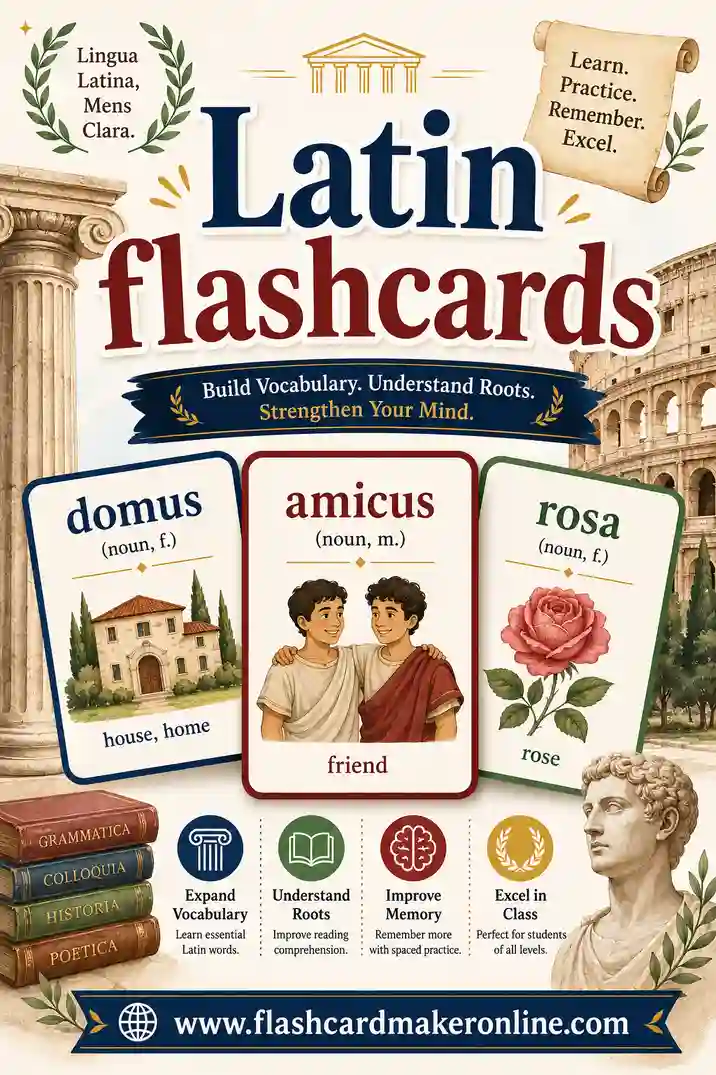
Latin flashcards are two-sided study cards with a Latin word, form, or phrase on one side and its English meaning on the other. You read the prompt, recall the answer, then flip to check. The fastest way to build a set is a free flashcard maker that lets you type your Latin vocabulary, flip through it on screen, and print a clean deck for class or self-study.
Want to start now? Open the free tool, add the words you're learning (there's a starter deck below), and you'll be drilling your own cards in under a minute. No sign-up, no app to install, nothing to pay.
What Are Latin Flashcards?
A Latin flashcard puts a prompt on one side and the answer on the other. For vocabulary, that's usually the Latin word on the front and the English meaning on the back. But Latin is a richly structured language, so your cards can drill far more than single words.
The big payoff comes from active recall. When you see amare and have to dig "to love" out of your memory before flipping, your brain works to retrieve it, and that retrieval is what cements the word. Re-reading a vocab list feels productive but does almost nothing by comparison. Flashcards force the recall every single time.
Latin cards shine for several jobs:
- Vocabulary — terra (land), bellum (war), rex (king).
- Verb conjugations — amo, amas, amat on one card each.
- Noun declensions — the case endings for a noun, drilled by form.
- Principal parts — amo, amare, amavi, amatus on a single card.
- Phrases and mottos — carpe diem, veni vidi vici.
Why Flashcards Are Perfect for Latin
Latin is a memorization-heavy language. Endings change with case, number, gender, and tense, and there's no way around learning a large core vocabulary. That's exactly the kind of material flashcards were built for.
Here's what most students learn the hard way: you can't cram Latin. The endings blur together and the words slip away within days. What actually works is spaced repetition — seeing each word and form many times, spread out over weeks, reviewing it right before you'd forget. Ten minutes a day with your deck beats a frantic two-hour session the night before a quiz.
A digital deck makes the spacing effortless. Shuffle the cards so you're not just memorizing the order, flip through, and pull out the ones you missed to drill again tomorrow. Do that consistently and the endings stop being scary.
A Free Latin Flashcard Starter Deck
Here's a ready-to-use set of high-frequency Latin words, the kind you'll meet in your very first lessons and in Caesar, Cicero, and Virgil alike. Copy any rows into the flashcard maker to build your deck.
| Latin | English |
|---|---|
| amare | to love |
| videre | to see |
| dicere | to say |
| facere | to do / make |
| portare | to carry |
| terra | land / earth |
| aqua | water |
| bellum | war |
| vita | life |
| mors | death |
| rex | king |
| regina | queen |
| amicus | friend |
| puella | girl |
| puer | boy |
| servus | slave / servant |
| via | road / way |
| urbs | city |
| miles | soldier |
| deus | god |
| magnus | great / large |
| bonus | good |
| malus | bad |
| novus | new |
| omnis | all / every |
That's 25 core cards covering the most common verbs, nouns, and adjectives. When these feel automatic, swap them for harder vocabulary and keep building.
Drill grammar, not just words
Latin rewards students who memorize forms, not only meanings. Try dedicated decks for:
- First-conjugation verbs — one card per form of amo.
- Noun declensions — the six cases of puella, singular and plural.
- Principal parts — all four for each verb on one card.
- Common phrases — e pluribus unum, in vino veritas, cogito ergo sum.
How to Make Latin Flashcards in 4 Steps
No design skills required. Here's the whole process.
- Open the tool. Go to the flashcard maker. Nothing to install.
- Add your vocabulary. Type the Latin on the front, the English on the back. For verbs, include the principal parts. Paste a whole chapter's list at once if you have one.
- Flip and study. Click through your deck on screen, shuffle so you don't memorize the order, and mark the words you miss.
- Print when you want. Print a paper set on cardstock for screen-free review or for quizzing with a classmate.
A small tip: write the gender and genitive of each noun on the card (puella, -ae, f.). Those details matter in Latin, and drilling them now saves headaches later.
Smart Ways to Study Your Latin Cards
Building the deck is the easy part. Studying it well is where the grades come from. A few habits make all the difference.
Say the Latin out loud
Read each word aloud as you flip. Speaking helps you remember the form and trains your ear for the rhythm of Latin prose and poetry. It also makes recall faster on test day.
Drill principal parts, not just first forms
Knowing amo means "I love" isn't enough; you need amo, amare, amavi, amatus to handle every tense. Put all the principal parts on one card and recite them as a set. This is the habit that separates students who breeze through Latin from those who struggle.
Go both directions
Run the deck Latin-to-English first to build recognition, then flip it and produce the Latin from the English. The second direction is harder and exactly what you need for composition and translation.
Keep it short and spaced
| Study style | How it feels | How well it works |
|---|---|---|
| One pre-quiz cram | Stressful, forgotten by next week | Weak |
| 10 minutes, 3x a week | Manageable | Good |
| 5 minutes, twice daily | Almost effortless | Best |
Frequent short sessions win. Your brain consolidates the vocabulary and endings during the gaps, so the spacing is doing real work even when the cards are in your bag.
Latin Flashcards for Different Goals
Tailor your deck to why you're learning.
For school and AP Latin
Match your deck to your textbook chapter or your reading. If you're translating Caesar, build a deck of the high-frequency words in that passage. Cards that mirror your coursework turn a daunting translation into a manageable one.
For the SAT, GRE, and beyond
Latin roots unlock thousands of English words. A student who knows bene (well), mal (bad), and port (carry) can decode benevolent, malice, and transport on sight. A roots deck is one of the best vocabulary investments you can make.
For reading classical literature
If your goal is to read Virgil or Ovid for pleasure, build decks from the actual texts. Pull the unfamiliar words from each section, drill them, then read. Your vocabulary grows alongside your reading, and the poetry opens up.
Building word power for tests? Pair this with our SAT vocab flashcards and GRE flashcards guides, and see general vocabulary flashcards tips that work for any subject.
Printable vs. Digital Latin Cards
Both formats work, and the best one is the one you'll actually use day after day.
Printable cards have a real charm for Latin. You can spread a chapter's vocabulary across your desk, group the cards by declension, and quiz a classmate before a test. Print on cardstock so they survive a semester of shuffling in a backpack, and write the gender and genitive right on each noun card so the details are always in front of you.
Digital cards win for daily speed. You can shuffle instantly so you're not memorizing the order, mark the words you missed without scribbling, and run through a hundred cards in a few minutes between classes. There's no paper, no scissors, and no lost cards.
The smart move is to use both. Build your deck once in the tool, drill it on screen during the week for quick daily reps, then print it for a focused review session before the exam. Same vocabulary, two formats, no extra work.
Common Latin Flashcard Mistakes to Avoid
A few habits quietly sabotage Latin students. Steer clear of these and your deck will work far harder for you.
- Skipping principal parts. Learning only amo leaves you stuck the moment you hit a perfect or passive form. Always put all four principal parts on the verb card.
- Ignoring gender and genitive. Nouns without their gender and genitive are half-learned. Via, -ae, f. tells you how to decline it; via alone doesn't.
- Memorizing the deck in order. If you always run the cards the same way, you learn the sequence, not the words. Shuffle every session.
- Cramming the night before. Latin endings blur together when crammed. Spread your reviews across the week instead.
- Never reversing the deck. Latin-to-English builds reading; English-to-Latin builds writing. Skip the second direction and your composition suffers.
Frequently Asked Questions
What should I put on a Latin vocabulary card?
For nouns, include the nominative, genitive, and gender (via, -ae, f.). For verbs, include all four principal parts (amo, amare, amavi, amatus). For adjectives, give the three endings. Those details are the heart of Latin, so put them on the card from the start.
Are these Latin flashcards really free to make and print?
Yes. You build and print them yourself at no cost. There's no sign-up and no watermark, so you can make a single chapter's deck or a full year's vocabulary on the same free tool.
Should Latin or English go on the front?
Both, at different times. Latin on the front builds recognition for reading; English on the front trains you to produce Latin for composition. Run the deck both ways, since translation and writing each need a different skill.
How many Latin words should I learn per week?
A steady 15 to 25 new words a week, reviewed daily, builds a strong vocabulary without burnout. Cramming a whole chapter the night before a quiz almost never sticks. Spread the work out and the words stay with you.
Do flashcards help with Latin grammar or just vocabulary?
Both. Beyond word meanings, flashcards are excellent for drilling verb conjugations, noun declensions, and principal parts. Put a form on one side and its identification on the other, and you can master the endings the same way you master vocabulary.
How long until I remember the words?
With short daily reps, most students lock in a 25-word chapter deck within one to two weeks. Showing up briefly every day beats one long session. Spacing and repetition do the heavy lifting.
Ready to Build Your Latin Deck?
Grab the starter list above, open the free flashcard maker, and you'll have your own Latin deck ready to flip in minutes. It's free, there's no sign-up, and you can study on screen or print a stack for class. Carpe diem — seize the day, and happy studying!