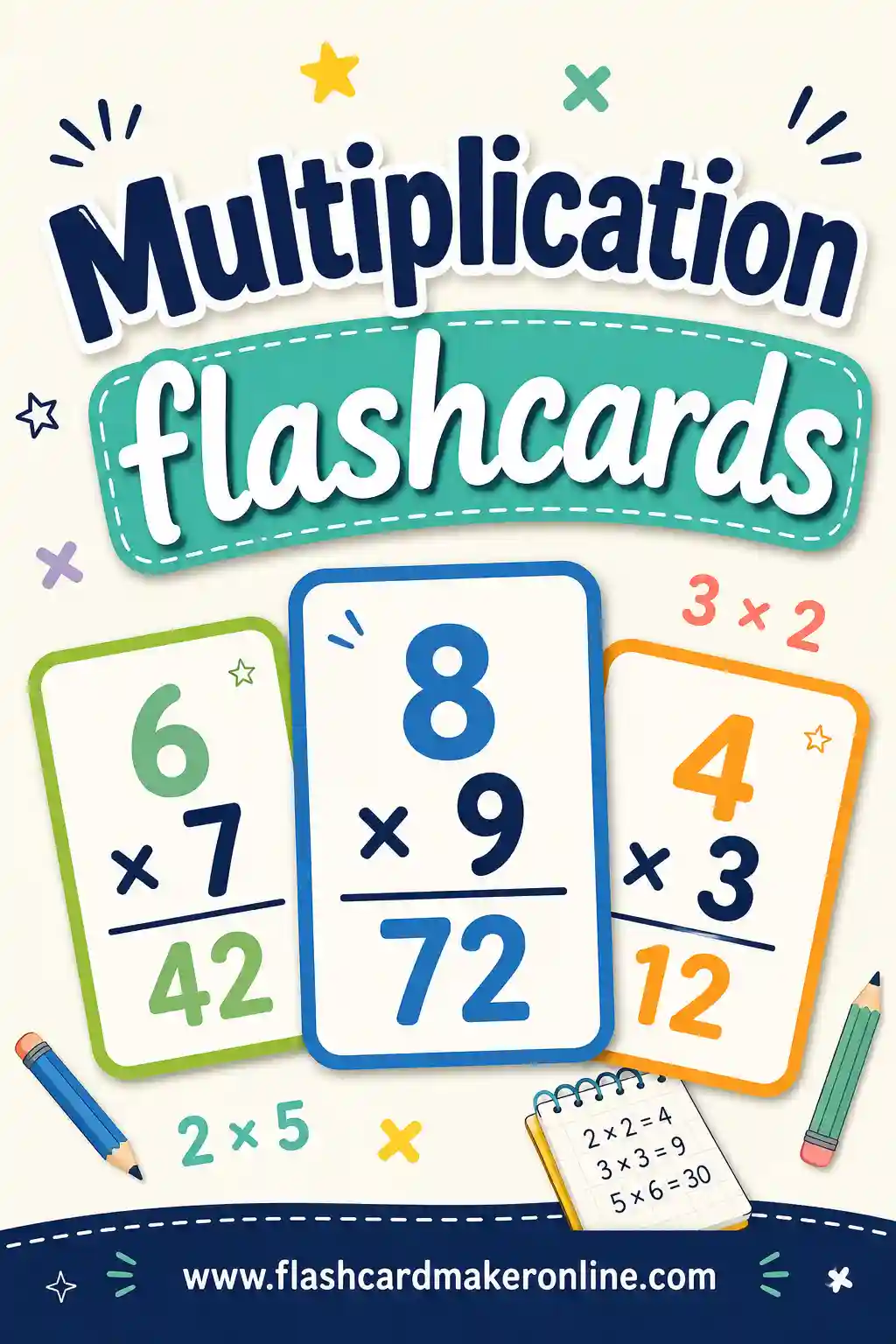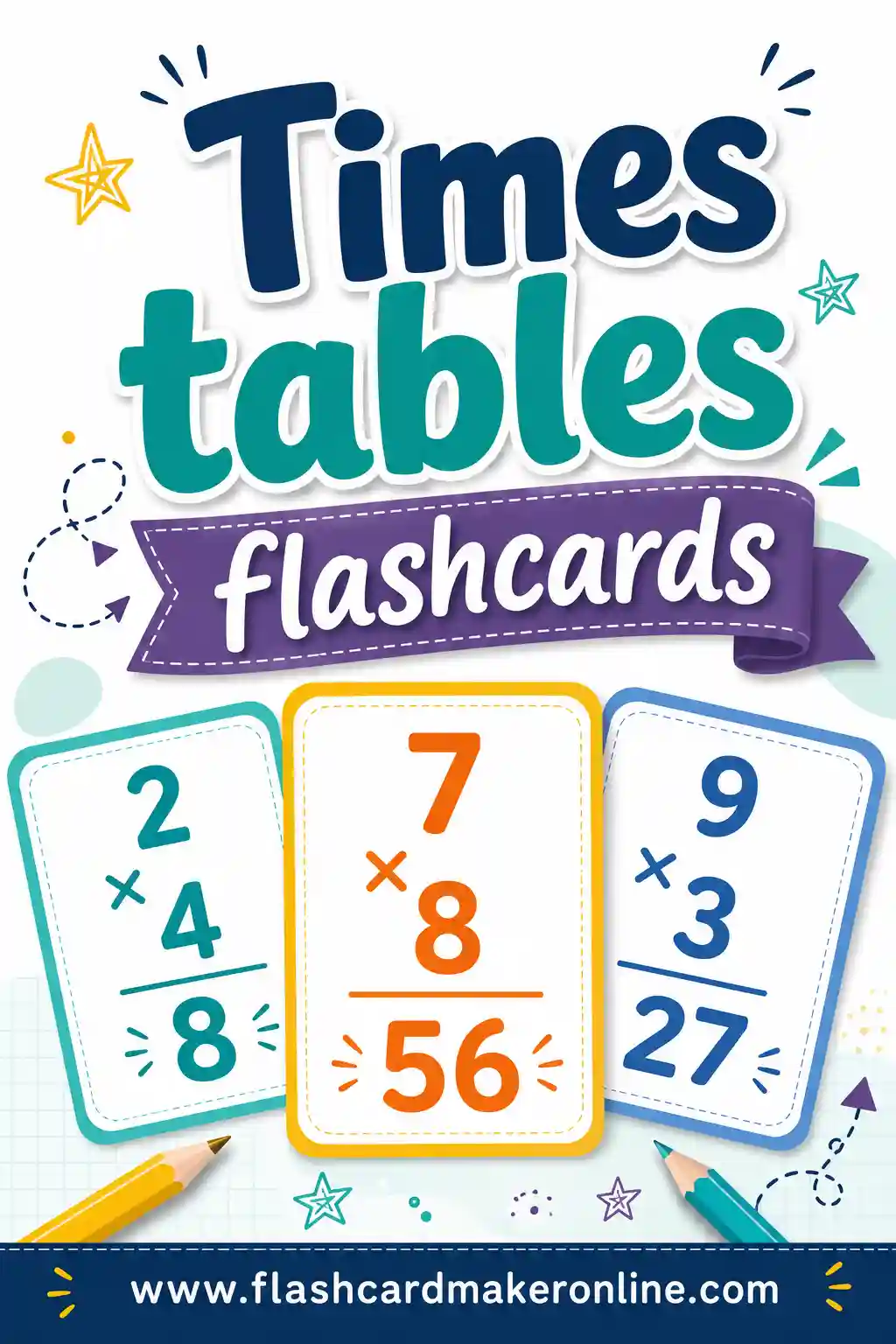
Printable Multiplication Flash Cards 0–12 With Answers on Back (PDF)
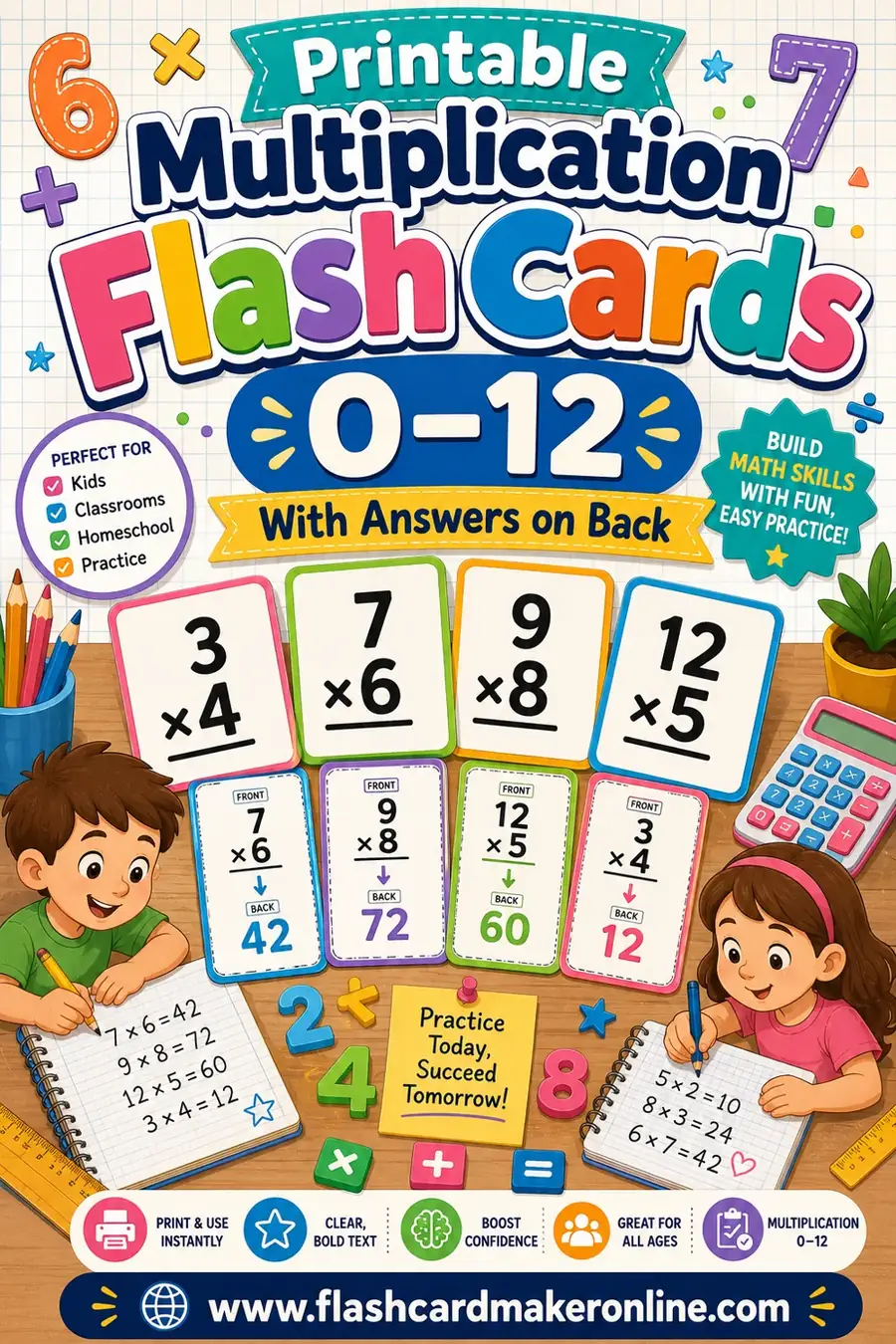
Printable multiplication flash cards 0-12 with answers on back PDF style are the complete times-table deck: every fact from 0 × 0 up to 12 × 12, problem on the front, answer printed directly on the back so each card flips like a real quiz. The easiest way to get the set is a free flashcard maker that lays out the double-sided pages for you — answers perfectly aligned behind their problems — and lets you print at home or save the whole deck as a PDF from the print dialog.
Want the full deck without hunting through download sites? Open the free maker, load the multiplication preset or paste the lists below, choose double-sided printing, and print or save the PDF. No sign-up, no fee, no watermarks.
What "Answers on Back" Actually Means (and Why It Matters)
Plenty of free multiplication card packs put the answer in a corner of the front, or on a separate answer sheet. Both spoil the drill: a corner answer gets peeked at, and an answer sheet turns every card into a two-handed operation.
Answers on the back means true double-sided cards. Your child sees only "9 × 7," has to pull "63" from memory, and flips to check. That moment of retrieval — before the answer appears — is active recall, and it's the entire reason flash cards outperform charts, worksheets, and rewatching a times-table song. The card design should protect that moment, and back-printed answers are how.
The catch with double-sided printing is alignment: the back page prints mirrored, so answers must be laid out in reverse order to land behind the right problems. Doing that by hand in a word processor is misery. The maker handles the mirroring automatically — you just print.
Why 0–12 and Not Just 1–10?
Most US classrooms drill multiplication through 12, and for good reason:
- 11s and 12s show up constantly — dozens, clock math, inches to feet, monthly anything.
- The 0s and 1s teach rules, not rote. Anything times zero is zero; anything times one is itself. Two cards' worth of insight that kids need stated explicitly.
- Timed tests go to 12. If school tests 0–12, practice should too — no surprises on quiz day.
The full 0–12 grid is 169 combinations, but the deck you actually print can be smarter than that, as the next section shows.
The Deck, Table by Table (Copy & Paste)
Paste whichever tables your child is working on into the flashcard maker — or load the multiplication preset and trim. Here's a high-value slice: the facts kids miss most, drawn from across the 0–12 range.
| Problem | Answer |
|---|---|
| 0 × 7 | 0 |
| 1 × 9 | 9 |
| 3 × 8 | 24 |
| 4 × 7 | 28 |
| 4 × 9 | 36 |
| 6 × 6 | 36 |
| 6 × 7 | 42 |
| 6 × 8 | 48 |
| 7 × 7 | 49 |
| 7 × 8 | 56 |
| 7 × 9 | 63 |
| 8 × 8 | 64 |
| 8 × 9 | 72 |
| 9 × 9 | 81 |
| 11 × 11 | 121 |
| 11 × 12 | 132 |
| 12 × 6 | 72 |
| 12 × 7 | 84 |
| 12 × 8 | 96 |
| 12 × 12 | 144 |
Print both orders — it's a fact-family habit
Make cards for 6 × 7 and 7 × 6. Kids often know a fact one way and freeze on the reverse. Better yet, think in fact families: 6 × 7 = 42, 7 × 6 = 42, 42 ÷ 6 = 7, 42 ÷ 7 = 6. Drilling multiplication both ways now means division facts arrive nearly free later — the family is already friends.
How to Make the Deck in 4 Steps
- Open the tool. Go to the free flashcard maker in any browser.
- Load or paste the facts. Use the multiplication preset for a fast start, then add or remove tables to match your child's current unit.
- Choose double-sided printing. This is the answers-on-back layout — the maker aligns every answer behind its problem automatically.
- Print or save as PDF. Print on cardstock at home, or pick "Save as PDF" in the print dialog to keep a reusable file for the library or print shop.
Print one test page first and flip it to confirm alignment with your printer's duplex settings — then run the deck.
How to Drill the Full 0–12 Deck Without Drowning
One hundred sixty-nine facts is a lot of cardstock and a lot of kid patience. Work smarter:
Print in waves, not all at once
Wave one: 0s, 1s, 2s, 5s, 10s — the pattern tables, quickly mastered, instant confidence. Wave two: 3s, 4s, 6s. Wave three: 7s, 8s, 9s, 11s, 12s. Each wave gets printed only when the previous one is fast.
Run three piles
Sort every card by answer speed: instant, slow, missed. Missed cards drill daily; slow cards every couple of days; instant cards once a week to stay fresh. Two clean, fast answers promote a card; one miss demotes it.
Keep sessions at five minutes
Times tables are won by frequency. A short daily flip — same time each day, right after snack works well — beats any weekend cram.
Track the wall chart backwards
Print a 0–12 grid and let your child color in each mastered fact. Watching the empty squares shrink is powerful motivation, and it shows both of you exactly which cards deserve reps.
Which Card Size Should You Print?
- Jumbo — 2 per page. Best for the first tables and for kids who need big, bold print to stay engaged. The full deck gets bulky at this size, so use it for the current wave only.
- Big — 4 per page. The kid default: bold numbers, sturdy in hand, and the full 0–12 deck stays manageable.
- Standard — 8 per page. The classic compact card. Best for older kids drilling the whole deck, and the most cardstock-efficient way to print all 169 facts.
A good pattern: current wave in Big, mastered archive reprinted in Standard for weekly review.
Printing Tips for a Clean Double-Sided Deck
- Cardstock (65 lb) beats paper for anything a child will shuffle daily.
- Always test one page. Duplex settings vary — "flip on long edge" versus "short edge" decides whether your answers land right-side up.
- No duplex printer? Print fronts, re-feed the stack, print backs — or use the cut-out grid layout, which puts fronts and backs side by side to fold into two-sided cards.
- Save the PDF once. A saved multiplication flash cards printable PDF means free reprints anywhere, forever, without rebuilding.
- Band by table. Rubber-band the 7s apart from the 8s so tonight's five-minute session starts in five seconds.
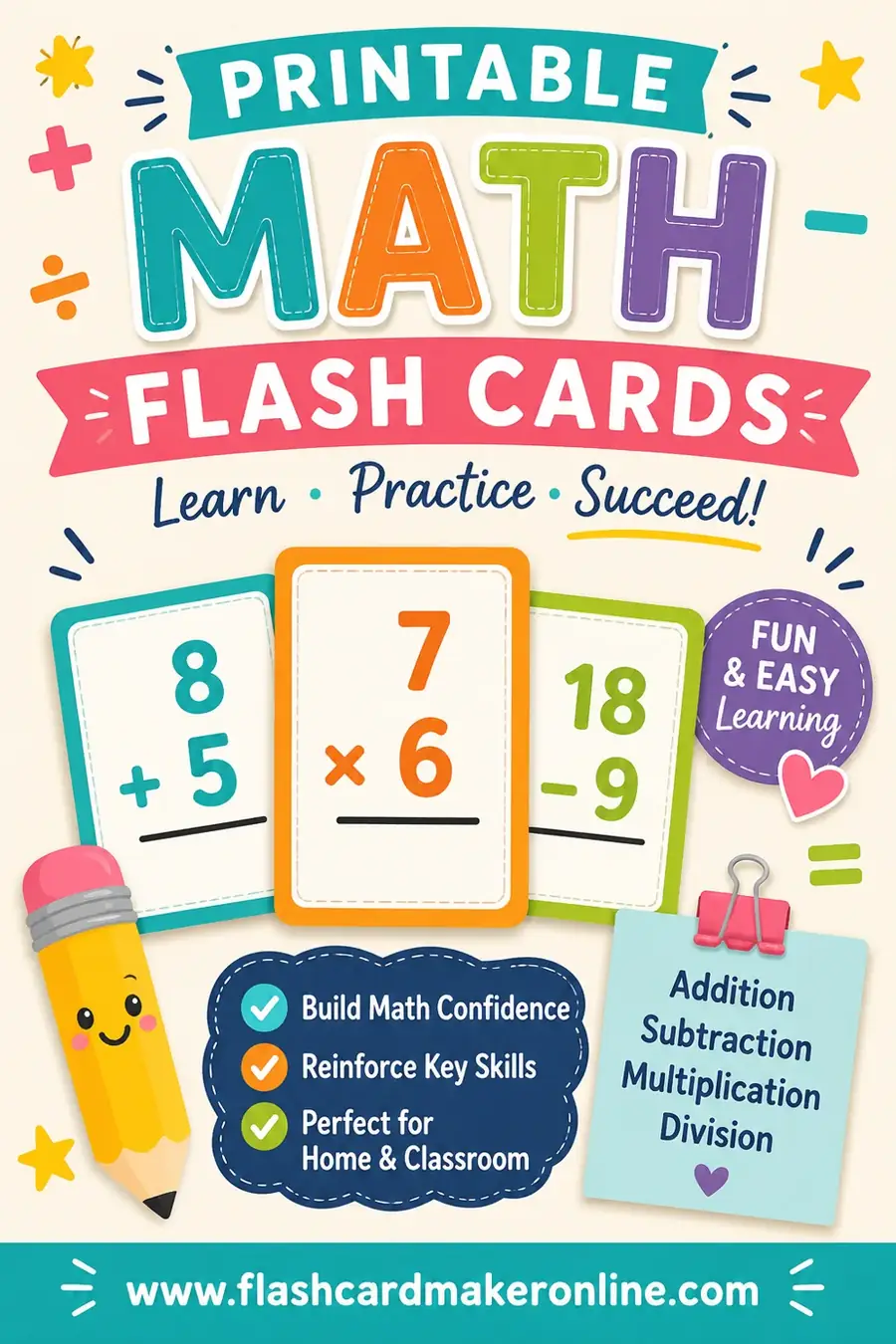
Want the bigger picture on times-table strategy? See our multiplication flashcards guide, the times tables flashcards walkthrough, and printable math flash cards for mixing operations.
Common Mistakes to Avoid
- Printing all 169 cards on day one. The stack intimidates and stalls. Waves win.
- Answers visible from the front. If the answer peeks, recall never happens. True answers-on-back printing protects the flip.
- Skipping the alignment test page. One mis-flipped duplex run wastes a whole stack of cardstock. Sixty seconds of testing saves it.
- Drilling one direction only. Print both 6 × 7 and 7 × 6 — reversed facts freeze more kids on tests than hard facts do.
- Grinding mastered facts. If 5 × 5 is instant, it needs a weekly visit, not a daily one. Spend the reps where the hesitation lives.
Frequently Asked Questions
Is this printable multiplication flash cards 0-12 with answers on back PDF free?
Yes — completely. Build the deck in the free maker, print it, or save the PDF, all without sign-ups, watermarks, or fees. Reprint whenever cards go missing.
How do I get the actual PDF file?
Build your deck, click print, and choose "Save as PDF" as the destination in the print dialog. The file keeps your card size and the double-sided answers-on-back layout.
How do the answers line up on the back?
The maker mirrors the back page automatically, so when you print double-sided, each answer lands directly behind its problem. Print a single test page first to match your printer's flip setting, then run the rest.
Do I really need the 0s, 1s, 11s, and 12s?
If your child's school tests 0–12 (most US schools do), yes. The 0s and 1s take one session to master, and the 11s and 12s show up in real life constantly — clocks, dozens, feet and inches.
What if my printer can't print double-sided?
Two easy options: print the fronts, re-feed the pages, and print the backs — or choose the cut-out grid layout, which prints front and back side by side so you fold each cell into a two-sided card.
How long does the full 0–12 deck take to master?
With five focused minutes a day and the wave approach, most kids get there in two to three months. The pattern tables fall in weeks; the 7s and 8s take the longest. Daily frequency matters far more than session length.
Ready to Print the Full 0–12 Deck?
Open the free flashcard maker, load the multiplication preset, pick double-sided printing, and print your first wave — or save the PDF for later. Every fact from 0 × 0 to 12 × 12, answers where they belong (on the back), and not a single email address surrendered to get it.