Organic Chemistry Functional Groups: Chart, Flashcards and Memory Tricks
Organic chemistry functional groups are the small, reactive parts of a molecule that decide how it behaves. Most intro courses expect you to know about 15 of them: alkane, alkene, alkyne, aromatic ring, alkyl halide, alcohol, ether, aldehyde, ketone, carboxylic acid, ester, amine, amide, nitrile and thiol. Learn each one as a pattern you can spot (a formula), a key feature and one example, and the rest of the course gets a lot easier. The chart below has all of them, and the flashcards help you lock them in.
Quiz yourself on the main groups. Read the name, picture the structure, then tap to check:
🃏 Quiz yourself: 15 cards from this page
Read the front, say your answer, then tap the card to check.
Make, study & print this deck → Opens the free flashcard maker with all 15 cards ready to edit or print.Functional groups chart
R stands for "the rest of the molecule," usually a carbon chain. R' means a second carbon group that may be different from the first.
| Group | General formula | Key feature | Name ending | Example |
|---|---|---|---|---|
| Alkane | R-H | only C-C single bonds | -ane | methane, CH4 |
| Alkene | R2C=CR2 | a C=C double bond | -ene | ethene, CH2=CH2 |
| Alkyne | R-C≡C-R | a C-C triple bond | -yne | ethyne (acetylene), HC≡CH |
| Aromatic (arene) | Ar-H | a benzene ring | -benzene | toluene (methylbenzene) |
| Alkyl halide | R-X | F, Cl, Br or I on an sp3 carbon | halo- (prefix) | chloromethane, CH3Cl |
| Alcohol | R-OH | OH on an sp3 carbon | -ol | 2-propanol (rubbing alcohol) |
| Phenol | Ar-OH | OH right on a benzene ring | -phenol | phenol, C6H5OH |
| Ether | R-O-R' | O between two carbons | alkoxy- (prefix) | diethyl ether |
| Thiol | R-SH | SH group (sulfur version of an alcohol) | -thiol | methanethiol, CH3SH |
| Amine | R-NH2, R2NH, R3N | N with no C=O beside it | -amine | methylamine, CH3NH2 |
| Aldehyde | R-CHO | C=O at the end, with an H on it | -al | methanal (formaldehyde) |
| Ketone | R-CO-R' | C=O between two carbons | -one | propanone (acetone) |
| Carboxylic acid | R-COOH | C=O and OH on the same carbon | -oic acid | ethanoic acid (acetic acid) |
| Ester | R-COO-R' | C=O with an O linking another carbon group | -oate | methyl ethanoate |
| Amide | R-CONH2 | C=O bonded to N | -amide | ethanamide (acetamide) |
| Acid chloride | R-COCl | C=O bonded to Cl | -oyl chloride | ethanoyl chloride (acetyl chloride) |
| Anhydride | R-CO-O-CO-R' | two C=O groups joined by an O | -oic anhydride | acetic anhydride |
| Nitrile | R-C≡N | a C-N triple bond | -nitrile | ethanenitrile (acetonitrile) |
Your course may skip a few of these or add others (like imines or nitro groups). Use your syllabus as the final word on which ones go in your deck.
How to memorize functional groups with flashcards
Here's the trick most students miss: knowing a group by name isn't the same as spotting it in a big molecule. Make two kinds of cards.
- Name to structure. Front: "Ester." Back: "R-COO-R'. C=O with an O linking a second carbon group. Ends in -oate. Example: methyl ethanoate." That's the card in the quiz above.
- Structure to name. Front: "CH3COCH3." Back: "Ketone (propanone, or acetone)." These reverse cards are the ones that help on exams, where you see the structure and have to name what's in it.
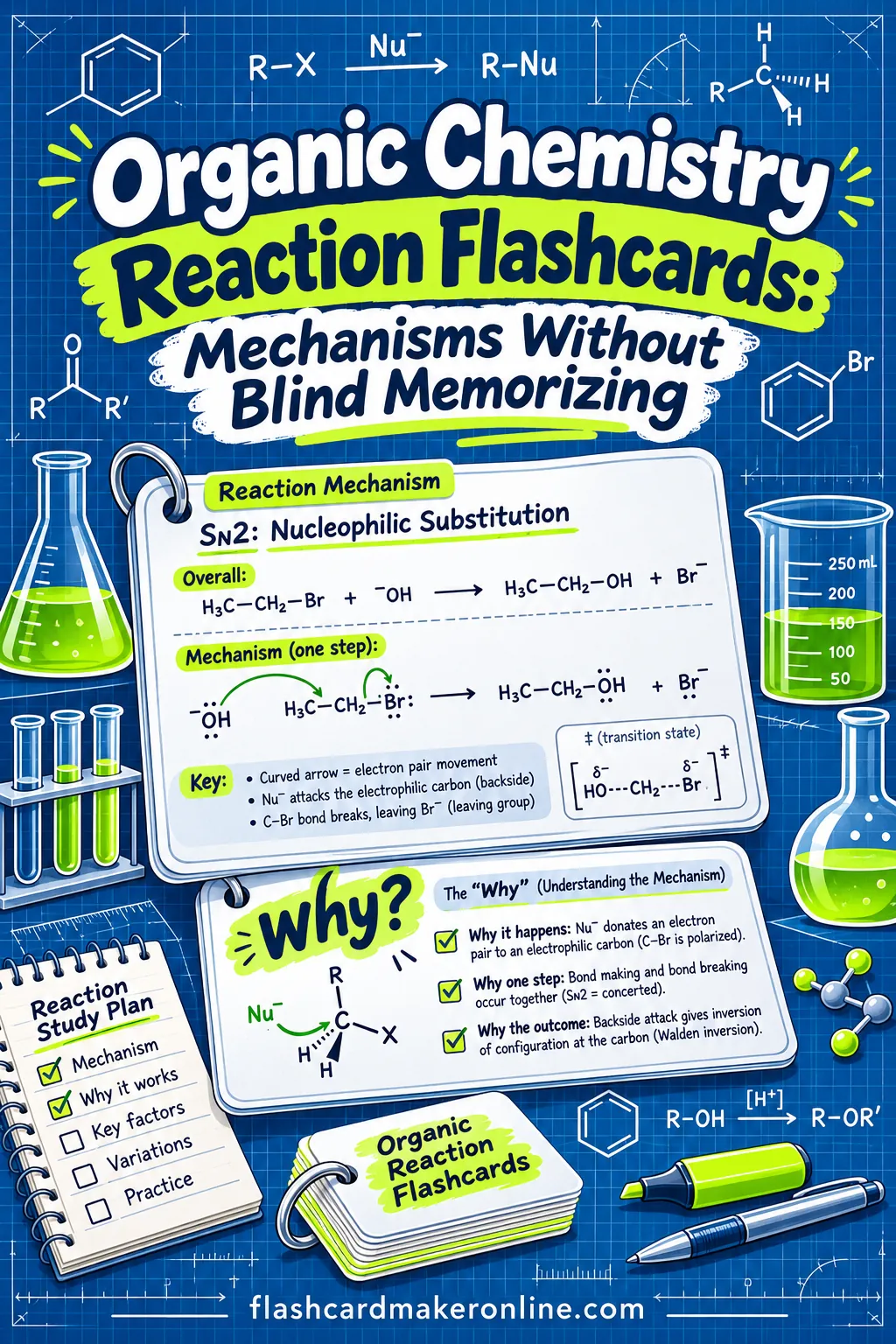
Start with 6 groups, not 18. Add three more each day once the first set feels easy. A few minutes a day for a week beats a long cram the night before. Our organic chemistry reaction flashcards page shows how to build the next deck once you know the groups, since reactions are mostly "what happens to this group."
Group them into families
Eighteen separate facts are hard. Four families are easy. Sort your cards like this:
- Hydrocarbons (just C and H): alkane, alkene, alkyne, aromatic ring. Count the bonds: single, double, triple, ring.
- Single-bonded heteroatoms: alkyl halide, alcohol, phenol, ether, thiol, amine. Something other than C or H hangs off a carbon with a single bond.
- Carbonyl family (C=O): aldehyde, ketone, carboxylic acid, ester, amide, acid chloride, anhydride. Ask "what's attached to the C=O?"
- Triple bond to N: nitrile. It's the odd one out, so it's easy to remember.
The carbonyl family in one question
Once you spot a C=O, look at the two things attached to that carbon:
| Attached to the C=O | Group |
|---|---|
| H and a carbon (or two H) | Aldehyde |
| Two carbons | Ketone |
| OH and a carbon | Carboxylic acid |
| O-R' and a carbon | Ester |
| N and a carbon | Amide |
| Cl and a carbon | Acid chloride |
| O-C=O and a carbon | Anhydride |
Alcohol vs ether vs ester (and other look-alikes)
These pairs cause the most lost points. Make a card for each pair with both structures on the back.
| Easy to mix up | How to tell them apart |
|---|---|
| Alcohol vs ether | An alcohol has an O-H. An ether's oxygen sits between two carbons and has no H. |
| Ether vs ester | An ester has a C=O right next to the single-bonded O. An ether has no C=O at all. |
| Alcohol vs carboxylic acid | Both have OH, but in an acid the OH is on a carbon that also has a C=O. |
| Alcohol vs phenol | A phenol's OH is directly on a benzene ring. An alcohol's OH is on an sp3 carbon. |
| Aldehyde vs ketone | Aldehyde: C=O at the end of a chain, with an H. Ketone: C=O in the middle, with two carbons. |
| Amine vs amide | An amide's N is bonded to a C=O. An amine's N isn't. |
| Ester vs carboxylic acid | Swap the H of the acid's OH for a carbon group and you have an ester. |
Our flashcards for confusing similar terms guide has a good card format for pairs like these.
Functional groups and boiling points
Exams love to ask which compound boils highest. As a general rule for molecules of about the same size:
- Highest: carboxylic acids and amides (strong hydrogen bonding).
- Next: alcohols, then amines (hydrogen bonding, a bit weaker for amines).
- Middle: aldehydes, ketones and esters (polar C=O, but no O-H to hydrogen bond with each other).
- Low: ethers and alkyl halides.
- Lowest: alkanes, alkenes and alkynes.
Size and branching matter too, so treat this as a starting point, not a law.
Naming priority of functional groups
When a molecule has more than one group, the highest-priority one gets the suffix and the others become prefixes. A simplified order, highest first:
carboxylic acid > anhydride > ester > acid halide > amide > nitrile > aldehyde > ketone > alcohol > amine > alkene, alkyne > alkane
Ethers and halides are always named as prefixes. Textbooks differ slightly on a few spots, so copy your own course's table onto a card.
A one-week plan for functional groups
| Day | New cards | Review |
|---|---|---|
| 1 | Alkane, alkene, alkyne, aromatic, alkyl halide, alcohol | None yet |
| 2 | Ether, phenol, thiol, amine | Day 1 cards |
| 3 | Aldehyde, ketone, carboxylic acid | Days 1 and 2 |
| 4 | Ester, amide, acid chloride, anhydride, nitrile | Anything you missed |
| 5 | Reverse cards (structure to name) | All name cards |
| 6 | Look-alike pair cards | Reverse cards |
| 7 | Circle every group in 5 real drug or textbook molecules | Only the cards you missed this week |
If you're juggling several classes, our flashcards for college students page has tips on fitting a deck like this into a busy week, and the chemistry flashcards page covers the gen chem basics that orgo builds on.
Common mistakes with functional groups
- Calling every C=O a ketone. Always check what's attached first.
- Missing the hidden groups. An ester inside a ring (a lactone) or an amide inside a ring (a lactam) is still an ester or an amide.
- Mixing up "alkyl" and "aryl." Alkyl is a carbon chain. Aryl is an aromatic ring.
- Only memorizing names. If you can't draw it, you don't know it yet. Practice drawing the back of the card before you flip.
Ready to build your deck? Open the free flashcard maker, paste in the chart above, and add a reverse card for every group.
Frequently Asked Questions
What are the main functional groups in organic chemistry?
The ones most intro courses expect you to know are alkane, alkene, alkyne, aromatic ring, alkyl halide, alcohol, ether, aldehyde, ketone, carboxylic acid, ester, amine, amide and nitrile. Many courses add thiol, phenol, acid chloride and anhydride.
What is the difference between an alcohol, an ether and an ester?
An alcohol has an OH group on a carbon (R-OH). An ether has an oxygen between two carbons (R-O-R'). An ester has a C=O with an oxygen next to it, linking two carbon groups (R-COO-R').
How do you tell an aldehyde from a ketone?
Both have a C=O (carbonyl) group. In an aldehyde, the carbonyl carbon is at the end of the chain and has at least one hydrogen (R-CHO). In a ketone, it sits between two carbons (R-CO-R').
What is the fastest way to memorize functional groups?
Make one flashcard per group with the name on the front and the formula, key feature and an example on the back. Then add reverse cards that show only the formula. Review a few minutes a day instead of cramming.
Which functional group has the highest naming priority?
In IUPAC naming, carboxylic acids rank highest among the common groups, followed by the acid derivatives (anhydrides, esters, acid halides, amides), then nitriles, aldehydes, ketones, alcohols and amines. Textbooks differ slightly, so follow your course's table.