Flashcards for Terms That Look Alike: Stop Mixing Up Similar Concepts
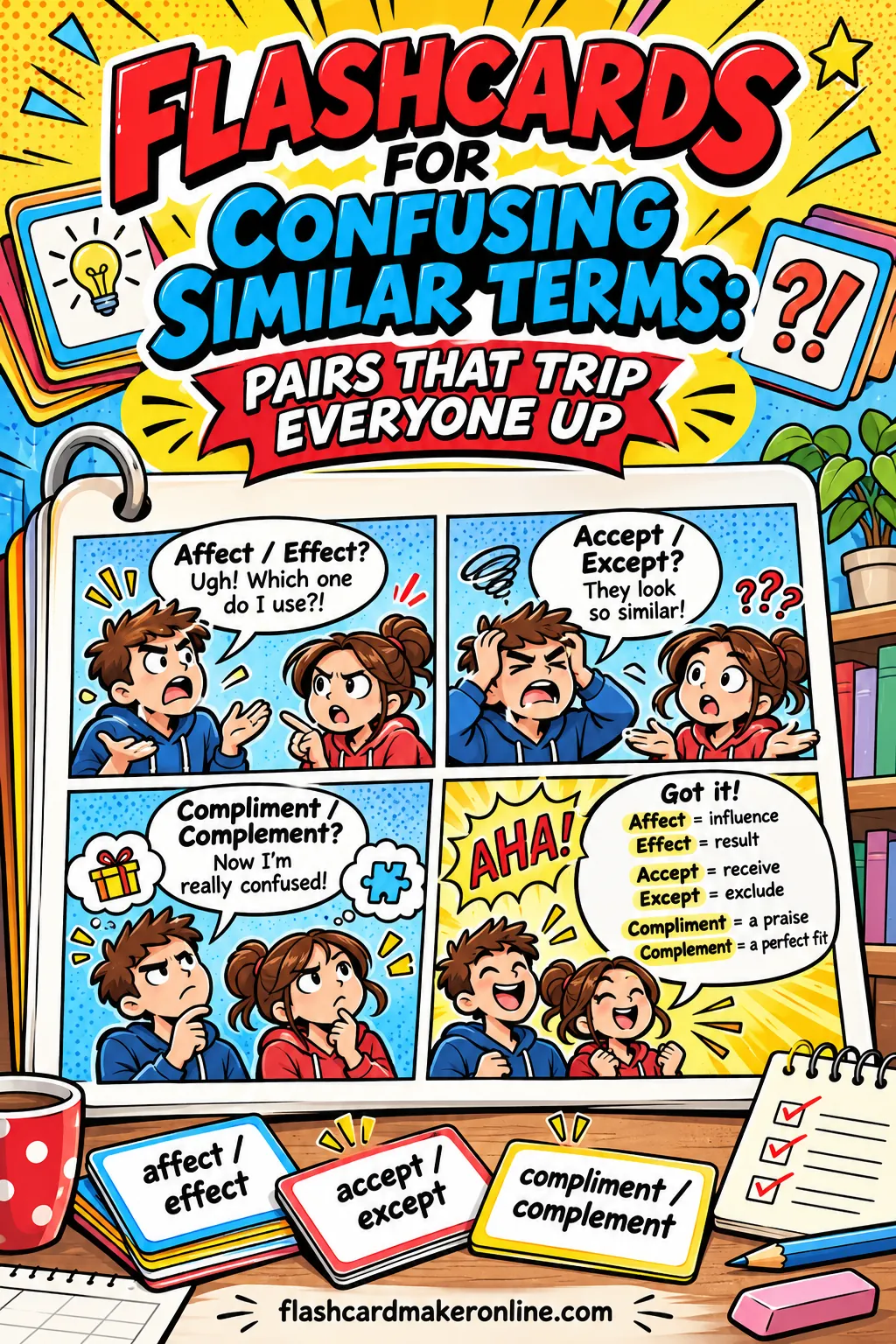
If you keep mixing up similar terms, stop making one card per term and make a contrast card instead: both terms on the front, the single difference that matters on the back, plus a short clue that tells them apart. Then study those cards shuffled with scenario cards that force you to pick one or the other. You can build a contrast deck in a few minutes with the free flashcard maker, no account needed.
You probably know the feeling. You've studied "afferent" and "efferent" a dozen times. You get both cards right when they come up alone. Then a test question uses one of them and your mind goes blank, or worse, you pick the wrong one with total confidence. That's not a memory problem in the usual sense. It's a discrimination problem, and it needs a different kind of card.
This guide explains why look-alike terms resist ordinary flashcards, shows you five card types that fix it, gives you a ready-to-paste deck of common confusable pairs across subjects, and walks through a study routine that keeps the pairs straight for good.
🃏 Quiz yourself: 10 cards from this page
Read the front, say your answer, then tap the card to check.
Make, study & print this deck → Opens the free flashcard maker with all 10 cards ready to edit or print.▶ Open this deck in the flashcard maker
Why Plain Flashcards Don't Fix Look-Alike Terms
A normal flashcard asks one thing: "What does X mean?" When you have two similar terms, you end up with two separate cards. "Afferent" on one card, "efferent" on another. Each one is easy on its own. The trouble is that the test never asks you to define them in isolation. It asks you to tell them apart.
Here's what's going on.
You learn each card, not the difference. Your brain stores "afferent means sensory" and "efferent means motor" as two facts. Nothing in your study connects them. So when you see "efferent" on a test, both facts light up at about the same strength, and you guess.
The cards cue each other. When two cards look alike, seeing one reminds you of the other. That's called interference. Learning a second similar item can make the first one harder to pull up, and the other way around.
Context gives the answer away. If you study afferent right after the "sensory pathways" lecture, the context does half the work. On a mixed exam, that context is gone.
Blocked review hides the problem. If your deck has all the nervous system cards in order, you'll see afferent and efferent near each other, in the same order, every time. You can start answering from position instead of meaning.
The fix is to make the difference itself the thing you study. That's what contrast cards do.
Five Card Types That Separate Similar Terms
You don't need all five for every pair. Start with the contrast card and add others for pairs that keep tripping you up.
| Card type | Front | Back | When to use it |
|---|---|---|---|
| Contrast | Term A vs term B. Key difference? | The one feature that splits them | Every confusable pair |
| Which one? | A short example or description | Which term fits, and why | When you know both but can't apply them |
| Clue | What's the trick to tell A from B? | A mnemonic or spelling hook | When you keep reversing them |
| One-sided | Term A. Is this the one that does X? | Yes or no, with the reason | When you always mix up the direction |
| Trio or group | A vs B vs C. How do they differ? | A short line for each | When three or more terms blur together |
1. The contrast card
This is the core card. Both terms go on the front, along with a specific question about the feature that differs. The back gives both answers side by side.
Front: "Afferent vs efferent. Direction relative to the brain and spinal cord?" Back: "Afferent arrives at the CNS. Efferent exits it."
The front names one dimension (direction), not "What's the difference?" A vague front invites a vague answer. If two terms differ in several ways, make one contrast card per dimension.
2. The "which one?" card
This card gives you a situation and asks you to choose. It's the closest match to how tests work, because a test question usually describes something and expects you to name it.
Front: "A nerve carrying a pain signal from your finger to your spinal cord. Afferent or efferent?" Back: "Afferent. It's arriving at the CNS."
Make several "which one?" cards for each pair, some for each answer. If every example happens to be afferent, you'll learn to always say afferent.
3. The clue card
A clue is a quick hook tied to the letters or sound of the word. "Afferent arrives, efferent exits" is a clue. So is "adduction adds the limb back to the body."
Front: "Trick for afferent vs efferent?" Back: "A for arrives, E for exits."
Clue cards help most early on. Once the difference is automatic, you can drop them from regular review.
4. The one-sided card
Sometimes you only need to nail down one of the pair. If you know one solidly, the other becomes "the one that isn't that." This is a handy shortcut.
Front: "Is stalactite the one hanging from the ceiling?" Back: "Yes. Stalactites hold tight to the ceiling. Stalagmites might reach the ceiling someday."
Pick whichever term has the easier hook and anchor on it.
5. The trio or group card
Some confusions involve three or more terms. Negative reinforcement, positive punishment, and negative punishment are a classic trio. One card listing all three side by side shows the full pattern in one view. Keep each line short.
A worked example: fixing one stubborn pair
Here's how to handle a pair from start to finish. Take negative reinforcement and punishment, one of the most commonly confused pairs in intro psychology.
Step 1. Find the exact point of confusion. Most students think "negative" means "bad," so they assume negative reinforcement is a kind of punishment. That's the error to target.
Step 2. Write the contrast card on that exact point.
| Front | Back |
|---|---|
| Negative reinforcement vs punishment. Does the behavior go up or down? | Reinforcement always increases the behavior. Punishment decreases it |
| In operant conditioning, what does "negative" mean? | Something is taken away. Not "bad" |
| In operant conditioning, what does "positive" mean? | Something is added. Not "good" |
Step 3. Add a clue. "Reinforce means strengthen. Negative means subtract." Put it on its own card.
Step 4. Add "which one?" cards, mixed.
| Front | Back |
|---|---|
| Your seatbelt alarm stops when you buckle up, so you buckle faster next time | Negative reinforcement. Annoying sound removed, behavior increases |
| A teen loses phone time for missing curfew, and misses curfew less | Negative punishment. Something good removed, behavior decreases |
| A student gets extra chores for talking back, and talks back less | Positive punishment. Something unpleasant added, behavior decreases |
| A dog gets a treat for sitting, and sits more often | Positive reinforcement. Something good added, behavior increases |
Step 5. Shuffle and review. Don't study the four examples in the same order each time. Mix them into the rest of your psychology deck so you have to decide fresh on each card.
That's five to eight cards for one pair. It sounds like a lot, but it's one pair you'll never mix up again. Compare that with reviewing two plain definition cards forty times and still guessing. For more cards in this area, see the guide to psychology flashcards.
Ready-to-Paste Deck of Common Confusable Pairs
Here's a starter deck of pairs that trip up lots of students. It's written in the front : back format for the maker's Paste a list feature. One card per line. Take the blocks that match your classes and skip the rest.
English and writing
Affect vs effect. Which is usually the verb? : Affect is usually the verb. Effect is usually the noun
Affect vs effect. Clue? : A for action (verb), E for end result (noun)
Then vs than. Which compares? : Than compares. Then is about time
Principal vs principle. Which means a rule or belief? : Principle. Principle and rule both end in -le
Principal vs principle. Which is the head of a school? : Principal. The principal is your pal
Complement vs compliment. Which means to complete? : Complement. Complement and complete share the letters c-o-m-p-l-e
Ensure vs insure. Which is about an insurance policy? : Insure. Ensure means to make sure
Stationary vs stationery. Which is paper? : Stationery. E for envelope
Elicit vs illicit. Which means illegal? : Illicit. Ill-icit, ill means bad
Fewer vs less. Which goes with things you can count? : Fewer. Fewer cards, less time
Imply vs infer. Who does which? : The speaker implies. The listener infers
Discreet vs discrete. Which means separate pieces? : Discrete. The t separates the two e's
Biology and anatomy
Mitosis vs meiosis. Number of daughter cells? : Mitosis 2 identical. Meiosis 4 with half the chromosomes
Mitosis vs meiosis. Clue? : Meiosis makes me, it makes sex cells
Osmosis vs diffusion. What moves in osmosis? : Water, across a selectively permeable membrane
Afferent vs efferent. Direction? : Afferent arrives at the CNS. Efferent exits it
Abduction vs adduction. Which moves toward the body? : Adduction. You add the limb back
Ileum vs ilium. Which is the hip bone? : Ilium. Ilium and hip both have an i
Ileum vs ilium. Which is part of the intestine? : Ileum. E for eating
Artery vs vein. Usual direction of blood? : Arteries carry blood away from the heart. Veins return it
Dominant vs recessive allele. Which shows with one copy? : Dominant
Genotype vs phenotype. Which is the visible trait? : Phenotype. Genotype is the gene combination
Prokaryote vs eukaryote. Which has a nucleus? : Eukaryote. Pro means no nucleus, eu means do
Xylem vs phloem. Which carries water up? : Xylem. Phloem carries food (sugars)
Chemistry and physics
Cation vs anion. Which is positive? : Cation. The t looks like a plus sign
Oxidation vs reduction. Electrons? : Oxidation is loss, reduction is gain. OIL RIG
Exothermic vs endothermic. Which releases heat? : Exothermic. Exo means out
Accuracy vs precision. Which means close to the true value? : Accuracy. Precision means close to each other
Mass vs weight. Which changes on the Moon? : Weight. Mass stays the same
Speed vs velocity. Which includes direction? : Velocity
Isotope vs ion. What differs? : Isotopes differ in neutrons. Ions differ in electrons
Psychology and statistics
Negative reinforcement vs punishment. Behavior up or down? : Reinforcement increases. Punishment decreases
Proactive vs retroactive interference. Which way does it go? : Proactive, old blocks new. Retroactive, new blocks old
Classical vs operant conditioning. What's learned? : Classical pairs stimuli. Operant links behavior to consequences
Reliability vs validity. Which means consistent? : Reliability. Validity means it measures what it claims to
Type I vs Type II error. Which is a false positive? : Type I. Rejecting a true null hypothesis
Mean vs median. Which resists outliers? : Median
Independent vs dependent variable. Which do you change? : Independent. The dependent is what you measure
Language learners
Ser vs estar. Which for location of a thing? : Estar. How you feel and where you are, use estar
Ser vs estar. Which for origin and identity? : Ser
Por vs para. Which for a purpose or goal? : Para
Saber vs conocer. Which for knowing a person? : Conocer
Savoir vs connaitre. Which for knowing a fact? : Savoir
Hiragana ne vs re vs wa. Telling them apart? : Ne ends in a small loop. Re ends in a kick out. Wa curves around
Hiragana nu vs me. Telling them apart? : Nu has a loop at the end. Me does not
Katakana shi vs tsu. Stroke direction? : Shi dashes are more horizontal, last stroke goes up from bottom left. Tsu dashes are vertical, last stroke comes down from top right
Katakana so vs n. Stroke direction? : So, short stroke more vertical, long stroke from top. N, short stroke flatter, long stroke rising from bottom
Everyday and general knowledge
Stalactite vs stalagmite. Which hangs down? : Stalactite. It holds tight to the ceiling
Latitude vs longitude. Which runs east and west? : Latitude lines run east and west. Think ladder rungs
Weather vs climate. Which is long-term? : Climate
Fiscal vs monetary policy. Who runs which? : Fiscal is taxes and spending by government. Monetary is the central bank and interest rates
RAM vs ROM. Which loses data when power is off? : RAM
Concave vs convex. Which caves in? : Concave
Prefix pairs that flip the meaning
Some of the worst mix-ups come from prefixes that look or sound close but mean opposite things. One prefix card fixes dozens of words at once, because every word built on that prefix follows the same rule.
Hypo vs hyper. Which means below or under? : Hypo. Hypoglycemia is low blood sugar
Hyper vs hypo. Clue? : Hyper is over the top. Hypo sounds like low
Inter vs intra. Which means between? : Inter. Interstate highways run between states
Intra vs inter. Which means within? : Intra. Intramural sports happen within one school
Ante vs anti. Which means before? : Ante. Anti means against
Endo vs exo. Which means inside? : Endo. Exo means outside, like an exit
Brady vs tachy. Which means slow? : Brady. Tachy means fast
Hetero vs homo. Which means same? : Homo. Hetero means different
Once a prefix card is solid, add "which one?" cards using real words. "Hyperthermia. High or low body temperature?" "Intravenous. Within or between?" Each word becomes a quick test of the rule. If medical words are where most of your prefix trouble shows up, a dedicated deck of word parts pays off fast, because the same few dozen prefixes and roots appear in thousands of terms.
That's around 70 cards. Use them as a model, then add pairs from your own classes. Your own pairs are the ones that matter most, because they're the ones you actually mix up.
How to Build a Contrast Deck in the Maker
Here's the full process, step by step. No sign-up.
- Open the flashcard maker and give the deck a clear title, like "Bio Mix-Ups" or "Spanish Contrast Cards."
- Check for a matching preset. If your confusions come from a subject with a preset, such as Biology, Anatomy, Chemistry, Spanish vocab, or Hiragana, load it into a separate deck first to see the plain cards. That's often where you'll notice which pairs you keep blurring.
- Click Paste a list. Paste the blocks you want. Each line is
front : back, with spaces around the colon. Choose Add to deck to combine blocks, or Replace deck to start clean. - Write your own pairs the same way. Keep fronts as "A vs B. Specific question?" and keep colons out of the card text, since the colon splits the front and back.
- Add pictures where the difference is visual. Kana that look alike, anatomy movements, concave versus convex lenses, and stalactites versus stalagmites all benefit from a small picture. Add one to the card so you see the shape every time you flip.
- Study with Shuffle on. Open Study mode and turn on Shuffle every session. This is the most important step. Contrast cards in a fixed order lose much of their value. Answer before you Flip, then use Next. 🔊 Read aloud helps with sound-alike words like affect and effect.
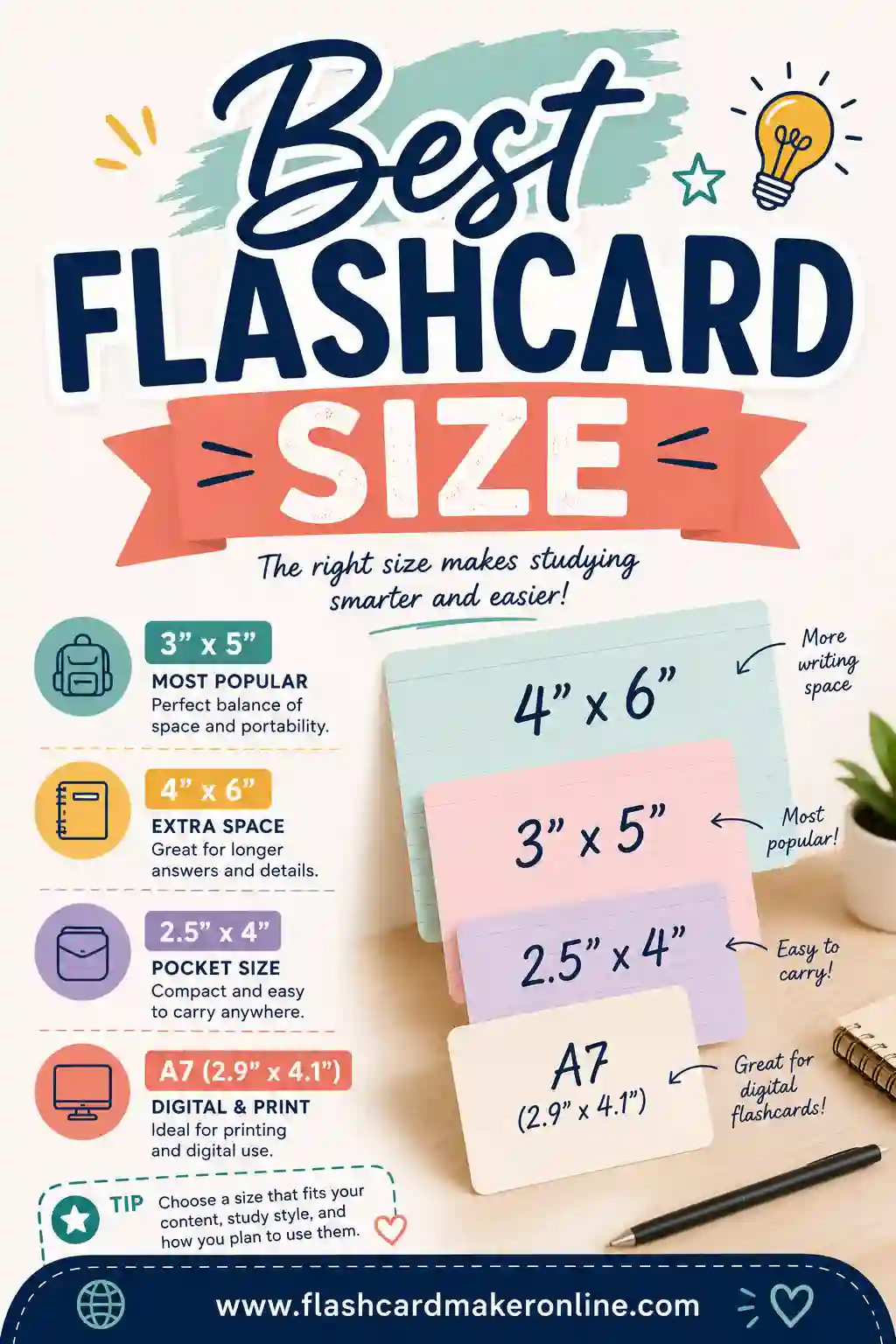
- Print for sorting. Choose Double-sided so the clue lines up behind each pair. Standard or 3×5 index card works for most text cards. For picture cards, Big gives the images more room. Click Print a test page first, then print or save as PDF.
- Keep it portable. Download .csv saves a backup you can bring back with Import a file. Get share link lets a classmate take their own copy.
Interleaving: Why Mixing Cards Matters So Much Here
For most decks, shuffling is a nice extra. For look-alike terms, it's essential.
When you study one topic at a time (all afferent cards, then all efferent cards), that's called blocked practice. When you mix topics so similar items appear close together in random order, that's interleaved practice. Research on learning has found that interleaving tends to help people tell similar categories apart, even though it often feels harder and slower while you're doing it. That feeling of struggle is a good sign, not a bad one.
Here's how to use it with your deck:
| Stage | How to mix | What it trains |
|---|---|---|
| First pass | Study one pair at a time with its clue card | Learning each difference |
| Second pass | Shuffle all cards from one subject | Picking the right term from many |
| Third pass | Shuffle "which one?" cards from both terms of a pair together | Fast, accurate discrimination |
| Ongoing | Mix contrast cards into your full subject deck | Spotting the pair in a real context |
The interleaved practice guide goes deeper into why this works and how to apply it across subjects.
Should you learn both terms at once or one at a time?
There are two reasonable approaches, and both can work.
Learn one first, then contrast. Get one term solid on its own. Once it's automatic, bring in the second term with a contrast card. This works well for beginners and for pairs where one term is far more common, like "affect" (verb) versus "effect" (noun).
Learn both together with contrast from day one. Introduce the pair as a pair, with a contrast card and a clue card right away. This works well when you already know a bit about both terms and the main problem is mixing them up.
If you're already confusing a pair, you're in the second group. Go straight to contrast cards.
Writing Clues That Actually Stick
A good clue is short, tied to the spelling or sound of the word, and impossible to reverse. Here's what separates strong clues from weak ones.
Tie the clue to a letter that differs. Afferent and efferent differ in the first letter, so the clue uses A and E: arrives, exits. Ilium and ileum differ by one vowel, so the clue uses that vowel.
Make it a full phrase, not a hint. "Something about the A" won't help under pressure. "A for arrives" will.
Anchor on the easier word. If one word has an obvious hook, use it and let the other be "the other one." Stationery has an e like envelope. That's enough to sort both words.
Use pictures for visual pairs. For kana, letters like b and d, or shapes like concave and convex, a drawing beats a sentence. The dual coding guide explains why pairing a word with an image tends to help it stick.
Check the clue for accuracy. A clever clue that's slightly wrong is worse than none. Double-check every clue against your textbook before you drill it.
Here's a quick comparison:
| Weak clue | Strong clue |
|---|---|
| "Affect is the action-ish one" | "A for action (verb), E for end result (noun)" |
| "Cations are positive somehow" | "The t in cation looks like a plus sign" |
| "Stalactites are on top" | "Stalactites hold tight to the ceiling" |
| "Proactive is old stuff" | "Proactive, old blocks new. Retroactive, new blocks old" |
| "Latitude goes sideways" | "Latitude lines are like ladder rungs, flat across" |
A Two-Week Routine to Fix Your Worst Pairs
Use this when a specific set of mix-ups keeps costing you points.
| Days | What to do | Time |
|---|---|---|
| Day 1 | List every pair you've mixed up on quizzes or homework. Write contrast and clue cards for each | 20–30 min |
| Days 2–3 | Study pair by pair with clue cards. Answer out loud before flipping | 10–15 min |
| Days 4–6 | Add "which one?" cards. Shuffle all pairs together | 10–15 min |
| Days 7–9 | Drop clue cards for pairs you get right every time. Keep shuffling | 10 min |
| Days 10–12 | Mix contrast cards into your full subject deck | 15–20 min |
| Days 13–14 | Self-test. Any pair you miss gets new "which one?" cards | 15 min |
Keep a running list of mix-ups as you go through your course. Every time you mix up two terms on a quiz, add the pair to your list. That list is the most valuable part of this whole method, because it targets your own confusions, not someone else's.
Turn every quiz mistake into a card
Your graded quizzes and homework are the best source for this deck. Each wrong answer usually has a reason, and often that reason is a look-alike term. When you go over a returned quiz, ask two questions for every miss. Did I pick a term that's similar to the right one? If so, which two terms got crossed?
Then write the pair down and make cards that same day. Use the wording from the actual question on at least one "which one?" card. Tests tend to reuse the same kind of phrasing, so practicing with it helps you recognize the trap the next time.
Also watch for misses where you knew both terms but read the question too fast. Those aren't knowledge gaps, so a card won't fix them. Slowing down and underlining the key word in each question will.
If you print the deck, sort cards into piles: "still mixing up," "getting it," and "solid." Review "still mixing up" every day. Move cards up when you get them right three times in a row. Move them back down the moment you miss one.
Common Mistakes and Fixes
Mistake: Two separate cards per pair. Fix: Merge them into a contrast card. Keep the separate definition cards only if you also need the definitions alone.
Mistake: "What's the difference?" on the front. Fix: Name the dimension. "Direction?" "Which is positive?" "Which is the verb?" Specific questions get specific answers.
Mistake: All examples point to the same term. Fix: Balance your "which one?" cards so about half go each way.
Mistake: Always studying in the same order. Fix: Turn on Shuffle every time. Order is a hidden cue that disappears on test day.
Mistake: Clues that don't match the spelling. Fix: Tie each clue to a letter or sound that actually differs between the two terms.
Mistake: Stopping when it feels easy. Fix: Keep contrast cards in rotation for a few weeks after they feel solid. Ease today doesn't mean you'll remember it in a month. The guide to the illusion of competence explains why "I know this" is often misleading during study.
Mistake: Ignoring trios. Fix: When three terms blur, make a group card and "which one?" cards for all three. Pairing them off two at a time often leaves the third one loose.
Variations by Subject and Age
Young kids and early readers. Letter reversals like b and d or p and q are the classic look-alikes. Use big picture cards, one clue per letter (like "b has a belly on the right"), and short sessions. Print in Jumbo so the letters are easy to see. Keep sessions playful and short, and stop while it's still fun.
English learners. Sound-alike and look-alike words, such as "then" and "than," or "quiet" and "quite," are great contrast card material. Use 🔊 Read aloud so you hear the difference along with seeing it.
Language learners. Pairs like ser and estar or por and para depend on usage rules. Contrast cards set up the rule. Lots of "which one?" sentence cards make it automatic.
Science and medical students. Anatomical directions, look-alike terms like ileum and ilium, and prefix pairs like hypo and hyper are prime targets. Add pictures for anything spatial.
Exam prep. Licensing and admissions tests often include answer choices built from similar terms. Build contrast cards from any wrong answer that fooled you on practice tests. If a distractor caught you once, it'll try again.
Start with your top three mix-ups. You don't need a giant deck to see results. Pick the three pairs that cost you the most points. Write a contrast card, a clue card, and four "which one?" cards for each. That's 18 cards. Shuffle them and study for ten minutes a day for a week. Then open the free flashcard maker and add your next three.
▶ Open this deck in the flashcard maker
Frequently Asked Questions
Why do I keep mixing up similar terms even after studying them?
Studying each term on its own card teaches the definitions but not the difference. When a test shows one term, both definitions come to mind at about the same strength, so you guess. Contrast cards make the difference itself the thing you practice.
What is a contrast flashcard?
It's a card with both similar terms on the front and a specific question about how they differ, like "Afferent vs efferent. Direction?" The back gives both answers side by side. It trains you to separate the two terms, not just recall each one.
Should I study similar terms together or apart?
Once you're mixing them up, study them together with contrast cards and shuffled "which one?" cards. Some learners find it easier to learn the first term solidly before adding the second, but if confusion has already set in, side-by-side study is the faster fix.
How many cards do I need for one confusing pair?
Start with one contrast card, one clue card, and four "which one?" cards, balanced so about half point to each term. That's six cards. Add more examples for pairs that still trip you up after a week.
Does shuffling flashcards really help?
For look-alike terms, yes. Studying in a fixed order lets you answer by position instead of meaning. Shuffling mixes similar items together, which forces you to tell them apart, the same thing a test will ask you to do.
Can I add pictures to contrast cards?
Yes. You can add a picture to any card in the maker. Pictures are especially useful for visual look-alikes, such as similar letters, kana characters, anatomy movements, or shapes.
How do I make good memory clues for similar words?
Tie the clue to the letter or sound that differs between the two words, and make it a full phrase you can't reverse, like "afferent arrives, efferent exits." Check every clue against your textbook so you don't drill a mistake.
When can I stop reviewing a contrast card?
Keep it in rotation until you've gotten it right on several separate days, then review it less often instead of dropping it entirely. Pairs that once confused you can drift back together if you stop seeing them for a long time.