Dual Coding Theory: How Pairing Words With Pictures Helps You Remember
Dual coding theory is the idea that your mind handles information in two connected systems: one for words and one for images and other nonverbal experiences. When you learn something in both forms, such as the word "volcano" plus a simple sketch of one, you create two linked memory traces instead of one, and that gives you more than one way to get the memory back later. The theory was developed by Canadian psychologist Allan Paivio starting in the 1960s, and it's one of the main reasons a well-chosen picture on a flashcard can make a real difference.
That doesn't mean "add pictures to everything." The research shows when pictures help, when they don't, and what kinds of pictures are worth the effort. This guide walks through the theory in plain language, the key experiments, the limits and criticisms, and step-by-step ways to use dual coding on your own flashcards for vocabulary, science, history and more.
What Dual Coding Theory Says
Paivio proposed that thinking runs on two separate but connected systems:
- The verbal system handles language: words you read, hear, say or write.
- The nonverbal system handles things that aren't language: objects, scenes, sounds, textures and movements. Most people think of this as the "imagery" system, since mental pictures are its best-known product.
In a 2006 chapter written for a University of Michigan conference, "Dual Coding Theory and Education," Paivio explained that each system is built from its own mental units. He called the verbal units logogens (from the Greek for "word") and the nonverbal units imagens. A logogen is what fires when you recognize or think about a word. An imagen is what fires when you recognize or think about a thing. These units are tied to specific senses, so there are different ones for what something looks like, sounds like, feels like and how you move to use it.
The two systems can work alone or together. Paivio's own examples were simple: a crossword puzzle leans mostly on the verbal system, while a jigsaw puzzle leans mostly on the nonverbal one. Most meaningful thinking uses both. When you read "the cat jumped onto the warm windowsill," the words are processed verbally, but you probably also form a quick image of the scene.
The links between the systems are called referential connections. They're what let you name a picture or picture a name. Dual coding is what happens when both systems get involved in learning the same thing, so the memory lives in two places connected by those links.
Who Allan Paivio Was and How the Theory Began
Allan Paivio (1925 to 2016) was a professor of psychology at the University of Western Ontario (now Western University) in Canada. According to an in memoriam article by Albert Katz of Western University, published in Psynopsis in 2017, Paivio grew up in northern Ontario, served in the Canadian Navy, earned degrees at McGill University, and even won the title of "Mr. Canada" in bodybuilding in 1948 before turning to psychology full time.
Katz writes that while Paivio was a graduate student at McGill, he noticed that concrete words (like "apple") worked better than abstract words (like "truth") as memory cues when people learned pairs of words. He suspected this was because concrete words easily call up mental images, which act as "pegs" for hanging other information on. That idea grew into a 1969 paper in Psychological Review and his 1971 book, Imagery and Verbal Processes, where dual coding theory was laid out in full.
The timing matters. For decades before that, many psychologists avoided the topic of mental imagery because it seemed too subjective to study. Katz credits Paivio with helping make imagery a respectable research topic again by testing it with careful, objective experiments. Paivio went on to publish about 200 empirical articles and chapters and five books.
Katz also points out a common misunderstanding: dual coding theory is often shrunk down to "a theory about mental pictures," when it's really a broader theory about how verbal and nonverbal representations work together.
The Old Idea Behind It: Words Plus Pictures in Teaching
Paivio was fond of pointing out that teachers were pairing words and pictures centuries before anyone had a theory for it. In his 2006 chapter, he traces the idea to the memory arts of ancient Greece and Rome and to the Czech educator Jan Amos Comenius.
Comenius published Orbis Sensualium Pictus ("The World Explained in Pictures") in Nuremberg in 1658. Paivio called it the "mother of all children's picture textbooks." It presented the world in 150 pictures, each with numbered objects matched to labels and short sentences, explaining about two thousand words. According to Paivio, it served as the model for more than 200 editions in twenty-six languages. In a sense, it was a giant set of illustrated flashcards for learning Latin and other languages.
What Paivio added was the science: a testable explanation of why the pairing works and experiments showing when it does.
The Key Evidence for Dual Coding Theory
Here are the main findings that support the theory. Where numbers appear, they come from Paivio's 2006 summary of the research or from the papers linked.
1. The concreteness effect
Memory generally improves as you move from abstract words (truth, justice) to concrete words (chair, lobster) to actual objects or their pictures. Paivio reported that for language materials, from single words up to long passages, memory for concrete material beats memory for abstract material by about a 2-to-1 ratio on average. The dual coding explanation is that concrete words are easier to picture, so they're more likely to get stored in both systems.
2. Picture superiority
Pictures are usually remembered better than words. In free-recall experiments, people tend to quietly name the objects they see, which gives them both a picture code and a word code. Concrete words can also be pictured, but people do that less reliably than they name pictures, so words fall behind. Paivio wrote that experiments confirmed this "additive" benefit of dual coding and suggested that the image code contributes more to the effect than the word code does.
3. The conceptual peg effect
When people learn word pairs, the first word (the cue) matters a lot. If you learn "monkey and bicycle" by picturing a monkey riding a bicycle, then later seeing "monkey" can bring the whole image back, along with "bicycle." Paivio's 1965 research found that how concrete the cue word was had a much stronger effect on recall than how concrete the answer word was: the cue's concreteness accounted for eight times more of the variation in recall.
4. Phrases that become one image
Paivio described a 1972 study by Begg that used two-word phrases. Some were concrete and easy to picture ("white horse"), others abstract ("basic truth"). People recalled more than twice as much from the concrete phrases. When one word from a phrase was given as a cue, recall was six times higher when the cue was a concrete word than when it was an abstract word. The concrete phrase seems to get stored as one integrated image that a single cue can bring back.
5. Age matters
Young children don't automatically benefit from pictures in the same way. Paivio noted that language-competent young children didn't recall pictures better than words in a free-recall task unless they were asked to name the pictures as they saw them. In a 1968 study with nursery school, kindergarten and first-grade children, recall was highest when a picture served as the cue and a spoken word was the answer, and lowest when a word was the cue and a picture was the answer. The lesson for parents and teachers: with little ones, saying the name out loud while looking at the picture matters.
| Finding | What happened | What it suggests for flashcards |
|---|---|---|
| Concreteness effect | Concrete material remembered about twice as well as abstract material on average | Turn abstract ideas into concrete examples or scenes |
| Picture superiority | Pictures generally recalled better than words | A relevant image can strengthen a card |
| Conceptual peg | Concrete cues led to much better recall of paired items | Put the most picturable part on the side you see first |
| Integrated images | Concrete phrases recalled more than twice as well; concrete cues six times better | Link two facts in one combined image, not two separate ones |
| Children's naming | Young children benefit more when they name the pictures | Have kids say the word aloud while viewing the image |
Dual Coding and Multimedia Learning
Paivio's work inspired a later line of research on learning from lessons that combine words and graphics. The best-known researcher here is Richard Mayer at the University of California, Santa Barbara. In a 2010 paper in Medical Education, Mayer summarized the cognitive theory of multimedia learning, which rests on three ideas:
- Two channels. People have separate channels for processing words and pictures. This is a direct descendant of dual coding.
- Limited capacity. Each channel can only handle a small amount at a time in working memory.
- Active processing. Meaningful learning requires the learner to select, organize and connect the information, not just look at it.
Mayer describes three goals for good instruction: reduce "extraneous" processing (mental effort wasted on distractions), manage "essential" processing (the effort needed to understand the core material), and foster "generative" processing (effort spent making sense of it). A UC Santa Barbara profile notes that Mayer and his colleagues have run more than 100 experiments that produced research-based principles for designing multimedia lessons.
For flashcard makers, the "limited capacity" piece is the important warning. Two channels mean you can use both, but each one can still be overloaded. A card stuffed with a busy photo, a paragraph of text and three colors of highlighting may use both channels and still overload them. The best dual-coded card is simple: a short phrase and one relevant picture.
Drawing: A Powerful Way to Dual Code
Some of the strongest recent evidence related to dual coding comes from studies on drawing. Wammes, Meade and Fernandes ran seven experiments, published in 2016 in the Quarterly Journal of Experimental Psychology as "The Drawing Effect: Evidence for Reliable and Robust Memory Benefits in Free Recall." Across all of them, people who drew pictures of words they had to remember recalled more words than people who wrote the words out. The benefit held up with different instructions, with shorter time to draw, with longer lists and in different study designs.
Interestingly, the authors found that the benefit wasn't fully explained by visual imagery alone or by pictures being remembered better. Their explanation was that drawing ties together several kinds of information at once: the meaning of the word, what it looks like and the hand movements of drawing it. That's very much in the spirit of dual coding, which always included motor and sensory codes, not just pictures.
A 2018 follow-up by the same team, "Creating a Recollection-Based Memory Through Drawing," found that drawn items were recognized better than written items, mostly because people could recall the experience of drawing them. When people had less time to use that kind of recollection, the drawing benefit got substantially smaller. In plain terms, drawing seems to create a vivid "I remember making that" memory that helps you find the information later.
For flashcards, this is good news. You don't need artistic talent. A quick stick-figure sketch that you made yourself may help more than a polished picture you found somewhere else.
Limits, Criticisms and Common Misunderstandings
Dual coding theory is well supported, but it isn't the only explanation for these effects, and it's easy to stretch it too far. Here's an honest look at the limits.
Other explanations for picture superiority
Some researchers argue that pictures are remembered better mainly because they're more physically distinctive than printed words, not because of two separate codes. In 2019, Ensor, Surprenant and Neath reported four experiments in Memory & Cognition showing that when they made words more visually distinctive (with different fonts, sizes, colors and capitalization) or made pictures less distinctive (black-and-white images with similar orientations), the picture superiority effect in recognition disappeared. The authors concluded that this was consistent with a distinctiveness account and inconsistent with dual coding. That's a real challenge to one part of the theory, at least for recognition tests.
For a student, the practical takeaway is similar either way: memorable, distinctive cards help. But it's a good reminder that "pictures are magic" is too simple.
Imagery for long texts has weak support
In the 2013 review by John Dunlosky and colleagues in Psychological Science in the Public Interest, imagery use for learning from text was rated as low utility, as was the keyword mnemonic (a technique that links a foreign word to a sound-alike image). That doesn't mean imagery never helps. It means that telling students "just picture what you read" didn't reliably improve learning across the kinds of material and tests they reviewed. Dual coding works best when the information is concrete or can be made concrete, and when the image is directly tied to what you need to remember.
Dual coding is not the same as "learning styles"
This is the biggest mix-up. Dual coding theory says that everyone has both a verbal and a nonverbal system, and that combining them can help everyone. The "learning styles" idea says that some people are "visual learners" who should get pictures and others are "verbal learners" who should get words. A major 2008 review by Harold Pashler and colleagues in Psychological Science in the Public Interest, "Learning Styles: Concepts and Evidence," found virtually no evidence for that matching approach and concluded there wasn't enough support to justify using learning-style assessments in schools.
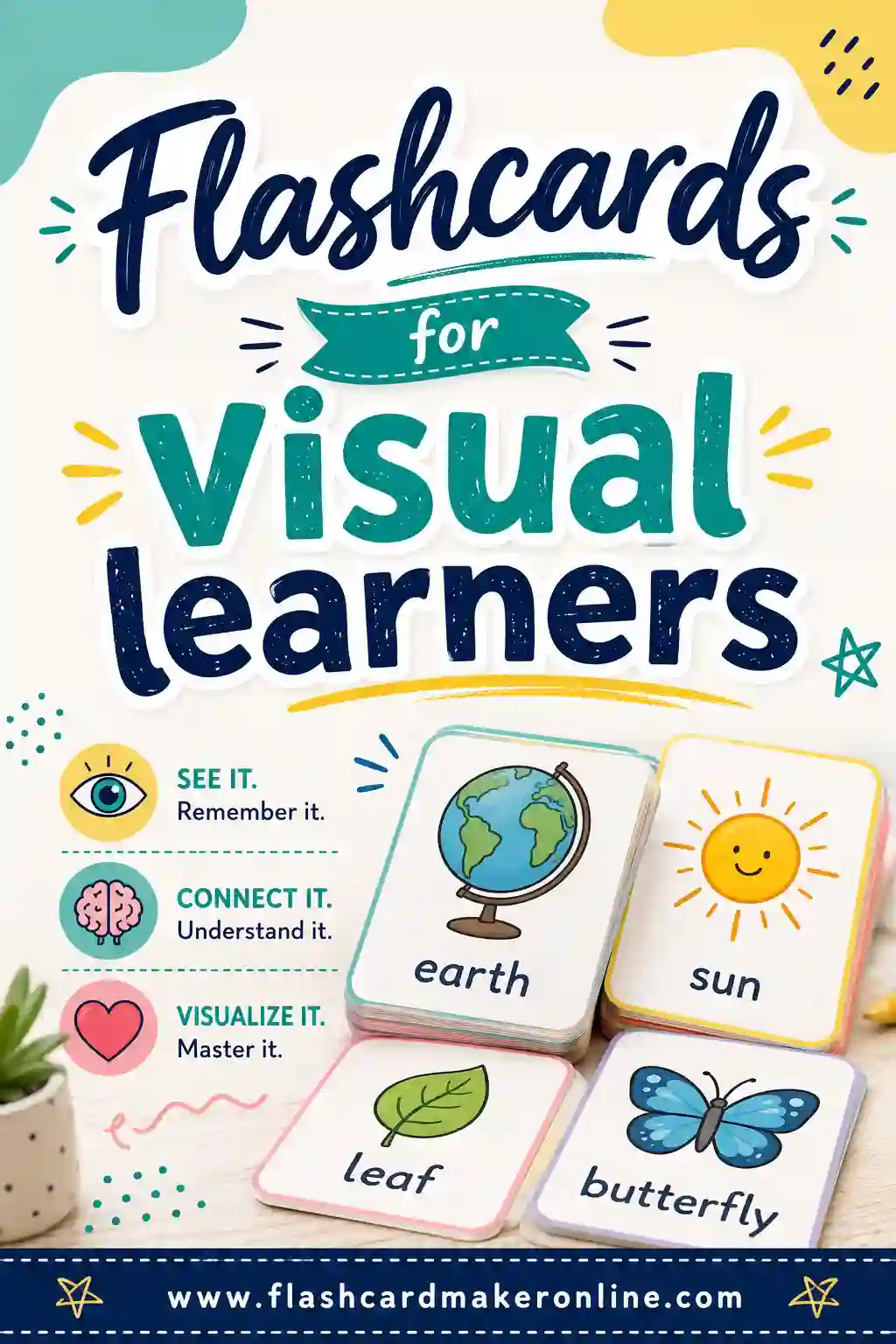
So if you consider yourself a "verbal person," dual coding still applies to you. And if you think of yourself as a "visual learner," you still need the words. If you'd like visual-friendly card ideas without the learning-styles baggage, see our page on flashcards for visual learners.
Decorative pictures don't count
A clip-art lightbulb next to the word "idea" doesn't add much. Pictures help when they carry the meaning you need to remember: the shape of a cell organelle, the layout of a map, the action a verb describes. A picture that's only decoration can even pull attention away from what matters.
| Myth | What the research actually supports |
|---|---|
| "Adding any picture makes a card better." | Relevant pictures that carry meaning help; decorative ones add little and can distract. |
| "Dual coding is for visual learners." | Dual coding applies to everyone; the learning-styles matching idea lacks evidence. |
| "More is better: words, photos, colors, icons." | Each channel has limited capacity; simple, focused cards work better. |
| "Just imagine it and you'll remember it." | Imagery instructions for long texts have weak support; concrete, tied-in images work best. |
| "You need to be good at art." | Quick personal sketches showed strong memory benefits in drawing studies. |
| "Pictures replace testing yourself." | Images strengthen what you store; you still need to practice recalling it. |
How to Use Dual Coding Theory on Flashcards
Here's a practical method that applies the research without overdoing it.
Step 1: Decide whether the idea can be pictured
Ask: "Is there a concrete thing, scene, shape, layout or action here?" Words like "volcano," "mitochondria," "to climb" or "the Nile River" are easy to picture. Abstract words like "justice" or "irony" are harder. For those, look for a concrete example (a judge's gavel and a balanced scale, or a fire station burning down) rather than a vague symbol.
Step 2: Choose one meaningful image
One clear image beats three busy ones. The image should show the thing you need to remember, not just the general topic. For a card on "erosion," a picture of a riverbank with soil washing away is better than a generic photo of a river.
Step 3: Keep the words short
Pair the image with a short phrase, not a paragraph. You're trying to link one verbal code to one image code. If you need more words, that's often a sign the card is trying to teach two things.
Step 4: Put the image where it works as a cue
Remember the conceptual peg effect: concrete cues are powerful. For vocabulary in a new language, try putting the picture on the front and the new word on the back, so the picture cues the word. Once you know that direction, make a reverse card with the new word on the front and see whether you can picture the meaning before you flip.
Step 5: Make some images yourself
Draw a quick sketch for the cards you struggle with most. Based on the drawing studies, the act of drawing can help as much as the picture itself. Stick figures and arrows are perfectly fine.
Step 6: Say it, see it, recall it
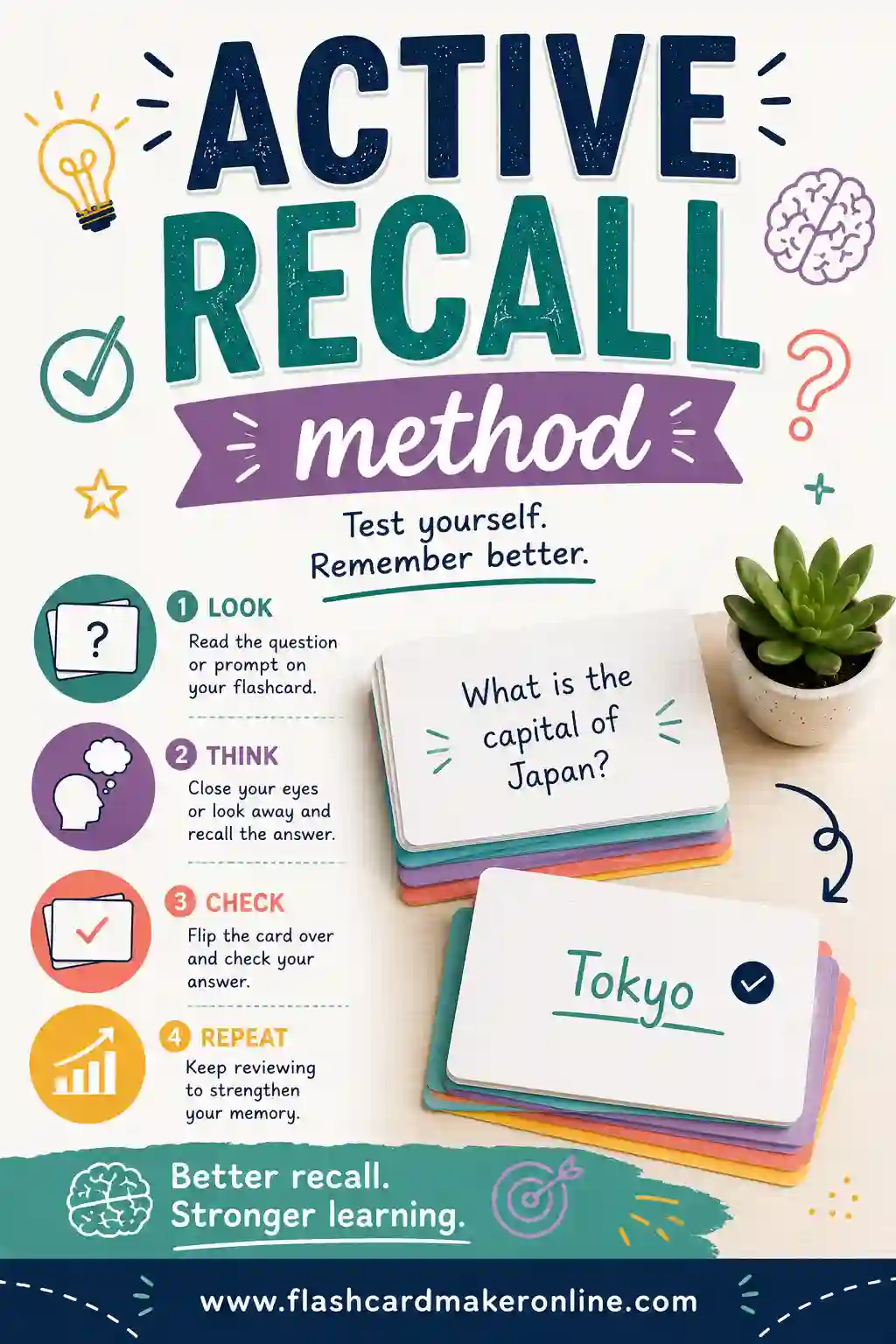
When you study, look at the image, say the word out loud, then flip and check. With young children, always have them name the picture aloud. Then, just as important, test yourself: cover one side and try to produce the other. Dual coding helps you store the memory. Retrieval practice, covered in our guide to the active recall method, helps you get it back out.
Step 7: Use spatial layouts for connected ideas
Some knowledge is about how parts relate: the stages of a cycle, the regions of a map, the parts of a cell. A simple diagram with one part highlighted ("What is this labeled part?") is a strong dual-coded card. Make one card per part instead of asking for every label at once.
Worked Examples by Subject
These examples are illustrative. They show how a plain text card can be turned into a dual-coded card.
Language learning
Before: Front: "el puente" / Back: "the bridge."
After: Front: a simple drawing of a bridge over a river / Back: "el puente." A second card reverses it. The picture lets you skip translating through English and connect the Spanish word straight to the meaning. For more on this, see flashcards for language learners.
Biology
Before: "What does the mitochondrion do?" / "It produces most of the cell's usable energy through cellular respiration."
After: Front: a sketch of a cell with one bean-shaped organelle circled, asking "Name this organelle and its main job." Back: "Mitochondrion: makes most of the cell's usable energy." Now you're linking the shape, the name and the function. Our anatomy flashcards page has more ideas for labeled-diagram cards.
History
Before: "Where was the Battle of Gettysburg fought?" / "Pennsylvania."
After: Front: an outline map of the eastern United States with Pennsylvania shaded, asking "Which major 1863 battle took place in this state?" Back: "Gettysburg." The map gives you a spatial anchor that a plain word list can't.
Abstract vocabulary
Before: "Irony" / "When the outcome is the opposite of what's expected."
After: Front: a quick sketch of a fire station on fire, with the question "What literary term fits this scene?" Back: "Irony: the outcome is the opposite of what you'd expect." The concrete scene gives the abstract word a peg.
Early readers
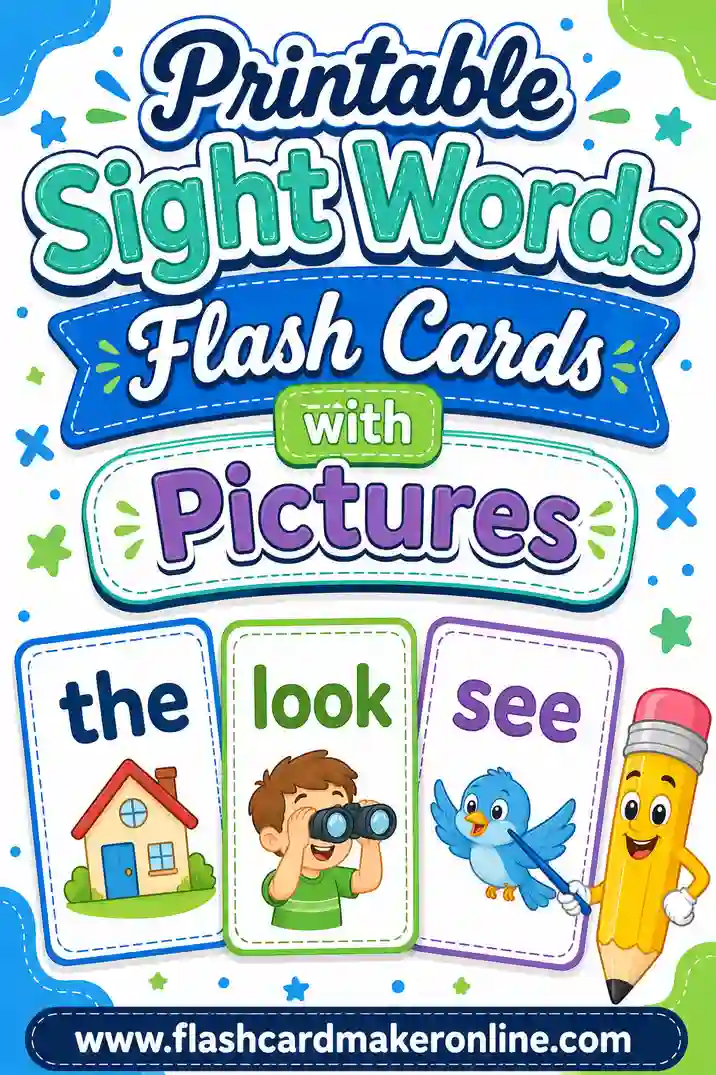
For young children learning words, a picture of a cat with the word "cat" underneath gives two codes. Have the child say "cat" while pointing to the picture, then later show the word alone and see if they can read it. Our sight words flash cards with pictures page explains how to fade the pictures so children end up reading the word itself rather than guessing from the image.
Math
For fractions, a circle cut into four parts with three shaded can sit next to "3/4." For geometry formulas, a sketch of the shape with the key measurement labeled (radius, height) is far more useful than the formula in words alone.
Try It Yourself: A Small Dual Coding Experiment
Want to see whether dual coding helps you? Try this over one week.
- Pick 20 new terms you need to learn, ideally concrete ones (vocabulary, anatomy parts, tools, places).
- Split them randomly into two groups of 10.
- For group A, make plain text cards: term on one side, definition on the other.
- For group B, make the same cards but add one meaningful image or a quick sketch you draw yourself.
- Study both groups the same number of times, testing yourself each time.
- Three to seven days later, quiz yourself on all 20 without looking.
Count how many you got right in each group. This isn't a scientific study, but it'll show you whether pictures are worth the extra minute per card for your subject.
Common Mistakes When Adding Pictures to Flashcards
Most problems with picture cards come from the same handful of habits. Here's what to watch for.
Using a picture that gives away the answer too easily
If a card asks "What's the Spanish word for this?" and the picture shows a bridge with "PUENTE" painted on its side, you're reading, not remembering. Make sure the image cues the answer without containing it.
Relying on the picture forever
For tests that use words alone, you eventually need to recall the idea without the image. Once a picture card feels easy, make a word-only version and check that you still know it. This matters most for early readers, who can learn to "read" the picture instead of the word.
Choosing images that are too similar
If ten cards about different birds all show small brown birds on branches, the pictures won't help you tell them apart. Pick images that highlight each item's distinctive feature, like a beak shape or a wing marking, or circle that feature on your sketch.
Spending more time decorating than studying
Making a beautiful deck can feel productive, but the payoff comes from testing yourself on it. A quick sketch in 20 seconds is often enough. Save detailed artwork for the handful of cards you keep missing.
Putting several ideas on one picture card
A full labeled diagram of the heart on one card asks you to recall a dozen things at once. Break it into several cards, each highlighting one part. You'll get clearer feedback on which parts you know and which you don't.
A Quick Checklist for Choosing a Good Image
Before you add a picture to a card, run through these questions:
- Does it show the thing I need to remember, not just the topic it belongs to?
- Is it simple? Can I tell what matters within a second or two?
- Does it point to one answer? Could it be mistaken for a neighboring card?
- Does it avoid spelling out the answer in text inside the image?
- Would a 20-second sketch of my own work just as well, or even better?
- Will I eventually practice without it if my test uses words only?
If an image passes most of these, it's probably worth including. If it fails several, a clear sentence alone may serve you better. You can find more design advice in our guide on how to make flashcards.
Dual Coding for Teachers and Parents
- Pair speech with visuals. When you explain a concept, sketch it on the board as you talk. That's dual coding in real time.
- Ask students to draw. Quick drawings of new vocabulary or science concepts are cheap and, based on the drawing studies, effective for memory.
- Cut decoration. Remove pictures and graphics that don't support the learning goal.
- Use timelines and maps. These turn abstract sequences and places into spatial layouts that are easier to remember.
- Don't sort kids into "visual" and "verbal" groups. Give everyone both codes.
- Have young children name pictures aloud. Research on young children suggests naming is what helps a picture become a dual memory.
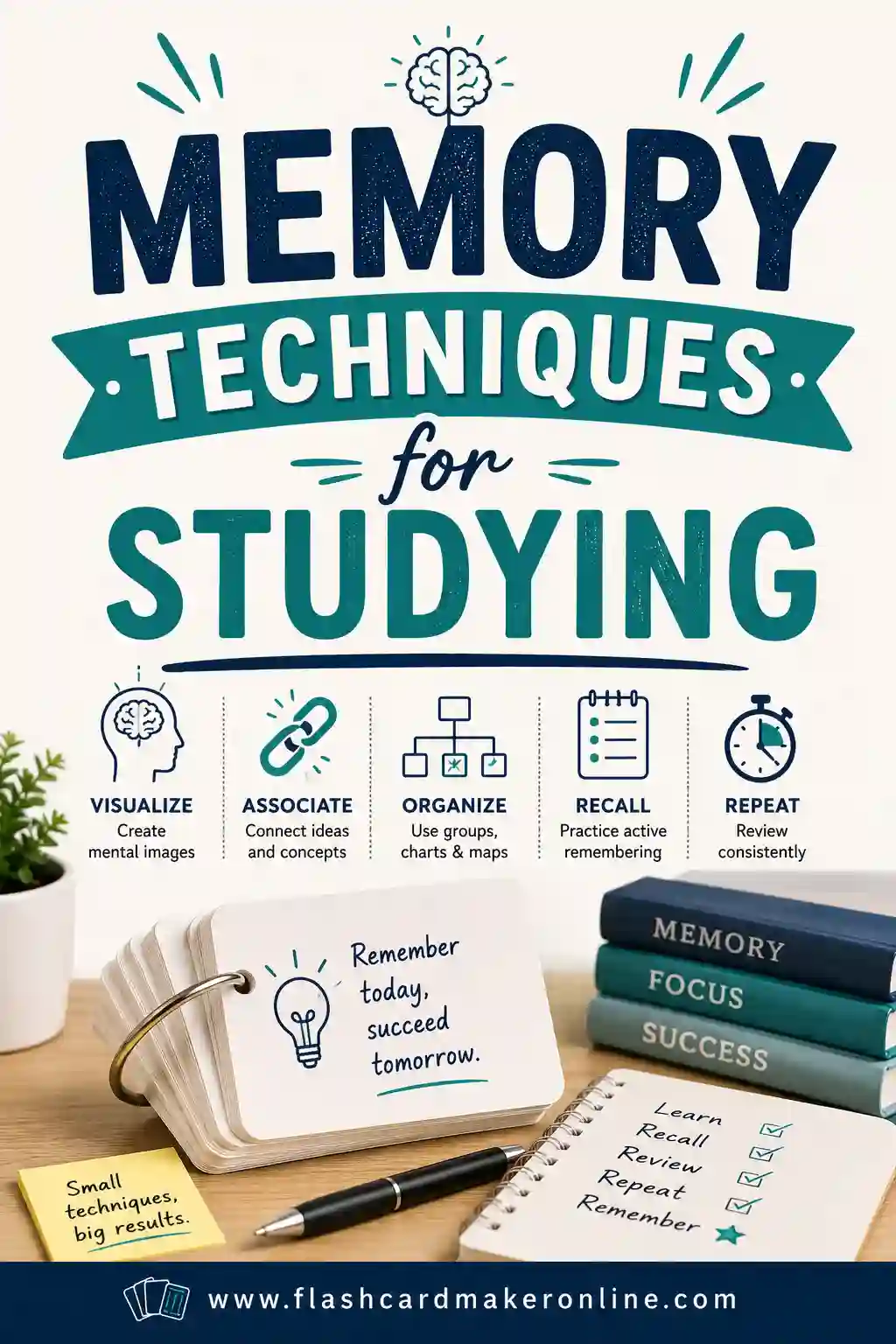
For more techniques that pair well with this one, including mnemonics and the method of loci, see our guide to memory techniques for studying.
How Dual Coding Fits With Other Study Strategies
Dual coding is about how you store information. It works best alongside strategies about how you practice it.
- Retrieval practice: A dual-coded card still needs to be tested. Look at the picture, try to say the word, then check.
- Spaced repetition: Review your picture cards over days and weeks, not all in one night.
- Elaboration: Ask why the picture fits. Explaining the connection between image and idea deepens both.
- Generation: Making your own sketches and examples, rather than copying them, adds an extra memory boost.
The generation effect and the learning styles myth are both good companion topics, and you'll find them on the site as those guides go live.
Make Dual-Coded Flashcards
Dual coding theory explains why a meaningful picture paired with a short phrase can be easier to remember than words alone: you're storing the idea in two connected systems, which gives you two routes back to it. The strongest evidence supports concrete images, pictures that act as cues, integrated scenes that link facts together, and drawings you make yourself. The limits are just as useful to know: decorative pictures don't help much, imagery advice for long readings has weak support, and dual coding has nothing to do with sorting people into learning styles.
To put it into practice, try our free flashcard maker. You can add words and your own pictures, study with flip cards on screen, and print double-sided or as cut-out sheets. Pick one clear image per card, keep the words short, and test yourself on both directions.
Dual Coding and Look-Alike Ideas Compared
Dual coding is easy to mix up with a few nearby ideas. This table sets them side by side, using what the article describes.
| Idea | What it says | What it means for your cards |
|---|---|---|
| Dual coding theory | Everyone has a verbal and a nonverbal system, and combining them can help everyone | Pair a short phrase with one meaningful image |
| Multimedia learning (Mayer) | Two channels, each with limited capacity, and learning needs active processing | Keep cards simple so neither channel gets overloaded |
| Learning styles | Some people are said to learn better in one mode; the matching idea lacks evidence | Don't skip the words if you think of yourself as a visual learner |
| Imagery for long texts | Rated low utility in the 2013 review by Dunlosky and colleagues | Use images for concrete ideas, not whole chapters |
| Decorative pictures | A clip-art lightbulb next to "idea" adds little | Choose images that carry the meaning you need to remember |
Frequently Asked Questions
What is dual coding theory in simple terms?
Dual coding theory says your mind has two connected systems for handling information: one for words and one for images and other nonverbal experiences. When you learn something in both forms, such as a word plus a meaningful picture, you store two linked memory traces instead of one. That gives you two routes back to the memory later. Psychologist Allan Paivio developed the theory, laying it out in full in his 1971 book Imagery and Verbal Processes.
Who created dual coding theory?
Allan Paivio, a Canadian psychologist who taught at the University of Western Ontario, now Western University, developed dual coding theory. As a graduate student at McGill University he noticed that concrete words worked better than abstract words as memory cues. That observation led to a 1969 paper in Psychological Review and his 1971 book Imagery and Verbal Processes. Paivio lived from 1925 to 2016 and published about 200 empirical articles and chapters and five books over his career.
What is an example of dual coding?
A simple example is a vocabulary flashcard with a drawing of a bridge on the front and the Spanish word el puente on the back. You store both the image and the word, linked together. Another example is a teacher sketching the water cycle on the board while explaining it out loud. A timeline, a labeled diagram of a cell or a map with one state shaded are also dual-coded, because they pair words with a meaningful visual layout.
Is dual coding the same as being a visual learner?
No. Dual coding theory says everyone has both a verbal and a nonverbal system and that combining them can help everyone. The learning styles idea claims some people learn best from pictures and others from words, so instruction should be matched to each person. A major 2008 review by Pashler and colleagues found virtually no evidence for that matching approach. So dual coding applies to self-described verbal people and visual people alike, and both need the words as well as the pictures.
Do pictures always improve memory?
Not always. Pictures help most when they carry the meaning you need to remember, such as the shape of an organ or the action a verb describes. Decorative images add little and can distract. Some researchers also argue that pictures are remembered better largely because they are more distinctive than printed words; one 2019 study made the picture advantage in recognition disappear by making words more visually distinctive. And telling students to simply imagine what they read has weak support for long texts.
Is drawing better than writing for memory?
In a 2016 set of seven experiments, Wammes, Meade and Fernandes found that people who drew pictures of words they had to remember recalled more words than people who wrote them out. The benefit held across different instructions, time limits and list lengths. A 2018 follow-up suggested drawing helps by creating a vivid memory of the drawing experience itself. You don't need artistic skill. Quick sketches of the items you find hardest are a cheap way to put this to work on flashcards.
How do I use dual coding on flashcards?
Pick one meaningful image per card and pair it with a short phrase. Turn abstract ideas into concrete examples or scenes. For language cards, put the picture on the front so it cues the new word, then make a reverse card later. Draw your own quick sketches for difficult items. Use labeled diagrams with one part highlighted per card. Then test yourself instead of just looking, and review the cards over several days. Pictures help you store the memory, while self-testing helps you retrieve it.
Does dual coding work for young children?
It can, but naming matters. Paivio summarized research showing that young children didn't automatically remember pictures better than words in free recall unless they were asked to name the pictures as they saw them. In a 1968 study with preschool through first-grade children, pairs that used a picture as the cue and a spoken word as the answer were recalled best. So when using picture cards with young kids, have them say the word aloud while looking at the image.
What is the difference between dual coding and multimedia learning?
Dual coding theory is Paivio's general account of how verbal and nonverbal systems represent information. Multimedia learning theory, associated with Richard Mayer at UC Santa Barbara, builds on it to explain learning from lessons that combine words and graphics. Mayer's theory adds that each channel has limited capacity and that meaningful learning requires actively selecting, organizing and connecting information. For flashcard makers, that means using both words and pictures but keeping each card simple enough not to overload either channel.
Sources
We checked every source below while writing this guide. Last reviewed October 30, 2026, by Joan Ramos.
- Dual Coding Theory and Education (Paivio, draft chapter, 2006) (University of Michigan School of Education, Pathways to Literacy Achievement conference)
- In Memoriam: Allan Urho Paivio (1925-2016), by Albert Katz (Psynopsis, via Western University Department of Psychology)
- Applying the Science of Learning to Medical Education (Mayer, 2010) (Medical Education, via PubMed)
- The Science of Learning (profile of Richard Mayer) (University of California, Santa Barbara)
- The Drawing Effect: Evidence for Reliable and Robust Memory Benefits in Free Recall (Wammes, Meade & Fernandes, 2016) (Quarterly Journal of Experimental Psychology, via PubMed)
- Creating a Recollection-Based Memory Through Drawing (Wammes, Meade & Fernandes, 2018) (Journal of Experimental Psychology: Learning, Memory, and Cognition, via PubMed)
- Increasing Word Distinctiveness Eliminates the Picture Superiority Effect in Recognition (Ensor, Surprenant & Neath, 2019) (Memory & Cognition, via PubMed)
- Improving Students' Learning With Effective Learning Techniques (Dunlosky et al., 2013) (Psychological Science in the Public Interest, via PubMed)
- Learning Styles: Concepts and Evidence (Pashler, McDaniel, Rohrer & Bjork, 2008) (Psychological Science in the Public Interest, via PubMed)