Printable Sight Words Flash Cards With Pictures: Free Deck
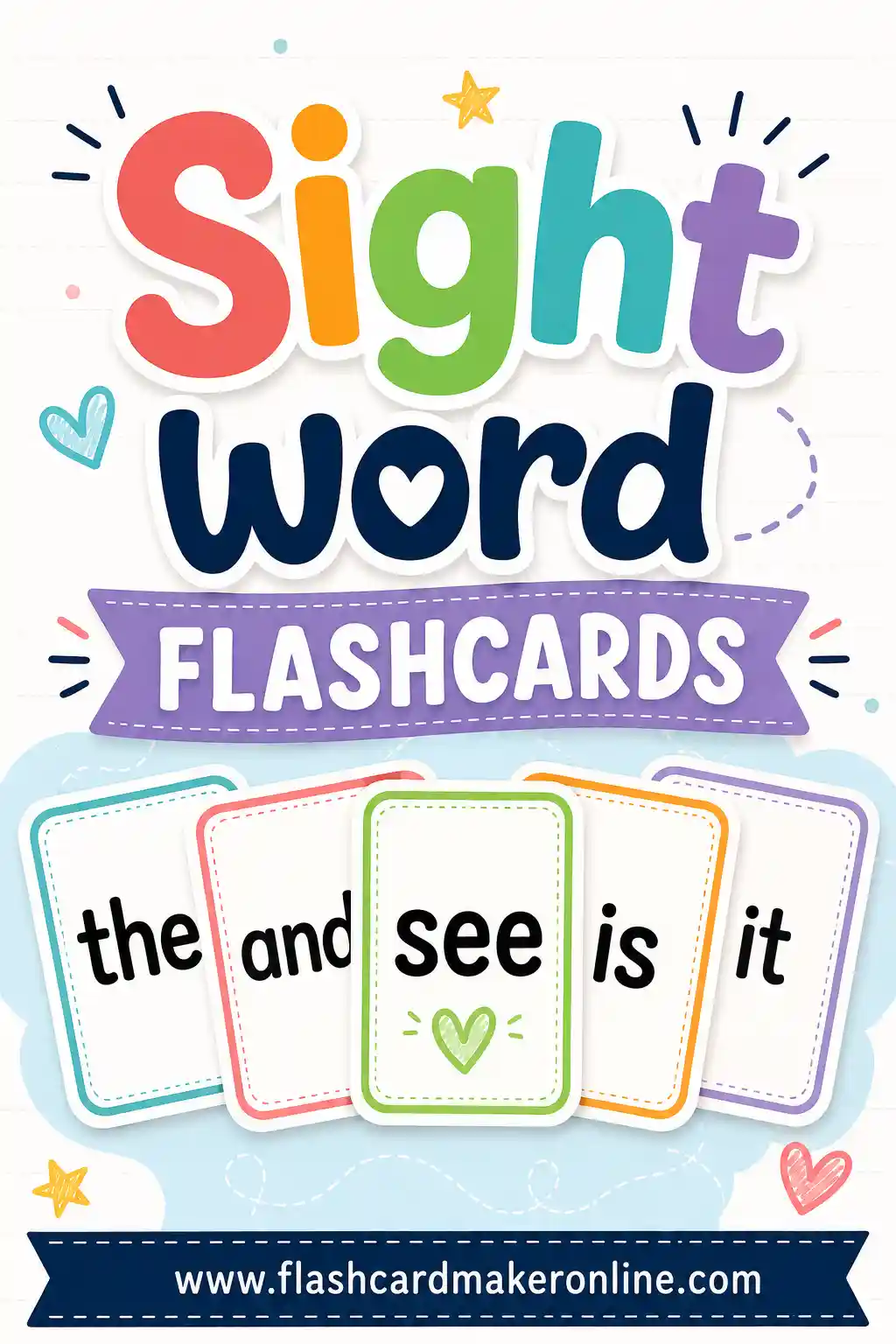
Printable sight words flash cards with pictures are cards that show a high-frequency word on the front — the, said, because — and support on the back: a short sentence, and a picture that anchors the sentence's meaning. Your child reads the word, flips, and sees it living inside something they can picture. The easiest way to build a set is a free flashcard maker that lets you add an image to any card and prints big, bold cards early readers can hold.
Want a deck before the next school folder comes home? Open the free maker, copy the starter list below, drop a picture onto the tricky cards, and print. No sign-up, no fee, and the words can match your child's actual class list.
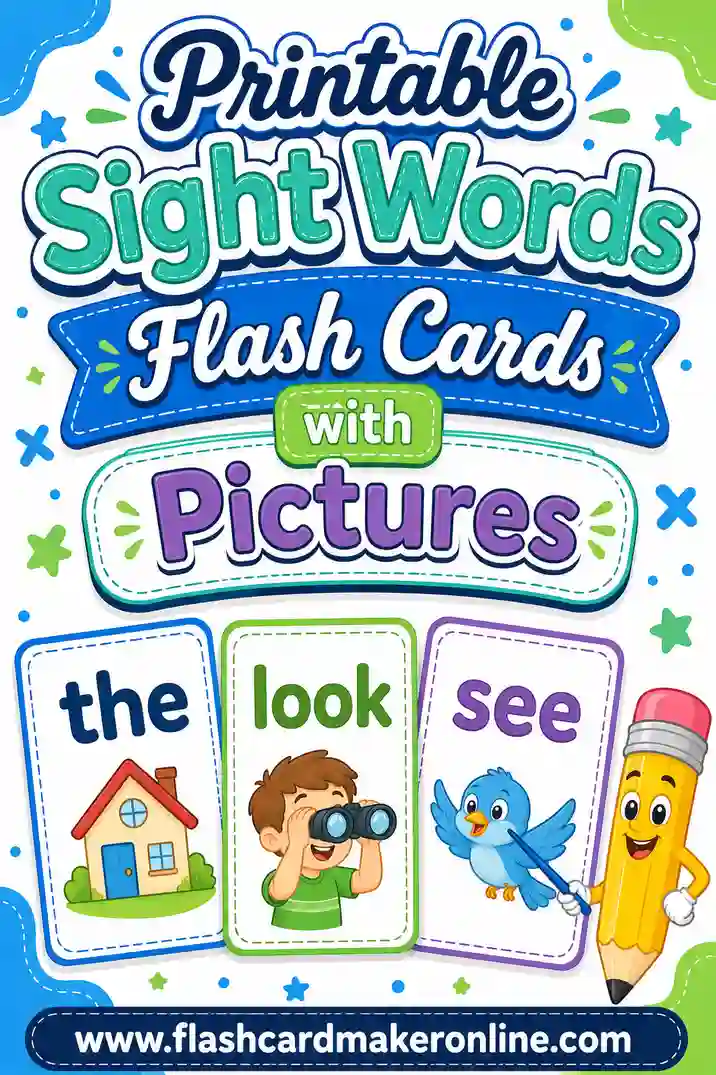
What Are Sight Words Flash Cards With Pictures?
Sight words are the little words that glue every sentence together — the, and, said, was, of, you. They appear so often that early readers need to recognize them instantly, on sight, without sounding out. Many of them can't be sounded out anyway (said refuses to follow the rules), which is exactly why schools drill them with flash cards from standard lists like Dolch and Fry.
The "with pictures" part needs a bit of care, though, and it's worth getting right. You can't draw the. Sight words are mostly abstract, so a picture can't represent the word itself — but it can anchor a sentence the word lives in. That's the design that works:
- Front: the word, big and bold, alone. Nothing to peek at.
- Back: a short sentence using the word, plus a picture of the sentence. "Look at the dog!" with a dog.
The child reads the front cold — that's the sight-word rep. The flip rewards them with meaning: a sentence they can read and a picture that proves they got it. Words stop being flash-drill noise and start being language.
Why Pictures Help (When They're on the Back)
There's a real debate about pictures and sight words: put a picture next to the word and many kids read the picture, not the word. The guessing habit is hard to unlearn.
The back-of-card design gets the good without the bad:
- The reading rep stays pure. The front is just the word, so recognition is genuine — no picture crutch.
- The flip builds meaning. Isolated words are forgettable; words inside a picture-backed sentence connect to the child's world.
- It rewards the work. A bare "correct" is dull. Flipping to a silly cat saying "Hi!" is a tiny payoff that keeps a five-year-old flipping.
- It doubles as first reading. The back sentences are real, readable text — each card is a one-line storybook.
Free Sight Words Starter Deck (Copy & Paste)
Here's a starter set drawn from the early Dolch-style lists, each with a picture-friendly sentence for the back. Copy it into the flashcard maker, then add an image to each back — an emoji, clip art, or a quick photo.
| Front | Back |
|---|---|
| the | The sun is up. ☀️ |
| a | I see a bug. 🐞 |
| I | I can run. 🏃 |
| see | I see a star. ⭐ |
| my | My hat is red. 🎩 |
| you | You are my friend. 🤝 |
| we | We play ball. ⚽ |
| go | Go, dog, go! 🐶 |
| up | Go up, up, up! 🎈 |
| look | Look at the moon. 🌙 |
| and | A cat and a dog. 🐱🐶 |
| can | I can jump. 🤸 |
| like | I like pizza. 🍕 |
| little | A little bug. 🐞 |
| big | A big truck! 🚚 |
| said | "Hi!" said the cat. 🐱 |
| here | Here is my house. 🏠 |
| play | We play in the sun. ☀️ |
| for | This is for you. 🎁 |
| was | The dog was wet. 💦 |
Got a word list from school instead? Even better — type those exact words in. Teachers send home the words your child will actually be tested on, and a custom deck means practice matches the classroom.
How to Make the Deck in 4 Steps
- Open the tool. Go to the free flashcard maker — it runs in any browser.
- Add the words. Paste the starter deck or your child's class list: word on the front, short sentence on the back.
- Add pictures to the backs. The maker supports an image on either side of any card. Emoji work in a pinch; simple pictures of the sentence work best.
- Print big and bold. Choose Big cards (4 per page), print on cardstock, and cut along the borders. Early readers get a deck sized for their hands and their eyesight.
The deck saves in your browser, so adding next week's five new words takes a minute.
Smart Ways to Practice Sight Words
Five words at a time
Schools introduce sight words in small batches for a reason. Keep five new words in rotation alongside ten or so review words. When a new word is instant three days running, it graduates to review.
Read the front cold, then celebrate the flip
The routine: child reads the word, then flips to the picture sentence and reads that too. If they stall on the front, say the word, use it in a quick sentence out loud, and shuffle it back into the pile for another try today.
Hunt the words in real books
After a card session, pick tonight's storybook and make it a game: "You've got said in your deck — shout when you spot it!" Sight words learned on cards and found in books stick twice as fast.
Two piles, always
"Snap words" (instant) and "still growing" (hesitant). The growing pile leads every session; the snap pile gets a quick weekly once-over so nothing slips.
Keep it under ten minutes
Reading practice at five and six years old should end with energy left over. Short, cheerful, daily — that's the formula.
Which Card Size Should You Print?
- Jumbo — 2 per page. Great for word walls, pocket charts, and pointing games across the room. Also kind to kids who find small print discouraging.
- Big — 4 per page. The sweet spot for kindergarten and first grade: bold print, room for the picture sentence on the back, sturdy in small hands.
- Standard — 8 per page. Compact review decks for kids who've mostly mastered their lists — a whole grade's words in one rubber-banded stack.
When in doubt, print Big. Struggling readers especially deserve print that doesn't make them squint.
Printing Tips for a Deck That Lasts the School Year
- Cardstock (65 lb). These cards get daily use for months; paper won't make October.
- Double-sided, test page first. Print one sheet and flip it to confirm each sentence lands behind its word.
- Cut-out grid if duplex is a headache. Fronts and backs print side by side; fold each cell for an instant two-sided card.
- Save the PDF. "Save as PDF" in the print dialog keeps a copy for reprints — handy when was vanishes under the fridge.
- Band by list. Keep List 1 separate from List 2 so review stays organized as the year moves.
Building the whole learn-to-read toolkit? Pair this deck with our sight word flashcards guide, phonics flashcards for sound-it-out skills, and flashcards for kindergarten.
Common Mistakes to Avoid
- Picture next to the word on the front. Kids read the picture and skip the word. Keep fronts word-only; pictures live on the back.
- Too many new words at once. Ten unfamiliar words in one session ends in tears. Five new, ten review.
- Drilling words only in isolation. A word recognized on a card but never met in a sentence stays fragile. The sentence backs — and real books — finish the job.
- Treating hesitation as failure. Slow is normal; it's the step before instant. Shuffle the word back in and cheer the progress.
- Tiny print for beginning readers. Small cards say "this is hard" before the child reads a letter. Big and bold says "you've got this."
Frequently Asked Questions
Are these printable sight words flash cards with pictures free?
Yes. You build, customize, and print the deck at no cost — no sign-up, no watermark, unlimited words and reprints.
Which sight word list should I use?
Whichever your child's school uses — check the class folder first. Otherwise, the classic Dolch pre-primer and primer lists (or the first hundred Fry words) are the standard starting points, and the starter deck above draws from that territory.
Won't pictures make my child guess instead of read?
Only if the picture sits next to the word. That's why this design keeps the front word-only: the reading rep happens first, and the picture sentence appears after the flip as meaning and reward.
Can I use my child's exact class word list?
Yes, and you should. Type the words from the school list into the maker, add sentence backs, and practice matches the classroom test for test.
How many sight words should a kindergartner know?
Programs vary, but many aim for around 50 words by the end of kindergarten and 100 or more through first grade. Steady five-word batches get there comfortably — it's a school year, not a sprint.
Can I save the deck as a PDF?
Yes. Choose "Save as PDF" in the print dialog for a keepable file at your chosen card size — perfect for reprinting at school or sharing with a reading tutor.
Ready to Print Your Picture Sight Word Deck?
Copy the starter list (or grab the school list from the folder), open the free flashcard maker, add your pictures, and print a deck of big, bold words with a little reward behind every flip. Free, no sign-up — and said finally starts behaving like a friend.