Phonics Flashcards: Free Printable & Customizable
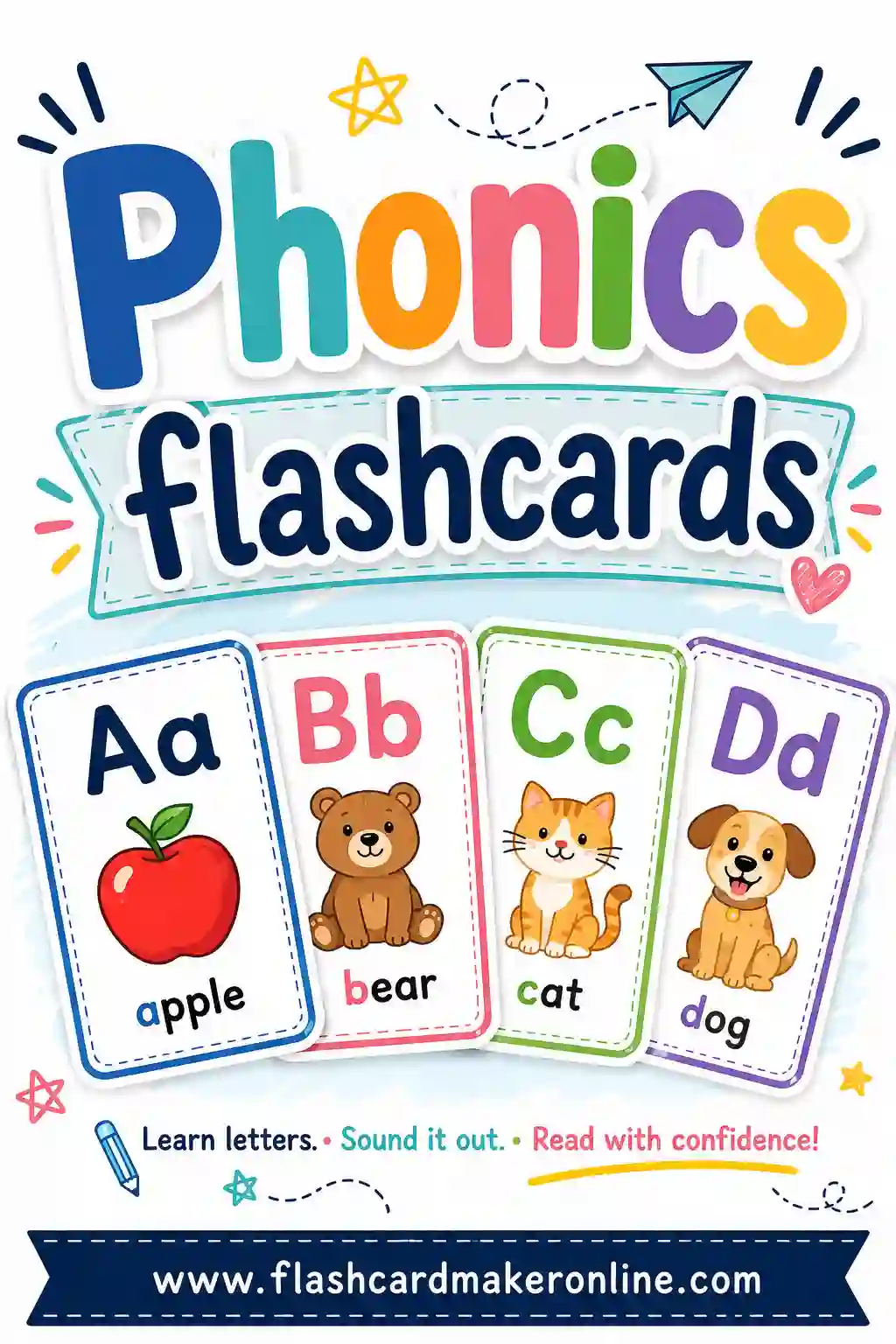
Phonics flashcards are cards that pair a sound with its letter or letter pattern, like "sh," "ai," or "ck," so a child learns to decode words by blending sounds together. You show the card, the child says the sound, and over short sessions those sounds become automatic, which is the engine of reading. The quickest way to build a full set is to use a free flashcard maker that turns your sound list into clean, printable cards.
Want to jump straight in? Open the free flashcard maker, paste in a phonics list (there's a ready-made one below), and print a deck in minutes. No sign-up, no software, no cost.
What Is Phonics, and Why Flashcards?
Phonics is the link between letters and the sounds they make. Once a child knows that "s" says /s/ and "h" together with it says /sh/, they can blend sounds to read words they've never seen before. That's the magic: phonics turns a child from "memorizing words" into "decoding any word."
Flashcards fit this perfectly because each sound is a tiny, self-contained unit. Show the card, get the sound, move on. The repetition builds speed, and speed is what lets a reader blend sounds smoothly instead of stalling on every letter.
You'll work through sounds in a rough order: single letter sounds first, then blends (two letters, two sounds, like "bl" or "st"), then digraphs (two letters, one sound, like "sh" or "ch"), and finally long-vowel teams ("ai," "ee," "oa"). The cards make each stage easy to drill in five-minute bursts.
Free Phonics Sound List (Copy & Paste)
Here's a ready-to-use set of phonics patterns, grouped by stage. Copy a column into the flashcard maker and print a deck. Put a sample word on the back of each card so the sound has a home.
| Single Sounds | Blends | Digraphs & Vowel Teams |
|---|---|---|
| s | bl | sh |
| a | cl | ch |
| t | fl | th |
| p | gl | wh |
| i | sl | ck |
| n | br | ng |
| m | cr | ai |
| d | dr | ee |
| g | fr | igh |
| o | gr | oa |
| c | pr | oo |
| k | tr | ou |
| e | sm | ow |
| u | sn | oy |
| r | sp | ar |
| h | st | or |
| b | sw | er |
| f | tw | ir |
Work top to bottom and left to right. Don't drill all three columns at once, master single sounds before you touch digraphs.
Make it a sample deck
Here's how a digraph deck might look once you build it, sound on the front, an example word on the back:
| Front (sound) | Back (example word) |
|---|---|
| sh | ship |
| ch | chip |
| th | thin |
| ck | duck |
| ai | rain |
| ee | feet |
| oa | goat |
| ng | king |
The example word anchors the sound. When a child blanks on "sh," "ship" jogs it loose.
How to Make Phonics Flashcards in 4 Steps
No hand-lettering required. Here's the whole process.
- Pick your stage. Single sounds for a brand-new reader, blends and digraphs once those are solid.
- Add your sounds. Paste your list into the flashcard maker, one per line, with an example word on the back.
- Print your deck. Hit print. Cardstock holds up far better than paper for daily practice.
- Cut and study. Slice them apart and run your first short session.
If you want them to last, print on cardstock and keep each stage in its own bag or box so you can pull the right deck fast.
How to Study Phonics Flashcards
The deck does nothing on its own. Here's how to run sessions that build real decoding skill.
Say the sound, not the letter name
This trips up a lot of parents. When you show "m," the child says /mmm/, not "em." When you show "sh," they say /sh/, not "ess-aitch." Sounds are what blend into words; letter names don't.
Blend, don't just label
Once a child knows a few sounds, line up cards to build a word: "c" + "a" + "t." Have them slide a finger under the cards and blend the sounds into "cat." That moment, sounds becoming a word, is the whole point of phonics.
Use the two-pile sort
Show a card. Quick, correct sound goes in "knew it." A miss or a long pause goes in "review." Run the review pile again, then end on a win. Tomorrow, start with yesterday's misses.
Keep it short and playful
A few games that reuse the same cards:
- Sound hunt. Show a card, the child finds something in the room that starts with that sound.
- Blend race. Lay out three cards, time how fast they can blend the word.
- Mystery word. You blend a word slowly, sound by sound, the child guesses it.
- Beat the clock. How many sounds can they say correctly in 60 seconds?
Phonics Stages: A Quick Roadmap
Match the deck to where your reader actually is. Moving too fast leaves gaps; moving too slow gets boring.
| Stage | Focus | Sample cards | When to move on |
|---|---|---|---|
| 1. Single sounds | One letter, one sound | s, a, t, p, i, n | Reads all single sounds fast |
| 2. CVC blending | Blend three sounds | c-a-t, d-o-g, p-i-g | Reads simple words smoothly |
| 3. Blends | Two letters, two sounds | bl, st, cr, sp | Reads words like "stop," "flag" |
| 4. Digraphs | Two letters, one sound | sh, ch, th, ck | Reads "ship," "chin," "duck" |
| 5. Vowel teams | Long vowel patterns | ai, ee, oa, igh | Reads "rain," "feet," "boat" |
Solid beats fast. A reader who truly owns stage one will fly through the rest.
Common Mistakes to Avoid
A few easy fixes make phonics practice click.
- Teaching letter names instead of sounds. "Bee" doesn't help blend "bat." Drill /b/, the sound.
- Adding an "uh." /b/ is a clean sound, not "buh." That extra vowel makes blending muddy. Keep sounds crisp.
- Skipping blending practice. Knowing sounds in isolation isn't reading. Always line up cards into words.
- Too many new patterns at once. Five or six new sounds per deck is plenty. Master them before adding more.
Pair phonics work with letter sound flashcards for the single-sound foundation, and add sight word flashcards for the tricky words that can't be sounded out. Teaching little ones? Our kindergarten flashcards and flashcards for kids guides have more ideas.
Decoding vs. Memorizing: Why Phonics Wins Long-Term
It's tempting to teach a child to memorize whole words. It feels fast at first, the child "reads" a handful of words after a few days. But memorization hits a wall. There are too many words in English to memorize them all, and a child who only memorizes is helpless the moment they meet a word they've never seen.
Phonics is the opposite. It's slower to start because the child has to learn the sounds and practice blending. But once those skills click, the child can decode almost any word independently, including ones they've never encountered. That's the difference between a reader with a fixed list of words and a reader who can read anything.
The research backs this up. Decades of reading studies point to systematic phonics, teaching sounds in a clear order and practicing blending, as the most reliable path to strong reading. Flashcards are simply an efficient way to deliver that practice in short, repeatable doses.
So when progress feels slow in the early weeks, trust the process. The child blending "c-a-t" with effort today is building the engine that will let them read fluently for life. Memorizing a few sight words has its place for rule-breakers, but the heavy lifting belongs to phonics.
Making Phonics Practice a Habit
The single biggest predictor of phonics success isn't talent, it's consistency. A few minutes most days beats a long session once a week, every time. Here's how to make it stick without it feeling like a chore.
Anchor the practice to something you already do. Right after breakfast, or in the ten minutes before a bedtime story, works well because it's predictable. A child who knows "we do our sounds after breakfast" resists less than one who's surprised by it.
Keep the deck visible and small. A little stack of cards on the kitchen counter invites a quick run-through far more than a workbook buried in a drawer. And keep each session genuinely short, five minutes is plenty, so it never feels like a slog.
Finally, celebrate the blending wins loudly. The first time a child sounds out a word on their own is a milestone. Make a big deal of it. That spark of "I did it myself" is what keeps a young reader coming back to the cards day after day.
Frequently Asked Questions
What are phonics flashcards?
They're cards that pair a sound with its letter or letter pattern, like "sh" or "ai," so a child learns to decode words by blending sounds. You flip through them in short sessions until the sounds become automatic, which is the foundation of fluent reading.
What order should I teach phonics sounds in?
Start with single letter sounds (s, a, t, p, i, n is a common first set), move to blending simple three-sound words, then blends like "st," then digraphs like "sh," and finally vowel teams like "ai." The list above is already in that order.
Should my child say the sound or the letter name?
The sound. When you show "m," they say /mmm/, not "em." Sounds are what blend together to make words; letter names don't help with decoding. This is the single most important habit in phonics practice.
Are phonics flashcards free to print?
Yes. Paste your sound list into the free flashcard maker, print on paper or cardstock, and cut them out. There's no sign-up and no cost, so you can build a fresh deck for every stage.
How are phonics flashcards different from sight word cards?
Phonics cards teach sounds you blend to decode words. Sight word cards teach whole words a child should recognize instantly, often ones that don't follow normal spelling rules. Most readers need both, and they work well side by side.
How long should a phonics session be?
Five to ten minutes is plenty, especially for young children. Two short, upbeat sessions a day beat one long one. Stop while it's still fun so your reader comes back eager.
Ready to Make Your Phonics Flashcards?
Grab the sound list above, open the free flashcard maker, and you'll have a clean, printable deck in minutes. It's free, there's no sign-up, and you can build a fresh set for every stage of reading. Keep sessions short, blend often, and watch decoding click into place.