Flashcards for College Students: How to Study Smarter
Flashcards for college students are short question-and-answer cards you flip through to test yourself, instead of just rereading your notes. They work because they force active recall — pulling an answer out of your head — which sticks far better than passive highlighting. The fastest way to build a set is to use a free flashcard maker, type your terms and definitions, and study or print them in minutes.
Want to start right now? Open the free flashcard maker, paste in your course terms (there's a sample deck below you can copy), and flip through them on your phone or print a stack for the library. No sign-up, no app to download.
Why Flashcards Work So Well in College
College throws a lot at you at once: dense readings, terms you've never heard, and exams that cover weeks of material. Rereading the textbook feels productive, but it mostly tricks you into thinking you know things you don't. Flashcards fix that.
When you look at a term and try to recall the answer before flipping the card, your brain does real work. That effort is the whole point. Psychologists call it the testing effect: the act of retrieving information makes it much easier to retrieve again later. One honest flip of a flashcard beats ten passes of a highlighter.
There's a second reason flashcards fit college life so well. They're tiny. You can review them in the ten minutes before lecture, on the bus, or while your coffee brews. Studying stops being a two-hour event you keep avoiding and becomes a habit you can squeeze into the cracks of your day.
Active recall vs. passive review
Here's the difference in plain terms:
- Passive review is reading, rewriting, or highlighting notes. It feels easy, which is the trap. Easy doesn't mean it's working.
- Active recall is forcing yourself to answer a question with the book closed. It feels harder. That difficulty is your memory getting stronger.
Flashcards are active recall in its simplest form. Question on the front, answer on the back, no peeking.
Which Courses Suit Flashcards Best
Almost any class with terms, facts, or formulas benefits. A few that are a near-perfect match:
- Biology, anatomy, and chemistry — endless terms, cycles, and structures to memorize.
- Foreign languages — vocabulary and verb forms are basically built for flashcards.
- Psychology and sociology — named theories, studies, and key thinkers.
- History and political science — dates, events, treaties, and cause-and-effect.
- Pre-med and pre-law — heavy fact loads that reward daily review.
Even essay-based courses help. You can make cards for quotes, key arguments, or the structure of a theory so you walk into the exam with the building blocks ready.
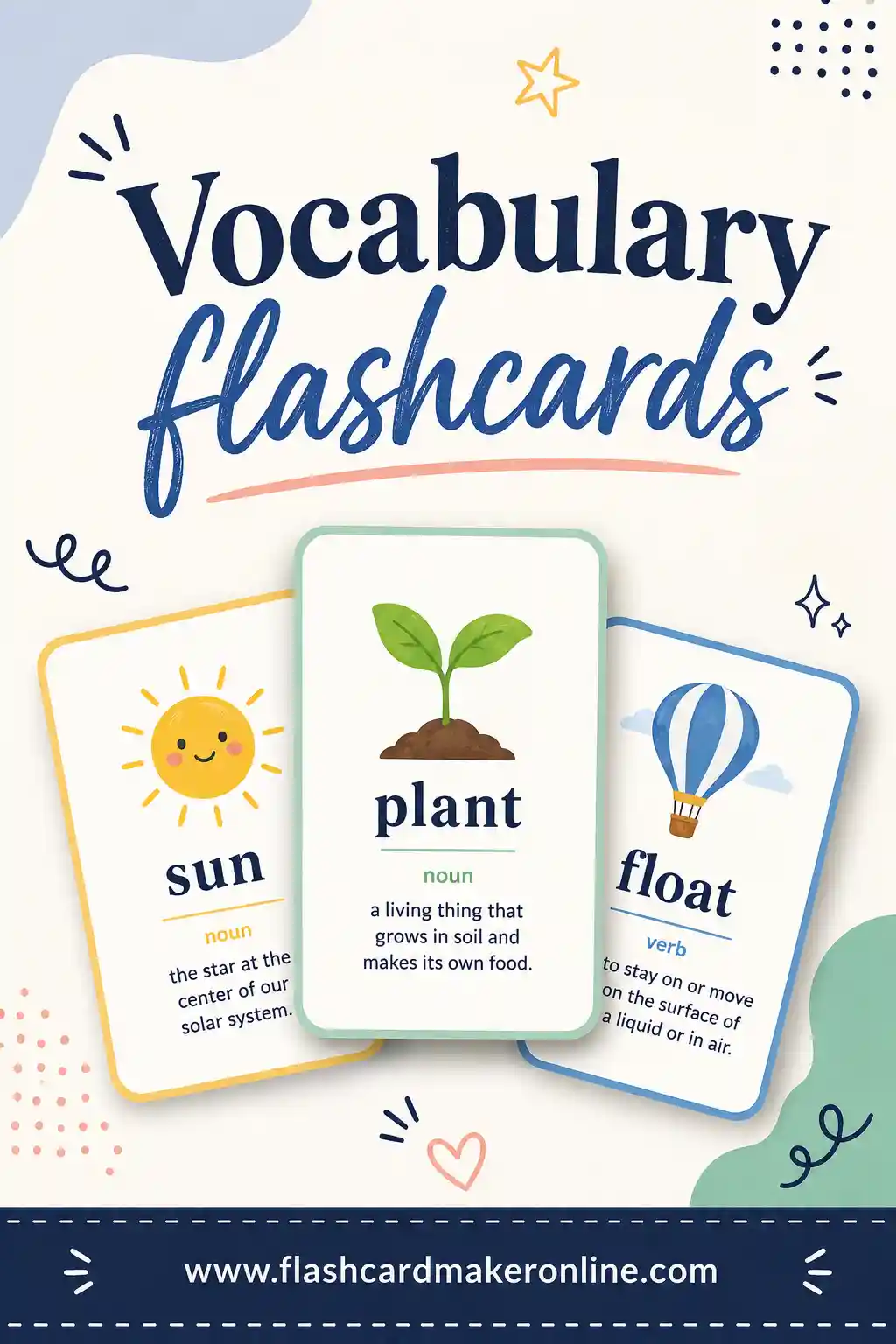
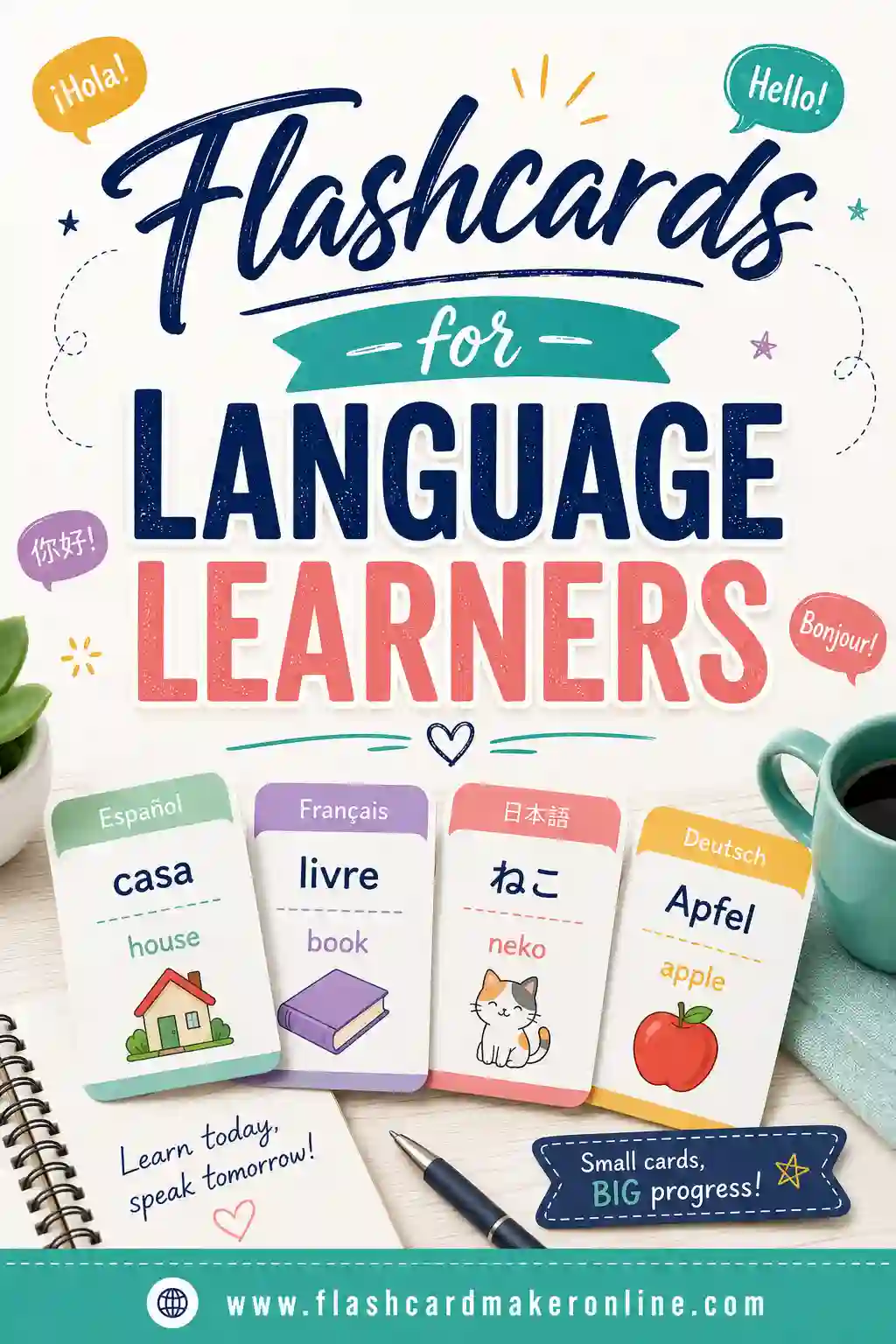
If you're studying a language, our guide to vocabulary flashcards and our tips for language learners go deeper on how to drill words that actually stick.
A Sample College Study Deck (Copy & Paste)
Here's a starter deck pulling common terms from intro-level courses across the catalog. Copy any rows straight into the flashcard maker and swap in your own as you go. Aim for short, clear answers — one idea per card.
| Term (Front) | Definition (Back) |
|---|---|
| Active recall | Retrieving info from memory instead of rereading it |
| Spaced repetition | Reviewing material at growing intervals to fight forgetting |
| Mitochondria | The organelle that produces energy (ATP) for the cell |
| Photosynthesis | How plants convert light into chemical energy |
| Osmosis | Movement of water across a membrane to balance concentration |
| Supply and demand | How price is set by buyers and sellers in a market |
| GDP | Total value of goods and services a country produces |
| Inflation | A general rise in prices over time |
| Hypothesis | A testable prediction you can prove or disprove |
| Correlation | A relationship between two variables, not necessarily causal |
| Cognitive dissonance | Mental discomfort from holding two conflicting beliefs |
| Classical conditioning | Learning by pairing a neutral cue with a response |
| Thesis statement | The single main claim an essay sets out to prove |
| Sonnet | A 14-line poem with a fixed rhyme scheme |
| Mole | The unit for amount of a substance in chemistry |
| Covalent bond | A chemical bond formed by sharing electrons |
| Separation of powers | Splitting government into branches that check each other |
| Federalism | Power shared between national and state governments |
| Standard deviation | A measure of how spread out a set of numbers is |
| Null hypothesis | The default claim that there is no effect or difference |
Notice the pattern: front is short, back is a single clean sentence. When a card gets long, split it into two. Smaller cards are easier to recall and faster to drill.
How to Make Flashcards That Actually Help
Bad flashcards are worse than none — they teach you to recognize the answer instead of recall it. Here's how to make cards that build real memory.
- One idea per card. If your back side has three bullet points, you've got three cards hiding in one.
- Use your own words. Rephrasing a textbook definition forces you to understand it, not just copy it.
- Front asks, back answers. Keep the front a clean prompt. Avoid giving hints that let you guess.
- Add a why or an example. "What is osmosis?" plus a one-line example beats a bare definition.
- Make cards as you learn. Build a few after every lecture. By exam week, your deck is already done.
Quick formats that work
- Term → definition. The classic. Great for vocabulary and concepts.
- Question → answer. "What causes inflation?" Good for cause-and-effect.
- Image → label. Anatomy, maps, and diagrams. Put the picture on the front, the name on the back.
- Formula → use. One side the formula, the other when and how you apply it.
How to Study a Deck Without Wasting Time
Making the cards is half the job. Studying them well is the other half.
- Shuffle every session. If you always study in the same order, you memorize the order, not the material.
- Sort into piles. Knew it cold, hesitated, blanked. Spend your time on the second and third piles.
- Say the answer out loud. Speaking forces a real, complete recall instead of a vague "yeah, I know this."
- Flip both ways. Quiz definition → term, then term → definition. Real understanding goes both directions.
- Keep sessions short. Twenty focused minutes beats two distracted hours. Stop before it turns to mush.
The biggest time-saver is being honest. If you only sort of knew a card, it goes back in the pile. Don't let "close enough" sneak cards out of your rotation too early.
Space It Out: The Secret to Long-Term Memory
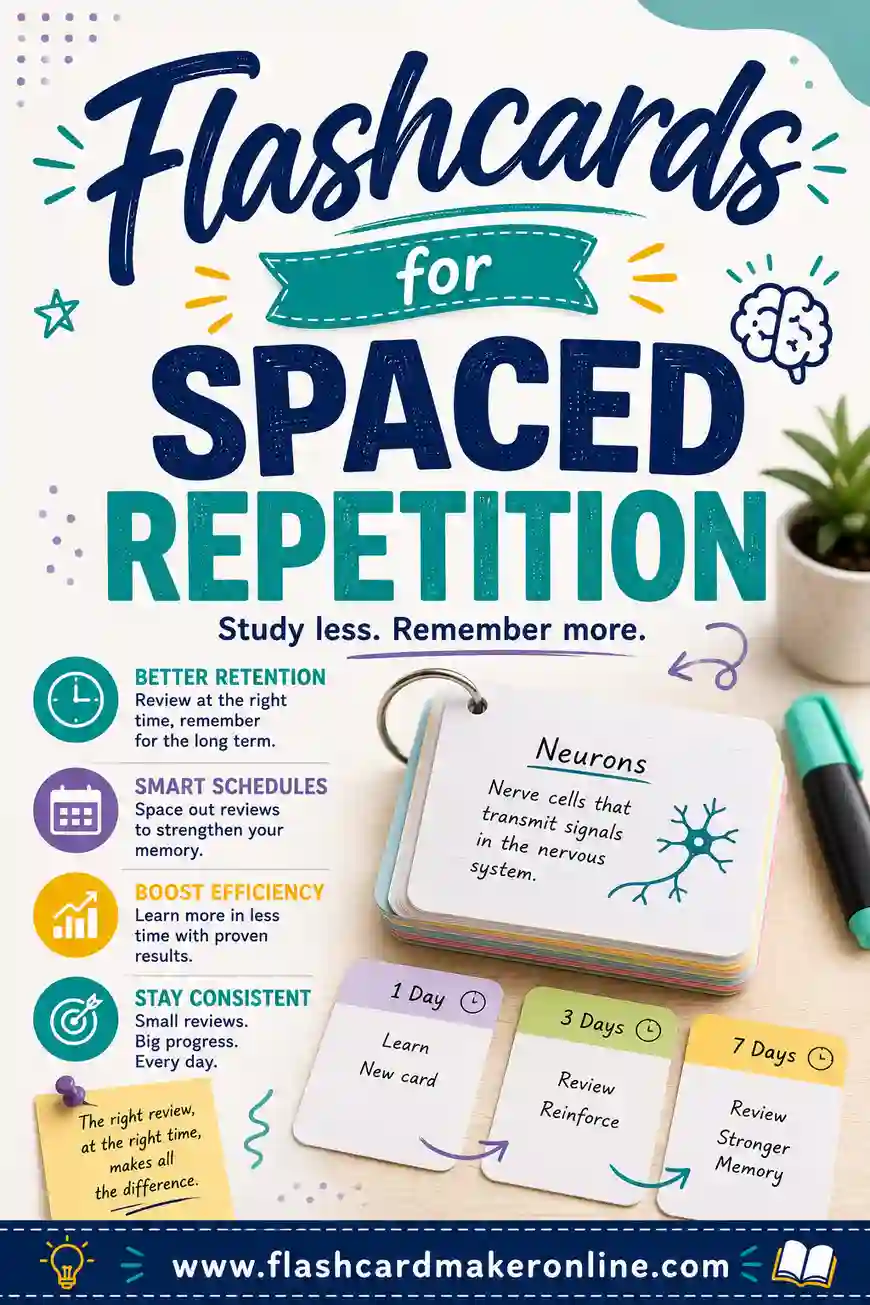
Cramming gets you through tomorrow's quiz and forgets everything by next week. Spaced repetition — reviewing cards at growing intervals — is how you keep material through finals and beyond.
The idea is simple. Review a card today, again in two days, then in five, then in two weeks. Each successful recall pushes the next review further out. Cards you keep missing come back sooner. Your hardest material gets the most attention automatically.
You don't need fancy software to start. Use three boxes or three piles labeled "daily," "every few days," and "weekly," and move cards forward as you nail them. We break the whole system down in our guide to flashcards for spaced repetition.
| Pile | Review every | When a card moves |
|---|---|---|
| Daily | 1 day | Got it right → move to "few days" |
| Few days | 3 days | Got it right → move to "weekly" |
| Weekly | 7 days | Missed it → drops back to "daily" |
Digital or Paper? Pick What Fits Your Day
Both work. The best choice is the one you'll actually use.
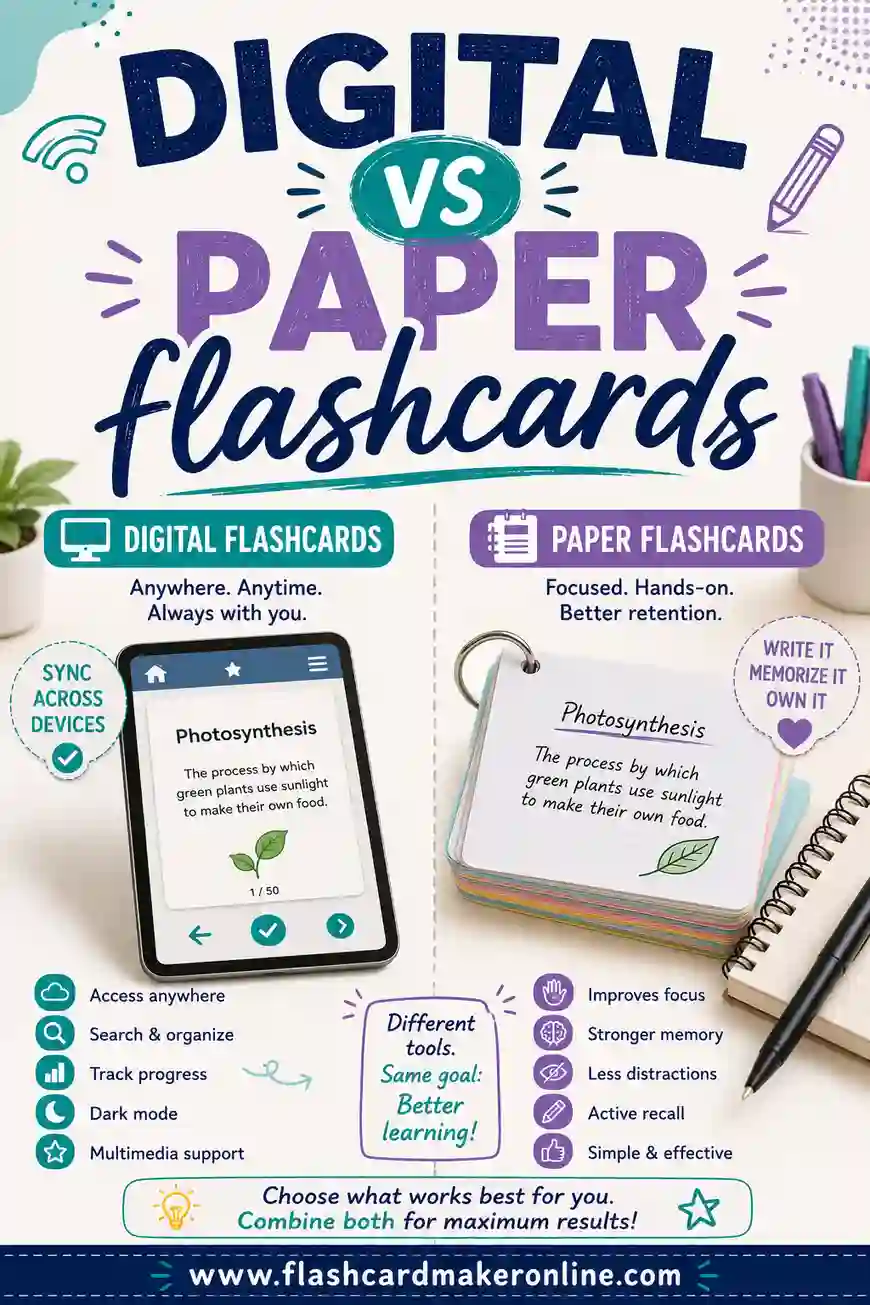
- Digital cards live on your phone, so you can drill them anywhere with zero supplies. Great for between-class review.
- Paper cards are easy to spread across a table, sort into piles, and study without screen distractions. Many people remember better when they physically write the card.
Plenty of students do both: build the deck once in the flashcard maker, study digitally during the week, then print the tough cards for a focused review before the exam. We compare the two in detail in digital vs paper flashcards.
Frequently Asked Questions
How many flashcards should I make for one exam?
Enough to cover the key terms and concepts, but no filler. For a single unit, 30 to 60 cards is common. If you're past 100 for one exam, check whether some cards are testing the same idea or could be merged. Quality beats quantity.
When should I start making flashcards in the semester?
From week one. Build a few cards after each lecture while the material is fresh. This spreads the work out and means your study deck is already built when finals arrive, instead of being a frantic all-nighter.
Are flashcards better than rereading my notes?
For memorizing facts and terms, yes, by a wide margin. Rereading feels productive but is mostly passive. Flashcards force active recall, which research consistently shows builds stronger, longer-lasting memory.
Can I use flashcards for essay-based classes?
Absolutely. Make cards for key quotes, the structure of an argument, important dates, or the main points of a theory. Walking into an essay exam with those building blocks memorized frees up your brain to actually write.
Should I study flashcards alone or with friends?
Both help. Solo study is best for raw memorization. Quizzing a friend (or being quizzed) adds pressure that mimics a real exam and catches the cards you only think you know. Try a mix.
Do I have to print my flashcards?
No. You can flip through them digitally on your phone for free. Printing is just an option for people who study better on paper or want a screen-free review before exam day.
Ready to Build Your Study Deck?
College gets a lot easier when your studying actually sticks. Copy the sample deck above, open the free flashcard maker, and start drilling with active recall and a little spaced repetition. It's free, there's no sign-up, and you can study on your phone or print a stack for the library. Build your deck once, and let it carry you from week one all the way to finals.